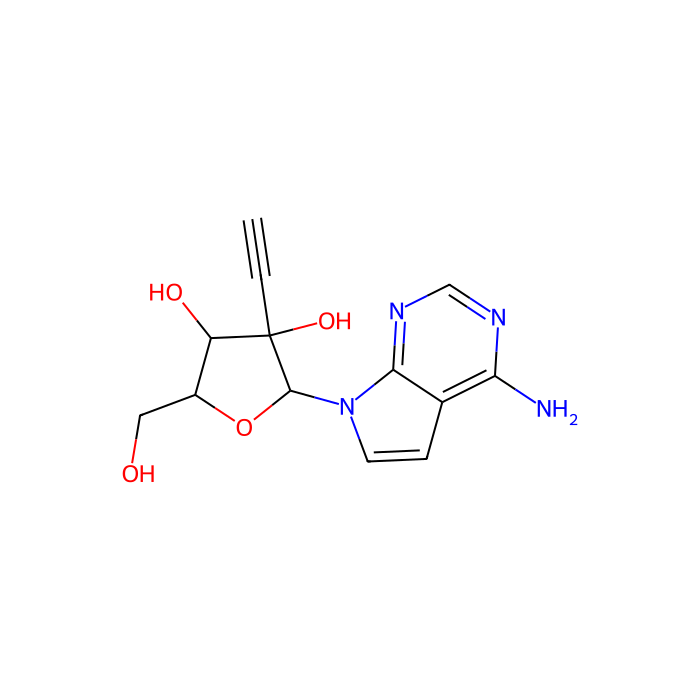
7H-Pyrrolo(2,3-d)pyrimidin-4-amine, 7-(2-c-ethynyl-beta-D-ribofuranosyl)- | (2R,3R,4R,5R)-2-(4-aminopyrrolo[2,3-d]pyrimidin-7-yl)-3-ethynyl-5-(hydroxymethyl)oxolane-3,4-diol | (2R,3R,4R,5R)-2-(4-AMINO-PYRROLO[2,3-D]PYRIMIDIN-7-YL)-3-ETHYNYL-5-HYDROXYMETHYL-TETRAHYDROFURAN-3,4-DIOL | 7-(2-C-ETHYNYL-.BETA.-D-RIBOFURANOSYL)-7H-PYRROLO(2,3-D) Show more
사양 및 순도
≥97%(HPLC)
생화학 및 생리적 메커니즘
Selective flavivirus inhibitor. Adenosine analog. Inhibits dengue virus (EC50= 0.64 μM), hepatitis C virus and cellular entry of Zika virus. Reduces increases of cytokines and NS1 and prevents death in dengue-infected mice. Activein vivo. Orally bioavailable.
This compound belongs to the class of organic compounds known as pyrrolopyrimidine nucleosides and nucleotides. These are nucleoside derivatives containing a ribose derivative which is n-glycosylated to a pyrrolopyrimidine. Also called deazapurine nucleosides, they are analogs of purine nucleosides with the N atom of the purine being replaced by a C atom at position 7.
External Descriptors
Not available
1. Djoumbou Feunang Y, Eisner R, Knox C, Chepelev L, Hastings J, Owen G, Fahy E, Steinbeck C, Subramanian S, Bolton E, Greiner R, and Wishart DS. ClassyFire: Automated Chemical Classification With A Comprehensive, Computable Taxonomy. Journal of Cheminformatics, 2016, 8:61.
Products are supplied to verified businesses, institutions, and qualified professionals for research and development use only. Not for use in humans, animals, diagnosis, or therapy.