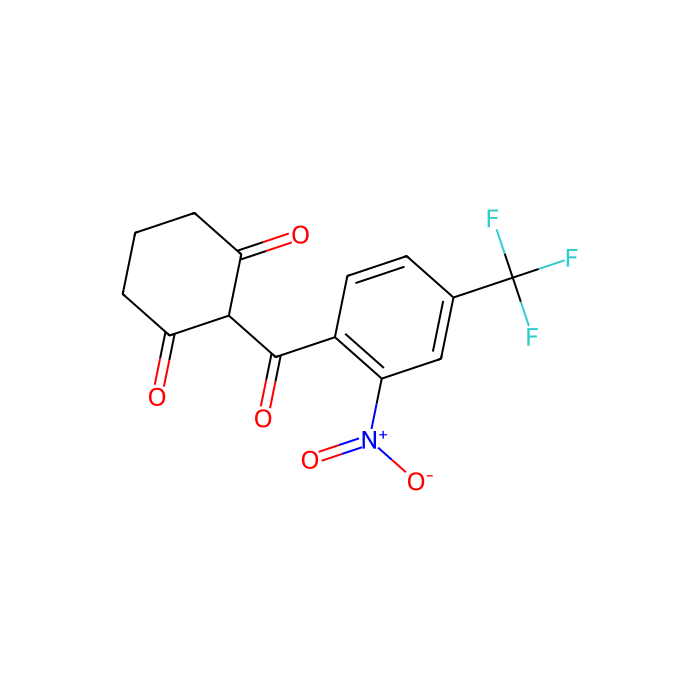
등급 & 순도Moligand™?Moligand™ — Aladdin's line of ligands and bioactive small molecules. Use for receptor, pathway, and binding studies needing defined small-molecule tools.10mM in DMSO
Application: Nitisinone has been used:to induce liver injury,to treat Ixodes scapularis tick cells to inhibit the activity of hydroxyphenylpyruvate dioxygenase,in supplemented water to block the accumulation of toxic metabolites in human hepatocyte engrafted mice,to study its effect on bacterial pyomelanin production
사양
동의어
NITISINONE [MART.] | 2-[2-Nitro-4-(trifluoromethyl)benzoyl]-1,3-cyclohexanedione | 2-[2-nitro-4-(trifluoromethyl)benzoyl]cyclohexane-1,3-dione;Nitisinone | Orfadin (TN) | 2-(2-nitro-4-trifluoromethylbenzoyl)-1,3-cyclohexanedione | nitisinonum | Orfadin | SC 0735 | Nitisinone | 2-(2-Nitro-4-trifluoromethylbenzoyl)cyclohexane-1,3-dione | NI Show more
사양 및 순도
Moligand™, 10mM in DMSO
생화학 및 생리적 메커니즘
Biochem/physiol Actions
Nitisinone is a competitive inhibitor that reversibly inhibits 4-Hydroxyphenylpyruvate oxidase (dioxygenase). Nitisinone is used in the treatment of hereditary tyrosinemia type 1, where it blocks the degradation of tyrosine into harmful substances.
This compound belongs to the class of organic compounds known as benzoylcyclohexane-1,3-diones. These are alkyl-phenylketones where the alkyl group is a cyclohexane 1,3-dione.
1. Djoumbou Feunang Y, Eisner R, Knox C, Chepelev L, Hastings J, Owen G, Fahy E, Steinbeck C, Subramanian S, Bolton E, Greiner R, and Wishart DS. ClassyFire: Automated Chemical Classification With A Comprehensive, Computable Taxonomy. Journal of Cheminformatics, 2016, 8:61.
Products are supplied to verified businesses, institutions, and qualified professionals for research and development use only. Not for use in humans, animals, diagnosis, or therapy.