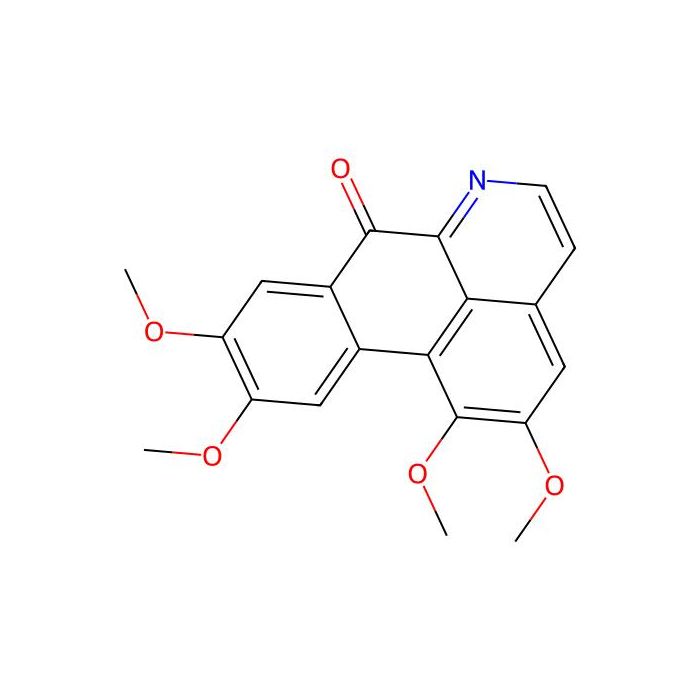
Oxoglaucine - ≥98% , CAS No.5574-24-3

CAS: 5574-24-3 Cat. No.: O695290 PubChem CID: 97662
주문 가능
GRADE & PURITY ≥98%
Storage
Room temperature
★
Size
USA
독일 (EU)*
Price
Qty
5mg
O695290-5mg
주문제작 · 8~12주
US$1,516.90
Enter a quantity for the sizes you want to add.
🧪
Why this grade

≥98% for sensitive chromatographic and analytical workflows requiring minimal baseline interference.

🌡

Storage & shipping

Room temperature Ships Check lot-specific COA for exact specifications.

📋

Quality documents

SDS, COA, datasheet, and spec sheet available for download. Lot-specific COA accessible via lot number lookup.

📚

Literature proof

Cited in 0 peer-reviewed publications across chromatography, organic synthesis, and cross-coupling reactions.

Specifications

사양 및 순도
≥98%
보관 조건
Room temperature
순수함
≥98%
이름과 식별자
정식 스마일
COC1=C(C2=C3C(=C1)C=CN=C3C(=O)C4=CC(=C(C=C42)OC)OC)OC
IUPAC Name
4,5,15,16-tetramethoxy-10-azatetracyclo[7.7.1.02,7.013,17]heptadeca-1(17),2,4,6,9,11,13,15-octaen-8-one
InChIKey
ZYKCETVKVRJFGD-UHFFFAOYSA-N
INCHI
1S/C20H17NO5/c1-23-13-8-11-12(9-14(13)24-2)19(22)18-16-10(5-6-21-18)7-15(25-3)20(26-4)17(11)16/h5-9H,1-4H3
이성체 SMILES
COC1=C(C2=C3C(=C1)C=CN=C3C(=O)C4=CC(=C(C=C42)OC)OC)OC
대체 CAS
5574-24-3
PubChem CID
97662
NSC 번호
141543
MeSH 용어
oxoglaucine

Documentation

📋 Safety Data Sheet (SDS)

Comprehensive hazard, handling, storage, and regulatory compliance document.

Download SDS →

✅ Certificate of Analysis (COA)

Lot-specific quality data. Enter your lot number to retrieve the exact COA.

Look up COA →

📊 Datasheet

Quick-reference summary of product specifications and applications.

View datasheet →

🔬 Specification Sheet

Full quality attributes and acceptance criteria for this grade.

View spec sheet →

Advanced Data

Taxonomic Classification

Taxonomy Tree

KingdomOrganic compounds
SuperclassAlkaloids and derivatives
분류Aporphines
SubclassNot available
Intermediate Tree Nodes Not available
Direct ParentAporphines
Alternative Parents Phenanthrenes and derivatives  Benzoquinolines  Naphthalenes  Isoquinolines and derivatives  Aryl ketones  Anisoles  Alkyl aryl ethers  Pyridines and derivatives  Heteroaromatic compounds  Azacyclic compounds  Organopnictogen compounds  Organonitrogen compounds  Organic oxides  Hydrocarbon derivatives  
Molecular FrameworkAromatic heteropolycyclic compounds
Substituents Aporphine - Benzoquinoline - Phenanthrene - Isoquinoline - Naphthalene - Quinoline - Anisole - Aryl ketone - Alkyl aryl ether - Pyridine - Benzenoid - Heteroaromatic compound - Ketone - Azacycle - Ether - Organoheterocyclic compound - Organic nitrogen compound - Organooxygen compound - Organonitrogen compound - Hydrocarbon derivative - Organic oxide - Organopnictogen compound - Organic oxygen compound - Aromatic heteropolycyclic compound
설명This compound belongs to the class of organic compounds known as aporphines. These are quinoline alkaloids containing the dibenzo[de,g]quinoline ring system or a dehydrogenated derivative thereof.
External Descriptors Not available
3D 구조
상호 작용 화학 구조 모델


관련 대상(인간)
MAOA Tclin Monoamine oxidase A (11911 Activities)
Activity TypeRelationActivity valueUnitsAction TypeJournalPubMed IddoiAssay Aladdin ID
MAOB Tclin Monoamine oxidase B (8835 Activities)
Activity TypeRelationActivity valueUnitsAction TypeJournalPubMed IddoiAssay Aladdin ID
POLB Tchem DNA polymerase beta (23632 Activities)
Activity TypeRelationActivity valueUnitsAction TypeJournalPubMed IddoiAssay Aladdin ID
CYP2D6 Tclin Cytochrome P450 2D6 (33882 Activities)
Activity TypeRelationActivity valueUnitsAction TypeJournalPubMed IddoiAssay Aladdin ID
CASP1 Tchem Caspase-1 (6235 Activities)
Activity TypeRelationActivity valueUnitsAction TypeJournalPubMed IddoiAssay Aladdin ID
CYP2C9 Tchem Cytochrome P450 2C9 (32119 Activities)
Activity TypeRelationActivity valueUnitsAction TypeJournalPubMed IddoiAssay Aladdin ID
CYP2C19 Tchem Cytochrome P450 2C19 (29246 Activities)
Activity TypeRelationActivity valueUnitsAction TypeJournalPubMed IddoiAssay Aladdin ID
CYP3A4 Tclin Cytochrome P450 3A4 (53859 Activities)
Activity TypeRelationActivity valueUnitsAction TypeJournalPubMed IddoiAssay Aladdin ID
HEK293 (82097 Activities)
Activity TypeRelationActivity valueUnitsAction TypeJournalPubMed IddoiAssay Aladdin ID
FEN1 Tchem Flap endonuclease 1 (12055 Activities)
Activity TypeRelationActivity valueUnitsAction TypeJournalPubMed IddoiAssay Aladdin ID
POLK Tbio DNA polymerase kappa (8653 Activities)
Activity TypeRelationActivity valueUnitsAction TypeJournalPubMed IddoiAssay Aladdin ID
POLH Tchem DNA polymerase eta (21678 Activities)
Activity TypeRelationActivity valueUnitsAction TypeJournalPubMed IddoiAssay Aladdin ID
HTT Tchem Huntingtin (19182 Activities)
Activity TypeRelationActivity valueUnitsAction TypeJournalPubMed IddoiAssay Aladdin ID
CREBBP Tchem CREB-binding protein (1602 Activities)
Activity TypeRelationActivity valueUnitsAction TypeJournalPubMed IddoiAssay Aladdin ID
APEX1 Tchem DNA-(apurinic or apyrimidinic site) lyase (38016 Activities)
Activity TypeRelationActivity valueUnitsAction TypeJournalPubMed IddoiAssay Aladdin ID
TDP1 Tchem Tyrosyl-DNA phosphodiesterase 1 (345557 Activities)
Activity TypeRelationActivity valueUnitsAction TypeJournalPubMed IddoiAssay Aladdin ID
KDM4E Tchem Lysine-specific demethylase 4D-like (40243 Activities)
Activity TypeRelationActivity valueUnitsAction TypeJournalPubMed IddoiAssay Aladdin ID
LMNA Tbio Prelamin-A/C (36751 Activities)
Activity TypeRelationActivity valueUnitsAction TypeJournalPubMed IddoiAssay Aladdin ID
HPGD Tchem 15-hydroxyprostaglandin dehydrogenase [NAD+] (24926 Activities)
Activity TypeRelationActivity valueUnitsAction TypeJournalPubMed IddoiAssay Aladdin ID
SMAD3 Tchem Mothers against decapentaplegic homolog 3 (68039 Activities)
Activity TypeRelationActivity valueUnitsAction TypeJournalPubMed IddoiAssay Aladdin ID
GMNN Tbio Geminin (128009 Activities)
Activity TypeRelationActivity valueUnitsAction TypeJournalPubMed IddoiAssay Aladdin ID
KMT2A Tchem Histone-lysine N-methyltransferase MLL (17327 Activities)
Activity TypeRelationActivity valueUnitsAction TypeJournalPubMed IddoiAssay Aladdin ID
MBNL1 Tbio Muscleblind-like protein 1 (34431 Activities)
Activity TypeRelationActivity valueUnitsAction TypeJournalPubMed IddoiAssay Aladdin ID
microRNA 21 (64692 Activities)
Activity TypeRelationActivity valueUnitsAction TypeJournalPubMed IddoiAssay Aladdin ID
CBX1 Tbio Chromobox protein homolog 1 (92434 Activities)
Activity TypeRelationActivity valueUnitsAction TypeJournalPubMed IddoiAssay Aladdin ID
ATAD5 Tbio ATPase family AAA domain-containing protein 5 (122566 Activities)
Activity TypeRelationActivity valueUnitsAction TypeJournalPubMed IddoiAssay Aladdin ID
BAZ2B Tchem Bromodomain adjacent to zinc finger domain protein 2B (56204 Activities)
Activity TypeRelationActivity valueUnitsAction TypeJournalPubMed IddoiAssay Aladdin ID
관련 대상(비인간)
Mapk1 MAP kinase ERK2 (650 Activities)
Activity TypeRelationActivity valueUnitsAction TypeJournalPubMed IddoiAssay Aladdin ID
Saccharomyces cerevisiae (19171 Activities)
Activity TypeRelationActivity valueUnitsAction TypeJournalPubMed IddoiAssay Aladdin ID
Plasmodium falciparum (966862 Activities)
Activity TypeRelationActivity valueUnitsAction TypeJournalPubMed IddoiAssay Aladdin ID
Poliovirus 1 (1274 Activities)
Activity TypeRelationActivity valueUnitsAction TypeJournalPubMed IddoiAssay Aladdin ID
Coxsackievirus B1 (166 Activities)
Activity TypeRelationActivity valueUnitsAction TypeJournalPubMed IddoiAssay Aladdin ID
rhinovirus B14 (1052 Activities)
Activity TypeRelationActivity valueUnitsAction TypeJournalPubMed IddoiAssay Aladdin ID
RAW264.7 (28094 Activities)
Activity TypeRelationActivity valueUnitsAction TypeJournalPubMed IddoiAssay Aladdin ID
lef Anthrax lethal factor (7585 Activities)
Activity TypeRelationActivity valueUnitsAction TypeJournalPubMed IddoiAssay Aladdin ID
Echovirus E13 (7 Activities)
Activity TypeRelationActivity valueUnitsAction TypeJournalPubMed IddoiAssay Aladdin ID
Giardia (1682 Activities)
Activity TypeRelationActivity valueUnitsAction TypeJournalPubMed IddoiAssay Aladdin ID
Mapt Microtubule-associated protein tau (6 Activities)
Activity TypeRelationActivity valueUnitsAction TypeJournalPubMed IddoiAssay Aladdin ID
fba Putative fructose-1,6-bisphosphate aldolase (15559 Activities)
Activity TypeRelationActivity valueUnitsAction TypeJournalPubMed IddoiAssay Aladdin ID
Impa1 Inositol monophosphatase 1 (16203 Activities)
Activity TypeRelationActivity valueUnitsAction TypeJournalPubMed IddoiAssay Aladdin ID
pos-1 Cytoplasmic zinc-finger protein (1690 Activities)
Activity TypeRelationActivity valueUnitsAction TypeJournalPubMed IddoiAssay Aladdin ID
mex-5 Zinc finger protein mex-5 (1676 Activities)
Activity TypeRelationActivity valueUnitsAction TypeJournalPubMed IddoiAssay Aladdin ID
작용 메커니즘
인증서(CoA, COO, BSE/TSE 및 분석 차트)
C of A & Other Certificates(BSE/TSE, COO):
Analytical Chart:
화학 및 물리적 특성
분자량351.400 g/mol
XLogP33.500
Hydrogen Bond Donor Count0
Hydrogen Bond Acceptor Count6
Rotatable Bond Count4
Exact Mass351.111 Da
Monoisotopic Mass351.111 Da
Topological Polar Surface Area66.900 Ų
Heavy Atom Count26
Formal Charge0
Complexity528.000
Isotope Atom Count0
Defined Atom Stereocenter Count0
Undefined Atom Stereocenter Count0
Defined Bond Stereocenter Count0
Undefined Bond Stereocenter Count0
The total count of all stereochemical bonds0
Covalently-Bonded Unit Count1
솔루션 계산기
리뷰

고객 리뷰

Application Protocols
  • Item-specific (Product Data)

    • No validated protocols are provided for this item.
  • General laboratory protocols (illustrative; adjust to your system)

    • Preparation of analytical stock solution
      • Weigh the required amount quickly in a low-humidity environment.
      • Dissolve to 10 mM in anhydrous DMSO or methanol. Sonicate briefly if needed. Store aliquots in amber vials to minimize light exposure.
    • RP-HPLC assay (general starting point)
      • Column: C18, 150 × 4.6 mm, 5 µm.
      • Mobile phase: A = water + 0.1% formic acid; B = acetonitrile.
      • Gradient: 20% to 70% B over 20 min; flow 1.0 mL/min; detection at 254 and 280–320 nm.
      • Inject a 0.1–0.5 mg/mL sample in MeOH or initial mobile phase.
    • LC–MS check
      • Use volatile acids (formic/acetic) only. Avoid non-volatile buffers. Scan in positive ESI due to tertiary amine; adjust cone voltage to maximize [M+H]+ signal.
  • Notes

    • Verify solubility and stability in the chosen solvent before long-term storage. For quantitative work, prepare fresh solutions or use validated stability-indicating methods.
Biological Roles
  • Scope: No biological data are provided in the product entry. The following are general literature-oriented notes on isoquinoline/aporphine alkaloids and should not be construed as clinical claims.

  • Literature/general context

    • Source: Oxidized derivatives of aporphine alkaloids (such as oxoglaucine) have been reported from certain plant taxa within the Annonaceae and related families. Isolation typically follows alkaloid-targeted extraction and chromatographic purification.
    • Biochemical behavior: Tertiary amine-containing alkaloids are protonated under physiological pH and can interact with biomacromolecules via cation–π and hydrogen-bonding interactions. Methoxy/phenolic groups modulate lipophilicity and membrane permeability.
    • Metabolism: Common metabolic pathways include O-demethylation, N-oxidation, and conjugation (glucuronidation/sulfation) catalyzed by hepatic enzymes (general for aporphines).
  • Research use examples

    • Employed as a reference material in phytochemical surveys, metabolomics libraries, and method validation for LC–MS/MS quantification of plant alkaloids.
    • Utilized as a probe to study structure–property relationships (ionization, permeability, and binding) within polycyclic aromatic alkaloids.
  • Important disclaimer

    • No medical, diagnostic, or therapeutic use is intended or implied. For research use only, as stated in the Product Data.
Buffer Applications
  • Not typically applicable. Oxoglaucine is a small-molecule alkaloid, not a buffering agent. It does not define a conventional buffer system.
  • Practical note: When preparing aqueous solutions, acidic buffers (e.g., acetate, citrate, or formate at pH 3–5) can aid solubilization by protonating the tertiary amine (general guidance). Select buffer components compatible with your analytical detection (e.g., volatile buffers for LC–MS).
Green Alternatives
  • Context: While oxoglaucine itself is a target analyte/compound, greener choices primarily concern solvent and reagent selection for its handling, separation, and derivatization.

  • Greener solvent substitutions (literature/general)

    • Replace chlorinated solvents (DCM/CHCl3) with ethyl acetate, 2-methyltetrahydrofuran (2-MeTHF), or dimethyl carbonate (where compatible with solubility and reaction requirements).
    • Prefer ethanol or methanol over acetonitrile where chromatographic performance allows.
    • For acid–base liquid–liquid extractions, use ethyl acetate/MTBE rather than DCM where phase behavior is acceptable.
  • Greener reagents for common transformations

    • O-Demethylation: avoid large excesses of BBr3 when possible; consider AlCl3/thiol systems or catalytic demethylations reported with ionic liquids or deep eutectic solvents (emerging literature), balancing selectivity.
    • Oxidations: employ H2O2/urea or O2 with suitable catalysts instead of stoichiometric peracids when feasible.
  • Comparison snapshot (general)

    • DCM vs 2-MeTHF: 2-MeTHF offers lower toxicity and bio-based sourcing; may require slightly elevated temperatures to match solubility and has a distinct odor.
    • ACN vs EtOH: ethanol is renewable and less toxic but may reduce chromatographic resolution; pressure may increase on RP columns.
  • Waste minimization

    • Implement micro-scale reactions, SPE cleanup over repeated LLE, and recycle high-purity solvents with in-lab distillation where policy permits.
Pharmaceutical Uses
  • Item-specific (Product Data)

    • No pharmacopeial or formulation information is provided for this item.
  • Literature/general (non-clinical)

    • Role in development workflows: may be used as a reference standard or impurity marker in natural-product-derived materials. Suitable for method development and validation (e.g., specificity, linearity, precision) in QC of botanical extracts.
    • Excipients/processing aids: not used as an excipient to the best of general knowledge; rather, it serves as a characterized analyte in research settings.
  • Compliance and handling

    • For research use only (per Product Data). Not for human or veterinary use. Any use in GMP settings would require independent qualification and verification of identity, purity, and stability, which are not specified here.
Physical Properties
  • Item-specific (Product Data)

    • Appearance: Not specified for this item; refer to CoA/Spec Sheet.
    • Grade/Purity: Not specified for this item; refer to CoA/Spec Sheet.
  • Literature/general properties (typical for aporphine-type alkaloids; verify for oxoglaucine specifically)

    • Physical state: usually isolated as a solid; free base often crystalline or amorphous; salts (e.g., HCl) are typically more crystalline.
    • Solubility: poor in water as free base; enhanced solubility in polar organic solvents (MeOH, EtOH, acetonitrile) and in DMSO; readily soluble in dilute aqueous acid as protonated salts.
    • Acid–base behavior: tertiary amine with pKa (conjugate acid) commonly in the 6–9 range for aporphines (literature, compound-class trend); expect increased aqueous solubility upon acidification.
    • Partitioning: lipophilic in free-base form (high logP typical for poly-methoxy aromatics; literature, class trend).
    • UV–Vis: aromatic chromophores and methoxy substituents typically afford strong UV absorbance in 230–290 nm region; additional bands possible near 320–360 nm depending on substitution (literature, class trend).
    • Melting/boiling point, density, refractive index: Not specified for this item; refer to CoA/Spec Sheet.
  • Practical analytical notes

    • HPLC detection at 254 nm and/or 280–330 nm is commonly effective for isoquinoline alkaloids (literature practice). Adjust based on actual spectrum of this lot.
Quality and Grades
  • Item-specific (Product Data)

    • Grade/Purity: Not specified for this item; refer to CoA/Spec Sheet.
    • Shipped in: Not specified for this item; refer to CoA/Spec Sheet.
  • Guidance on interpreting grade (general)

    • Research grade natural products are commonly specified by HPLC purity (area %) with accompanying chromatogram and UV trace. When available, review spectroscopic identity confirmation (1H/13C NMR, HRMS) and residual solvent profile.
    • If supplied as a salt (e.g., hydrochloride), assay may be reported on an anhydrous/free-base basis—confirm basis before calculating molar quantities.
    • Low-UV or LC–MS grade solvents and reconstitution reagents are recommended for trace analysis. For bioassay or metabolomics workflows, consider additional testing for residual metals or peroxide-forming impurities when relevant.
  • What to check on the CoA for this item

    • Exact structural assignment (name-to-structure mapping), counterion (if any), purity method and wavelength, water/volatiles content (KF/TGA), residual solvents, and any stabilizers. If values are not present, request a detailed specification sheet.
Reaction and Applications
  • Item-specific (Product Data)

    • Manufacturer applications: Not specified for this item.
  • Research applications (literature/general)

    • Reference standard: used in phytochemical profiling, dereplication, and quantitative assays of plant extracts containing aporphine/isoquinoline alkaloids.
    • Probe compound: suitable for studying oxidative metabolism (e.g., O-demethylation, N-oxidation) using microsomal or chemical models due to its methoxy- and tertiary-amine functionalities.
    • Photophysical/analytical: aromatic chromophores enable UV–Vis and fluorescence screening for binding or partition studies.
  • Chemistry context

    • Functional handles: aryl methoxy groups (subject to demethylation), tertiary amine (salt formation, quaternization), aromatic rings (electrophilic substitution under controlled conditions), potential benzylic positions (oxidation/reduction).
    • Derivatization:
      • O-Demethylation (BBr3, AlCl3/thiols, or Lewis acid-mediated) to access phenols for further coupling (e.g., Mitsunobu, carbamate formation).
      • N-oxidation (m-CPBA) followed by Polonovski-type rearrangements to probe structure–activity or modulate polarity.
      • Electrophilic aromatic substitution on activated rings (nitration/halogenation) with attention to deactivation by the “oxo” substituent.
  • Practical tips

    • Use anhydrous, oxygen-controlled conditions for sensitive transformations; protect methoxy-rich substrates from strong acids at elevated temperature to avoid decomposition.
    • For analytics, co-inject authentic standards and monitor multiple wavelengths to differentiate closely eluting alkaloids.
Reaction Conditions
  • General guidance (literature; adapt to oxoglaucine after confirming exact structure)

    • O-Demethylation: BBr3 (1–3 equiv per methoxy) in dry DCM at −78 to 0 °C, then warm to RT; quench carefully with MeOH/H2O. Typical times: 1–12 h depending on substitution. Competing demethylations may occur—monitor by LC–MS.
    • N-oxidation: m-CPBA (1.1–1.5 equiv) in DCM or CHCl3 at 0–25 °C for 1–3 h affords the N-oxide; neutralize residual peracid with aqueous Na2S2O3.
    • Electrophilic aromatic substitution: Nitration or halogenation under mild conditions (AcOH/HNO3, NBS/NCS) can be feasible on activated rings; protect sensitive phenols if present.
    • Salt formation/crystallization: dissolve free base in minimal EtOAc or MeOH and treat with anhydrous HCl in dioxane or gaseous HCl to precipitate the hydrochloride salt; isolate by filtration and dry under vacuum.
  • Solvent/atmosphere

    • Use anhydrous solvents and inert atmosphere (N2/Ar) for Lewis-acid-mediated steps. Protect from prolonged light/air to minimize oxidative degradation.
  • Yields and kinetics

    • Reported yields for analogous aporphine manipulations vary widely (40–90%) depending on substitution and conditions (literature, general). Optimize stoichiometry and temperature, and employ TLC/LC–MS to avoid overreaction.
  • Safety

    • Handle BBr3 and peracids with appropriate controls (dry glassware, fume hood, low-temperature quench). Carefully manage exotherms during acid gas salt formation.
Safety and Handling
  • Item-specific (Product Data)

    • GHS classification: Not specified for this item; refer to SDS.
    • Signal word: Not specified for this item; refer to SDS.
    • Hazard statements: Not specified for this item; refer to SDS.
    • Pictograms: Not specified for this item; refer to SDS.
    • Storage conditions: Room temperature (per product data).
  • General safety guidance (literature/general; not a substitute for SDS)

    • Potential hazards: small-molecule alkaloids can present acute toxicity, skin/eye irritation, or specific organ toxicity; handle as potentially harmful. Avoid inhalation/ingestion and contact with skin/eyes.
    • PPE: lab coat, safety glasses, and appropriate chemical-resistant gloves (e.g., nitrile). Use in a fume hood to prevent inhalation of dust or solvent vapors.
    • First aid overview: in case of exposure, rinse affected area with water for ≥15 min; remove contaminated clothing; seek medical attention. If inhaled, move to fresh air; if ingested, do not induce vomiting—seek medical care. Follow SDS instructions.
    • Handling: minimize dust generation; employ antistatic measures when weighing fine powders. For solution handling, cap vials promptly and avoid light/air exposure where degradation is a concern.
    • Incompatibilities: strong oxidants may react with phenolic/amine functionalities; strong bases/acids may induce decomposition under forcing conditions. Store away from oxidizers and moisture unless stored as a defined salt.
    • Waste: dispose according to institutional hazardous waste protocols for organic, nitrogen-containing compounds.
Solvent Selection
  • Applicability: Oxoglaucine is a neutral/tertiary-amine-containing aromatic alkaloid. Solvent choice is typically driven by intended use (analytical vs. synthesis) and by the desired ionization state.

  • Practical guidance (literature/general)

    • Stock solutions for analytics: DMSO or methanol are robust first choices due to high solvating power for poly-methoxy aromatics. For LC–MS, methanol or acetonitrile with 0.1% formic acid can improve peak shape by suppressing on-column interactions.
    • Aqueous work: Poor water solubility is expected for the free base. Prepare acidic aqueous solutions (e.g., 0.01–0.1 M HCl) to form a soluble ammonium salt when required.
    • Partitioning/purification: Ethyl acetate, dichloromethane, or MTBE often extract the free base efficiently; switch to aqueous acid–base partitioning to toggle solubility during workups.
    • Solid-phase cleanup: Strong cation-exchange (SCX) cartridges retain protonated alkaloids; elute with basic organic mixtures (e.g., MeOH + NH4OH).
  • Comparative solvent notes

    • DMSO vs MeOH: DMSO offers highest solubility; MeOH is more volatile and LC–MS friendly.
    • ACN vs MeOH (HPLC): ACN tends to give lower backpressure and sharper peaks but is costlier; MeOH is greener and less expensive.
  • Non-applicability

    • No specific solvent spec is provided for this item; the above are general recommendations to be validated in your method.
Storage and Reconstitution
  • Item-specific (Product Data)

    • Storage conditions: Room temperature.
    • Shipped in: Not specified for this item; refer to CoA/Spec Sheet.
  • General best practices (literature/general)

    • Solid storage: keep tightly capped in a desiccated environment, protected from light. Many methoxy-rich aromatics are light/air sensitive over long periods; amber glass and inert-gas headspace are advisable for archival storage.
    • Reconstitution: dissolve in dry DMSO or methanol to prepare concentrated stocks (e.g., 10–50 mM). Filter through a PTFE syringe filter (0.2 µm) for analytical use. For aqueous applications, acidify to form a soluble salt as needed.
    • Freeze–thaw: for DMSO or MeOH stocks, aliquot to avoid repeated freeze–thaw cycles. Store DMSO stocks at −20 °C and protect from moisture to prevent dilution by absorbed water (general recommendation; not specified for this item).
    • Stability monitoring: periodically verify by HPLC/LC–MS for degradation (demethylation/oxidation) if stored for extended periods.
  • Disclaimer

    • Where specific stability limits, water content, and impurity specifications are required, consult the product’s Certificate of Analysis and SDS. Values not provided above are: Not specified for this item; refer to CoA/Spec Sheet.
Structure and Identity
  • Item-specific (Product Data)

    • SKU: O695290
    • Product name: Oxoglaucine
    • CAS: 5574-24-3
    • PubChem CID: 97662
    • InChIKey (as provided): 469714
    • SMILES: Not specified for this item; refer to CoA/Spec Sheet.
    • Molecular formula: Not specified for this item; refer to CoA/Spec Sheet.
    • Molecular weight: Not specified for this item; refer to CoA/Spec Sheet.
  • Literature/general identity (for reference only; verify against primary sources before use)

    • Compound class: aporphine/isoquinoline-type plant alkaloid (oxidized derivative of glaucine).
    • Structural features (descriptive): polycyclic tetracyclic isoquinoline-derived scaffold with multiple aromatic rings; typically contains several methoxy substituents and one additional carbonyl functionality relative to glaucine (“oxo-” derivative). No stereocenters are expected in fully aromatic aporphine frameworks; partially hydrogenated variants can present axial chirality—confirm for the exact structure from primary data.
    • 2D description in words: fused benzoisoquinoline core (aporphine-type) bearing methoxy substituents on the aromatic ring system; one ring carries a ketone (oxo) functionality; tertiary nitrogen embedded in the heteroaromatic/aza ring (protonatable under acidic conditions).
  • Notes

    • The precise constitutional isomerism and stereochemical state must be confirmed from the Certificate of Analysis or an authenticated spectral dataset (1H/13C NMR, HRMS).
Synthetic Utility
  • Strategic value (literature/general)

    • Oxoglaucine represents an oxidized aporphine scaffold, offering a platform for SAR elaboration on a rigid polycyclic framework. The tertiary amine, aryl methoxy groups, and an “oxo” moiety enable orthogonal transformations.
  • Representative transformations and tactics

    • Amine chemistry: salt formation (HCl, HBr) for crystallization/purification; quaternization (MeI, MeOTf) to tune solubility and reactivity; N-oxide formation (m-CPBA) for directed rearrangements.
    • O-Demethylation: selective BBr3-mediated demethylation to phenols; subsequent etherification/esterification enables linker installation.
    • Cross-coupling handles: after halogenation of activated aryl positions, Suzuki or Buchwald–Hartwig couplings can diversify substitution (requires prior installation of halogens).
    • Oxidation/reduction: benzylic or ring-activated positions may be addressed with mild oxidants or hydrogenation; the “oxo” group can participate in acylation chemistry or be reduced to alcohols depending on position (verify structure before planning).
  • Retrosynthetic considerations

    • Access via oxidative modification of glaucine or de novo assembly of the aporphine core (e.g., Bischler–Napieralski/Pictet–Spengler sequences followed by oxidative cyclizations) is reported in the aporphine literature; these routes inform derivatization strategies for oxoglaucine analogs.
Target Specificity
  • Not applicable. This product is a small-molecule alkaloid, not a biological targeting reagent or antibody. No antigen/epitope, clone, isotype, or species reactivity information applies.

Shall we send you a message when we have discounts available?

Remind me later

Thank you! Please check your email inbox to confirm.

Oops! Notifications are disabled.