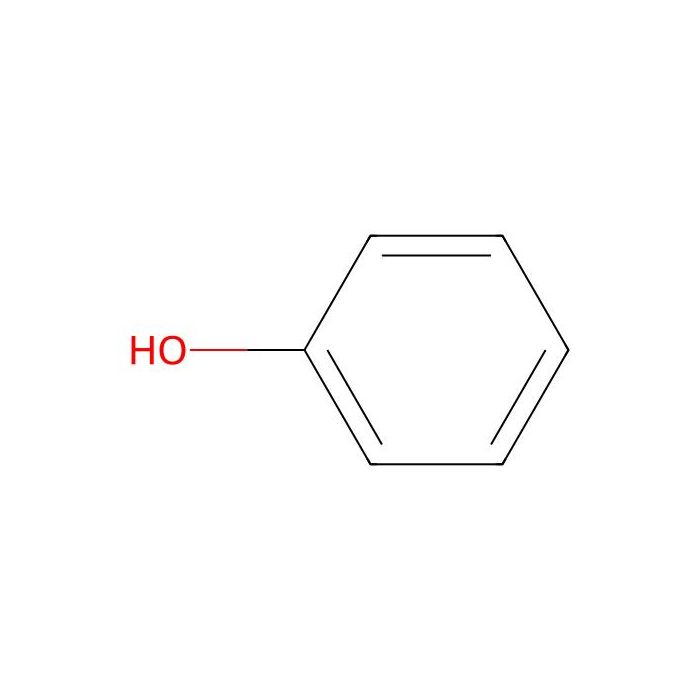
Phenol - UltraBio™, Suitable for molecular biology, TE-saturated, ~73% (T) , CAS No.108-95-2

CAS: 108-95-2 Cat. No.: P755666 분자식: C6H6O 분자량: 94.11 Beilstein Registry Number: 969616 EC 번호: 203-632-7
주문 가능
GRADE & PURITY UltraBio™ ? UltraBio™ — Aladdin's line for molecular-biology applications. Use for nuclease-free, high-consistency reagents across molecular workflows. Suitable for molecular biology ? Molecular-biology grade — free of nucleases and contaminants that degrade DNA/RNA. Use in cloning, PCR, and nucleic-acid work needing clean reagents. TE-saturated, ~73% (T)
Storage
Store at 2-8°C,Protected from light,Argon charged
Shipped In
Wet ice,FedEx DG Service
★
Size
USA
독일 (EU)*
Price
Qty
50ml
P755666-50ml
주문제작 · 8~12주
US$158.90
250ml
P755666-250ml
주문제작 · 8~12주
US$609.90
Enter a quantity for the sizes you want to add.
🧪
Why this grade

UltraBio™, Suitable for molecular biology, TE-saturated, ~73% (T) Suitable for molecular biology,UltraBio™ for sensitive chromatographic and analytical workflows requiring minimal baseline interference.

🌡

Storage & shipping

Store at 2-8°C,Protected from light,Argon charged Ships Wet ice,FedEx DG Service Check lot-specific COA for exact specifications.

📋

Quality documents

SDS, COA, datasheet, and spec sheet available for download. Lot-specific COA accessible via lot number lookup.

📚

Literature proof

Cited in 1528 peer-reviewed publications across chromatography, organic synthesis, and cross-coupling reactions.

개요

Phenol, also known as hydroxybenzene, is an aromatic compound produced both naturally and synthetically. It acts as a disinfectant and is highly toxic. Exposure to phenol through inhalation, cutaneous adsorption, or oral ingestion causes denaturation and precipitation of cellular protein, which in turn leads to poisoning.
saturated with 10 mM TRIS buffer pH 8.0 and 1 mM EDTA

Application:

Phenol (TE-saturated) has been used in the phenol-chloroform extraction procedure for plasmid DNA isolation. It has also been used to extract the aqueous phase during DNA linearization and mRNA synthesis.

Specifications

사양 및 순도
UltraBio™, Suitable for molecular biology, TE-saturated, ~73% (T)
보관 조건
Store at 2-8°C,Protected from light,Argon charged
배송
Wet ice,FedEx DG Service
이 제품은 콜드 체인 배송이 필요합니다.지상 및 기타 경제 서비스는 사용할 수 없습니다.
등급
Suitable for molecular biology, UltraBio™
이름과 식별자
PH
~7.8(aqueous phase)
정식 스마일
C1=CC=C(C=C1)O
IUPAC Name
phenol
InChIKey
ISWSIDIOOBJBQZ-UHFFFAOYSA-N
INCHI
1S/C6H6O/c7-6-4-2-1-3-5-6/h1-5,7H
이성체 SMILES
C1=CC=C(C=C1)O
WGK 독일
2
RTECS
SJ3325000
UN 번호
UN 1671
포장 그룹
II
분자량
94.11
Beilstein
969616
Reaxy-Rn
969616
Reaxys-RN_link_address
https://www.reaxys.com/reaxys/secured/hopinto.do?context=S&query=IDE.XRN=969616&ln=

Documentation

📋 Safety Data Sheet (SDS)

Comprehensive hazard, handling, storage, and regulatory compliance document.

Download SDS →

✅ Certificate of Analysis (COA)

Lot-specific quality data. Enter your lot number to retrieve the exact COA.

Look up COA →

📊 Datasheet

Quick-reference summary of product specifications and applications.

View datasheet →

🔬 Specification Sheet

Full quality attributes and acceptance criteria for this grade.

View spec sheet →

Advanced Data

Taxonomic Classification

Taxonomy Tree

KingdomOrganic compounds
SuperclassBenzenoids
분류Phenols
Subclass1-hydroxy-4-unsubstituted benzenoids
Intermediate Tree Nodes Not available
Direct Parent1-hydroxy-4-unsubstituted benzenoids
Alternative Parents 1-hydroxy-2-unsubstituted benzenoids  Benzene and substituted derivatives  Organooxygen compounds  Hydrocarbon derivatives  
Molecular FrameworkAromatic homomonocyclic compounds
Substituents 1-hydroxy-4-unsubstituted benzenoid - 1-hydroxy-2-unsubstituted benzenoid - Monocyclic benzene moiety - Organic oxygen compound - Hydrocarbon derivative - Organooxygen compound - Aromatic homomonocyclic compound
설명This compound belongs to the class of organic compounds known as 1-hydroxy-4-unsubstituted benzenoids. These are phenols that are unsubstituted at the 4-position.
External Descriptors a phenol
3D 구조
상호 작용 화학 구조 모델


인증서(CoA, COO, BSE/TSE 및 분석 차트)
C of A & Other Certificates(BSE/TSE, COO):
Analytical Chart:

Find and download the COA for your product by matching the lot number on the packaging.

4 results found

Lot NumberCertificate Type날짜항목
H2627059Certificate of AnalysisAug 19, 2026 P755666
H2627060Certificate of AnalysisAug 19, 2026 P755666
D2613482Certificate of AnalysisJul 07, 2026 P755666
G2607613Certificate of AnalysisJul 02, 2026 P755666
화학 및 물리적 특성
감도Light sensitive
굴절률1.54178
발화점(°F)177.8 °F - closed cup
발화점(°C)79.44℃(closed cup)
끓는점(°C)181.7°C
녹는점(°C)43°C
분자량94.110 g/mol
XLogP31.500
Hydrogen Bond Donor Count1
Hydrogen Bond Acceptor Count1
Rotatable Bond Count0
Exact Mass94.0419 Da
Monoisotopic Mass94.0419 Da
Topological Polar Surface Area20.200 Ų
Heavy Atom Count7
Formal Charge0
Complexity46.100
Isotope Atom Count0
Defined Atom Stereocenter Count0
Undefined Atom Stereocenter Count0
Defined Bond Stereocenter Count0
Undefined Bond Stereocenter Count0
The total count of all stereochemical bonds0
Covalently-Bonded Unit Count1
자주 묻는 질문과 기사
UltraBio™: Defining Excellence in Molecular Biology Applications
Molecular Biology Grade
Strategies for Eluting Biotinylated Proteins and Nucleic Acids from Streptavidin Supports
Research Progress in Detection Technologies for Soluble Sugars in Plants
A Review of Ten Commonly Used Techniques for Detection, Quantification, and Interaction Analysis in Nucleic Acid Research
Recent Advances in Methods for Measuring Starch-Related Indices in Plants and Their Application-Oriented Selection
RNA Extraction Technologies: Method Systems, Operational Workflows, and Key Quality-Control Considerations
Cholesterol Esterase: Mechanistic Insights and Application Frameworks Driven by Interfacial Hydrolysis
Lipid Panel Testing in Research (TC, TG, HDL-C, LDL-C): Indicator System, Assay Principles, Technical Routes, and Application Overview
Micrococcal Nuclease (MNase): A Technical Review of Enzymatic Properties, Reaction Control, and Research and Biomanufacturing Applications
Interleukin-29 (IL-29/IFN-λ1): Molecular Features, Signaling Networks, and a Systematic Framework for Research Applications
Physicochemical Properties of Diphenylamine, Analytical Applications, and a Review of Its DNA Colorimetric Reaction
Review of the Principles, Common Methods, and Key Application Considerations for the Determination of Glycerol and Triglyceride Contents
Haloheterocycles and Cross-Coupling: A Research-Oriented Selection Framework from Substrate Identification to Bond-Forming Routes (Including Product Navigation and Tables 1–5)
β-Acyloxy Alkenyl Amides (AAAs): A New Approach to Amide Bond and Peptide Bond Construction Worth Attention
Revisiting Titanium Tetrachloride: New Advances in the Direct Amidation and Esterification of Carboxylic Acids
Understanding ATD-DMAP: From Reagent Design to Esterification, Amidation, and Stereochemical Integrity
Triphenylphosphine Dibromide (PPh₃Br₂) Is More Than Just a Brominating Reagent: Experimental Selection Logic from Alcohol-to-Alkyl Bromide Conversion to Carboxylic Acid Activation and One-Pot Esterification, Vinyl Bromide Formation, and Nitrile Constructi
Reaction Roles of DBU in Different Systems: Experimental Judgment from a Strong Organic Base to Nucleophilic Catalysis and Participation in the Reaction Pathway
DMAP Is More Than Just an Organic Base: Experimental Judgment from Nucleophilic Acyl Transfer to Esterification and Macrolactonization
Experimental Evaluation of Triphosgene in Organic Synthesis: Understanding Its Selection Logic Through Reaction Tasks
Comparative Analysis and Selection Strategies for Mounting Media in Immunological Experiments
Formulation Design and Selection of Amine Curing Agents in Epoxy Systems
Experimental Decision-Making for Cross-Coupling Reactions: Target Bond Type, Substrate Combination, and Catalytic System Selection
Adding a Temperature-Triggered Switch to NCO: How Blocked Isocyanates Affect the Storage, Curing, and Film Performance of 1K Baking Coatings
Microscopic Interpretation and Taxonomic Value of Iodine Staining Reaction in Fungal Spores
1K, 2K, Waterborne, Moisture-Curing, and Blocked Systems: Classification Logic and Identification Methods for Polyurethane Coating Curing Systems
Key Control Points in Polyurethane Coating Formulation Design and Application
Microbial Morphological Identification: Observation Systems, Staining Methods, and Result Interpretation
How to Troubleshoot Abnormal Impurities in Peptide Synthesis? Locating Process Issues Through Amino-Related Side Reactions
Why Do Phenolic Resins Have Good Heat and Chemical Resistance? Analyzing the Source of Their Performance from Molecular Structure to Cured Networks
Epoxy Phenolic Coatings: Why Are They Commonly Used for Chemical Resistance, Solvent Resistance, Heat Resistance, and Internal Metal Surface Protection?
Phenolic-Modified Alkyd Resin: Performance Enhancement and Applications in Fast-Drying Industrial Coatings
Selection and Formulation Design Guidelines for Phenolic Resins in Coatings: Applicable Scenarios, Application Limitations, and Performance Verification
Applications of Rosin and Modified Rosin Resins in Coatings and Inks: Structure–Property Relationships, Modification Pathways, and Usage Guidelines
Cashew Nut Shell Liquid (CNSL): From Cashew Processing By-Product to Reactive Bio-Based Raw Material for Coating Resins
Choline Metabolism and Detection Methods: Pathway Analysis of Choline, Phosphatidylcholine, Betaine, Acetylcholine, and TMAO
Strain Release of Azatricycloalkanes: Modular Bridge-Position Functionalization and Stereochemical Control of Three-Dimensional Bridged Aza Scaffolds
Moisturizing Mechanisms of Tremella fuciformis Polysaccharides: From Polysaccharide Structure and Hydration Rheology to Dynamic Film Formation on the Skin Surface
How to Bypass α-Fluoride Elimination: Bromine-Transfer Capture and Oxidative Coupling of α,α-Difluorobenzylic Anions
Phase-Partitioning Principles, System Differences, and Application Selection in Phenol-Based DNA and RNA Extraction
Why Primary and Secondary Amines Have Difficulty Participating Directly in the Classical Mitsunobu Reaction: Mechanism, Inversion of Configuration, and Reaction Scope of BEHT-Mediated Alcohol Amination
Reaction Logic of I₂/DMSO-Mediated Oxidation of Aryl Methyl Ketones: In Situ Generation, Trapping, and Heterocycle Construction of Aryl Glyoxals
From Temporary Covalent Assembly to Intramolecular Smiles Aryl Migration: DCPDC-Mediated Phenol–Primary Amine C–N Cross-Coupling
Citations of This Product
솔루션 계산기
리뷰

고객 리뷰

Shall we send you a message when we have discounts available?

Remind me later

Thank you! Please check your email inbox to confirm.

Oops! Notifications are disabled.