Determine the necessary mass, volume, or concentration for preparing a solution.
Mw 100KDa 최소한의 기준선 간섭이 필요한 민감한 크로마토그래피 및 분석 워크플로우용.
Protected from light,Room temperature Normal 출고. 정확한 사양은 로트별 COA를 확인하세요.
SDS, COA, 데이터시트, 사양서를 다운로드할 수 있습니다. 로트별 COA는 로트 번호 조회를 통해 확인할 수 있습니다.
크로마토그래피, 유기 합성 및 교차 커플링 반응 분야의 동료 심사 논문 459편에서 인용되었습니다.
위험성, 취급, 보관 및 규제 준수를 포괄하는 종합 문서.
<<<<<<< HEAD SDS 다운로드 → ======= SDS 다운로드 → >>>>>>> release248-p3Find and download the COA for your product by matching the lot number on the packaging.
| Lot Number | Certificate Type | 날짜 | 항목 |
|---|---|---|---|
| Certificate of Analysis | Sep 29, 2026 | P1506434 | |
| Certificate of Analysis | Sep 29, 2026 | P1506434 | |
| Certificate of Analysis | Nov 10, 2025 | P1506434 | |
| Certificate of Analysis | Nov 10, 2025 | P1506434 |
| 굴절률 | 1.49 |
|---|---|
| 발화점(°F) | >250 ℉ |
| 발화점(°C) | >121.11℃ |
The following generic protocols are provided as literature-based guidance for processing PMMA; they are not specifications or performance claims for this SKU. Adjust parameters to your material’s molecular weight and additives (not specified here).
Safety note: Manage flammable solvents with appropriate ventilation and ignition control. For lithography or device fabrication, run small trials to calibrate thickness and quality.
PMMA is a synthetic, non-ionic thermoplastic with no intrinsic biological role or metabolic pathway. It is widely regarded as chemically inert under physiological conditions, and it does not participate in cellular signaling or enzymatic processes.
Research context (literature/general)
Note: No biological function or clinical claim is implied for this SKU; it is provided strictly for research and laboratory use, as stated in the Product Data.
Not typically applicable. PMMA is a hydrophobic polymeric solid and does not serve as a buffering agent. For research workflows, refer instead to sections on Solvent Selection, Reaction & Applications, and Application Protocols for guidance on dissolving, processing, or coating PMMA.
Greener considerations focus on solvent/process choices and potential polymer substitutes. The polymer itself is a durable, non-biodegradable thermoplastic; selection should weigh performance vs. environmental impact.
Solvent and process substitutions (literature/general)
Potential material alternatives (application-dependent)
Trade-off snapshot (general)
Note: Choice of alternative depends on optical demands, thermal budget, and solvent infrastructure; pilot trials are recommended.
Item-specific regulatory/grade status
Materials/formulation context (literature/general)
Practical considerations
No therapeutic or clinical claims are made for this product. It is supplied strictly for research use only, per the Product Data.
Item-specific specifications (this SKU)
Literature/general polymer properties (typical ranges; not product specifications)
Note: For processing-critical parameters (Mw, PDI, residual monomer, additive content), consult the item’s CoA/Spec Sheet.
Item-specific grade/purity information
How PMMA quality is typically defined (literature/general guidance)
Interpreting the CoA (practical tips)
Primary use domains (literature/general for PMMA)
Chemical transformations on PMMA (polymer-level reactions)
Practical tips
Note: No specific application testing is claimed for this SKU; use cases above are general for PMMA.
General processing and modification conditions for PMMA (literature; not product-specific)
Dissolution for film formation
Spin coating (positive-tone PMMA resists as a general example)
Hydrolysis/surface activation
Thermal processing
Always confirm compatibility of solvents and conditions with your specific PMMA lot (Mw, additives), which are not specified here.
GHS and hazard information (this SKU)
General safety considerations for PMMA (literature/general)
PPE and handling
Storage incompatibilities and precautions
First aid (overview; defer to SDS)
Always consult the product SDS for authoritative safety data and emergency procedures.
Applicability
Solubility profile (literature/general)
Selection by application
Practical considerations
Note: Exact dissolution behavior and recommended solvents for this SKU are not specified; consult the CoA/Spec Sheet and conduct a small-scale solubility screen.
Item-specific storage/shipping (from Product Data)
General best practices for PMMA (literature/general)
Reconstitution / solution preparation
Note: If this SKU includes specific molecular weight or additive information, follow the CoA/Spec Sheet for any storage nuances (e.g., avoid specific solvents, solution shelf life).
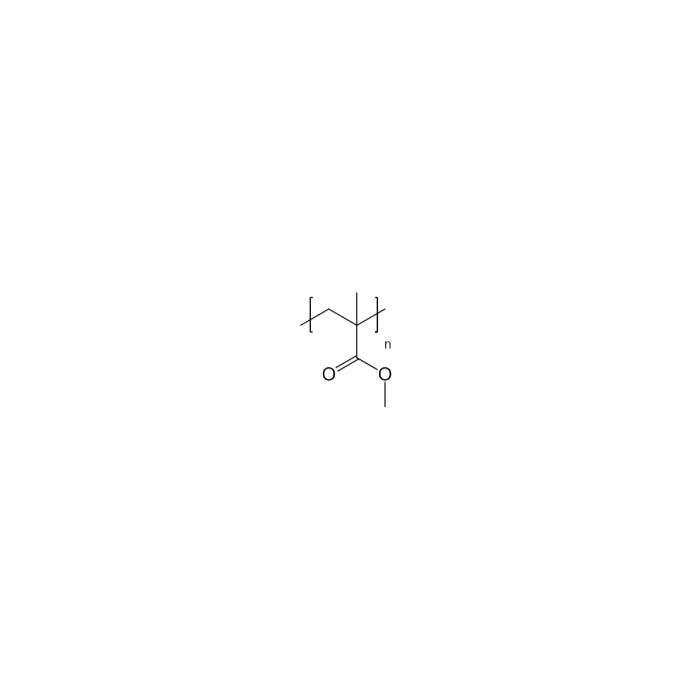
Poly(methyl methacrylate) (PMMA) is an amorphous vinyl polymer derived from the methyl methacrylate (MMA) monomer.
Item-specific identifiers (from Product Data)
Structural description (literature/general)
Key features
While PMMA is not a small-molecule reagent, it provides valuable synthetic utility as a functional materials scaffold and polymer-chemistry platform (literature/general):
Caveats
Not applicable. PMMA is a synthetic polymeric material and does not possess biological target specificity (no antigen/epitope/isotype attributes). This section is relevant to antibodies or affinity reagents, not to materials like PMMA.