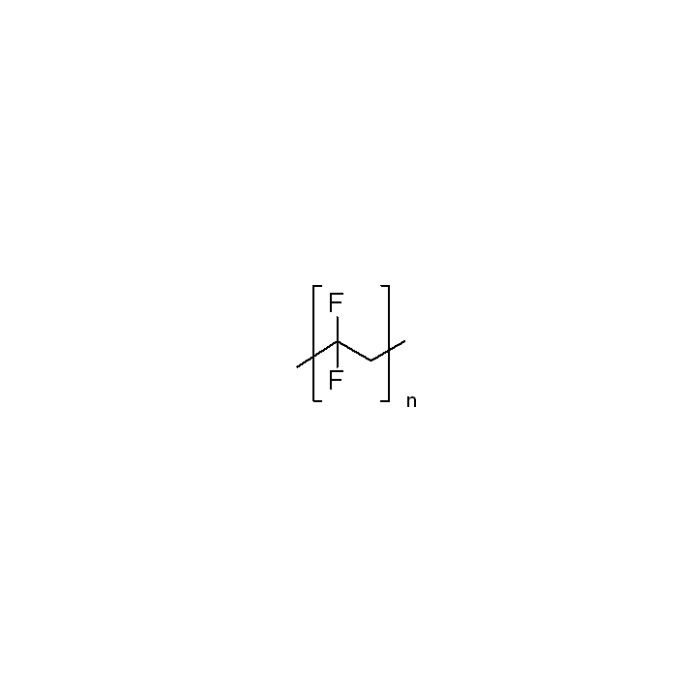
Poly(vinylidene fluoride) (PVDF) - Granular materials, medium viscosity injection, extrusion forming , CAS No.24937-79-9

CAS: 24937-79-9 Cat. No.: P302010 분자식: (CH2CF2)n EC 번호: 607-458-6
주문 가능
등급 & 순도 Granular materials, medium viscosity injection, extrusion forming
Synonyms
1,1-DIFLUOROETHENE [HSDB]|FC 1132a|Kynar 460|PVF2|VF 2|Vidar|KF 1000|fluorovinylidene|K 160|Dalvor|Ftoroplast 2|Kynar 202|Foraflon 50|VINYLIDENE DIFLUORIDE [INCI]|1,1-Difluoroethylene or Refrigerant gas R 1132a|Halocarbon 1132A|Difluoro 1.1 ethene|Kynar|1,1-Difluoroethylene|Kynar 200|R 1132A|Vinylidene fluoride|1,1-Difluoroethylene or Refrigerant gas R 1132a [UN1959] [Flammable gas]|KF 1100|Difluoro 1.1. ethylene|Fluorolon 2|Dulite|VINYLIDENE FLUORIDE (IARC)|Kynar 901|Ftorlon 2|Kynar 51|Genetron 1132a|Ethene, 1,1-difluoro-|Kynar 300|Vinylidene difluoride|HFC 1132A|Kynar 500|Kynar 821|Ethylene, 1,1-difluoro-|F 2|Difluoro-1,1-ethylene|REFRIGERANT GAS R-1132A|VINYLIDENE FLUORIDE [IARC]|VW 12|REFRIGERANT GAS R 1132A|Kynar 301|Kynar 450|VDF|1,1-DIFLUOROETHENE|1,1-Difluoro-ethene
Storage
Room temperature
Shipped In
Normal
★
크기
USA
독일 (EU)*
가격
수량
100g
P302010-100g
1 재고 있음
—

US$58.90

US$68.90
저장 US$10.00 (14.51%)
500g
P302010-500g
3 재고 있음
1 재고 있음
US$205.90
Enter a quantity for the sizes you want to add.

개요

Poly(vinylidene fluoride) PVDF is a semi crystalline non-centrosymmetric polymer which exhibits piezo-, pyro- and ferroelectric properties. It is a linear polymer that shows permanent electric dipoles perpendicular to the direction of the molecular chain. These dipoles result from the difference in electronegativity between the atoms of hydrogen and fluorine with respect to carbon. Depending on the processing conditions, PVDF exhibits several different crystalline phases (α,β,γ,δ). The β phase of PVDF is the phase that exhibits the best ferroelectric and piezoelectric properties.

Poly(vinylidene fluoride) (PVDF) is used in nanoporous electrodes. It is used to synthesize composites comprising of ultrafine fibers of PVDF embedded with carbon nanotubes. It can be used in sensors, actuators, for energy storage, sphygmomanometers, pressure sensors and nanogenerators, lithium ion batteries. Additionally, it may find application as matrix for PVDF-nanoclay nanocomposites and PVDF acrylic rubber/clay nanocomposite hybrid.

사양

동의어
1,1-DIFLUOROETHENE [HSDB] | FC 1132a | Kynar 460 | PVF2 | VF 2 | Vidar | KF 1000 | fluorovinylidene | K 160 | Dalvor | Ftoroplast 2 | Kynar 202 | Foraflon 50 | VINYLIDENE DIFLUORIDE [INCI] | 1,1-Difluoroethylene or Refrigerant gas R 1132a | Halocarbon 1132A | Difluoro 1.1 ethene | Kynar | 1,1-Difluoroethylene | Kynar 200 | R 1132A | Vinyl Show more
사양 및 순도
Granular materials, medium viscosity injection, extrusion forming
보관 조건
Room temperature
배송
Normal
이름과 식별자
Pubchem Sid
SMILES
FC(F)=C
IUPAC Name
1,1-difluoroethene
InChIKey
BQCIDUSAKPWEOX-UHFFFAOYSA-N
InChI
1S/C2H2F2/c1-2(3)4/h1H2
이성체 SMILES
C=C(F)F

고급 데이터

Taxonomic Classification

Taxonomy Tree

KingdomOrganic compounds
SuperclassOrganic oxygen compounds
분류Organooxygen compounds
SubclassKetene acetals
Intermediate Tree Nodes Not available
Direct ParentKetene acetals
Alternative Parents Vinyl fluorides  Fluoroalkenes  Organofluorides  Hydrofluorocarbons  Hydrocarbon derivatives  
Molecular FrameworkAliphatic acyclic compounds
Substituents Ketene acetal or derivatives - Fluoroalkene - Haloalkene - Vinyl halide - Vinyl fluoride - Hydrofluorocarbon - Hydrocarbon derivative - Organofluoride - Organohalogen compound - Aliphatic acyclic compound
설명This compound belongs to the class of organic compounds known as ketene acetals. These are organic compounds comprising the ketene acetal functional group, with the general structure XC(Y)=C(R3)R4 (R1,R2=H, alkyl, aryl; X,Y=any hetero atom).
External Descriptors acetal
3D 구조
상호 작용 화학 구조 모델


작용 메커니즘
인증서(CoA, COO, BSE/TSE 및 분석 차트)
C of A & Other Certificates(BSE/TSE, COO):
Analytical Chart:

Find and download the COA for your product by matching the lot number on the packaging.

17 results found

Lot NumberCertificate Type날짜항목
K2223726K2223726Certificate of AnalysisSep 03, 2026 P302010
K2223717K2223717Certificate of AnalysisSep 03, 2026 P302010
G2608496G2608496Certificate of AnalysisJun 29, 2026 P302010
K2611145K2611145Certificate of AnalysisJun 29, 2026 P302010
G2608498G2608498Certificate of AnalysisJun 29, 2026 P302010
G2608495G2608495Certificate of AnalysisJun 29, 2026 P302010
E2606063E2606063Certificate of AnalysisApr 03, 2025 P302010
D2601043D2601043Certificate of AnalysisApr 03, 2025 P302010
D2515472D2515472Certificate of AnalysisApr 03, 2025 P302010
D2515471D2515471Certificate of AnalysisApr 03, 2025 P302010
K2513019K2513019Certificate of AnalysisApr 03, 2025 P302010
D2515426D2515426Certificate of AnalysisApr 03, 2025 P302010
E2413032E2413032Certificate of AnalysisNov 17, 2022 P302010
D2324136D2324136Certificate of AnalysisNov 17, 2022 P302010
J2311084J2311084Certificate of AnalysisNov 17, 2022 P302010
K2223713K2223713Certificate of AnalysisNov 17, 2022 P302010
K2425020K2425020Certificate of AnalysisNov 17, 2022 P302010
화학 및 물리적 특성
녹는점(°C)155-165°C
분자량64.03
XLogP31.300
Hydrogen Bond Donor Count0
Hydrogen Bond Acceptor Count2
Rotatable Bond Count0
Exact Mass64.0125 Da
Monoisotopic Mass64.0125 Da
Topological Polar Surface Area0.000 Ų
Heavy Atom Count4
Formal Charge0
Complexity27.000
Isotope Atom Count0
Defined Atom Stereocenter Count0
Undefined Atom Stereocenter Count0
Defined Bond Stereocenter Count0
Undefined Bond Stereocenter Count0
The total count of all stereochemical bonds0
Covalently-Bonded Unit Count1
자주 묻는 질문과 기사
How to Choose a Hydrogen Evolution (HER) Catalyst: Kinetic Barriers in Water Electrolysis, AWE/PEM/AEM Pathways, and a Materials-Family Roadmap (with a Product Map)
Panorama Guide to Lithium-Ion Battery Electrode Materials: Working Principles, Materials Map, and Selection Navigation (incl. Tables 1–4)
A Panorama Guide to Synthetic Resins: Definitions & Polymerization Mechanisms, Classification Frameworks, Common Resins and Applications, Packaging Codes, and a Selection Roadmap (Tables 1–3)
Optical & Optoelectronic Materials Selection Guide:Positioning materials, key metrics, and validation paths along “Generation → Guiding → Control → Readout” (with product navigation and Tables 1–4)
uide to Hydrophobic Polymers and Hydrophobic Surfaces: Wetting Models, Evaluation Metrics, and Task-Oriented Material Selection (including Tables 1–3)
Research Value of Polyelectrolyte Multilayers: Layer-by-Layer Design of Interfacial Composition, Mass Transport, and Function
Why Fluorocarbon Resins Are Weatherable: Structural Stability, Low Surface Energy, and Coating Film Appearance Retention
PVDF, FEVE and Functional Fluororesins: System Differences and Application Selection in Fluorocarbon Coatings
Fluorocarbon Resin Coating Formulation Design: Resin Selection, Supporting Systems, and Key Application Control Points
When Should You Choose Silicone Resin? Selection Comparison with Epoxy, Acrylic, Polyurethane, Fluororesin, and Other Coating Resins
Applicability Boundaries, Failure Risks, and Alternative System Selection for Chlorinated Rubber Resin in Coatings
Citations of This Product
솔루션 계산기
리뷰

고객 리뷰

Shall we send you a message when we have discounts available?

Remind me later

Thank you! Please check your email inbox to confirm.

Oops! Notifications are disabled.