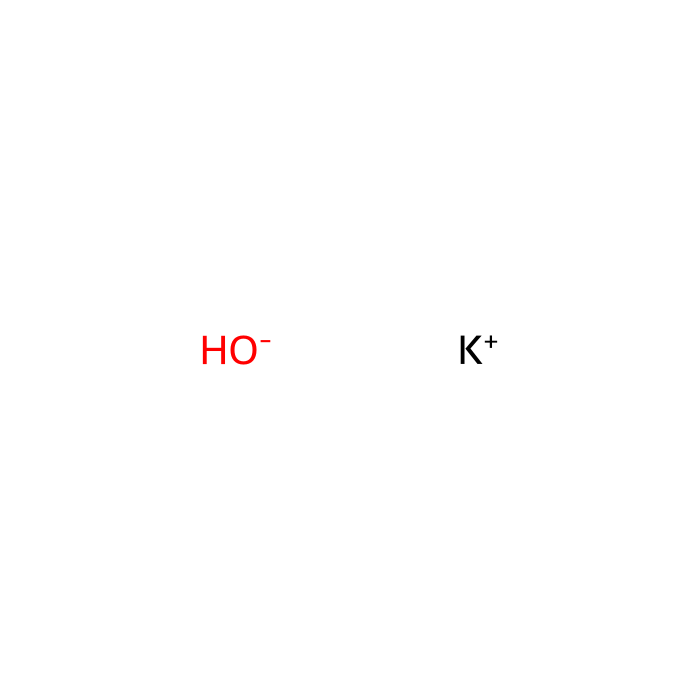
Potassium Hydroxide - 0.0100 Normal (N/100) , CAS No.1310-58-3

CAS: 1310-58-3 Cat. No.: P291807 분자식: KOH 분자량: 56.11 EC 번호: 215-181-3
주문 가능
GRADE & PURITY 0.0100 Normal (N/100)
Storage
Room temperature,Desiccated
Shipped In
FedEx DG Service
★
Size
USA
독일 (EU)*
Price
Qty
500ml
P291807-500ml
3 재고 있음
1 재고 있음

US$19.90

US$27.90
저장 US$8.00 (28.67%)
Enter a quantity for the sizes you want to add.
🧪
Why this grade

0.0100 Normal (N/100) for sensitive chromatographic and analytical workflows requiring minimal baseline interference.

🌡

Storage & shipping

Room temperature,Desiccated Ships FedEx DG Service Check lot-specific COA for exact specifications.

📋

Quality documents

SDS, COA, datasheet, and spec sheet available for download. Lot-specific COA accessible via lot number lookup.

📚

Literature proof

Cited in 2830 peer-reviewed publications across chromatography, organic synthesis, and cross-coupling reactions.

Specifications

사양 및 순도
0.0100 Normal (N/100)
보관 조건
Room temperature,Desiccated
배송
FedEx DG Service
이름과 식별자
이성체 SMILES
[OH-].[K+]
WGK 독일
1
UN 번호
UN 1814
포장 그룹
II
분자량
56.11
Reaxy-Rn
11342937
Reaxys-RN_link_address
https://www.reaxys.com/reaxys/secured/hopinto.do?context=S&query=IDE.XRN=11342937&ln=

Documentation

📋 Safety Data Sheet (SDS)

Comprehensive hazard, handling, storage, and regulatory compliance document.

Download SDS →

✅ Certificate of Analysis (COA)

Lot-specific quality data. Enter your lot number to retrieve the exact COA.

Look up COA →

📊 Datasheet

Quick-reference summary of product specifications and applications.

View datasheet →

🔬 Specification Sheet

Full quality attributes and acceptance criteria for this grade.

View spec sheet →

Advanced Data

인증서(CoA, COO, BSE/TSE 및 분석 차트)
C of A & Other Certificates(BSE/TSE, COO):
Analytical Chart:

Find and download the COA for your product by matching the lot number on the packaging.

2 results found

Lot NumberCertificate Type날짜항목
E2619281Certificate of AnalysisMay 25, 2026 P291807
I2110212Certificate of AnalysisJun 16, 2025 P291807
화학 및 물리적 특성
끓는점(°C)1324 °C
녹는점(°C)380°C
자주 묻는 질문과 기사
Nanowires: Properties, Preparation Routes, and Process Selection (Comprehensive Analysis of Top-Down and Bottom-Up Approaches with Recommended Aladdin Reagents)
How to Choose a Hydrogen Evolution (HER) Catalyst: Kinetic Barriers in Water Electrolysis, AWE/PEM/AEM Pathways, and a Materials-Family Roadmap (with a Product Map)
NiMH Nickel–Metal Hydride Batteries: A Full View of the MH (Metal Hydride) Negative Electrode—Working Mechanism, Materials Families, and a Selection Map (with Tables 1–2)
Selection of Common Research Salts: A Task Map for Alkali Metal Salts & Alkaline Earth Metal Salts (with Product Tables 1–6)
How to Make the Suzuki–Miyaura Reaction Robust: Pinpoint the Bottleneck and Lock in a Reproducible Operating Window (with Selection Navigation and Product Tables 1–5)
Ferulic Acid: Structural Features, Preparation Routes, and Key Points for Research Applications
Preparation Methods and Precautions for Silane Coupling Agent Primer Solutions
Experimental Selection Logic for Phase-Transfer Catalysts: Choosing Catalysts by Phase-State System, Source of Anionic Species, and Reaction Task
Perovskite Oxides for Energy and Environmental Catalysis: How Oxygen Vacancies, B-Site Metals, and the Metal–Oxygen Bond Network Regulate Reaction Performance
Microscopic Interpretation and Taxonomic Value of Iodine Staining Reaction in Fungal Spores
Microbial Morphological Identification: Observation Systems, Staining Methods, and Result Interpretation
Potassium Fatty Acid Soaps: Structure and Formulation Applications—Production Processes, Alkalinity, Foam Control, and Low-Foam Cleaning
Why Do Phenolic Resins Have Good Heat and Chemical Resistance? Analyzing the Source of Their Performance from Molecular Structure to Cured Networks
What Is Silica Sol: Mechanism of Action, Application Scenarios, and Selection Criteria for Nanosilica Dispersions
Why LABSA (Sulfonic Acid) Is Commonly Used in Household Cleaning Formulations: Neutralization Mechanism, Detergency Action, and Formulation Application Points
From Structure to Rheology: How Carbomer Forms Gel Structures and Enables Thickening, Suspension, and Auxiliary Emulsion Stabilization
What Is the Difference Between Triethanolamine and Diethanolamine: Understanding Their Formulation Functions, Application Differences, and Selection Logic from a Molecular-Structure Perspective
Why Can 6501 (Cocamide DEA) Stabilize Foam and Build Viscosity? Structural Mechanism, 1:1/1:1.5 Differences, and Application Selection
Differences, Functions, and Selection Guidelines for Sodium Hydroxide Flakes, Granules, Liquid Caustic Soda, and Caustic Soda in Household and Personal Care Product Manufacturing: The Functional and Application Logic of Sodium Hydroxide
Why Daily Chemical Formulations Need Alkaline Ingredients: From pH Adjustment and Saponification to Detergency Boosting and Selection Logic
Degreasing Agents from a Molecular-Structure Perspective: How AEO, APG, and Related Surfactants Can Replace Nonylphenol Ethoxylates (NPE)
From Structure to Selection: Mechanisms and Application Assessment of Low-Foam Oil and Wax Removal with Fatty Acid Methyl Ester Ethoxylates (FMEE)
Sodium Metasilicate in Cleaning Applications: Hydration-Form Differences, Mechanisms of Action, and Selection Logic
What Is an Etchant? Etching Mechanisms for Revealing Metallographic Microstructures, Selection Methods, and Applications of Related Wet-Etching Reagents
Mechanisms and Troubleshooting of Foam Reduction in Personal and Household Care Formulations: Film Rupture, Weak Interfacial Films, Insufficient Surfactant Supply, and Phase-State Disturbance
Why Are Daily Chemical Products Prone to Viscosity Thinning in Summer? Core Mechanisms, Troubleshooting Methods, and Solutions
Key Variable in the Long-Term Stability of Waterborne Pigment Concentrates: How Dispersant Molecular Weight Distribution (MWD) Affects Pigment Dispersion, Surface Adsorption-Layer Formation, and Storage Stability
Potential Mechanisms of Succinic Acid in Acne Care: From Dicarboxylic Acid–Base Equilibria to Metabolic Antagonism Among Skin Microorganisms
Overcoming the Electronic-Effect Limitations of Nucleophilic Aromatic Substitution in Fluoroarenes: Anion Activation, Concerted Substitution, and HF Capture by t-Bu-P4
3,3-Spiro-α-Proline Building Blocks: Structural Features, Complementary Synthetic Routes, and Multigram-Scale Preparation
MTAD-Mediated Oxidative Dearomatization of Pyridines: Transient para-Cycloaddition, Alkene Oxidation, and Heteroatom Functionalization
Aminative Suzuki–Miyaura Coupling: Bond-Formation Order and Chemoselectivity Control in the Transformation from Ar–Ar′ to Ar–NH–Ar′
Citations of This Product
솔루션 계산기
리뷰

고객 리뷰

Shall we send you a message when we have discounts available?

Remind me later

Thank you! Please check your email inbox to confirm.

Oops! Notifications are disabled.