Secondary alcohol - Carboxylic acid salt - Organic alkali metal salt - Monocarboxylic acid or derivatives - Carboxylic acid - Organic oxygen compound - Organic oxide - Hydrocarbon derivative - Organic potassium salt - Organic salt - Organic zwitterion - Organooxygen compound - Carbonyl group - Alcohol - Aliphatic acyclic compound
설명
This compound belongs to the class of organic compounds known as carboxylic acid salts. These are ionic derivatives of carboxylic acid.
External Descriptors
Not available
1. Djoumbou Feunang Y, Eisner R, Knox C, Chepelev L, Hastings J, Owen G, Fahy E, Steinbeck C, Subramanian S, Bolton E, Greiner R, and Wishart DS. ClassyFire: Automated Chemical Classification With A Comprehensive, Computable Taxonomy. Journal of Cheminformatics, 2016, 8:61.
Determine the necessary mass, volume, or concentration for preparing a solution.
Dilution Calculator
Determine the dilution needed to prepare a stock solution.
Reconstitution Calculator
리뷰
고객 리뷰
Application Protocols
No assay-specific, manufacturer-validated protocols are provided for this item. General uses include:
Preparing lactate buffers by combining potassium L-lactate solution with lactic acid to the desired pH and ionic strength.
Supplementing microbial culture media as a defined carbon source (verify concentration and sterilize by filtration if needed).
Serving as substrate in LDH enzyme assays (calibrate concentration using CoA or independent assay).
For detailed, application-specific SOPs, consult primary literature and validate conditions in your lab.
Biological Roles
General biochemistry (literature; not product specifications):
Metabolic intermediate: L-Lactate is the reduced product of pyruvate via L-lactate dehydrogenase (LDH) during glycolysis. It interconverts with pyruvate depending on cellular NADH/NAD+ ratios.
Cori/Alanine cycles: In higher organisms, lactate participates in shuttling carbon between tissues and organs. In microbes, lactate can serve as both a substrate and product depending on species and oxygen availability.
pH homeostasis: Export and uptake of lactate anion/protons through monocarboxylate transporters (MCTs) influence extracellular and intracellular pH.
Metal complexation: Lactate (α-hydroxycarboxylate) weakly chelates divalent metals (e.g., Ca2+, Mg2+, Fe2+/3+), modulating bioavailability in culture media.
Osmotic/electrolyte considerations: Potassium is a major intracellular cation; using potassium salts can better mimic intracellular ion balances in certain in vitro systems compared with sodium salts.
Stereochemistry: The L-enantiomer is the predominant biological form produced by most mammalian cells; many enzymes are stereospecific for L-lactate.
Applications arising from these roles (research use only):
Substrate in enzyme kinetics (LDH assays), metabolic tracing (with isotopic labels), and respirometry.
Controlled carbon source in microbial cultures to reduce catabolite repression or acetate overflow seen with glucose in some hosts.
Component of defined media where potassium balance is critical.
Note: No medical or clinical claims are implied; this product is for research use only (per Product Data).
Buffer Applications
Potassium L-lactate is frequently paired with lactic acid to prepare lactate buffers in the mildly acidic range. Item-specific concentration and pH are Not specified for this item; refer to CoA/Spec Sheet.
Effective buffering range (literature): pH ~2.8–4.8 (centered around lactic acid pKa ≈ 3.86 at 25 °C). Useful where chloride- or phosphate-free acidic buffers are desired.
Preparation approaches (general guidance):
Approach A (salt + acid): Mix potassium L-lactate solution with lactic acid to achieve target pH using the Henderson–Hasselbalch relationship. Adjust ionic strength with KCl if needed.
Approach B (acid neutralization): Start from lactic acid and titrate with KOH to the desired pH, matching the potassium content of your system.
Practical tips:
Temperature affects pH; calibrate pH meter at working temperature when preparing precision buffers.
Verify final concentration by mass (gravimetric) or refractive index if using high-strength stocks.
Avoid strong bases during final pH adjustment to prevent overshoot; use dilute KOH for fine control.
Filter sterilize (0.22 µm) for cell culture applications when appropriate; confirm endotoxin/bioburden if required by your workflow (not specified for this item).
Compatibility:
Minimally interacts with most proteins at low concentrations; at higher ionic strengths, may influence protein solubility and activity.
Provides potassium rather than sodium, which may be advantageous in potassium-sensitive systems.
All recipes should be validated in your lab; this section provides literature-based guidance only.
Green Alternatives
From a green chemistry standpoint, potassium L-lactate solution is already an aqueous, low-VOC, biodegradable reagent. Alternatives depend on the intended role of lactate.
Alternatives: Direct use of lactic acid (aqueous) or sodium/ammonium lactate. Trade-offs: cation choice (K+ vs Na+/NH4+), osmolarity, and downstream compatibility.
Role: Carbon source in microbial media
Current: Potassium L-lactate (readily metabolized by many organisms)
Alternatives: Citrate, gluconate (biogenic ligands). Trade-offs: complex stability constants, pH ranges, and potential interference in assays.
Sustainability notes (literature):
Lactic acid and its salts are typically produced by fermentation of renewable carbohydrates.
Aqueous solutions minimize flammability and VOC emissions.
End-of-life: Readily biodegradable; however, solutions with high chemical oxygen demand (COD) should be treated to avoid oxygen depletion in wastewater systems.
Optimization tips:
Use the minimum effective ionic strength and carbon loading.
Prefer potassium over sodium when downstream processes recover or recycle K+ more efficiently.
Verify concentration to avoid overuse; concentrated stocks can reduce packaging and transport footprint.
Pharmaceutical Uses
No therapeutic or clinical claims are made. The notes below describe common formulation roles of lactate salts in general (literature context) and are not specifications for this item.
Typical roles (formulation/excipient context):
pH adjustment and buffering in the acidic range when chloride-, acetate-, or phosphate-free systems are preferred.
Electrolyte source (K+) in non-clinical development formulations, in vitro dissolution media, or process buffers where potassium is specified.
Osmolality modulation in laboratory-scale dosage-form development studies.
Regulatory context (general):
Pharmacopoeial monographs exist for potassium lactate (solid) and related lactate salts (e.g., sodium lactate). Applicability to a specific solution product depends on grade and documentation, which are Not specified for this item; refer to CoA/Spec Sheet.
Manufacturing/process uses:
Cleaning validation studies using aqueous lactate systems (readily water-rinsable, biodegradable).
Buffer component in bioprocess steps that require mild acidity and potassium counterion.
For any use in regulated environments, confirm identity, assay, impurity profile, microbial/endotoxin limits, and compliance with relevant compendial standards via the product’s CoA/Spec Sheet and SDS.
Physical Properties
Item-specific physicochemical specifications (concentration, density, refractive index, pH) are Not specified for this item; refer to CoA/Spec Sheet. The properties below are general/literature guidance for potassium L-lactate and its aqueous solutions and are not product specifications.
Physical state: Aqueous solution (appearance not specified for this item).
Miscibility: Completely miscible with water (literature). Poorly soluble in nonpolar solvents due to ionic character (literature).
Volatility: Nonvolatile solute; solution volatility governed by water content (literature).
Hygroscopicity: Concentrated solutions are humectant; they can absorb moisture and resist crystallization (literature).
pKa: Lactic acid pKa ≈ 3.86 at 25 °C (literature). As the potassium salt, solutions are typically slightly basic to near-neutral depending on concentration and CO2 exposure.
Partitioning: LogP not applicable (ionic). Distribution favors aqueous phase (literature).
Density and refractive index: Increase with concentration (literature). Exact values depend on % w/w and temperature (not specified for this item).
Thermal behavior: Aqueous solutions boil approximately near 100 °C, elevating with concentration; decomposition of the salt occurs only on strong heating of the dry residue (literature).
Conductivity: Strong electrolyte; conductivity rises with concentration and temperature (literature).
Practical notes:
If concentration is high, viscosity may be noticeably greater than water (literature).
Freezing point depression depends on concentration; concentrated solutions may supercool (literature).
Quality and Grades
Grade/Purity: Not specified for this item; refer to CoA/Spec Sheet. Because this is a solution, “purity” typically refers to assay of potassium lactate (% w/w), residual impurities (e.g., metals, chloride, sulfate), and bioburden/endotoxin if applicable to bioprocess grades.
What “solution” implies for quality:
Assay is expressed as % w/w or % w/v potassium lactate, often standardized by titration or density/refractive index correlations (not specified for this item).
pH and clarity are common release parameters for aqueous salt solutions; exact specification is not provided here.
Typical grades encountered in the market (context, literature):
Reagent/Biochemical grade: Controlled inorganic/organic impurities; suitable for general lab use and media preparation.
Cell culture/Bioprocess grades: Additional controls on endotoxin, bioburden, and trace metals.
Food grade/USP/Ph. Eur. (for related lactate salts): Pharmacopoeial monographs exist for potassium lactate solids; however, applicability to this item is not specified.
Stabilizers/Preservatives: Not specified for this item; refer to CoA/Spec Sheet. Some lactate solutions are self-preserving at high concentrations and low water activity, but this depends strongly on formulation.
For critical applications (e.g., bioprocessing, analytics), request the CoA/Spec Sheet for: assay (%), pH, conductivity, UV absorbance profile, trace metals, bioburden/endotoxin (if relevant), and identification tests.
Reaction and Applications
This product is primarily used as an aqueous source of L-lactate and potassium ion rather than as a traditional reagent for organic transformations.
Biochemical/bioprocess uses (general, research):
Carbon/energy source: L-lactate is readily metabolized by many microbes; useful in selective media or fed-batch strategies where lactate metabolism is desired.
Buffering component: Together with lactic acid, forms lactate buffers in the acidic range. Potassium counterion may be advantageous for K+-dependent systems.
Enzymology: Substrate for L-lactate dehydrogenase assays, redox studies, or metabolic flux analyses.
Coordination/analytical chemistry (literature):
Lactate acts as a bidentate ligand (α-hydroxycarboxylate) to chelate metal ions; can be used to maintain metals in solution or modulate redox properties in aqueous media.
Serves as a chiral anion for phase behavior studies or ion-pair chromatography (with appropriate cationic analytes).
Transformations (context):
For organic synthesis, esterification or acylation typically proceeds from lactic acid or lactyl chlorides rather than directly from potassium lactate. If derivatization is desired, first acidify the solution to liberate lactic acid, isolate, then proceed to ester/amide formation under standard conditions (Fischer esterification, Steglich esterification, etc.).
Practical notes:
If used in enzymatic assays, confirm enantiopurity (L-form) and quantify exact concentration via CoA or titrimetric verification.
Ionic strength and potassium concentration may affect protein stability, membrane potentials, and enzyme activity; titrate conditions accordingly.
Reaction Conditions
The following are literature-based, general conditions relevant to working with lactate systems and converting potassium lactate to more reactive derivatives. They are not specifications for this item.
Acidification to lactic acid:
Add stoichiometric mineral acid (e.g., HCl, H2SO4) at 0–25 °C with stirring to pH < 2, maintaining temperature to limit exotherm. Extract lactic acid into suitable solvent only if needed; otherwise use aqueous lactic acid directly.
Esterification (from lactic acid):
Fischer: Alcohol (ROH, 3–10 equiv), catalytic H2SO4 or p-TsOH (1–5 mol%), Dean–Stark or azeotropic water removal, 50–120 °C depending on alcohol; typical yields moderate to high for methyl/ethyl lactate.
Steglich: DCC/EDC (1.1–1.5 equiv), DMAP (5–10 mol%) in DCM/THF at 0–25 °C for base-sensitive substrates.
Amide formation (from lactic acid):
Activate as mixed anhydride (e.g., isobutyl chloroformate) or via carbodiimide coupling, then react with amines at 0–25 °C.
Metal complexation studies (aqueous):
pH 4–7 to favor chelation while minimizing metal hydrolysis; ionic strength controlled with KNO3/KCl; monitor by UV–vis, NMR, or potentiometry.
Enzymatic/biocatalytic systems:
For LDH assays, maintain pH near 7–8 (Tris or phosphate) when converting lactate to pyruvate; include NAD+ and monitor at 340 nm. For reduction (pyruvate to lactate), maintain pH ~7 with NADH present. Use potassium lactate as substrate source and adjust ionic strength accordingly.
Always validate reaction conditions at small scale. If using this specific product, confirm exact concentration and impurities via CoA before stoichiometric calculations.
Safety and Handling
GHS classification, signal word, hazard statements, and pictograms: Not specified for this item; refer to SDS for authoritative safety information.
Storage: Room temperature (per Product Data). Store tightly closed to prevent evaporation and concentration drift. Protect from contamination and prolonged exposure to air/CO2, which can slowly acidify the solution.
Incompatibilities (general):
Strong oxidizing agents (may react with organic components).
Strong acids can liberate lactic acid from the lactate salt.
Avoid mixing with reactive acylating or dehydrating agents.
Personal protective equipment (typical laboratory practice): Lab coat, safety glasses or goggles, and appropriate chemical-resistant gloves. Use in a well-ventilated area; avoid aerosol generation.
Handling guidance:
Wipe threads after dispensing; cap immediately to maintain concentration.
If crystallization occurs (in cold storage), warm gently and mix to fully redissolve before use.
Spills & cleanup: Absorb with inert material (e.g., vermiculite), then water-wash residue. Prevent entry into drains in large quantities. Dispose according to institutional and local regulations.
First aid (general, non-diagnostic):
Skin/eyes: Rinse with water for at least 15 minutes; remove contact lenses if present and easy to do.
Ingestion/inhalation: Rinse mouth; move to fresh air. Seek medical attention if symptoms persist.
Always consult the product’s SDS and your institutional EHS guidance for risk assessment and controls appropriate to your use.
Solvent Selection
Potassium L-lactate solution is itself an aqueous electrolyte solution rather than an organic solvent. Selection considerations revolve around diluents and co-solvents.
Polarity and miscibility (literature):
Fully miscible with water; practically immiscible with nonpolar solvents. Partial compatibility with lower alcohols (methanol, ethanol) but salt may not remain fully dissociated in anhydrous alcohols.
Dielectric environment: High in water; supports ionic dissociation and conductivity.
Practical use scenarios:
As an aqueous additive or buffer component in the pH ~3–6 range (with lactic acid base-pairing for pH control).
Carbon source or osmotic/electrolyte component in microbial media where potassium ion is preferred over sodium (application-dependent).
When to choose vs. alternatives:
Choose potassium lactate when K+ is desired (e.g., to maintain K+/Na+ balance in physiological or fermentation settings) or when avoiding chloride/acetate is beneficial.
Consider sodium lactate solution when Na+ is acceptable and materials compatibility favors Na-salts.
Consider lactic acid (free acid) when stronger acidification or non-ionic precursor for esterification is required.
Lactic acid: partially miscible with organics; pH-lowering agent without introducing additional cations.
Lactate esters (e.g., ethyl lactate): green organic solvents (non-ionic), miscible with many organics but hydrolyze in water; not substitutes for ionic functions.
Storage and Reconstitution
Storage conditions (per Product Data): Room temperature. Store tightly closed to avoid evaporation and concentration changes. Keep in a clean environment to limit microbial contamination.
Shipped in: Normal (per Product Data).
Appearance: Not specified for this item; refer to CoA/Spec Sheet.
Stability/practical guidance:
Avoid prolonged exposure to heat or direct sunlight. If crystals or precipitates form at low temperatures, warm gently (e.g., 25–40 °C water bath) and mix to redissolve.
Minimize headspace or consider using inert gas blanket for long-term storage to reduce CO2 absorption and pH drift.
For sterile applications, filter sterilize upon receipt (0.22 µm) if grade allows; maintain aseptic handling.
Reconstitution: Not applicable; supplied as a solution. For working solutions, dilute with high-purity water (e.g., ASTM Type 1) to the desired concentration. Verify final concentration by mass, density/refractive index correlation, or titration when precision is required.
Freeze–thaw: Generally unnecessary and not recommended; freezing may cause concentration gradients or precipitation of salts. If accidental freezing occurs, thaw completely and homogenize before use.
Always consult the product CoA/Spec Sheet for any item-specific stability windows, assay values, and handling notes.
Structure and Identity
Potassium L-lactate solution is an aqueous solution of the potassium salt of L-lactic acid (the L-2-hydroxypropionate anion).
SMILES: Not specified for this item; refer to CoA/Spec Sheet.
Molecular formula (solution): Not specified for this item; refer to CoA/Spec Sheet.
Molecular weight (solution): Not specified for this item; refer to CoA/Spec Sheet.
Literature identity (solid potassium L-lactate, for reference only — not item-specific):
Molecular formula: C3H5O3K
Average molecular weight: ~128.17 g/mol
InChIKey (neutral salt): typically corresponds to potassium 2-hydroxypropanoate (literature)
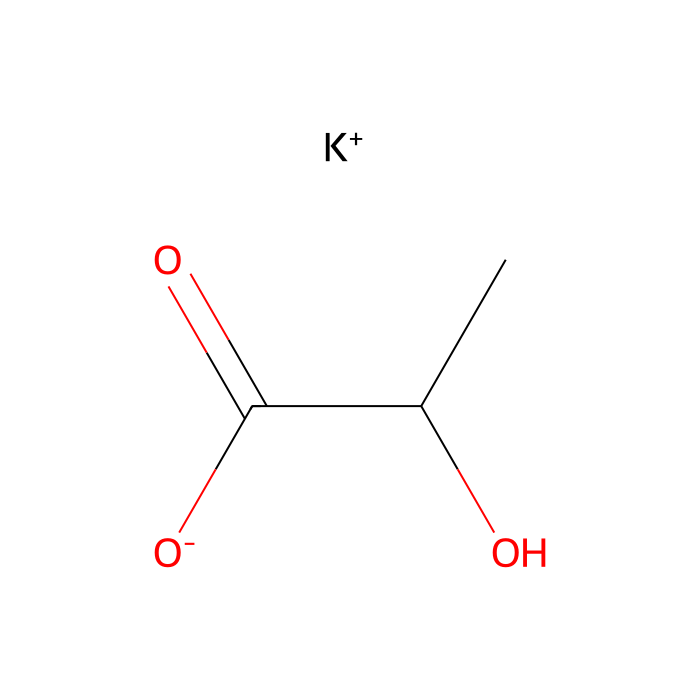
SMILES (one representation): CC(C(=O)[O-])O.[K+]
Structural features (general description):
The anion is L-lactate: a three-carbon backbone with a secondary alcohol at C2 and a terminal carboxylate. The stereocenter at C2 has L-configuration (S absolute configuration under standard priorities).
Counterion: K+; in aqueous solution, complete dissociation into K+ and L-lactate is expected.
2D description: HO–CH(CH3)–COO− paired with K+ in water. No ring systems; functional groups: secondary alcohol (–OH) and carboxylate (–COO−).
Notes: Because this product is a solution, exact concentration and any stabilizers (if present) determine the effective composition; these are Not specified for this item; refer to CoA/Spec Sheet.
Synthetic Utility
Although potassium L-lactate solution is not a classical building block for organic synthesis, it is a convenient aqueous source of the L-lactate anion and potassium cation, enabling specific transformations or conditions in water.
Functional group features (lactate anion):
α-Hydroxycarboxylate: can chelate metals (bidentate coordination) to modulate reactivity and solubility of metal salts in aqueous media.
Nucleophilicity: weak under neutral conditions; derivatization generally requires prior protonation to lactic acid or activation (e.g., conversion to lactyl chloride or mixed anhydrides) rather than direct reaction from the potassium salt.
Uses in synthesis/processing (literature):
As a chiral, weakly coordinating anion in ion-pairing scenarios or phase-transfer studies.
Precursor to chiral lactic acid derivatives after acidification: esters (Fischer/Steglich), amides (via activated esters), and cyclic acetals with carbonyls.
Additive in aqueous/biocatalytic systems to stabilize enzymes or adjust ionic strength and pH near 3–5.
Retrosynthetic perspective:
When a lactate motif is needed, access via lactic acid (from this salt by acidification) offers broader downstream chemistry: esterification, acylation, and polymer precursor synthesis (e.g., to polylactide via lactide, though this typically proceeds from lactic acid/esters, not the salt directly).
Practical note:
If chirality is critical, track enantiomeric integrity (L-form) through any acidification and derivatization steps; racemization is minimal under mild acidic conditions but can occur under strong base or high temperature.
Target Specificity
This product is a small-molecule inorganic/organic salt solution, not a biological targeting reagent (e.g., antibody, probe). No antigen/epitope specificity, clone, or isotype applies.
자주 묻는 질문
How is this product shipped?
This product ships under standard ambient conditions. No temperature-controlled packaging is required.
What are the CAS number, molecular formula and molecular weight?
The CAS Number is 85895-78-9, the molecular formula is C3H5KO3, and the molecular weight is 128.17 g/mol. InChIKey PHZLMBHDXVLRIX-DKWTVANSSA-M.
What documentation is provided?
Available product documentation, including Certificates of Analysis (COA), Safety Data Sheets (SDS), and specification sheets, is shown in the product document area. Document availability and access follow the current site policy.
Products are supplied to verified businesses, institutions, and qualified professionals for research and development use only. Not for use in humans, animals, diagnosis, or therapy.

 A2122456