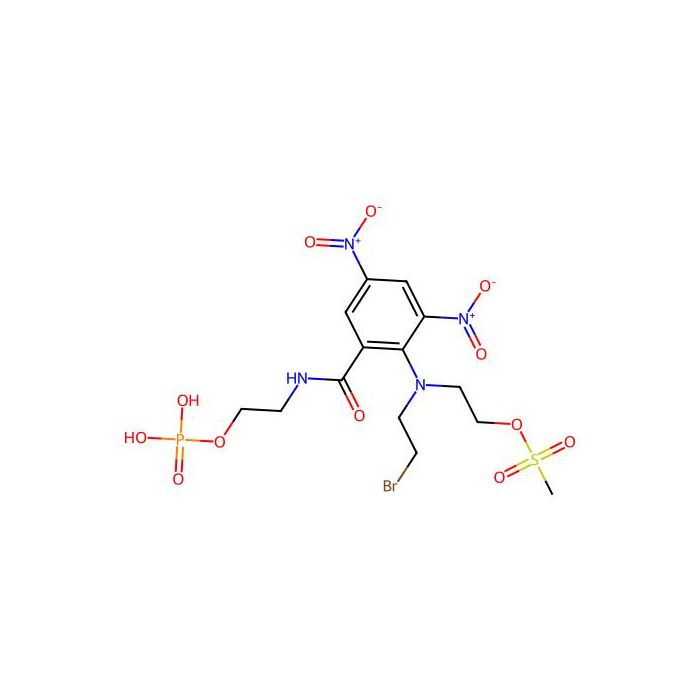
PR-104 is a selective hypoxia-activated DNA cross-linking agent and can be used for the research of multiple tumor xenograft models. PR-104, as a nitrogen mustard pre-proagent, is converted efficiently to the more lipophilic dinitrobenzamide mustards alcohol PR-104A.
In Vitro
PR-104 (80 μM; 1 hour; SiHa cells) shows greater suppression of radiation-induced DNA single-strand breaks under hypoxic than aerobic conditions. PR-104 (100 μM; 1 hour; SiHa cells) results in phosphorylation of Ser139 of histone H2AX (gH2AX). PR-104 (0.266 mmol/kg; 18 h; SiHa cells) shows activity against hypoxic cells after irradiation. PR-104 varies in potency between cell lines, with the lowest IC 50 (0.51 μmol/L) in H460 cells and highest (7.3 μmol/L) in PC3 prostate cells. MCE has not independently confirmed the accuracy of these methods. They are for reference only.
In Vivo
PR-104 (0.56 mmol/kg; i.v. or i.p.; 0~2 hours) makes the plasma area under the curve. PR-104 (0.23 mmol/kg; i.p.; 100 days) shows antitumor activity . MCE has not independently confirmed the accuracy of these methods. They are for reference only. Animal Model: CD-1nu/nu mice Dosage: 0.56 mmol/kg (Pharmacokinetics Analysis) Administration: I.v. or i.p. Result: The plasma area under the curve. Animal Model: CD1-Foxn1nu mice Dosage: 0.23 mmol/kg Administration: I.p. Result: Showed antitumor activity.
PR-104 is a selective hypoxia-activated DNA cross-linking agent and can be used for the research of multiple tumor xenograft models. PR-104, as a nitrogen mustard pre-proagent, is converted efficiently to the more lipophilic dinitrobenzamide mustards alco
This compound belongs to the class of organic compounds known as dinitroanilines. These are organic compounds containing an aniline moiety, which is substituted at 2 positions by a nitro group.
External Descriptors
Not available
1. Djoumbou Feunang Y, Eisner R, Knox C, Chepelev L, Hastings J, Owen G, Fahy E, Steinbeck C, Subramanian S, Bolton E, Greiner R, and Wishart DS. ClassyFire: Automated Chemical Classification With A Comprehensive, Computable Taxonomy. Journal of Cheminformatics, 2016, 8:61.
DMSO : 100 mg/mL (172.63 mM; Need ultrasonic) H2O : 31.25 mg/mL (53.95 mM; ultrasonic and warming and heat to 60°C)
분자량
579.300 g/mol
XLogP3
-0.600
Hydrogen Bond Donor Count
3
Hydrogen Bond Acceptor Count
13
Rotatable Bond Count
12
Exact Mass
577.972 Da
Monoisotopic Mass
577.972 Da
Topological Polar Surface Area
242.000 Ų
Heavy Atom Count
33
Formal Charge
0
Complexity
839.000
Isotope Atom Count
0
Defined Atom Stereocenter Count
0
Undefined Atom Stereocenter Count
0
Defined Bond Stereocenter Count
0
Undefined Bond Stereocenter Count
0
The total count of all stereochemical bonds
0
Covalently-Bonded Unit Count
1
솔루션 계산기
Molarity Calculator
Determine the necessary mass, volume, or concentration for preparing a solution.
Dilution Calculator
Determine the dilution needed to prepare a stock solution.
Reconstitution Calculator
리뷰
고객 리뷰
자주 묻는 질문
What is the purity of this product?
This product is supplied at ≥97% purity (chemical assay). Lot-specific values are stated on the Certificate of Analysis.
How should this product be stored?
Store at ?80 °C, protected from light, under argon. It is supplied under an argon blanket; reseal under inert gas after each use.
How is this product shipped?
This product ships frozen with dry ice and cold packs. Unpack on arrival and transfer it to the storage condition stated above; handle dry ice with insulated gloves in a ventilated area.
What are the CAS number, molecular formula and molecular weight?
The CAS Number is 851627-62-8, the molecular formula is C14H20BrN4O12PS, and the molecular weight is 579.27 g/mol. InChIKey GZSOKPMDWVRVMG-UHFFFAOYSA-N.
What documentation is provided?
Available product documentation, including Certificates of Analysis (COA), Safety Data Sheets (SDS), and specification sheets, is shown in the product document area. Document availability and access follow the current site policy.
Products are supplied to verified businesses, institutions, and qualified professionals for research and development use only. Not for use in humans, animals, diagnosis, or therapy.