등급 & 순도Moligand™?Moligand™ — Aladdin's line of ligands and bioactive small molecules. Use for receptor, pathway, and binding studies needing defined small-molecule tools.10mM in DMSO
Determine the necessary mass, volume, or concentration for preparing a solution.
Dilution Calculator
Determine the dilution needed to prepare a stock solution.
Reconstitution Calculator
리뷰
고객 리뷰
Application Protocols
Not specified for this item; refer to CoA/Spec Sheet.
General guidance for typical lab workflows (non-validated suggestions):
Prepare a 10–50 mM stock in DMSO. For biochemical assays, dilute into assay buffer keeping final DMSO ≤0.5–1% v/v.
Include matched solvent controls and a reference standard curve if quantifying activity or MIC-like endpoints.
For LC-MS quantitation, use a stable internal standard and bracketed calibration with matrix-matched samples.
These suggestions are not tested/validated for this SKU and are provided only as generic laboratory practices.
Biological Roles
Scope: Biological context provided here is literature/general background to inform experimental design; it is not product specification nor a clinical claim.
Literature/general background:
Compound class: Heteroaromatic thioamide related to isonicotinamide analogs. Such thioamides are known prodrugs that can undergo bioactivation via flavin-dependent monooxygenases.
Mechanistic theme: Upon oxidative activation (e.g., S-oxidation), thioamides can form reactive species that condense with nicotinamide cofactors, generating adducts that inhibit enoyl-acyl carrier protein (ACP) reductase enzymes in fatty acid synthesis pathways.
Experimental utility: Serves as a chemical probe for studying cofactor-dependent enzyme inhibition, redox activation cascades, and lipid biosynthesis regulation in bacteria. In cell-based systems, careful control of solvent and exposure conditions is necessary due to limited aqueous solubility and potential off-target effects at high concentrations.
ADME-relevant considerations: Moderate lipophilicity and heteroatom content suggest appreciable passive permeability, with metabolic liability at the thioamide sulfur (oxidation) and amide bond (hydrolysis). These features can be leveraged in in vitro metabolism and transporter studies.
Research use only:
Use in enzyme kinetics, target engagement assays (biophysical or activity-based), and microbiology growth assays as a positive control/reference where appropriate.
Avoid inferring therapeutic efficacy or safety from laboratory findings; this product is not intended for human or animal use.
Buffer Applications
Not typically applicable. Protionamide is not a buffering reagent and does not form defined buffer systems over useful pH ranges.
Practical guidance:
For biological assays, prepare compound stocks in DMSO and dilute into your standard buffer system (e.g., phosphate-buffered saline, HEPES, MOPS) appropriate to the assay. Maintain final organic solvent content at or below assay-validated levels (commonly ≤0.5–1% v/v DMSO).
Choose buffers that maintain enzyme or cell culture performance, and confirm that the compound does not precipitate upon dilution at working concentrations.
Green Alternatives
Context: Protionamide itself is the compound of interest; “green alternatives” primarily concern solvent and process choices when handling or modifying it, rather than alternatives to the compound.
Greener solvent choices (literature/general):
Primary stock solvent: DMSO is widely accepted; while not “green” per se, it is safer and less volatile than DMF and NMP.
Aqueous cosolvent systems: Where feasible, use water with small percentages of ethanol or DMSO to minimize organic load. Surfactant-assisted dispersion (e.g., polysorbates) can reduce the need for high organic content in biological assays.
Replacement of chlorinated solvents: For any synthetic transformations (e.g., S-oxidations), consider ethyl acetate or 2-MeTHF in place of DCM or chloroform when compatible.
Illustrative comparison (general):
DMF vs DMSO: DMSO generally offers lower worker exposure risk and better biodegradability metrics. DMF is reprotoxic and should be minimized.
DCM vs 2-MeTHF/EtOAc: If extraction or workup is required during analytical sample prep, 2-MeTHF or ethyl acetate can often substitute dichloromethane with acceptable performance.
Operational practices:
Use minimal solvent volumes; adopt microplate-based assays to reduce waste.
Consolidate stock solutions and aliquot to extend shelf life, reducing repeated thaw–freeze and waste.
Note: The intrinsic selection of the active scaffold is driven by research aims; solvent/process greening is the realistic optimization lever here.
Pharmaceutical Uses
This section focuses on formulation and manufacturing relevance without therapeutic claims.
Research/formulation role: In pharmaceutical R&D laboratories, protionamide can serve as a reference compound for analytical method development, impurity/metabolite comparisons, and as a positive control in biochemical or microbiological assays.
Standards and characterization: It can be employed as a system suitability compound in LC-UV/LC-MS methods designed to quantify thioamide-containing analytes or to assess oxidative metabolite profiles (e.g., sulfoxides/sulfones) under stress-testing conditions.
Pre-formulation insights (literature/general): Limited aqueous solubility suggests that enabling formulations (e.g., DMSO or ethanol cosolvent systems, cyclodextrin inclusion, or micellar solubilization) may be required for high-concentration dosing in in vitro studies. Stability screening should include oxidative stress (peroxide-containing excipients), light exposure, and pH stress to map degradation pathways.
Item-specific constraints:
This Aladdin Scientific product is designated For research use only. It is not intended for use in humans or as an active pharmaceutical ingredient in manufacturing. For any regulated applications, procure compendial or GMP-grade material separately.
Physical Properties
Item-specific (Product Data):
Appearance: Not specified for this item; refer to CoA/Spec Sheet.
Molecular Weight: Not specified for this item; refer to CoA/Spec Sheet.
Literature/general (not item specifications):
Physical state: Typically an organic solid at ambient temperature for isolated reference-grade material.
Solubility profile (typical for thioamide-containing pyridines):
High solubility in polar aprotic organic solvents such as DMSO and DMF; moderate solubility in acetonitrile and alcohols (ethanol, methanol). Sparingly soluble in water.
Acid–base behavior: Contains a basic ring nitrogen (pyridine) and a thioamide NH (weakly acidic); overall neutral at physiological pH with limited aqueous ionization.
Partitioning: Drug-like heteroaromatic with moderate lipophilicity; expect enhanced membrane permeability in biological assays when formulated in DMSO with co-solvent or surfactant.
Important cautions:
Do not treat the above as specifications; actual melting point, purity, and exact solubility for this SKU are Not specified for this item; refer to CoA/Spec Sheet.
For accurate assay preparation (e.g., making 10 mM DMSO stocks), confirm maximum solubility and any hygroscopicity or polymorphism on the CoA prior to use.
Quality and Grades
Item-specific (Product Data):
Grade/Purity designation: Moligand™
What Moligand™ implies:
Intended use: Research-use small-molecule screening library quality suitable for target validation, hit confirmation, and mechanism-of-action studies. Typically provided at a purity suitable for cheminformatics and biochemical screening workflows.
Documentation: Lot-specific CoA/Spec Sheet provides actual purity, analytical methods (e.g., HPLC/UPLC traces, MS), and structural confirmation. If you require tight specifications (e.g., residual solvent content, water content, counter-ions, polymorph), consult the CoA.
Not specified for this item; refer to CoA/Spec Sheet:
LC-MS verification: Confirm identity and purity on receipt for critical studies; record retention time and mass for future QC.
Batch consistency: For SAR or medicinal chemistry, keep a single lot for a campaign to minimize variability; cross-check with internal QC.
Format: If you need plate-ready aliquots, dry films, or specific solvents, contact us for custom formatting under the Moligand™ program.
Reaction and Applications
Item-specific application domain:
This SKU is part of a small-molecule screening collection (Moligand™), making it appropriate for biochemical target engagement studies, microbiological growth inhibition assays, and chemical biology probes under research-use-only conditions.
Research applications (literature/general, not item specifications):
Mechanistic probe in lipid metabolism pathways of mycobacteria where thioamide prodrugs are bioactivated and engage enoyl-ACP reductase systems. Useful in validating reductase-dependent activation cascades and NAD adduct formation in vitro.
Reference control in comparative studies with related thioamides (e.g., ethionamide analogs) to assess structure–activity relationships (SAR) involving thioamide oxidation and heteroaromatic substitution.
Chemical stability assessments: Serves as a substrate in model S-oxidation and hydrolysis studies (e.g., peracid-mediated conversions) to explore thioamide reactivity and generate metabolites or analogs for profiling.
Practical tips:
Prepare fresh DMSO stocks for assays sensitive to oxidation; consider inert gas blanket for long incubations at elevated temperature.
For microbiological assays, strictly control DMSO content (often ≤1% v/v) and include solvent controls.
Analytical tracking: LC-UV or LC-MS provides robust monitoring of parent depletion and formation of oxidized species in metabolism-mimicking experiments.
Note: No therapeutic or clinical use is implied; use this compound solely for laboratory research purposes.
Reaction Conditions
General literature guidance for transformations relevant to thioamide-containing heteroaromatics (for planning only; not product specifications):
S-oxidation to sulfoxide:
Typical reagents: mCPBA (1.0 eq) in dichloromethane or ethyl acetate at 0–25°C; monitor by TLC/LC-MS to avoid over-oxidation.
Alternative greener option: Oxone (KHSO5) in MeOH/H2O or acetone/H2O with NaHCO3 buffering at 0–25°C.
Workup: Aqueous bicarbonate wash to remove acids; purify by silica or reverse-phase chromatography.
Over-oxidation to sulfone:
Reagents: Excess mCPBA (≥2 eq) or H2O2/AcOH; cooler temperatures mitigate side reactions.
Stability testing (analytical):
Oxidative: 0.1% H2O2 in aqueous media at room temperature; follow depletion/formation of oxidized products by LC-MS.
pH stress: pH 2 and pH 9 buffer incubations at 40–60°C to map hydrolytic liability of the thioamide.
Stock solution preparation (assay context):
10–50 mM in anhydrous DMSO, sterile-filter if necessary (0.22 µm PTFE) for cell-based assays.
Avoid prolonged exposure to strong light/air if oxidation is a concern; store aliquots frozen.
Expected outcomes:
Selective mono-oxidation often proceeds in good conversions at ambient temperature within 0.5–2 h; sulfone formation requires longer or stronger conditions. Always confirm structures by NMR/MS.
Note: Choose conditions based on your substrate, scale, and safety assessments; thioamide substrates can vary in sensitivity.
Safety and Handling
Item-specific (Product Data):
GHS classification, H-statements, pictograms, signal word: Not specified for this item; refer to SDS.
Storage: Store at -80°C.
Shipping: Dry ice packs + Cold packs.
General safety guidance (consult SDS for authoritative details):
Likely hazards: As a heteroaromatic thioamide, avoid inhalation, ingestion, and skin/eye contact. Handle powders in a fume hood or ventilated enclosure to control dust/aerosol.
Personal protective equipment (PPE): Laboratory coat, appropriate chemically resistant gloves (e.g., nitrile), and safety goggles. Use respiratory protection if dust generation cannot be controlled.
Handling: Minimize exposure to ambient humidity/temperature during weighing. Warm sealed containers to room temperature before opening to prevent condensation. Avoid contact with strong oxidizers and strong acids/bases that may degrade the thioamide functionality.
First aid (overview): If on skin/eyes, rinse with water for at least 15 minutes; remove contaminated clothing. If inhaled, move to fresh air. If swallowed, rinse mouth; seek medical attention in all cases.
Spills and disposal: For small spills, dampen to avoid dust and collect with inert absorbent. Dispose of waste according to institutional and local regulations for organic laboratory chemicals.
Always defer to the product SDS and your institutional EHS protocols for definitive hazard, exposure limit, and emergency response information.
Solvent Selection
Use-case focus: Preparing stock solutions and working dilutions for biochemical, microbiology, and cell-based assays.
General solvent behavior (literature/general):
Polarity class: Moderately lipophilic heteroaromatic containing a basic pyridine nitrogen and a thioamide. Prefers polar aprotic organic solvents.
Recommended solvents for stocks: DMSO (primary), DMF (alternative). Ethanol or methanol can be used for intermediary dilution, often alongside aqueous buffers with surfactants (e.g., 0.1–1% Tween 80) for dispersion.
Miscibility: DMSO and DMF are fully miscible with water, enabling straightforward serial dilutions into assay buffers while controlling final organic percentage (typically ≤0.5–1% v/v DMSO).
Practical guidance:
Start with 10–50 mM stocks in anhydrous DMSO, then dilute into buffer or media. Confirm compound stability in DMSO at intended storage temperature (see Storage & Reconstitution).
For microbiological media, pre-dissolve in DMSO and add to pre-warmed media under vigorous mixing to prevent local precipitation.
Avoid neat water additions to dry solid; wetting with a small volume of DMSO or ethanol before aqueous dilution helps.
Comparison notes (literature/general):
DMSO vs DMF: DMSO is generally preferred for biotesting due to lower volatility/odor and better biocompatibility; DMF may offer higher solubility in some cases but has greater cytotoxic concerns.
Alcohols: Ethanol can be suitable for short-term dosing; watch for solubility limits and precipitation upon cooling or dilution.
Storage and Reconstitution
Item-specific (Product Data):
Storage Conditions: Store at -80°C.
Shipped In: Dry ice packs + Cold packs.
Research Use Note: For research use only.
Practical guidance:
Aliquoting: Upon receipt, allow the shipping container to equilibrate to room temperature externally to minimize condensation, then transfer the item to a -80°C freezer. If supplied as solid, subdivide into small, dry aliquots under inert atmosphere or low humidity to minimize repeated freeze–thaw and moisture exposure.
Stock solution preparation: Dissolve in anhydrous DMSO to 10–50 mM. Mix thoroughly (gentle vortex/sonication). If undissolved particulates remain, warm gently (≤40°C) briefly and re-mix. Optionally sterile-filter through 0.22 µm PTFE for cell-based work.
Storage of solutions: Store sealed, low-headspace aliquots at -80°C, protected from light and air. Avoid frost-free freezers that cycle temperatures. Record preparation date and concentration on each vial.
Thawing/handling: Thaw on ice or at room temperature; vortex to ensure homogeneity. Avoid multiple freeze–thaw cycles; discard aliquots after defined number of uses per your lab SOP (e.g., ≤3 thaws).
Not specified for this item; refer to CoA/Spec Sheet:
Exact appearance (solid form, color), water content, and stabilizers (if any).
Long-term solution stability and adsorption losses to plastics/glass.
Always consult the product’s CoA and SDS for definitive handling and storage details.
Structure and Identity
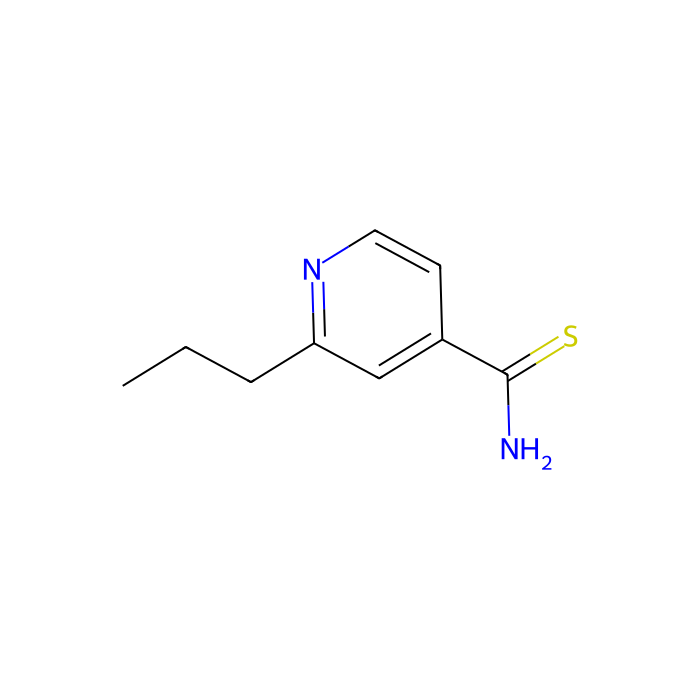
Brief overview: Protionamide (also spelled prothionamide in some literature) is a small-molecule heteroaromatic thioamide used widely as a reference compound in biochemical and microbiology research and in small-molecule screening libraries.
Storage: Store at -80°C (see Storage & Reconstitution)
SMILES: Not specified for this item; refer to CoA/Spec Sheet.
InChIKey: Not specified for this item; refer to CoA/Spec Sheet.
Molecular Formula: Not specified for this item; refer to CoA/Spec Sheet.
Molecular Weight: Not specified for this item; refer to CoA/Spec Sheet.
Literature structural features (for context; not item specifications):
Core scaffold: A substituted pyridine (isonicotinamide-type) bearing a thioamide (–C(=S)NH–) functionality.
Functional groups: Aromatic nitrogen heterocycle (pyridine), thioamide (thiocarbonyl), and an alkyl substituent on the ring.
2D description: A six-membered aromatic ring containing one ring nitrogen (pyridine) para to a carbothioamide side chain; an alkyl group is present on the ring ortho to the ring nitrogen. No stereocenters are present in common representations.
Notes:
Synonyms in literature may include “prothionamide”; ensure exact identity via CAS and CoA when setting up experiments.
If structural identifiers (SMILES/InChIKey) are needed for cheminformatics, obtain them from the item’s CoA/Spec Sheet or authenticated databases using the given CAS.
Synthetic Utility
Although primarily used as a final research probe compound, protionamide’s functional groups provide instructive reactivity in method development and metabolite synthesis.
Literature/general synthetic considerations:
Thioamide functionality (–C(=S)NH–):
Oxidation: Selective S-oxidation to sulfoxide or sulfone using peracids (mCPBA), oxone, or H2O2/urea systems. These reactions are relevant to metabolite-mimic preparation and mechanistic studies of bioactivation.
Electrophilic activation: Thioamides can form imidoyl intermediates under activating conditions (e.g., Lawesson’s reagent reversal, or thioimidate formation), enabling downstream derivatization.
Metal-catalyzed transformations: Under specific conditions, thioamides participate in cyclizations or C–N bond formations (e.g., Pummerer-type rearrangements after prior S-oxidation of thioethers when present in the scaffold).
Heteroaromatic pyridine: Amenable to N-oxidation (pyridine N-oxide formation) and subsequent regiocontrolled substitution (e.g., Boekelheide rearrangement in related systems) for analog generation.
Retrosynthetic value: The scaffold exemplifies late-stage thioamidation of an acid chloride or activated ester of an isonicotinic acid analog followed by ring substitution with an alkyl group; conversely, analog diversification can proceed via varying the ring substituent or exchanging the thioamide for amide/urea/isothiourea isosteres.
Applications:
Generate oxidized metabolites for analytical standards.
Prepare SAR analogs by ring substitution or functional group interconversion to probe physical property/performance relationships.
Target Specificity
Not specified for this item; refer to CoA/Spec Sheet and product documentation.
Note: While literature may discuss molecular targets for related thioamide scaffolds, Aladdin Scientific provides no target validation data for this SKU beyond general research-use designation. Users should establish target engagement empirically under their assay conditions.
자주 묻는 질문
What is Moligand??
Moligand? is one of Aladdin Scientific's premium product lines, formulated for high-purity applications across multiple workflows. Compared to standard grades in the same workflow, Moligand? products typically offer tighter specifications, more rigorous QC, and stronger lot-to-lot consistency.
How should this product be stored?
Store at ?80 °C. Ultra-low temperature storage is required to maintain the specified shelf life.
How is this product shipped?
This product ships frozen with dry ice and cold packs. Unpack on arrival and transfer it to the storage condition stated above; handle dry ice with insulated gloves in a ventilated area.
What are the CAS number, molecular formula and molecular weight?
The CAS Number is 14222-60-7, the molecular formula is C9H12N2S, and the molecular weight is 180.27 g/mol.
What documentation is provided?
Available product documentation, including Certificates of Analysis (COA), Safety Data Sheets (SDS), and specification sheets, is shown in the product document area. Document availability and access follow the current site policy.
Products are supplied to verified businesses, institutions, and qualified professionals for research and development use only. Not for use in humans, animals, diagnosis, or therapy.