GRADE & PURITYAnimal Free?Animal-free — produced without animal-derived components to reduce contamination risk. Use in biomanufacturing and culture avoiding animal-origin material.Carrier Free?Carrier-free — supplied without added carrier protein/stabilizer. Use when carriers (e.g. BSA) would interfere with conjugation or sensitive assays.Bioactive?Bioactive grade — verified to retain biological activity in functional assays. Use when the molecule must be functionally active, not just pure.ActiBioPure™?ActiBioPure™ — Aladdin's premier line for bioactive and recombinant products. Use when both high purity and preserved biological activity are required.High Performance?High-performance grade with optimized purity and performance characteristics. Use for sensitive analyses where ordinary grades fall short.His Tag?His tag grade — recombinant protein bearing a His tag for affinity purification/detection. Use to purify, immobilize, or detect the tagged protein.Fc tag?Fc tag grade — recombinant protein bearing a Fc tag for affinity purification/detection. Use to purify, immobilize, or detect the tagged protein. The Fc tag aids dimerization and protein-A/G capture.≥95%(SDS-PAGE)
Accession #
Q6UX41
Protein Tag
C-hFc & His
Expression system
HEK293
Endotoxin Concentration
<0.1 EU/μg
Bioactivity
Measured by its ability to enhance anti-CD3-induced IFN-gamma secretion of mouse CD3+ T cells. The ED50 for this effect is 0.5-2.5 μg/mL.
Animal Free,Carrier Free,Bioactive,ActiBioPure™,High Performance,His-Tag,Fc tag,≥95%(SDS-PAGE) ActiBioPure™,Animal Free,Bioactive,Carrier Free,Fc tag,High Performance,His Tag for sensitive chromatographic and analytical workflows requiring minimal baseline interference.
🌡
Storage & shipping
Store at -20°C,Avoid repeated freezing and thawing Ships Ice chest + Ice pads Check lot-specific COA for exact specifications.
📋
Quality documents
SDS, COA, datasheet, and spec sheet available for download. Lot-specific COA accessible via lot number lookup.
📚
Literature proof
Cited in 0 peer-reviewed publications across chromatography, organic synthesis, and cross-coupling reactions.
개요
Function May stimulate primary immune response. Acts on T-cell stimulated sub-optimally through the TCR/CD3 complex stimulating their proliferation and cytokine production.
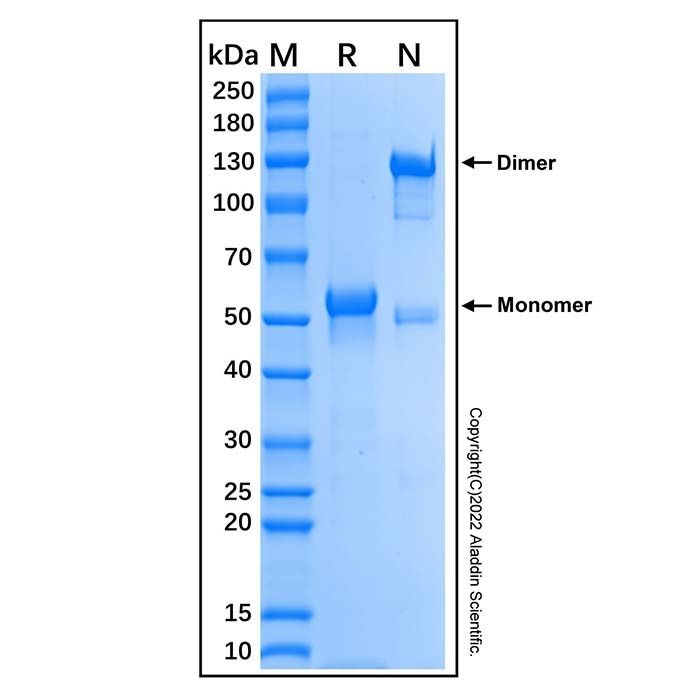
55 kDa, under reducing conditions; 50 & 128 kDa, under non-reducing conditions.
분자 유형
Protein
Product Line
biological_products
보관 및 배송
재구성
Reconstitute in sterile water to a concentration of 0.1-0.5 mg/ml.
보관 조건
Store at -20°C,Avoid repeated freezing and thawing
배송
Ice chest + Ice pads
안정성 및 스토리지
Store at -20~-80℃ for more than 1 year. Upon receipt, it is recommended to aliquot. Avoid freeze/thaw cycle.
이미지
Recombinant Human BTNL8 Protein (rp166345) - SDS-PAGE 2 μg/lane of Recombinant Human BTNL8 Protein was resolved with SDS-PAGE under reducing (R) and non-reducing (N) conditions and visualized by Coomassie® Blue staining, showing the band at 55 kDa under reducing conditions and 50 & 128 kDa under non-reducing conditions.
Documentation
📋 Safety Data Sheet (SDS)
Comprehensive hazard, handling, storage, and regulatory compliance document.
Determine the necessary mass, volume, or concentration for preparing a solution.
Dilution Calculator
Determine the dilution needed to prepare a stock solution.
Reconstitution Calculator
리뷰
고객 리뷰
Application Protocols
Item-specific tested applications, recommended concentrations, and step-by-step protocols are not provided in the Product Data. Refer to the CoA/Spec Sheet for any available usage guidance.
General guidance (not item-specific):
For plate-based binding assays (ELISA-style), start with 0.5–2 μg/mL coating or capture concentrations and titrate the analyte; verify compatibility of Fc/His tags with detection reagents.
For SPR/BLI, immobilize via Fc (Protein A/G sensors) or His (Ni-NTA sensors) and perform multi-point titrations to derive kinetic constants; include appropriate Fc or His controls.
For cell assays, perform a broad dose–response and include Fc-only and buffer controls to account for tag-related effects.
These are generic starting points only and must be empirically optimized for each laboratory setup. No guarantees of performance in any specific application are implied.
Biological Roles
BTNL8 (Butyrophilin-like 8) is a member of the butyrophilin/Ig superfamily implicated in immune modulation (literature). The following summarizes general biological knowledge and is not item-specific.
Tissue expression (literature): BTNL8 transcripts/protein are reported in epithelial barriers, including intestinal tissues, suggesting roles in mucosal immunity.
Immune regulation (literature): BTNL family members can modulate T-cell responses; BTNL8 has been associated with regulation of γδ T cells and co-regulatory signaling to conventional T cells, affecting activation thresholds and cytokine output in model systems.
Molecular features: Extracellular IgV/IgC-like domains mediate ligand interactions; the native protein is a type I membrane glycoprotein. Recombinant soluble extracellular domains are used to probe binding/functional outcomes.
Pathway context: Interfaces with adaptive immune signaling; potential crosstalk with co-stimulatory/co-inhibitory pathways typical of the Ig superfamily (general immunobiology). Specific binding partners and downstream pathways can be cell-type and context dependent.
Note: The above reflects literature context for human BTNL8 to aid experimental design. This product is provided strictly for research use; no clinical or diagnostic claims are made.
Buffer Applications
This reagent is a recombinant protein, not a buffering agent. Therefore, buffer capacity/pKa systems are not applicable.
Practical notes (general):
For reconstitution/dilution, neutral physiological buffers (e.g., PBS, HEPES, or Tris at pH ~7.2–7.5) are commonly used for recombinant proteins, provided they are compatible with the intended assay. Exact buffer recommendations for this item are not specified; refer to the CoA/Spec Sheet.
Avoid chelators (e.g., EDTA) when using Ni-affinity capture of the His tag; avoid imidazole carryover in binding assays.
Item-specific buffer composition and pH are not provided in the Product Data.
Green Alternatives
Green chemistry considerations for recombinant proteins focus on aqueous handling and minimizing waste.
Aqueous systems: Proteins are intrinsically compatible with water-based buffers, eliminating hazardous organic solvents in most workflows.
Energy use: Store at –20°C as specified; to reduce freeze–thaw cycles and energy-intensive re-cooling, aliquot once and use chilled benchtop periods efficiently.
Consumables: Use reusable cold blocks and low-binding, recyclable plastics where validated. Avoid single-use glass if shattering risk or adsorption leads to waste.
Shipping: Product is shipped in an ice chest with ice pads. Consolidating shipments and reusing cold-chain materials can reduce environmental footprint (subject to institutional policies).
Comparison (general):
Standard recombinant protein handling vs. solvent-based small-molecule workflows: dramatically lower VOC emissions and flammability risk; tradeoff is cold-chain energy demand and plastic consumables use.
No alternative chemical substitute is applicable here; sustainability gains come from buffer-only protocols, right-sized aliquots, and efficient cold-chain management.
Pharmaceutical Uses
This product is intended for research use only. It is not approved for therapeutic, diagnostic, or clinical applications.
Assay development: Recombinant BTNL8 can serve as a target/ligand in screening assays, potency assays, or biomolecular interaction analyses supporting discovery research.
Reference standard: May be used as a non-pharmacopeial in-house reference material for analytical method development (e.g., ELISA, SPR), subject to internal qualification.
Excipients: None added by design (Carrier Free). If formulating for extended storage in research settings, excipients such as trehalose or glycerol are often considered by end users; compatibility must be verified.
No pharmacopeial monograph or excipient role is claimed for this item; any use is restricted to laboratory research.
Physical Properties
Item-specific physico-chemical specifications (exact mass, concentration, buffer, pI) are not provided in the Product Data.
Appearance: Not specified for this item; refer to CoA/Spec Sheet.
Molecular weight (item-specific): Not specified for this item; refer to CoA/Spec Sheet.
Formulation/buffer: Not specified for this item; refer to CoA/Spec Sheet.
Concentration: Not specified for this item; refer to CoA/Spec Sheet.
Extinction coefficient (ε280): Not specified for this item; refer to CoA/Spec Sheet.
Isoelectric point (pI): Not specified for this item; refer to CoA/Spec Sheet.
General/literature context for BTNL8 proteins (not item-specific):
Predicted domain mass (literature): Human BTNL8 extracellular domain is typically ~28–35 kDa; Fc fusion adds ~50 kDa per dimer; His tag adds ~1 kDa. Glycosylation increases apparent mass on SDS-PAGE (literature estimates; construct-dependent).
Solubility: Recombinant BTNL8-Fc constructs are commonly soluble in neutral, isotonic aqueous buffers (e.g., PBS) and stable at 0.1–1 mg/mL with low protein-binding plastics (general guidance).
Storage behavior: Proteins are sensitive to freeze–thaw; stability improves with aliquoting and storage at ≤ –20°C (general protein handling).
Quality and Grades
This product is offered with multiple quality attributes. Item-specific test results and acceptance criteria are not listed here; consult the CoA/Spec Sheet.
Animal Free: Manufactured without animal-derived raw materials to minimize adventitious agents and variability. Supports workflows requiring defined, xeno-free inputs (e.g., in vitro bioassays).
Carrier Free: Supplied without protein carriers (e.g., BSA, gelatin). Advantages: precise mass balance, lower background in binding/enzymatic assays. Handling: use low-binding plastics; consider adding your own inert carrier post-reconstitution if your application requires it (end-user decision).
Bioactive: Indicates the lot has demonstrated biological activity in an internal assay appropriate to BTNL8 (assay format not specified for this item). Activity units/method: Not specified for this item; refer to CoA/Spec Sheet.
ActiBioPure™ / High Performance: Branding that typically denotes high purity, low aggregates, and stringent QC suitable for sensitive applications (e.g., ligand binding, cell-based readouts). Exact specifications (purity %, endotoxin, aggregate by SEC, UV profile): Not specified for this item; refer to CoA/Spec Sheet.
His Tag / Fc tag: Dual-tag configuration facilitates affinity capture (Ni-NTA for His; Protein A/G for Fc), improves stability/avidity (Fc dimerization), and enables immobilization on Fc-binding surfaces. Tag orientation and cleavage options: Not specified for this item.
Documentation: For detailed grade definitions, assay data, and analytical methods (SDS-PAGE, SEC, MS, endotoxin), see the lot-specific CoA and product Spec Sheet.
Reaction and Applications
As a recombinant immune-modulatory protein, this reagent is used in biochemical/biophysical binding experiments and cell-based research rather than synthetic organic reactions.
Typical research applications (literature/general):
Ligand–receptor interaction studies: Use as analyte or ligand in SPR/BLI to quantify binding to candidate receptors or antibodies recognizing BTNL8.
Functional immunology assays: Evaluate co-regulatory effects on T-cell subsets (including γδ T cells) in co-culture systems; measure cytokine release, activation markers, or proliferation (optimize per cell model). No therapeutic claims.
ELISA/bridging assays: Calibrator or capture antigen for quantifying anti-BTNL8 antibodies.
Flow cytometry staining (indirect): Fc-tagged protein can be complexed with labeled anti-Fc reagents for cell-surface binding studies (optimize concentration to minimize background).
Affinity matrices: Immobilize via His (Ni-NTA) or Fc (Protein A/G) to create columns or beads for pull-downs of interacting proteins.
Practical tips (general):
Maintain cold chain; avoid repeated freeze–thaw by aliquoting.
For Fc-mediated immobilization, confirm orientation does not occlude the BTNL8 binding interface.
Validate activity in your assay context; buffer components (e.g., EDTA, imidazole, surfactants) can affect interactions, especially with His tag usage.
Item-specific validated applications are not provided; refer to the CoA/Spec Sheet for any lot-specific activity data.
Reaction Conditions
Classical reaction conditions (solvent, temperature, catalysts) are not applicable to a recombinant protein. For bioassays involving this reagent, conditions must be optimized per assay.
General assay-condition guidance (literature/common practice; not item-specific):
Binding assays (SPR/BLI): 10–25°C; running buffer such as PBS or HEPES with 0.005–0.05% surfactant; include 0.1–1% BSA only if compatible (note: this item is Carrier Free; any additives are end-user choices). Monitor for non-specific Fc interactions; consider Fc-blocking where appropriate.
Cell-based assays: 37°C, 5% CO2 in appropriate culture medium; titrate protein across a broad range (e.g., 0.01–10 μg/mL) to establish dose–response. Exact active concentration varies with cell model and readout.
Pull-down/affinity capture: 4°C to room temperature; equilibrate Ni-NTA or Protein A/G matrices in compatible buffer; avoid EDTA for His capture; wash stringency optimized to balance specificity and yield.
Expected yields, kinetics, and potency values are assay- and construct-dependent and are not provided for this item. Always perform pilot experiments to define optimal conditions.
Safety and Handling
GHS classification, pictograms, H-statements: Not specified for this item; refer to the SDS for authoritative safety information.
Signal word: Not specified for this item; refer to SDS.
Research use only: For research use only. Not for human or veterinary use, clinical diagnostics, or ingestion.
Primary hazards (general for proteins): Low acute toxicity expected for purified recombinant proteins; potential for respiratory/skin sensitization in susceptible individuals. Avoid aerosol generation and direct contact.
Recommended PPE: Lab coat, nitrile gloves, safety glasses. Use a biological safety cabinet for procedures that may generate aerosols.
Handling notes:
This listing is Carrier Free; handle in low-binding tubes/tips to minimize adsorption.
Avoid repeated freeze–thaw (can cause aggregation and loss of activity).
Keep on ice during use; return promptly to recommended storage.
Incompatibilities (general): Avoid strong oxidizers and extreme pH that may denature proteins. Surfactants and high salt may affect binding assays; evaluate compatibility with your assay.
First aid (general): If inhaled, move to fresh air; in case of skin/eye contact, rinse with water for several minutes; if swallowed, rinse mouth. Seek medical attention if symptoms occur. Always follow institutional biosafety procedures.
Spill response: Absorb liquid with inert material, clean with mild detergent, dispose per local regulations for non-hazardous biological materials (consult SDS).
Solvent Selection
This is a recombinant protein, typically handled in aqueous buffers rather than organic solvents.
Primary medium: Neutral, isotonic aqueous buffers (e.g., PBS, HEPES, Tris) are commonly used for recombinant proteins (general guidance). Exact buffer/formulation for this item is not specified.
pH/ionic strength (general): pH 7.2–7.5 and 100–300 mM total ionic strength often balance solubility and activity for Ig-like proteins; optimize for your assay.
Additives (general): Low levels of non-ionic surfactants (e.g., 0.01% Tween-20) can reduce adsorption; glycerol (10–20%) can enhance freeze–thaw stability. Confirm compatibility with your bioassay. Note: This listing is Carrier Free; any additives are end-user choices.
Organic solvents: Not recommended; organic co-solvents can denature proteins and disrupt Fc/His interactions.
When to choose this reagent:
Prefer Fc-tagged BTNL8 when dimerization/avidity or Protein A/G immobilization is desired; prefer His-tag capture for oriented immobilization on Ni-NTA chips/resins. If monomeric BTNL8 is required, consider non-Fc tagged constructs (alternative products).
Storage and Reconstitution
Storage conditions (item-specific): Store at –20°C. Avoid repeated freezing and thawing.
Shipping condition (item-specific): Shipped in ice chest with ice pads.
Reconstitution: Not specified for this item; refer to CoA/Spec Sheet.
Aliquoting: Strongly recommended to prevent activity loss due to freeze–thaw (general best practice for proteins).
Handling: Keep on ice during use; return promptly to –20°C after aliquoting.
Stability after thaw (general): Short-term stability on ice or at 2–8°C varies by formulation; absent item-specific data, minimize time at ambient temperature.
If additional stabilizers or carriers are desired for your workflow, add them only after verifying assay compatibility and understanding that this product is supplied Carrier Free by design.
For precise formulation, concentration, and permissible storage durations, please consult the lot-specific CoA/Spec Sheet.
Structure and Identity
Recombinant Human BTNL8 Protein is a tagged recombinant form of the human butyrophilin-like 8 (BTNL8) protein for research applications.
Protein name: Butyrophilin-like protein 8 (BTNL8), human
Source/type: Recombinant protein; Animal Free, Carrier Free; dual-tagged (His tag, Fc tag) as indicated in Grade/Purity
Sequence region: Not specified for this item; refer to CoA/Spec Sheet.
Molecular formula: Not applicable for proteins; empirical amino-acid composition not specified for this item.
Molecular weight: Not specified for this item; refer to CoA/Spec Sheet.
SMILES / InChI / InChIKey: Not applicable to proteins; not provided.
Construct details (tags): His-tag enables IMAC/Ni-NTA capture; Fc-tag typically supports dimerization and Protein A/G affinity (general information).
Structural features (general, literature): BTNL8 is a type I membrane glycoprotein in the butyrophilin/Ig superfamily; its extracellular region contains immunoglobulin-like (IgV/IgC) domains. Recombinant preparations commonly comprise the soluble extracellular domain fused to an Fc for stability and dimerization (literature/typical), but the exact domain boundaries for this item are not specified.
2D/feature description (general): Linear polypeptide bearing N- to C-terminal tags; Fc fusion confers a symmetric dimeric architecture via IgG Fc dimerization (literature).
Synthetic Utility
Not applicable. This is a recombinant protein used for biochemical and cell-based studies, not a small-molecule building block.
For researchers planning conjugation/derivatization (general):
Tag-directed immobilization: Utilize Fc–Protein A/G or His–Ni-NTA for oriented coupling without chemical modification.
Covalent labeling (general): NHS esters (lysines) or maleimides (cysteines) can be used for fluorophore/biotin coupling, provided such modifications do not disrupt BTNL8 activity. Item-specific free cysteine/lysine availability is not specified; evaluate empirically.
No organic synthesis or retrosynthetic applications are relevant.
Target Specificity
Target/antigen: Human BTNL8 (Butyrophilin-like 8)
Species: Homo sapiens
Construct specifics (domain, tag orientation, sequence range): Not specified for this item; refer to CoA/Spec Sheet.
Epitope/ligand information: Not specified for this item.
Cross-reactivity: Not specified for this item.
Validated binding partners/applications: Not specified for this item.
Notes:
The product name indicates recombinant human BTNL8 with His and Fc tags. Detailed mapping of the expressed domain(s) and any confirmed interaction partners for this specific lot are not provided here; consult lot documentation for any available specificity data.
Need help choosing the grade?
Our grade selection guide covers purity, stabilizer status, and application suitability for all variants in our catalog.
We use cookies to ensure the website functions properly and, where permitted, to improve your experience. You can manage your preferences at any time in Settings. Learn more in our Cookie Policy.
Shall we send you a message when we have discounts available?
Remind me later
Thank you! Please check your email inbox to confirm.
Products are supplied to verified businesses, institutions, and qualified professionals for research and development use only. Not for use in humans, animals, diagnosis, or therapy.

 ZJ25F0420646