Recombinant Src Antibody - 1차 항체, specific to Src, Rabbit IgG

Cat. No.: Ab129134
주문 가능
등급 & 순도 Recombinant ? Recombinant — produced via recombinant expression for defined sequence and consistency. Use for reproducible, animal-free proteins of known origin. ExactAb™ ? ExactAb™ — Aladdin's antibody line emphasizing precision and validated quality. Use for reliable, specificity-validated antibody applications. KD Validation ? Knockdown-validated — specificity supported by signal loss after target knockdown. Use when you want functional evidence of antibody specificity. Validated ? Validated grade — performance confirmed in defined applications before release. Use when you want documented assurance the reagent works as stated. See COA
Application
WB
Host species
토끼
Reactive species
마우스, 인간, 조언
Isotype
Rabbit IgG
Conjugation
Unconjugated
★
크기
USA
독일 (EU)*
가격
수량
10μl
Ab129134-10μl
US 주문제작 · 2–4주 ·
—
US$99.90
50μl
Ab129134-50μl
1 재고 있음
—
US$259.90
100μl
Ab129134-100μl
US 주문제작 · 2–4주 ·
—
US$419.90
1ml
Ab129134-1ml
US 주문제작 · 2–4주 ·
—
US$3,399.90
Enter a quantity for the sizes you want to add.
🧪
이 등급을 선택하는 이유

Recombinant, ExactAb™, KD Validation, Validated, See COA ExactAb™,KD Validation,Recombinant,Validated 최소한의 기준선 간섭이 필요한 민감한 크로마토그래피 및 분석 워크플로우용.

🌡

보관 및 배송

Store at -20°C,Avoid repeated freezing and thawing Ice chest + Ice pads 출고. 정확한 사양은 로트별 COA를 확인하세요.

📋

품질 문서

SDS, COA, 데이터시트, 사양서를 다운로드할 수 있습니다. 로트별 COA는 로트 번호 조회를 통해 확인할 수 있습니다.

📚

문헌적 근거

크로마토그래피, 유기 합성 및 교차 커플링 반응 분야의 동료 심사 논문 0편에서 인용되었습니다.

개요

Rabbit anti Human Src Antibody, Recombinant, could be used for WB and so on.

사양

Product Name
Recombinant Src Antibody - 1차 항체, specific to Src, Rabbit IgG
동의어
ASV1 | THC6 | c-SRC | p60-Src | SRC | ASV | EC 2.7.10 | EC 2.7.10.2 | pp60c-src | Rous sarcoma | RSVgp4 | tyrosine kinase pp60c-src | tyrosine-protein kinase SRC-1 | v-src avian sarcoma (Schmidt-Ruppin A-2) viral oncogene homolog | v-src sarcoma (Schmidt-
사양 및 순도
Recombinant, ExactAb™, KD Validation, Validated, See COA
생화학 및 생리적 메커니즘
Acts as a receptor for sonic hedgehog (SHH), indian hedgehog (IHH) and desert hedgehog (DHH). Associates with the smoothened protein (SMO) to transduce the hedgehog's proteins signal. Seems to have a tumor suppressor function, as inactivation of this prot
숙주 종
토끼
특이성
Src
면역원
A synthetic peptide derived from human Src (AA 250-536)
포지티브 제어
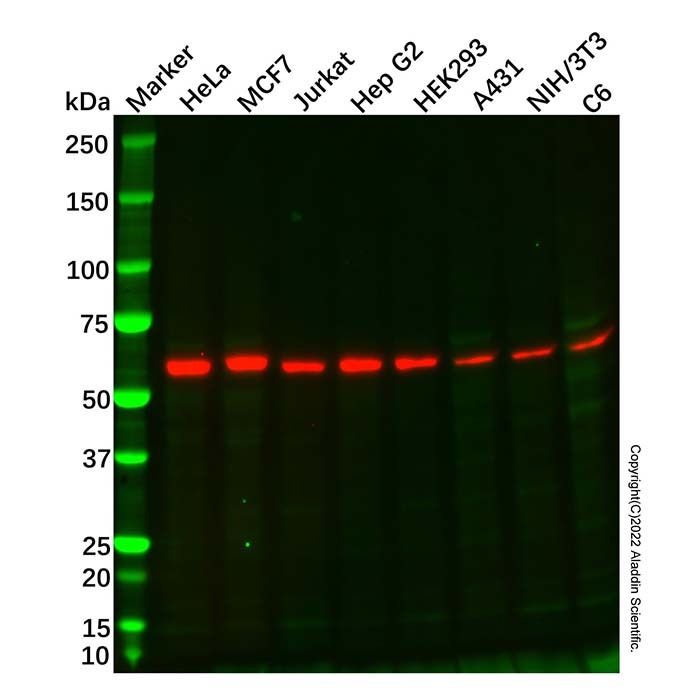
WB: HeLa, Jurkat, Hep G2, MCF7, HEK293, A431, NIH/3T3 and C6 cell lysates.
변화
Unconjugated
등급
ExactAb™, KD Validation, Recombinant, Validated
아이소타입
Rabbit IgG
라이트 체인 유형
kappa
SDS-PAGE
150 kDa
정화 방법
Protein A purified
집중력
See COA
Product Line
생물 제품
보관 및 배송
모양
Liquid
보관 조건
Store at -20°C,Avoid repeated freezing and thawing
배송
Ice chest + Ice pads
안정성 및 스토리지
Store at 2-8℃ short term (1-2 weeks). Store at -20℃ long term (24 months). Upon receipt, it is recommended to aliquot. Avoid freeze/thaw cycle.
이미지

Recombinant Src Antibody (Ab129134) - Western Blot
All lanes: Recombinant Src Antibody (Ab129134) at 1/1000 dilution
Samples: Lysates at 20 µg per lane
Secondary: Goat Anti-Rabbit IgG H&L (HRP) (Ab170144) at 1/20000 dilution

Predicted band size: 60 kDa
Observed band size: 59 kDa
Exposure time: 100.0 s

적용
적용
Dilution info
WB

1/1000 - 1/2000

문서

📋 안전 데이터 시트(SDS)

위험성, 취급, 보관 및 규제 준수를 포괄하는 종합 문서.

<<<<<<< HEAD SDS 다운로드 → ======= SDS 다운로드 → >>>>>>> release248-p3

✅ 분석 성적서(COA)

로트별 품질 데이터. 로트 번호를 입력하여 정확한 COA를 확인하세요.

COA 조회 →

📊 데이터시트

제품 사양 및 응용 분야에 대한 빠른 참조 요약.

데이터시트 보기 →

🔬 사양서

이 등급의 전체 품질 특성 및 합격 기준.

사양서 보기 →

고급 데이터

관련 대상(인간)
SRC Tclin Proto-oncogene tyrosine-protein kinase Src (0 Activities)
Activity TypeActivity Value -log(M)Mechanism of ActionActivity ReferencePublications (PubMed IDs)
SRC Tclin Tyrosine-protein kinase SRC (10310 Activities)
Activity TypeRelationActivity valueUnitsAction TypeJournalPubMed IddoiAssay Aladdin ID
SRC Tclin VEGF-receptor 2 and tyrosine-protein kinase SRC (25 Activities)
Activity TypeRelationActivity valueUnitsAction TypeJournalPubMed IddoiAssay Aladdin ID
SRC Tclin Calmodulin/Proto-oncogene tyrosine-protein kinase Src (2 Activities)
Activity TypeRelationActivity valueUnitsAction TypeJournalPubMed IddoiAssay Aladdin ID
SRC Tclin VHL/SRC (1 Activities)
Activity TypeRelationActivity valueUnitsAction TypeJournalPubMed IddoiAssay Aladdin ID
SRC Tclin Src/Lck kinase (1 Activities)
Activity TypeRelationActivity valueUnitsAction TypeJournalPubMed IddoiAssay Aladdin ID
작용 메커니즘
인증서(CoA, COO, BSE/TSE 및 분석 차트)
C of A & Other Certificates(BSE/TSE, COO):
Analytical Chart:

Find and download the COA for your product by matching the lot number on the packaging.

1 results found

Lot NumberCertificate Type날짜항목
ZJ24F1215984ZJ24F1215984Certificate of AnalysisSep 28, 2026 Ab129134
자주 묻는 질문과 기사
솔루션 계산기
리뷰

고객 리뷰

Application Protocols

Tested applications, recommended dilutions, incubation times/temperatures, antigen-retrieval conditions, and positive control samples are not specified for this item; refer to the CoA/Spec Sheet for authoritative application guidance.

General reminder: Application performance can vary with sample type, fixation, and buffer composition. Validate conditions empirically in your laboratory and include appropriate positive/negative controls. Do not substitute this general note for item-specific protocols.

Biological Roles

Target context (literature, general):

  • Src (c-Src) is a prototypical non-receptor tyrosine kinase of the Src family kinases (SFKs) with modular SH3–SH2–kinase domain architecture and myristoylation at the N-terminus for membrane association. It regulates signaling pathways controlling adhesion, cytoskeletal dynamics, migration, proliferation, and survival.
  • Regulation involves intramolecular interactions: phosphorylation of C-terminal Tyr527 (human) promotes a closed, autoinhibited conformation via SH2 engagement, whereas autophosphorylation at Tyr416 within the activation loop enhances catalytic activity.
  • Upstream inputs include integrins, receptor tyrosine kinases (EGFR, PDGFR), GPCRs, and focal adhesion components (FAK). Downstream substrates encompass focal adhesion proteins (paxillin, FAK itself), adaptor molecules, and components of MAPK and PI3K pathways.
  • Cellular/organismal roles: Src contributes to focal adhesion turnover, endocytosis, and cell cycle control. Dysregulated Src activity has been widely studied in the context of aberrant signaling in model systems; however, this product is for research use only.

Implications for antibody use (general):

  • Antibodies to Src are used to detect total Src, specific phosphorylation states (e.g., pTyr416, pTyr527) or domain-specific epitopes in immunoblotting, immunoprecipitation, immunofluorescence, and kinase-proximity studies. For this specific item, the epitope/phospho-specificity and application validations are not specified; consult the CoA/Spec Sheet for tested features.
Buffer Applications

Item-specific buffer composition and recommended diluents are not provided and should be confirmed on the CoA/Spec Sheet. General guidance for antibody handling in common applications:

  • Working buffers (general, literature best practice):
    • PBS or TBS at neutral pH (7.2–7.6) for routine dilutions; add 0.01–0.05% non-ionic surfactant (e.g., Tween-20) for immunoblotting or ELISA to reduce nonspecific binding, if compatible with the antibody.
    • Include carrier proteins (e.g., 0.1–1% BSA) where adsorption to plastics is a concern; confirm compatibility with downstream assays.
    • For cell-based assays, use azide-free buffers to avoid inhibition of peroxidase-based detection and to maintain cell viability; sterile-filter all buffers.
  • Sample preparation considerations:
    • For immunoprecipitation, maintain isotonic buffers and consider mild detergents (NP-40/Triton X-100) at low percentages to preserve protein–protein interactions; adjust salt to modulate stringency.
    • For kinase signaling studies, include phosphatase and protease inhibitors during lysis to preserve Src phosphorylation states.

Note: The presence/absence of preservatives, stabilizers, and exact pH for this item are not specified. Always cross-check the product datasheet to align buffers with the supplied formulation.

Green Alternatives

Antibodies are inherently aqueous biomolecules and are commonly supplied in water-based buffers, aligning with green chemistry principles by avoiding volatile organic solvents during use.

  • General considerations for greener practice with antibodies:
    • Prefer phosphate- or HEPES-buffered saline over organic cosolvents; limit glycerol to only what is necessary for freeze–thaw stabilization if cold-chain reliability is high.
    • If azide-free handling is feasible (e.g., for live-cell applications), use sterile, filtered buffers and low-protein-binding plastics to maintain stability without biocides, recognizing the tradeoff of reduced antimicrobial protection.
    • Minimize single-use plastics by planning aliquots efficiently; adopt recyclable cold packs for short shipments and validated reusable shippers where permitted.
    • Avoid harsh detergents unless required for the application; choose mild non-ionic surfactants at minimal effective concentrations to reduce environmental load.

Tradeoffs (general): Removing preservatives reduces environmental and user exposure but increases contamination risk; lower glycerol content improves viscosity/handling and reduces carbon footprint but may reduce freeze–thaw resilience. Evaluate based on your lab’s storage and sterility controls. Item-specific formulation details for this product are not specified; consult the CoA/Spec Sheet.

Pharmaceutical Uses

This product is designated For research use only and is not intended for human or veterinary therapeutic or diagnostic use.

Within pharmaceutical and bioprocess laboratories (non-clinical contexts), antibodies like this are commonly employed as:

  • Analytical reagents for characterization of signaling pathways in cell lines and process-development models.
  • QC/assay reagents in potency or identity assays for research materials, and as controls in immunoblotting or ELISA supporting discovery workflows.
  • Tools for target validation and mechanism-of-action studies in preclinical research models.

No pharmacopeial status, GMP grade, or clinical applicability is claimed in the Product Data. Item-specific details such as endotoxin level, bioburden, residual host-cell protein/DNA, and compliance with compendial chapters are not specified for this item; refer to the CoA/Spec Sheet if your workflow requires defined quality attributes for regulated environments.

Physical Properties

Item-specific physico-chemical properties are not provided for this recombinant antibody and should be obtained from the CoA/Spec Sheet. Antibodies are aqueous biomacromolecules; standard solvent-style properties (bp, mp, logP) are not applicable.

  • Appearance: Not specified for this item; refer to CoA/Spec Sheet.
  • Concentration/formulation: Not specified for this item; refer to CoA/Spec Sheet.
  • Molecular weight: Not specified for this item; refer to CoA/Spec Sheet. (Literature: full-length IgG often ~150 kDa; fragments vary.)
  • Solubility: Antibodies are typically soluble in buffered aqueous solutions (e.g., PBS, Tris-based) with stabilizers; specific buffer for this item is not provided.
  • Isoelectric point (pI): Not specified for this item; refer to CoA/Spec Sheet. (Literature values for IgG pI commonly ~6–9, clone-dependent.)
  • Extinction coefficient (A280): Not specified for this item; refer to CoA/Spec Sheet. (General: IgG mass extinction coefficient ~1.4 (mg/mL)−1 cm−1, literature.)
  • Stability considerations (general): Temperature-sensitive; avoid elevated temperatures and repeated freeze–thaw cycles to minimize aggregation and activity loss.

Because this product is protein-based, typical small-molecule properties such as boiling point, melting point, density, and refractive index are not applicable and are therefore not listed.

Quality and Grades
  • Grade/Purity (as provided): Recombinant, ExactAb™, KD Validation, Validated.

Interpretation and implications (general, non-item-specific explanations):

  • Recombinant antibody: Produced from defined cloned sequences in a controlled expression system (e.g., mammalian or other host). Advantages typically include lot-to-lot sequence identity and reduced variability compared with hybridoma-derived monoclonals or polyclonals.
  • ExactAb™: Trademarked designation by the supplier/manufacturer; typically denotes a precisely defined recombinant antibody format. For this item, the specific criteria underlying the mark are not detailed—refer to the CoA/Spec Sheet for exact specifications (sequence, isotype, host system, purity method).
  • KD Validation: Indicates binding affinity characterization has been performed (e.g., KD determination by SPR/BLI or equivalent). The numerical KD value, assay platform, and conditions are not specified here; consult the datasheet for binding parameters and acceptance criteria.
  • Validated: The product has undergone internal validation; however, validated applications, species reactivity, and performance claims are not enumerated in the Product Data and must be verified on the CoA.

What is not specified for this item (obtain from CoA/Spec Sheet): isotype/subclass, clonality, concentration, purity metrics (e.g., % monomer by SEC), endotoxin level, host/expression system, formulation (buffer, preservatives), and tested applications. These attributes directly influence assay performance and should be reviewed for QC-sensitive workflows.

Reaction and Applications

This section is not typically applicable to antibodies. Recombinant Src Antibody is used as a binding reagent in immunoassays rather than as a reactant/solvent in chemical synthesis. For practical usage contexts, refer to Application Protocols (when available on the CoA/Spec Sheet) and Biological Roles for target context.

Reaction Conditions

Not applicable in the chemical reaction sense. Antibody performance depends on assay conditions rather than stoichiometric reaction parameters. Conditions such as incubation time, temperature, and buffer composition are application-specific and must be obtained from the product’s CoA/Spec Sheet or validated empirically in your lab for techniques like WB, IP, IF, IHC, or ELISA (if applicable).

Safety and Handling
  • GHS classification, signal word, pictograms, H-statements: Not specified for this item; refer to the SDS for authoritative safety information.
  • General laboratory safety (good practice for protein antibodies):
    • Wear appropriate PPE: lab coat, gloves (nitrile), and safety glasses.
    • Handle in a clean environment to avoid microbial contamination; use sterile tips/tubes when asepsis is required.
    • Avoid aerosol generation and splashes; work in a biosafety cabinet if handling biological samples in conjunction.
  • Storage incompatibilities and stability (general):
    • Avoid repeated freeze–thaw cycles, which can denature or aggregate antibodies—aliquot upon first thaw.
    • Do not mix with strong oxidants, proteases, or metal-catalyzed oxidative systems; avoid extreme pH (<5 or >9) unless the antibody is engineered/validated for such conditions.
    • Presence of sodium azide (if any) is not specified for this item; if present, avoid contact with metals (risk of explosive metal azides) and dispose of azide-containing waste properly.
  • First-aid (general guidance; defer to SDS):
    • Skin/eye contact: Rinse with water. Remove contaminated clothing. Seek medical attention if irritation persists.
    • Ingestion/inhalation: Rinse mouth, move to fresh air, and obtain medical advice if symptoms occur.
  • Transport: Shipped in ice chest with ice pads (per Product Data) to maintain cold chain integrity.

Always consult the product-specific SDS and institutional biosafety protocols before use.

Solvent Selection

Not typically applicable. As a recombinant antibody supplied for biochemical assays, it is intended for use in aqueous biological buffers rather than organic solvents. For practical considerations on buffers and diluents, see Buffer Applications and Storage & Reconstitution tabs.

Storage and Reconstitution
  • Storage conditions (item-specific): Store at -20°C. Avoid repeated freezing and thawing. Shipped in an ice chest with ice pads to maintain the cold chain.
  • Aliquoting: To comply with the “avoid repeated freezing and thawing” instruction, divide into single-use or limited-use aliquots upon initial receipt/thaw. Use low-protein-binding tubes.
  • Freeze–thaw management: Thaw gently on ice. Do not heat to accelerate thawing. Mix by gentle inversion; avoid vortexing to limit aggregation.
  • Light and contamination: Protect from microbial contamination by using sterile technique. Protect from prolonged exposure to strong light if conjugated; no conjugation is specified for this item.
  • Reconstitution: Not specified for this item; refer to CoA/Spec Sheet. If supplied lyophilized (not specified), reconstitute only with the recommended buffer to the stated concentration.
  • Short-term handling: Keep on ice during use. For bench-top work exceeding 1–2 hours, consider chilled blocks to maintain temperature; exact stability window is not specified.
  • Long-term storage: No data beyond “Store at -20°C” is provided. Many antibodies are stable at -80°C for extended storage (general practice), but item-specific guidance should be followed from the datasheet.

Always refer to the product-specific datasheet for formulation details (buffer, stabilizers, preservatives) and any additional storage instructions.

Structure and Identity

Recombinant Src Antibody is a proteinaceous affinity reagent directed against the Src proto-oncogene product (c-Src), a non-receptor tyrosine kinase. As a biologic macromolecule, it does not have small-molecule identifiers (SMILES/InChI) or a defined elemental molecular formula in the sense used for organic compounds.

  • Item-specific identifiers
    • Product name: Recombinant Src Antibody (ExactAb™, KD Validation)
    • Category: Antibody (research use)
    • Molecular formula: Not specified for this item; refer to CoA/Spec Sheet.
    • Molecular weight: Not specified for this item; refer to CoA/Spec Sheet.
    • CAS, CID, InChIKey, SMILES: Not applicable to recombinant antibodies; not specified for this item.
  • Structural features (general, literature)
    • Typical antibody architecture: two heavy chains and two light chains linked by disulfides, forming an H2L2 immunoglobulin with variable domains (VH/VL) providing antigen recognition and constant domains (CH/CL) conferring isotype-specific properties.
    • If IgG (common for research antibodies), the quaternary structure is a Y-shaped homodimer of heavy–light chain pairs; glycosylation at Fc is typical and host/expression-system dependent.
    • Approximate mass for a full-length IgG is commonly ~150 kDa (literature; item-specific mass/isotype not provided).
  • Antigen identity (general)
    • Target: c-Src (SRC gene), a cytoplasmic tyrosine kinase with SH3–SH2–kinase domain organization; regulatory Tyr527 (human numbering) and activation loop Tyr416 are canonical features.

Note: Epitope, clone, isotype, host species, and sequence are not specified for this item; consult the CoA/Spec Sheet for definitive identity attributes.

Synthetic Utility

Not applicable. As a recombinant antibody, this material is a biological affinity reagent rather than a synthetic building block or catalyst. It is not typically used to mediate or undergo organic reactions in a synthetic chemistry context. For its laboratory value, see Biological Roles, Buffer Applications, and Application Protocols (when available).

Target Specificity
  • Antigen/Target: Src (c-Src) non-receptor tyrosine kinase (general target identity inferred from product name). Item-specific epitope, phospho-specificity, and cross-reactivity profile are not provided.
  • Clone ID, isotype/subclass, host/expression system, and species reactivity: Not specified for this item; refer to CoA/Spec Sheet.

Notes (general):

  • Src-family homology can lead to cross-reactivity among SFKs (e.g., Yes, Fyn) depending on epitope selection; actual specificity for this item is not stated and should be confirmed on the datasheet or by in-house testing.
  • If phospho-specific, the antibody would recognize defined tyrosine phosphorylation sites (e.g., Tyr416 or Tyr527); no such claim is made in the provided Product Data.

자주 묻는 질문

What does ExactAb? mean?
ExactAb? indicates the product has been validated for use in rigorous antibody validation workflows. Validation may include positive/negative control samples, signal-to-noise testing, and protocol-specific QC. Lot-specific test data is published on the Certificate of Analysis where available.
What does Recombinant mean?
Recombinant is a defined analytical purity tier suitable for workflows requiring a specific validated property. It specifies a minimum assay percentage, controlled limits on common impurities (water, heavy metals, residue on ignition), and lot-to-lot consistency. Recombinant is one of several purity tiers — choose based on the sensitivity and regulatory requirements of your method.
How should this product be stored?
Store at ?20 °C. Avoid repeated freeze–thaw cycles. Aliquot into single-use volumes before freezing.
How is this product shipped?
This product ships in an insulated container with ice pads. Unpack on arrival and transfer it to the storage condition stated above.
What documentation is provided?
Available product documentation, including Certificates of Analysis (COA), Safety Data Sheets (SDS), and specification sheets, is shown in the product document area. Document availability and access follow the current site policy.
Which species reactivity has this antibody been validated against?
Validated reactivity is listed on the PDP and on each lot's datasheet. We validate against the most commonly tested species for the target (Recombinant Src Antibody); cross-reactivity in untested species may exist but is not guaranteed. Contact technical support for specific species inquiries.

등급 선택에 도움이 필요하신가요?

당사의 등급 선택 가이드는 카탈로그의 모든 변형 제품에 대해 순도, 안정제 상태 및 용도 적합성을 다룹니다.

Recombinant 등급 가이드 보기 → Validated 등급 가이드 보기 → ExactAb™ 등급 가이드 보기 → KD Validation 등급 가이드 보기 →

관련 상품

Goat Anti-Rabbit IgG H&L Antibody - 2차 항체, for ELISA,LF,GICA various applications, from Rabbit, generated in Goat
Goat Anti-Rabbit IgG H&L (AF594) - 2차 항체, IgG
Goat Anti-Rabbit IgG H&L (Biotin) - 2차 항체, IgG
Goat Anti-Rabbit IgG H&L (AF488) - 2차 항체, IgG
Goat Anti-Rabbit IgG H&L (AF405) - 2차 항체, IgG
Donkey Anti-Rabbit IgG H&L (AF647) - 2차 항체, specific to , IgG
Donkey Anti-Rabbit IgG H&L (Biotin) - 2차 항체, IgG
Goat Anti-Rabbit IgG H&L (HRP) - 2차 항체
Goat Anti-Rabbit IgG H&L Antibody - 2차 항체, Goat IgG
Goat Anti-Rabbit IgG H&L (Biotin) - 2차 항체
Goat Anti-Rabbit IgG H&L (Cy5) - 2차 항체
Goat Anti-Rabbit IgG H&L (FITC) - 2차 항체
Goat Anti-Rabbit IgG H&L (TRITC) - 2차 항체
Goat Anti-Rabbit IgG H&L (Biotin) - 2차 항체, Goat IgG
Goat Anti-Rabbit IgG H&L (HRP) - 2차 항체, Goat IgG
Goat Anti-Rabbit IgG H&L (Cy5) - 2차 항체, Goat IgG
Goat Anti-Rabbit IgG H&L (TRITC) - 2차 항체, Goat IgG
Goat Anti-Rabbit IgG H&L (FITC) - 2차 항체, Goat IgG
Goat Anti-Rabbit IgG H&L (PE) - 2차 항체, Goat IgG
Goat Anti-Rabbit IgG H&L (APC) - 2차 항체, Goat IgG
Src (phospho Y529) Antibody - 1차 항체, specific to Src (phospho Y529), Rabbit IgG
Goat Anti-Rabbit IgG H&L (AF647) - 2차 항체, Goat IgG
Goat Anti-Rabbit IgG H&L (AF405) - 2차 항체, Goat IgG
Goat Anti-Rabbit IgG H&L (AF555) - 2차 항체, Goat IgG
Goat Anti-Rabbit IgG H&L (AF546) - 2차 항체, specific to Rabbit IgG
Goat Anti-Rabbit IgG H&L (AF700) - 2차 항체, specific to Rabbit IgG
Goat Anti-Rabbit IgG H&L (AF488) - 2차 항체
Goat Anti-Rabbit IgG H&L (AF647) (Ready to use) - 2차 항체, specific to Rabbit IgG

Shall we send you a message when we have discounts available?

Remind me later

Thank you! Please check your email inbox to confirm.

Oops! Notifications are disabled.