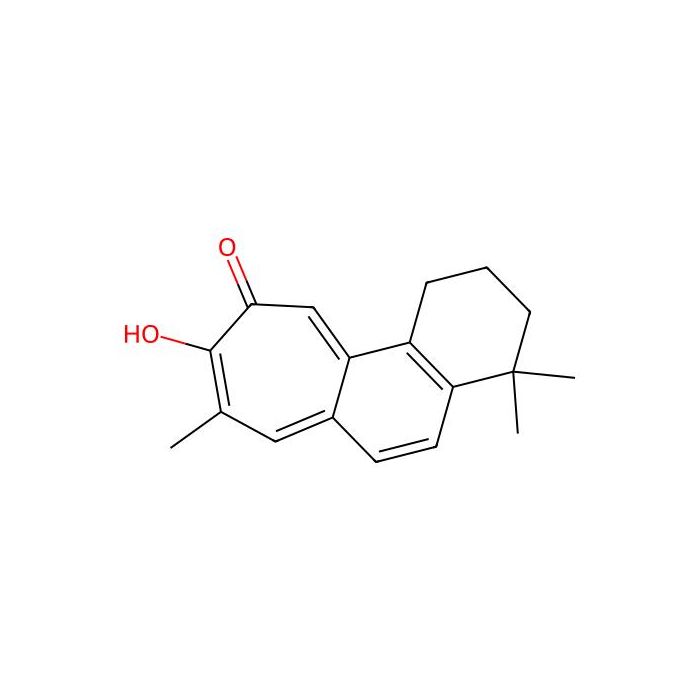
Salviolone is a natural diterpenoid derivative that can against melanoma cells. Salviolone exhibits a pleiotropic effect against melanoma by hampering cell cycle progression, STAT3 signaling, and malignant phenotype of A375 melanoma cells.
In Vitro
Salviolone (5-60 μM; 72 hours) reduces cell viability in the A375 and MeWo melanoma cell lines with EC 50 values of 17 µM and 22 µM, respectively. Salviolone does not affect the growth of normal melanocytes. Salviolone (20 μM; 48-72 hours) strongly reduces pRb, pCdk2, and cyclin A2, Tyr705-STAT3 phosphorylation expression levels in A375 cells. Salviolone also strongly increases the P21 and P53 protein expression level. Salviolone induces sustained activation of the phosphorylation of ERK1/2 and Akt. Salviolone (10-20 μM) inhibits MMP2 gelatinase activity in the A375 melanoma cell line. MCE has not independently confirmed the accuracy of these methods. They are for reference only. Cell Viability AssayCell Line: A375, MeWo melanoma cells, and NHEM cells Concentration: 5 μM, 10 μM, 20 μM, 30 μM, 40 μM, 50 μM, 60 μM Incubation Time: 72 hours Result: Impaired the viability of melanoma cells without affecting the growth of normal melanocytes. Western Blot AnalysisCell Line: A375 cells Concentration: 20 μM Incubation Time: 48 hours, 72 hours Result: Reduced the expression of the active forms of Cdk2 (pCdk2) and cyclin A2, and the phosphorylation of Rb.
Form:Solid
사양
생화학 및 생리적 메커니즘
Salviolone is a natural diterpenoid derivative that can against melanoma cells. Salviolone exhibits a pleiotropic effect against melanoma by hampering cell cycle progression, STAT3 signaling, and malignant phenotype of A375 melanoma cells.
This compound belongs to the class of organic compounds known as tanshinones, isotanshinones, and derivatives. These are a group of abietane-type norditerpenoid quinones.
External Descriptors
Not available
1. Djoumbou Feunang Y, Eisner R, Knox C, Chepelev L, Hastings J, Owen G, Fahy E, Steinbeck C, Subramanian S, Bolton E, Greiner R, and Wishart DS. ClassyFire: Automated Chemical Classification With A Comprehensive, Computable Taxonomy. Journal of Cheminformatics, 2016, 8:61.
Determine the necessary mass, volume, or concentration for preparing a solution.
Dilution Calculator
Determine the dilution needed to prepare a stock solution.
Reconstitution Calculator
리뷰
고객 리뷰
Application Protocols
No tested biological or analytical application protocols are provided for this item in the Product Data.
General research-use guidance (non-validated suggestions):
Stock preparation: Dissolve in anhydrous DMSO to 10–50 mM. Vortex and sonicate briefly if needed. Protect from light.
Working solutions: Dilute into assay buffer/media with rapid mixing to a final DMSO content typically ≤1–2% v/v. Use amberware or foil-wrapped tubes.
Analytical QC: Verify identity/purity by LC–MS and 1H NMR before critical experiments. Monitor stability over time by HPLC-UV (watch for new peaks indicating redox or photoproducts).
Chromatography: Purify or analyze using reversed-phase HPLC (C18) with water–acetonitrile or water–methanol gradients containing 0.1% formic acid; detect at both UV (250–280 nm) and visible (ca. 420–480 nm) where quinones absorb (literature/class-level).
Note: The above are general practices for quinone diterpenoids, not validated protocols for Salviolone. Optimize conditions for your specific setup.
Biological Roles
Item-specific biological data: Not specified for this item; no biological testing data are provided in the Product Data. For research use only.
Literature/general context (non-clinical):
Provenance: Salviolone has been reported as a diterpenoid constituent of Salvia species (sage) within the abietane diterpenoid family (literature). Such secondary metabolites often contribute to plant chemical ecology (defense/signaling) and pigmentation due to quinone chromophores.
Chemical biology interest: Quinone-bearing natural products are model systems for studying redox biochemistry, electron transfer, and covalent conjugation to nucleophiles (e.g., thiols) under controlled in vitro conditions.
Assay considerations: Low aqueous solubility typically necessitates DMSO stock solutions. Final DMSO concentrations are commonly limited to ≤1–2% v/v in enzymology or binding assays to maintain protein function (general practice). Adsorptive losses can be mitigated using polypropylene plates and addition of non-ionic surfactants at low levels where compatible.
Important limitations:
No claims are made regarding biological activity, potency, selectivity, or safety in any therapeutic context. Any biological insights should be generated empirically under your specific experimental conditions.
Recommendations:
Confirm compound identity/purity by LC–MS/1H NMR before critical biological experiments.
Include vehicle controls to deconvolute solvent effects and consider light protection during assays to minimize photochemical changes.
Buffer Applications
Not typically applicable. Salviolone is a hydrophobic small molecule rather than a buffering reagent. It does not form a defined conjugate acid/base pair in the aqueous range used for buffer preparation.
Practical guidance for using Salviolone in buffered systems (general):
Prepare a concentrated stock in DMSO (e.g., 10–50 mM), then dilute into the desired aqueous buffer (PBS, HEPES, Tris, etc.) with vigorous mixing to prevent precipitation.
Keep final organic cosolvent fraction low (commonly ≤1–2% v/v) and consistent across control and test samples.
If precipitation occurs, consider increasing temperature slightly, adding a small percentage of co-solvent (MeOH, acetonitrile), or using solubilizing excipients compatible with your assay (e.g., 0.01–0.05% non-ionic surfactant).
Item-specific buffer/solubility specifications: Not specified for this item; refer to CoA/Spec Sheet.
Green Alternatives
Guidance focuses on solvent and process choices surrounding Salviolone, since the molecule itself is fixed.
Greener solvent swaps (general suggestions):
Replace chlorinated solvents: Use ethyl acetate or 2-MeTHF in place of dichloromethane/chloroform for extractions and chromatography when separation performance allows.
Replace petroleum ether/hexanes: Use cyclopentyl methyl ether (CPME) or heptane/EtOAc blends with improved safety/greenness profiles.
Reaction media: 2-MeTHF or CPME can support many quinone reactions (Michael additions, reductions) with easier solvent recovery and lower peroxide risk than THF (still monitor peroxides as good practice).
Comparison (general):
DCM vs EtOAc: EtOAc is biodegradable with lower toxicity; polarity differences may affect elution and reaction rates.
THF vs 2-MeTHF: 2-MeTHF offers higher boiling point and partial water miscibility, enabling biphasic catalysis; both can form peroxides—test and treat accordingly.
Operational improvements:
Use amber glass and minimize headspace to extend shelf life and reduce waste due to degradation.
Concentrate by rotavap at reduced temperatures to limit energy use and decomposition.
Implement micro-/flow-scale screening to reduce solvent consumption in SAR campaigns.
Note: No alternative chemical form (salt/solvate) for Salviolone is specified for this item. Verify reaction performance and impurity profiles when changing solvents.
Pharmaceutical Uses
This product is provided strictly for research use and is not intended for human or veterinary use.
Item-specific pharmacopeial status/excipient role: Not specified for this item; no USP/EP/JPE monograph or excipient designation is provided.
General formulation context (non-clinical, discovery-stage):
Natural-product scaffolds such as abietane quinones are sometimes examined in pre-formulation studies to understand solubility, stability (light/redox), and compatibility with common excipients (e.g., cyclodextrins, lipid carriers). Such activities are strictly exploratory at the research stage.
For in vitro dosing, DMSO stocks are commonly diluted into aqueous media. For non-clinical in vivo research by qualified labs, solubilization systems may include mixed cosolvents or lipid-based vehicles; however, no recommendations are made here for this item.
Caveats:
No clinical, therapeutic, or diagnostic claims are made. Regulatory assessment and GMP manufacturing considerations are outside the scope of this research reagent.
If formulation-like studies are planned, conduct forced-degradation screens (light, pH, redox) to map stability and define appropriate protection strategies.
For any application approaching regulated use, obtain comprehensive analytical characterization and stability data specific to your lot.
Physical Properties
Item-specific specifications:
Appearance: Not specified for this item; refer to CoA/Spec Sheet.
Molecular weight: Not specified for this item; refer to CoA/Spec Sheet.
Other specs (bp, mp, density, RI, UV cutoff, water/peroxide/metal limits): Not specified for this item; refer to CoA/Spec Sheet.
Literature/general properties for abietane-type quinone diterpenoids (for context only):
Physical state/color: Often isolated as orange to red-brown crystalline solids due to quinone chromophores (literature, class-level).
UV–Vis: Quinone-containing diterpenoids commonly show strong bands in the UV and a visible band in the 400–500 nm region associated with the quinone π→π* system (literature, class-level). Specific λmax for Salviolone is not provided here.
Solubility: Typically low aqueous solubility; soluble in polar aprotic organic solvents (DMSO, DMF) and moderately in less polar organics (EtOAc, CH2Cl2) (literature, class-level). Aqueous buffers generally require cosolvent or surfactant systems for dissolution.
Partitioning: Diterpenoid quinones generally exhibit high lipophilicity (literature, class-level), but no logP/logD for this item is specified.
Practical notes (general):
Prepare concentrated DMSO stocks (e.g., 10–50 mM) and dilute into assay media with vigorous mixing to avoid precipitation (research-use guidance).
Protect from light to limit photoreduction/photodegradation common to quinones.
Always consult the CoA/SDS for authoritative, item-specific physical data.
Quality and Grades
Item-specific quality information:
Grade/Purity: Not specified for this item; refer to CoA/Spec Sheet.
Appearance: Not specified for this item; refer to CoA/Spec Sheet.
Guidance on interpreting grades (general):
Research grade: Appropriate for discovery chemistry, screening, and method development. Purity is typically reported by HPLC/GC and corroborated by NMR/MS; please refer to the item’s CoA for exact values and analytical methods.
Library/Screening compounds: When supplied as part of a small-molecule library, compounds are commonly QC’d for identity (NMR/HRMS) and purity (HPLC/UPLC). Absence of stabilizers is typical for solid natural products unless noted.
Stabilizers and additives:
None specified for this item. If stability concerns arise (e.g., quinone photoreactivity), handle under subdued light and store frozen as directed.
Release documents to review per lot:
CoA: Identity (NMR/MS), purity (chromatography), residual solvents, and water content (if measured) — Not specified for this item; refer to CoA/Spec Sheet.
Spec Sheet: Target purity thresholds, appearance, and handling instructions — Not specified for this item; refer to CoA/Spec Sheet.
If low-UV absorbance or trace-metal levels are critical to your application, contact Technical Support to confirm suitability or request tighter specifications.
Reaction and Applications
Scope (research use only): As a quinone-bearing diterpenoid, Salviolone is suited for mechanistic, redox, and derivatization studies, and as a representative scaffold in natural-product-inspired libraries.
Typical research applications (literature/general for abietane quinones):
Redox chemistry: Reversible two-electron reductions to hydroquinones; evaluation of single-electron transfer and semiquinone formation under electrochemical or chemical conditions (e.g., with dithionite, ascorbate, or electroreduction).
Conjugate addition/Michael reactions: Nucleophiles (amines, thiols, enolates) can add to activated quinone systems; used to prepare adducts for SAR and probe design.
Diels–Alder and cycloadditions: Quinones can act as dienophiles in [4+2] cycloadditions under thermal or Lewis-acid catalysis, enabling rapid diversification.
Protective-group and functional manipulation: Selective reduction (NaBH4, hydrogenation) or acylation/alkylation of phenolic positions (when present) to tune electronics and solubility.
Photochemistry: Quinone chromophores may undergo photoreduction or photoinduced electron transfer; protect from light during handling to maintain integrity.
Practical tips:
Maintain anhydrous, oxygen-limited conditions for sensitive transformations; use amber glassware and low-temperature storage between steps.
Monitor by HPLC-UV/Vis or UHPLC-MS exploiting characteristic quinone absorbance to track conversions and impurity profiles.
Manufacturer Applications: Not specified for this item; where catalog notes are absent, the above reflect common literature practices for quinone diterpenoids.
Reaction Conditions
General conditions reported for quinone diterpenoid transformations (literature/class-level guidance; optimize empirically for Salviolone):
Reductions to hydroquinones:
Reagents: NaBH4 or catalytic hydrogenation (H2/Pd-C) in alcohols (MeOH, EtOH) or mixed solvents at 0–25°C.
Notes: Control equivalents to avoid over-reduction; work under inert atmosphere and protect from light.
Michael additions (thiols/amines):
Solvents: MeOH, EtOH, MeCN, or DMSO; bases such as Et3N or NaHCO3, 0–40°C.
Notes: Monitor by HPLC-UV (visible band of quinone). Product stability may require mildly acidic quench and rapid purification.
Diels–Alder cycloadditions:
Conditions: Thermal or Lewis acids (e.g., BF3·OEt2, AlCl3) in CH2Cl2, toluene, or 2-MeTHF, typically 0–80°C depending on partners.
Notes: Control moisture and use inert atmosphere for Lewis-acid-mediated variants.
Phenolic derivatization (if applicable):
Acylation/alkylation with acyl chlorides/alkyl halides in pyridine/DMAP or K2CO3 in acetone; 0–25°C.
Analytical control:
Use LC–MS and UV–Vis to track consumption and product formation; quinones provide distinctive absorbance enabling sensitive monitoring.
Expected yields and exact parameters for Salviolone are not specified for this item; consult literature precedents for closely related abietane quinones and perform small-scale optimizations.
Safety and Handling
Regulatory/GHS status for this item:
Signal word: Not specified for this item; refer to SDS.
H-statements: Not specified for this item; refer to SDS.
GHS classification and pictograms: Not specified for this item; refer to SDS.
General hazard considerations for quinone-containing natural products (literature/general):
Quinones can be skin/respiratory sensitizers and may cause irritation to eyes, skin, or mucosa. They can participate in redox cycling under certain conditions.
Avoid inhalation of dust and contact with skin/eyes. Work in a fume hood.
PPE and handling:
Wear lab coat, nitrile gloves, and splash-resistant safety glasses or goggles.
Use local exhaust ventilation. Avoid generating dust/aerosols.
Protect from light (as directed in Product Data) to minimize degradation.
Storage and incompatibilities:
Storage: Store at −20°C, protected from light (per Product Data). Keep container tightly closed. Limit freeze–thaw cycles by preparing aliquots.
Incompatibilities (general): Strong reducing agents (may reduce quinone), strong oxidizers, strong bases/acids that may induce decomposition or unwanted reactions; avoid prolonged exposure to light and elevated temperatures.
First aid (general guidance; defer to SDS):
Skin/eye contact: Rinse with water for at least 15 minutes; remove contaminated clothing; seek medical attention if irritation persists.
Inhalation: Move to fresh air; seek medical attention if symptoms occur.
Ingestion: Rinse mouth; do not induce vomiting; seek medical attention.
Always consult the product SDS for definitive safety and regulatory information.
Solvent Selection
Compound class context: Salviolone is a hydrophobic, quinone-bearing diterpenoid (literature/class-level). This typically dictates use of organic solvents for stock solutions and handling.
Recommended solvents (general guidance):
DMSO: Primary choice for preparing concentrated stocks (e.g., 10–50 mM). Excellent solvating power for lipophilic natural products; miscible with water for assay dilution.
DMF or NMP: Alternatives when DMSO is incompatible with the assay matrix. Similar solvating capability; consider cytotoxicity in biological screens.
EtOAc, CH2Cl2, MeOH or MeCN: Useful for chromatography, workup, or analytical sample prep; limited aqueous miscibility (except MeOH/MeCN).
Poor solubility in water; requires organic cosolvent. A final DMSO content of ≤1–2% v/v is typically used in biochemical screens to limit solvent effects (assay practice).
When to choose alternatives:
If light sensitivity is a concern, prefer amber vials and minimal air headspace regardless of solvent.
For greener practices, choose EtOAc or 2-MeTHF over CH2Cl2/THF where applicable (see Green Alternatives).
Practical tips:
Warm gently (≤30–40°C) and vortex/sonicate to dissolve; avoid prolonged heating or strong base that could induce redox or Michael reactions.
Filter 0.2 µm PTFE for analytical injections to remove particulates.
Item-specific solvent specifications (solubility, UV cutoff, water content): Not specified for this item; refer to CoA/Spec Sheet.
Shipped in ice chest with ice pads to maintain cold chain.
Reconstitution guidance (general best practices for hydrophobic natural products):
Upon receipt, allow the sealed container to equilibrate to room temperature before opening to prevent condensation. Open under low-light conditions.
If supplied as a solid: Prepare DMSO stock solutions (e.g., 10–50 mM) in amber vials. Vortex/sonicate briefly to aid dissolution. If any insoluble particulates remain, gently warm (≤30–40°C) and/or filter through a 0.2 µm PTFE syringe filter.
If supplied in solution: Mix thoroughly and, if aliquoting, use dry, amber microvials. Avoid introducing moisture.
Aliquoting and stability:
Prepare single-use aliquots to minimize freeze–thaw cycles. Store aliquots at −20°C, protected from light and air (minimize headspace; consider inert gas blanket).
Working solutions in aqueous media are typically prepared fresh. Assess stability over the experiment duration by analytical methods (e.g., HPLC-UV/Vis).
Item-specific stability/shelf-life data: Not specified for this item; refer to CoA/Spec Sheet.
Always consult the SDS for handling precautions and the CoA for lot-specific details prior to use.
Structure and Identity
Brief intro: Salviolone is a plant-derived small molecule (natural-product diterpenoid) supplied for research use as part of a small-molecule/compound library.
SMILES: Not specified for this item; refer to CoA/Spec Sheet.
Molecular formula: Not specified for this item; refer to CoA/Spec Sheet.
Molecular weight: Not specified for this item; refer to CoA/Spec Sheet.
Structural features (literature/general):
Reported as an abietane-type diterpenoid isolated from Salvia species (literature), typically featuring a fused tricyclic (perhydrophenanthrene-like) core.
Frequently described as a quinone/phenolic diterpenoid; many salvia abietanes possess ortho-/para-quinone moieties with two conjugated carbonyls and a highly conjugated aromatic/quinonoid ring system (literature, class-level).
Typical substituents in this chemotype include an isopropyl group on the aromatic/quinonoid ring and various oxygenation patterns (phenolic OH, quinone C=O), enabling redox and Michael-type chemistry (literature, class-level).
2D description (literature-based, class-level):
A compact, tricyclic carbon framework with one aromatic/quinonoid ring bearing two carbonyl groups; additional rings are alicyclic and may carry methyl substituents. Conjugation across the quinone ring gives rise to strong visible/UV absorbance typical of abietane quinones.
Notes:
Exact stereochemistry, substitution pattern, and tautomers should be verified against primary literature or the product CoA/SDS. No stereochemical or positional assignments are specified in the Product Data.
Synthetic Utility
Salviolone, as a quinone-bearing abietane diterpenoid (literature/class-level), offers multiple handles for derivatization and mechanistic studies.
Key functional elements and reactivity (general):
Quinone carbonyls: Electrophilic sites enabling Michael additions by soft nucleophiles (thiols, amines), and participating in redox cycles (reduction to hydroquinone, re-oxidation by air or oxidants).
Aromatic/quinonoid ring: Amenable to Friedel–Crafts-type substitutions in select cases and to cycloadditions (as dienophile in Diels–Alder) under Lewis-acid catalysis.
Phenolic positions (if present): Allow ether/ester formation for prodrug-like masking in chemical biology, and for tuning electronics/solubility.
Terpenoid skeleton: Multiple methyl/isopropyl substituents afford sites for C–H oxidation, benzylic functionalization, or radical chemistry to access analog series.
Applications in synthesis and profiling:
Scaffold modification to probe structure–property relationships (SPR) in redox potential, lipophilicity, and conjugation.
Installation of reporter groups (alkynes/azides) via nucleophilic addition or phenolic derivatization to enable pull-down or imaging in chemical biology experiments (research-only context).
Serving as a natural-product reference in chromatography and metabolomics method development due to characteristic UV–Vis features.
Practical considerations:
Control redox environment during workups; include antioxidant or inert atmosphere when needed.
Use amberware and minimize strong base to avoid undesired transformations of the quinone motif.
Item-specific reactivity data: Not specified; consult primary literature and verify with small-scale trials.
Target Specificity
Not applicable. This product is a small-molecule natural product, not an antibody, enzyme, or biological binding reagent.
Antigen/epitope information: Not applicable.
Species reactivity/clone/isotype: Not applicable.
If used in target-engagement studies, any specificity data must be generated empirically within your assay system; no target-binding data are provided for this item.
Products are supplied to verified businesses, institutions, and qualified professionals for research and development use only. Not for use in humans, animals, diagnosis, or therapy.