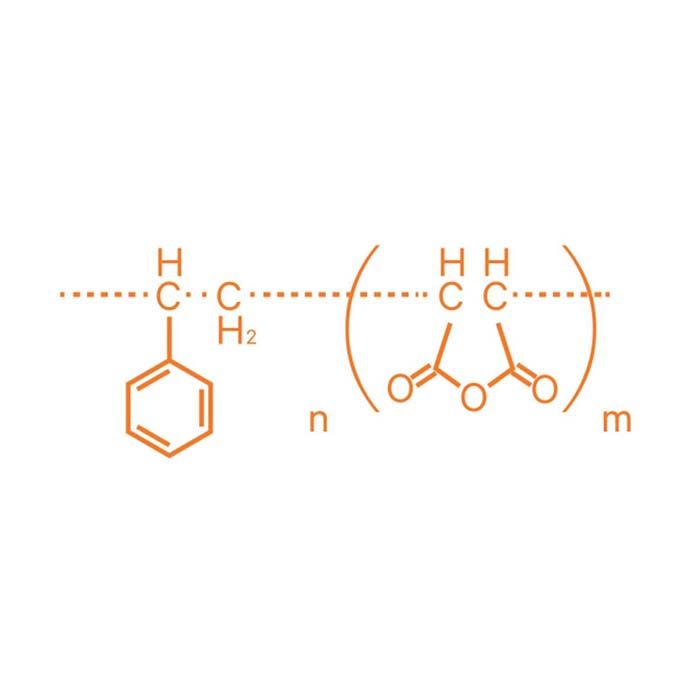
S1509052 are non-modified, random styrene maleic anhydride (SMA) copolymers with a low molecular weight. Product properties: low molecular weight; high solvent solubility; high glass transition temperature; excellent thermal stability; low VOC content; ability to form low viscosity aqueous anionic salt solutions.
사양
보관 조건
Protected from light,Room temperature,Argon charged
배송
Normal
이름과 식별자
이성체 SMILES
C=CC1=CC=CC=C1.C1=CC(=O)OC1=O
WGK 독일
3
고급 데이터
인증서(CoA, COO, BSE/TSE 및 분석 차트)
C of A & Other Certificates(BSE/TSE, COO):
Analytical Chart:
Find and download the COA for your product by matching the lot number on the packaging.
Charge a dry flask with acetone (degassed) and establish an argon blanket.
Add SMA base resin gradually to reach 10 wt% solids while stirring vigorously.
Mix at 25–35 °C for 1–3 h until homogeneous. If needed, warm to 40–50 °C.
Filter through a medium porosity filter to remove fines/gels. Store under argon.
B) Hydrolysis/neutralization to SMA-Na (for aqueous applications)
Steps (overview):
Slurry SMA in water:THF (1:1) at room temperature under argon.
Add 2.0 equiv of NaOH per anhydride slowly, maintaining pH 8–9 and <40 °C.
Stir 4–8 h until the mixture becomes a clear solution. Remove THF under reduced pressure.
Dialyze (MWCO suitable for polymer) or ultrafilter to remove salts/low-MW species; adjust to desired concentration and pH 7.5–8.0.
C) Amidation (half-amide) of SMA
Steps (overview):
Dissolve SMA in dry THF (5–15 wt%) under argon.
Add primary amine (1.0–1.2 equiv per anhydride) and catalytic DMAP or triethylamine.
Stir 2–12 h at 25–50 °C; monitor IR for anhydride consumption.
Precipitate into hexane, filter, and dry under vacuum.
Note: Stoichiometry requires anhydride content from the CoA. Always observe appropriate PPE and consult the SDS.
Biological Roles
Applicability: SMA base resin is a synthetic polymer and does not have intrinsic biological “roles” in living systems. The following notes describe literature uses of related SMA derivatives in biochemical research. No medical or clinical claims are made.
Literature context
Membrane protein solubilization: Hydrolyzed/neutralized SMA (styrene–maleic acid copolymer, often Na+ salt) can directly extract native lipid nanodiscs (SMALPs) from biological membranes without detergents, preserving native lipid–protein interactions.
Mechanism: The amphiphilic copolymer inserts into bilayers; carboxylate groups (from ring-opened anhydrides) provide aqueous compatibility, while styrenic segments interact with lipid tails.
Variables influencing performance: Styrene:maleic content, molecular weight, degree of hydrolysis/neutralization, buffer composition and ionic strength, and pH (carboxylate ionization required for solubility).
Relevance to this item
This product is the anhydride-form “SMA base resin,” which is generally not water-soluble and not directly applied in aqueous biological systems until it is hydrolyzed/neutralized. If your aim is SMALP formation or aqueous biophysics, convert to the SMA-acid salt under controlled conditions (see Application Protocols for a literature procedure).
Safety note
Use only for research use (per Product Data). Avoid interpreting polymer usage as having therapeutic or physiological function.
Buffer Applications
Not typically applicable to the anhydride-form SMA base resin, which is not water-soluble and does not act as a buffering agent.
Literature note
After hydrolysis/neutralization to the carboxylate (SMA-acid salt), solutions are prepared in standard biological buffers (e.g., Tris, HEPES, phosphate) at pH values ≥7.4 to maintain polymer solubility. Ionic strength and divalent cations (Mg²⁺, Ca²⁺) can affect aggregation; many SMALP protocols limit divalent cations and use NaCl ~100–300 mM (literature). These conditions are not specifications for this item.
Green Alternatives
Context: SMA base resin often requires organic solvents and dehydrating/derivatizing agents. Greener process choices can reduce hazard while maintaining performance. The guidance below is literature-based and not item-specific.
Greener solvent strategies
Prefer ethyl acetate, isopropyl acetate, or 2-methyltetrahydrofuran (2-MeTHF) over chlorinated solvents for dissolution and coatings when solubility allows.
Use acetone/MEK with adequate recovery/condensation; these are VOCs but have better EHS profiles than chlorinated solvents.
For aqueous systems, convert SMA to its acid/salt form to process in water (acknowledging chemistry change from anhydride to carboxylate).
Catalysis and energy
Employ organocatalysts (e.g., DMAP) or solid acids for esterifications to lower temperature/time versus thermal processes.
Consider reactive extrusion with precise temperature control to reduce solvent use, provided off-gassing is managed.
Comparison (literature; qualitative)
Option | Benefit | Trade-off
Ethyl acetate vs DCM | Lower toxicity, biodegradable | May require heat; slower dissolution
2-MeTHF vs THF | Renewable source, lower peroxide risk | Slightly different solubility; odor
Close-loop solvent recovery (distillation) and solid catalyst reuse.
Use stoichiometric control to reduce excess amines/alcohols; capture water in imidizations with azeotropes (e.g., toluene) rather than chemical dehydrants when feasible.
Pharmaceutical Uses
No pharmacopeial grade or excipient designation is provided for this item. Grade/purity is Not specified for this item; refer to CoA/Spec Sheet.
General industry context (literature)
Film formers and coatings: SMA derivatives have been explored as binders, overprint varnish components, and adhesion promoters. Carboxylate- or imide-modified SMA can improve adhesion to metal/oxide substrates and pigments.
Controlled release matrices: The reactivity of anhydride functions enables covalent attachment to amine-containing actives or excipients (research stage; not a claim of suitability for medicinal products).
Device/packaging: SMA-based resins may serve in inks, primers, or adhesive tie-layers due to their polarity and reactivity.
Regulatory note
For any use in pharmaceutical manufacturing or as an excipient, lot-specific compliance data (e.g., residual monomers, metals, solvent residues, bioburden) and applicable standards would be required. Such data are not provided here. This product is for research use only (per Product Data).
Physical Properties
Item-specific specifications
Molecular formula: Not applicable for polymers; Not specified for this item; refer to CoA/Spec Sheet.
Molecular weight: Not specified for this item; refer to CoA/Spec Sheet (polymer exhibits an Mw distribution).
Appearance: Not specified for this item; refer to CoA/Spec Sheet.
Literature/general properties for SMA (styrene–maleic anhydride copolymers)
Physical form: Typically off-white to light tan thermoplastic granules or powder (grade-dependent).
Thermal behavior: Glass transition Tg commonly reported in the ~130–170 °C range (literature; varies with styrene:anhydride ratio and molecular weight). Softening point increases with anhydride content and Mw.
Solubility (qualitative):
Soluble in many polar aprotic and moderately polar organic solvents (e.g., acetone, MEK, ethyl acetate, THF, dioxane) and in some chlorinated solvents. Solubility in aromatics (toluene/xylene) is grade-dependent and often requires heat.
Insoluble in aliphatic hydrocarbons and water in the anhydride form. Hydrolyzed/neutralized SMA (styrene–maleic acid salts) becomes water-soluble.
Swelling behavior: Can swell in aromatic hydrocarbons; dissolution facilitated by elevated temperature and shear.
Density: Common reports ~1.05–1.15 g/cm³ (literature; composition-dependent). Not specified for this item.
Acidity: Anhydride functions are latent diacids; upon hydrolysis they yield vicinal dicarboxylic acids (no single pKa; two-step dissociation typical after ring opening—values depend on composition and degree of neutralization).
Optical: Generally amorphous; no UV–vis cutoff defined for polymer solutions (solvent-dominated). Not specified for this item.
Note: Exact numeric values (Tg, Mw, acid number, solution viscosity) are grade-specific and are Not specified for this item; refer to CoA/Spec Sheet.
Quality and Grades
Item-specific details
Grade/purity: Not specified for this item; refer to CoA/Spec Sheet.
Stabilizers/additives: Not specified for this item; refer to CoA/Spec Sheet.
Interpretation and guidance (literature/industry context)
“SMA base resin” typically denotes the anhydride-form copolymer prior to hydrolysis/neutralization or imidization. It is the reactive parent polymer used to prepare SMA acids (hydrolyzed), SMA salts (e.g., Na+), SMA esters, and SMA-imides.
Critical quality attributes for SMA (to be found on CoA/spec):
Styrene:maleic anhydride ratio (e.g., ~1:1 or ~2:1)—governs polarity and reactivity.
Molecular weight distribution (Mw, Mn, PDI)—controls solution viscosity, film properties, and processing.
Acid/anhydride content (meq/g) and residual monomer—affects derivatization stoichiometry and odor.
Color (APHA), volatiles, ash/metal content—relevant for electronics or high-purity applications.
Grades you may encounter:
Base (anhydride) resin: maximizes reactive anhydride functionality; intended for chemical modification, compatibilization, and solvent-borne coatings.
Hydrolyzed/neutralized SMA: water-dispersible materials for pigment dispersion and biophysical applications (not this item).
Imidized SMA: higher Tg, enhanced heat resistance, and different solubility.
Selection tips
For precise stoichiometric reactions (e.g., amidation), use a lot-specific acid/anhydride value from the CoA.
For solution processing and coating, request solution viscosity data in your intended solvent/solids content.
If low UV background is critical (chromatographic/optical work), ask for UV absorbance/impurity data—Not specified for this item by default.
Reaction and Applications
Overview (literature/general)
Functional platform: SMA’s pendant cyclic anhydrides provide versatile handles for covalent modification—hydrolysis to diacids, esterification with alcohols, amidation with amines, and imidization under dehydrating conditions.
Representative transformations
Hydrolysis/neutralization: Converts SMAnh to SMA-acid or its salts (e.g., Na+, K+), enabling water solubility and use as dispersants, binders, and membrane-solubilizing agents (after conversion).
Alcoholysis (ester formation): Reaction with alcohols (ROH) in presence of catalysts (e.g., DMAP, acid catalysts) affords half-esters; diesters possible with excess ROH or sequential steps.
Aminolysis to amic acids/amides: Primary amines open the anhydride; subsequent dehydration (thermal or with agents like acetic anhydride) can yield imides (SMA-imide copolymers with enhanced thermal properties).
Grafting/coupling: Nucleophile-bearing dyes, ligands, or macromolecules can be tethered along the polymer, creating amphiphilic materials and compatibilizers for blends.
Application domains
Coatings/adhesives: Reactive resin for crosslinkable finishes, pigment grinding vehicles, and adhesion promotion to metals/oxides via carboxylate/anhydride chemistry.
Polymer compatibilization: SMA can compatibilize polar/nonpolar blends (e.g., polyolefins with polar fillers) after controlled derivatization.
Lithography/electronics: Film-forming, developable layers after partial hydrolysis.
Biophysical tools: After hydrolysis/neutralization (not the base resin itself), SMA salts form SMA–lipid particles (SMALPs) used for membrane protein studies.
Practical notes
Maintain low moisture if preserving anhydride; store and process under inert gas (as per Product Data).
Monitor reaction progress by IR (anhydride C=O ~1850/1780 cm⁻¹; acid/amide shifts on ring-opening). Quantify substitution by acid number titration (grade-dependent; see CoA).
Reaction Conditions
The following are literature/general guidelines for transforming SMA base resin; they are not specifications for this item. Always optimize on small scale and consult the CoA for anhydride content.
Hydrolysis/Neutralization to SMA-acid (Na+ salt)
Solvent: Water/THF (or water/acetone) mixture to aid wetting; ultimately aqueous.
Base: NaOH (1.8–2.2 equiv per anhydride for full diacid neutralization). Maintain pH 8–9.
Temperature/time: 25–60 °C, 2–16 h with efficient stirring; remove organic co-solvent after dissolution.
Endpoint: IR shift (loss of anhydride at ~1850/1780 cm⁻¹; appearance of carboxylate ~1550/1400 cm⁻¹); stable clear solution.
Esterification (half-ester)
Solvent: Anhydrous EtOAc, acetone, or toluene.
Reagents: Alcohol (1.0–1.2 equiv per anhydride) with catalyst (e.g., p-TsOH, H₂SO₄, or DMAP under basic conditions).
Conditions: 25–80 °C, 2–24 h; remove water by azeotrope (toluene) or molecular sieves.
Aminolysis/Imidization
Solvent: THF, dioxane, or NMP/DMF for higher Mw.
Reagents: Primary amine (1.0–2.0 equiv per anhydride). For imide formation, heat 120–180 °C (solid-state or high-bp solvent) or use acetic anhydride/carbodiimide dehydrants.
Monitoring: IR/NMR of model compounds; acid number titration for extent of reaction.
General tips
Dry polymer under vacuum (e.g., 50–60 °C) before reactions to minimize adventitious hydrolysis.
Use inert gas (argon, per Product Data) to limit oxidation and moisture uptake.
Viscosity rises during partial derivatization; adjust solids, temperature, and stirring accordingly. Precipitation in aliphatic hydrocarbons can isolate modified polymers.
Safety and Handling
Item-specific hazard data
Signal word, H-statements, GHS classification, pictograms: Not specified for this item; refer to the SDS for authoritative information.
Storage per Product Data: Store at room temperature, protected from light, under argon (moisture- and oxygen-minimizing blanket). Shipped at ambient.
General safety guidance for SMA base resin (literature/industry practice)
Hazards: Solid polymer; not acutely hazardous in typical handling. Dust may cause mechanical irritation to eyes, skin, and respiratory tract. Thermal decomposition can release irritating vapors (e.g., organic acids, styrenics). Residual monomer content is grade-dependent.
Sensitization: Maleic anhydride is a sensitizer as a monomer; the polymerized form is substantially less hazardous, but avoid generating fumes or fine dust. Consult SDS.
Incompatibilities: Strong oxidizers; strong bases and nucleophiles (promote anhydride ring opening); moisture/water (causes hydrolysis to diacids over time, altering reactivity). Avoid prolonged exposure to elevated humidity if anhydride functionality must be preserved.
Handling practices:
Work in a well-ventilated area; avoid dust formation. Use local exhaust when melting or dissolving at elevated temperature.
PPE: Safety glasses, lab coat, suitable gloves (e.g., nitrile) when handling solids and solutions; dust mask/respirator if dust is generated.
Thermal processing: Do not exceed recommended processing temperatures; use inert atmosphere to minimize oxidation/discoloration.
First aid (overview; defer to SDS):
Eyes: Rinse cautiously with water for several minutes; remove contact lenses if present and easy to do.
Skin: Wash with soap and water.
Inhalation: Move to fresh air; seek medical attention if symptoms persist.
Ingestion: Rinse mouth; do not induce vomiting; seek medical advice.
Waste: Collect polymer/solution waste per local regulations. Avoid discharge to drains; many SMA solutions are considered nonhazardous but solvent choice governs disposal.
Solvent Selection
Applicability: SMA base resin is a thermoplastic copolymer; solvent choice dictates processability. Numeric solvent parameters below are literature values for the solvents themselves, not product specifications.
General solvent compatibility (literature)
Good solvents (often at RT or mild heat): acetone, MEK, ethyl acetate, THF, dioxane; many chlorinated solvents (e.g., dichloromethane) can dissolve grades of SMA.
Conditional solvents (often require heat/shear): toluene, xylene, anisole; NMP/DMF/DMAc can aid dissolution and derivatization but raise EHS concerns.
Poor solvents: aliphatic hydrocarbons (hexane, heptane); water for the anhydride form.
Water compatibility: After hydrolysis/neutralization to SMA-acid salts (not this base resin), aqueous solubility emerges.
Polarity and selection tips
Anhydride-rich SMA benefits from moderately polar aprotic solvents with solubility parameters matching aromatic backbones and polar anhydride rings.
Avoid protic solvents when preserving anhydride; alcohols can ring-open (intentionally useful for esterification but not for simple dissolution).
Comparison (literature-oriented)
THF/acetone/EtOAc: Fast dissolution, low boiling, easy removal; flammable.
Toluene/xylene: Better for high-aromatic systems; higher boiling aids film formation; slower dissolution and may need heat.
NMP/DMF: Powerful solvents for high-Mw SMA and for amidation/imidization; higher bp and regulatory burdens.
Practical guidance
Start at 5–20 wt% solids. Add polymer slowly with stirring to a pre-warmed solvent. Use inert atmosphere to limit hydrolysis/oxidation.
Filter through medium porosity to remove gels/fines if needed. Verify solution stability over time (anhydride can react with trace moisture).
Storage and Reconstitution
Item-specific storage (from Product Data)
Store protected from light at room temperature under an argon atmosphere. Ship at ambient conditions. Research use only.
General storage guidance for SMA base resin (literature/practice)
Keep container tightly closed and under inert gas to minimize hydrolysis/oxidation and discoloration. Employ desiccant where practical.
Avoid prolonged exposure to humidity and elevated temperature; the anhydride can slowly convert to acid in moist air, changing reactivity and solubility.
If long-term storage is anticipated, periodic QC (acid number, IR) helps verify anhydride content.
Reconstitution/solution preparation
For organic solutions: Use dry, oxygen-free solvents (e.g., acetone, MEK, THF, EtOAc). Add polymer gradually with strong stirring to avoid agglomeration. Typical working concentrations are 5–30 wt% depending on viscosity and application.
For aqueous processing: Convert to SMA-acid/salt before dissolution in water (see Application Protocols). The base (anhydride) resin is not water-soluble.
Freeze–thaw and stability
Not applicable to the solid resin. For prepared solutions, avoid freeze–thaw cycles that can cause phase separation or gelation; store solutions in sealed, inerted containers and use within project-defined intervals.
Disposal
Dispose of polymer residues and solvent blends according to local regulations. Solvent choice primarily determines waste classification.
Storage: Protected from light; Room temperature; Argon charged; Shipped at ambient
SMILES: Not specified for this item; refer to CoA/Spec Sheet.
InChIKey: Not specified for this item; refer to CoA/Spec Sheet.
Literature/general description of structure
Polymer identity: Statistical/alternating copolymer derived from repeating units of styrene and maleic anhydride (often near 1:1 or 2:1 styrene:anhydride depending on grade; exact composition is product-specific and not provided here).
Functional groups: Cyclic anhydride moieties along the backbone (reactive toward hydrolysis, alcoholysis, and aminolysis) and phenyl substituents from styrene units providing hydrophobicity and rigidity.
Topology: Linear thermoplastic copolymer; no defined small-molecule formula or exact molecular weight—distributed Mw/Mn values (grade-dependent; not specified for this item).
2D structural description: A carbon–carbon chain bearing alternating phenethyl pendant groups (from styrene) and five-membered cyclic anhydride rings (from maleic anhydride). The anhydride rings can be opened to vicinal dicarboxylates; subsequent derivatization (amide, imide, ester) is common.
Stereochemistry: Not applicable (vinyl polymer with tacticity/distribution depending on polymerization; no defined stereocenters reported).
Synonyms (literature): Styrene–maleic anhydride copolymer; SMAnh; SMA base; SMA resin.
Computed/mapped identifiers (literature)
PubChem CID: 62707 (polymer record).
Synthetic Utility
Functional group leverage
The cyclic anhydride units are bifunctional acylating agents. They undergo selective ring-opening with nucleophiles to give amic acids (with amines) or half-esters (with alcohols), enabling dense grafting along the polymer backbone.
Common transformations (literature)
Amidation/Imidization: Primary amines open the anhydride; dehydration (thermal, acetic anhydride, or carbodiimides) yields imides. Imidized SMA improves heat resistance, Tg, and solvent resistance.
Esterification: Alcohols (ROH) with catalysts (e.g., mineral acids, organocatalysts) produce half-esters; diesters are accessible with excess ROH or stepwise activation.
Hydrolysis/Neutralization: Base (NaOH, KOH) opens the ring to diacids followed by salt formation—key to aqueous processing and polyelectrolyte behavior.
Coupling to biomolecules: Amine-bearing ligands/peptides can be tethered under mild conditions (organic or mixed solvent), furnishing functional amphiphiles.
Retrosynthetic value
SMA serves as a scaffold to distribute functional groups statistically along a polymer chain, enabling libraries of amphiphilic copolymers without step-growth syntheses.
Practical tactics
Control degree of substitution via equivalents of nucleophile relative to anhydride equivalents (from CoA acid/anhydride value). Monitor by IR (loss of 1850/1780 cm⁻¹ bands) and titration.
Choose solvents that dissolve starting SMA yet do not prematurely react (avoid protic solvents unless they are intentional reagents). Maintain inert atmosphere (as in Product Data) to limit hydrolysis.
Post-reaction purification: Precipitation into nonsolvents (e.g., aliphatic hydrocarbons) or dialysis (for water-soluble derivatives).
Target Specificity
Not applicable. This product is a synthetic polymeric resin (SMA base) and is not an antibody, probe, or biologic with defined binding targets. No target, epitope, clone, isotype, or species reactivity information applies.
자주 묻는 질문
How should this product be stored?
Store at room temperature, protected from light, under argon. It is supplied under an argon blanket; reseal under inert gas after each use.
How is this product shipped?
This product ships under standard ambient conditions. No temperature-controlled packaging is required.
What are the CAS number, molecular formula and molecular weight?
The CAS Number is 9011-13-6.
What documentation is provided?
Available product documentation, including Certificates of Analysis (COA), Safety Data Sheets (SDS), and specification sheets, is shown in the product document area. Document availability and access follow the current site policy.
Products are supplied to verified businesses, institutions, and qualified professionals for research and development use only. Not for use in humans, animals, diagnosis, or therapy.

 D2629220