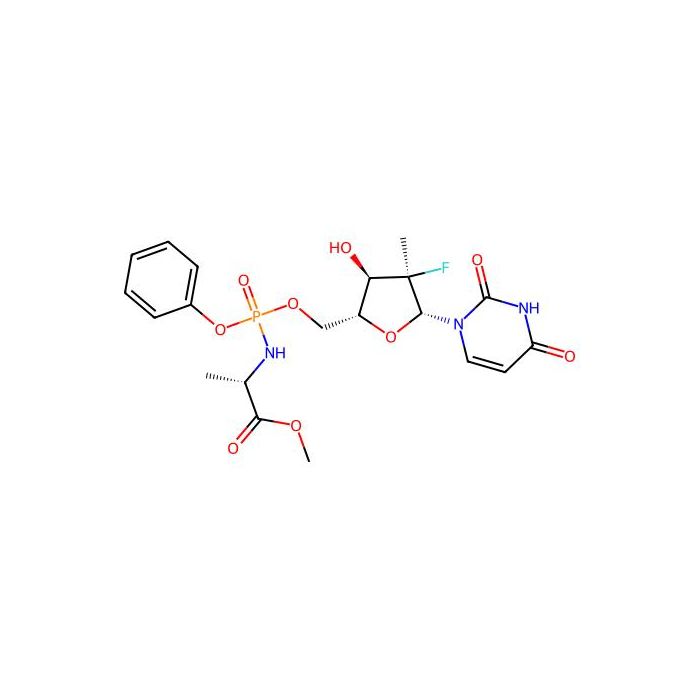
Sofosbuvir impurity N, an diastereoisomer of Sofosbuvir, is the impurity of Sofosbuvir. Sofosbuvir (PSI-7977) is an inhibitor of HCV RNA replication, demonstrates potent anti-hepatitis C virus activity.
Form:Solid
IC50& Target:HCV
사양
생화학 및 생리적 메커니즘
Sofosbuvir impurity N, an diastereoisomer of Sofosbuvir, is the impurity of Sofosbuvir. Sofosbuvir (PSI-7977) is an inhibitor of HCV RNA replication, demonstrates potent anti-hepatitis C virus activity.
DMSO : 100 mg/mL (199.44 mM; ultrasonic and warming and heat to 60°C)
솔루션 계산기
Molarity Calculator
Determine the necessary mass, volume, or concentration for preparing a solution.
Dilution Calculator
Determine the dilution needed to prepare a stock solution.
Reconstitution Calculator
리뷰
고객 리뷰
Application Protocols
Example analytical workflows (general guidance; adjust per your method and CoA):
Preparation of stock and working solutions:
Equilibrate vial to room temperature before opening to avoid condensation. Dissolve an accurately weighed amount in DMSO, methanol, or acetonitrile to prepare a primary stock (e.g., 1–5 mg/mL). Filter through 0.2 µm PTFE if particulate is present and compatible.
Prepare calibration standards by serial dilution into initial mobile phase or sample diluent. Target levels around expected reporting thresholds.
LC–MS identification:
Inject a mid-range standard to determine retention time and dominant ions. Record exact m/z and major fragments; set up MRM/SIM transitions where applicable.
LC–UV quantitation:
Determine λmax from a spectral scan; construct a 5–7 point calibration curve. Assess linearity (r ≥ 0.999 typical goal) and check residuals.
System suitability (example criteria to tailor):
%RSD of peak area for n ≥ 5 injections ≤ 2%, retention time %RSD ≤ 0.5%, and tailing factor within method limits.
These are generic templates; finalize acceptance criteria and procedures under your internal SOPs.
Biological Roles
This catalog item is an analytical impurity standard, not supplied for biological assay use. No biological function, pathway role, or target engagement is assigned for this item.
Context (general):
“Impurity N” denotes a specific structurally defined related substance associated with the synthesis or degradation of sofosbuvir. While the parent API is a nucleotide prodrug, the impurity’s biological activity, if any, is not characterized here and is outside the scope of this research-use material.
In regulated environments, such impurity standards are used to monitor and control related substances in drug substance/product, aiding in quality risk assessments and ensuring manufacturing consistency.
Please refer to the CoA for identity confirmation. Do not infer pharmacology from the impurity designation. This product is for research use only.
Buffer Applications
Not typically applicable. This product is not a buffering agent and is not intended to create or maintain solution pH.
Analytical context (general):
In LC method development, volatile buffers such as ammonium formate or ammonium acetate (pH 3–6.5) are commonly employed to optimize retention and MS response for small molecules. The choice and pH should be driven by the impurity’s ionization characteristics as determined during scouting runs.
For UV-only methods, low-UV-absorbing buffer systems at minimal concentrations can improve baseline quality.
Consult your CoA and preliminary scouting data to select an appropriate buffer system for chromatographic analyses.
Green Alternatives
As an analytical reference material, the “green” considerations mainly concern the chromatographic solvents and sample preparation rather than the compound itself.
Greener choices for LC workflows (general guidance):
Prefer methanol over acetonitrile when separation selectivity allows; MeOH is generally considered less hazardous and more sustainable. Note the higher viscosity may require pressure adjustments.
Replace acetonitrile with ethanol or 2-propanol in RP-LC where feasible, acknowledging changes in elution strength and UV transparency.
Aqueous buffers: Use volatile, MS-friendly additives (e.g., ammonium formate/acetate) at minimal effective concentrations to reduce salt waste.
Ethanol: renewable; higher viscosity; higher UV cutoff; may alter selectivity.
Lab practice improvements:
Miniaturize injection volumes and use microbore columns to reduce solvent consumption.
Batch analyses to minimize instrument start/stop cycles and column conditioning waste.
Any substitution must preserve method suitability criteria (resolution, tailing, precision). Validate changes before routine use.
Pharmaceutical Uses
This product is not an excipient or therapeutic; it is supplied strictly as an analytical reference standard for research use only.
Typical roles in pharmaceutical development and QC (general):
Related-substance standard: Establishes identification, reporting, and qualification thresholds for sofosbuvir manufacturing and stability programs.
Method validation support: Used for accuracy, precision, specificity, linearity, LOQ/LLOD, and robustness assessments per ICH Q2(R2) for impurity methods.
Release and stability testing: Serves as a reference to trend impurity profiles over shelf life and under ICH stability conditions.
Regulatory note:
Pharmacopoeial status for this specific impurity is not specified. If pharmacopoeial reference standards exist for related substances, their use and suitability should be evaluated per compendial guidelines.
All use is non-clinical and for laboratory research or quality control method work. No medical or therapeutic claims are made or implied.
Physical Properties
Item-specific properties (from Product Data):
Appearance: Not specified for this item; refer to CoA/Spec Sheet.
Molecular weight: Not specified for this item; refer to CoA/Spec Sheet.
Common analytical-reference considerations (general guidance, not specifications):
Melting/boiling points: Not specified for this item; refer to CoA/Spec Sheet.
Density, refractive index: Not specified for this item; refer to CoA/Spec Sheet.
Solubility: Not specified for this item; refer to CoA/Spec Sheet. For method development, analysts often evaluate DMSO, methanol, acetonitrile, water, and their mixtures to establish a stock solution compatible with LC or LC–MS.
Partitioning/logP and pKa: Not specified for this item; refer to CoA/Spec Sheet. If the CoA includes ionization or UV characteristics, use those to select detection wavelengths and buffer pH.
Notes for analytical use (general):
If UV detection is planned, scan 200–400 nm to identify absorbance maxima. If MS detection is used, optimize source parameters after confirming ionization mode (ESI+/ESI−) from trial injections.
Hygroscopicity and photolability are unknown for this item; minimize ambient exposure until CoA guidance is reviewed.
All numerical specifications for this catalog item should be taken from the CoA/Spec Sheet.
Quality and Grades
Item-specific quality declarations:
Grade/purity: Not specified for this item; refer to CoA/Spec Sheet.
Guidance on reference-standard quality (general):
Analytical/reference grade materials are typically supplied with a certificate reporting identity confirmation (e.g., NMR, HRMS), purity by quantitative methods (qNMR, HPLC area%), and water/volatile content by KF/LOD when applicable. Because this listing does not include those values, please consult the CoA for the definitive specifications, analytical methods used, and assigned purity for quantitative assays.
If a stabilizer is present, it will be declared on the label/CoA. None is specified here.
Trace metal content, residual solvents, and counter-ion content (if salt form) may be reported on the CoA where relevant to analytical performance.
What this means for your work:
For quantitative method validation (e.g., impurity reporting), use the CoA-assigned purity to correct response factors when preparing calibration standards.
If lot-to-lot comparability is critical, retain a reference aliquot and request CoAs for each lot. Record storage conditions and opening dates to maintain audit trails.
Reaction and Applications
This product is supplied as an impurity reference standard rather than as a synthetic reagent. Consequently, it is not typically employed to drive chemical transformations. Its primary applications are analytical:
Impurity profiling: Establish retention time and MS fingerprint for related-substance methods of sofosbuvir drug substance and drug product.
Method development: Optimize gradient profiles, buffer pH, and detection settings (UV, DAD, MS) using the impurity as a system probe during LC method development.
System suitability and identity confirmation: Use narrow-spec windows for retention factor and mass tolerance to verify method readiness.
Stability-indicating methods: Support forced-degradation studies (acid/base, oxidative, thermal, photolytic) by confirming whether this impurity appears and tracking its response.
Calibration/quantitation: Prepare calibration levels around reporting/identification thresholds to validate linearity, accuracy, precision, and LOQ in accordance with ICH Q2(R2).
Practical tips (general):
Prepare fresh working solutions; minimize freeze–thaw cycles of concentrated stocks.
For MS work, scan both positive and negative ESI initially; refine based on signal intensity and fragmentation. Record qualifier/quantifier ion ratios for routine QC.
Reaction Conditions
Not applicable as a reagent. This product is supplied for analytical reference use and is not intended to participate in synthetic reactions.
Analytical method conditions (general guidance):
LC–UV/LC–MS scouting: Begin with reversed-phase C18, linear gradient 5–95% organic over 10–20 min. Organic phase: acetonitrile or methanol. Aqueous phase: water with 0.1% formic acid (for ESI+) or 5–10 mM ammonium acetate at pH ~5. Adjust as dictated by retention and signal.
MS source: Evaluate both ESI+ and ESI−; optimize capillary voltage, desolvation temperature, and gas flows for maximal signal-to-noise. Confirm qualifier/quantifier ions and establish ion ratio windows.
UV detection: Scan 200–400 nm during scouting; lock at the wavelength of maximum absorbance if adequate selectivity exists.
These are general literature-style starting points and not specifications for this item. Final conditions should be validated in your laboratory.
Safety and Handling
Authoritative safety information must be taken from the item-specific SDS.
GHS details for this item:
Signal word: Not specified for this item; refer to SDS.
Hazard statements (H-codes): Not specified for this item; refer to SDS.
GHS classification and pictograms: Not specified for this item; refer to SDS.
General laboratory precautions for small-molecule reference standards:
Use appropriate PPE: lab coat, safety glasses, and suitable gloves (nitrile recommended). Handle solids and powders in a fume hood to avoid inhalation of particulates and to control solvent vapors from stock solution preparation.
Avoid ingestion, inhalation, and skin/eye contact. Wash thoroughly after handling. Keep away from incompatible reagents per SDS.
Unknown dust/combustibility and decomposition profile: avoid grinding or aerosol generation. Do not heat above recommended temperatures without a fume hood and thermal control.
Accidental exposure: Rinse eyes/skin with water for at least 15 minutes. If inhaled, move to fresh air. If ingested, rinse mouth. Seek medical attention; provide SDS to responders.
Waste: Dispose according to institutional chemical waste procedures. LC/LC–MS mobile phases containing the compound should be collected as organic waste.
Always consult the SDS and institutional EHS policies before use.
Solvent Selection
Item-specific solubility is not provided. The following framework supports rapid solvent screening for small-molecule impurity standards used in LC/LC–MS:
Primary stock solvent candidates:
DMSO: high solvating power; miscible with water/organic; commonly used at 1–10 mg/mL stocks.
Methanol or acetonitrile: LC-compatible; often suitable for direct injection after dilution; minimize water to enhance solubility if needed.
Mixed solvents: DMSO:MeOH or MeOH:H2O (with or without 0.1% formic acid) can balance solubility and chromatographic compatibility.
Polarity and ionization: If the CoA indicates ionizable groups, align mobile phase pH to keep the analyte in a form compatible with the separation and detector (neutral for RP retention; charged for ESI efficiency as appropriate).
Dielectric and miscibility (general): DMSO (ε ~47), MeOH (ε ~33), ACN (ε ~36) are mutually miscible with water and are standard for RP-LC workflows.
Comparison (general use):
DMSO: best solubility; less ideal at high injection fractions.
Upon receipt, inspect the vial for integrity. Allow the container to equilibrate to room temperature in a desiccated environment before opening to minimize moisture condensation.
For long-term use, prepare single-use aliquots of concentrated stock solution in an appropriate solvent (e.g., DMSO, MeOH, or ACN as compatible with your method) and store at -20°C. Clearly label aliquots with concentration, solvent, and date.
Avoid repeated freeze–thaw cycles. Protect from light if your method development indicates photolability; store in amber vials where practical.
Solid-state stability, solution stability, and hygroscopicity: Not specified for this item; refer to CoA/Spec Sheet. If stability data are absent, verify short-term solution stability (bench, autosampler) experimentally before routine use.
Disposal: Follow institutional chemical waste procedures for organic solutions and contaminated materials.
Structure and Identity
Brief: Sofosbuvir impurity N (CAS 1394157-34-6) is an analytical reference material associated with the manufacture/analysis of the nucleotide prodrug sofosbuvir. It is typically used for method development, system suitability, and impurity profiling in QC/QA environments.
SKU: S649525
Product name: Sofosbuvir impurity N
CAS: 1394157-34-6
PubChem CID: 67440929 (literature identifier)
InChIKey: 331076 (as provided in Product Data)
SMILES: Not specified for this item; refer to CoA/Spec Sheet.
Molecular formula: Not specified for this item; refer to CoA/Spec Sheet.
Molecular weight: Not specified for this item; refer to CoA/Spec Sheet.
Structural features (general, literature context):
This material represents a defined process or degradant impurity related to sofosbuvir. Specific functional groups, ring systems, and stereochemical descriptors are not provided in the current Product Data and may vary by impurity label; consult the CoA for definitive structure.
2D description: Not specified for this item; refer to CoA/Spec Sheet for structural diagram and atom-level annotation.
Synthetic Utility
Not a typical synthetic building block. As an impurity reference standard, this material is generally not used as a reagent or intermediate in preparative chemistry.
Where it can assist synthetic chemists (general):
Route scouting feedback: Presence/levels of this impurity can indicate specific side pathways or incomplete conversions in nucleotide prodrug syntheses, guiding optimization of coupling, protecting group strategies, or purification trains.
Mechanistic insight: Tracking its formation versus process parameters (e.g., reagent ratios, solvent, temperature, base) may elucidate competing pathways.
Purification development: Provides a benchmark for resolving power of chromatographic steps (flash, prep RP) or crystallizations targeting impurity rejection.
If any transformation or derivatization of this impurity is planned for research purposes, consult the CoA for structure and assess stability/reactivity under proposed conditions before scale-up.
Target Specificity
Not applicable. This product is a small-molecule impurity standard and does not possess a biological target specificity profile (no antigen/epitope, clone, or isotype). Use it for analytical characterization and method development related to sofosbuvir impurity control.
자주 묻는 질문
How should this product be stored?
Store at ?20 °C. Freezer storage is required to maintain the specified shelf life.
How is this product shipped?
This product ships in an insulated container with ice pads. Unpack on arrival and transfer it to the storage condition stated above.
What are the CAS number, molecular formula and molecular weight?
The CAS Number is 1394157-34-6, the molecular formula is C20H25FN3O9P, and the molecular weight is 501.40 g/mol. InChIKey SASYBZIIPQSWBV-ZWXZMKCMSA-N.
What documentation is provided?
Available product documentation, including Certificates of Analysis (COA), Safety Data Sheets (SDS), and specification sheets, is shown in the product document area. Document availability and access follow the current site policy.
Products are supplied to verified businesses, institutions, and qualified professionals for research and development use only. Not for use in humans, animals, diagnosis, or therapy.