등급 & 순도Moligand™?Moligand™ — Aladdin's line of ligands and bioactive small molecules. Use for receptor, pathway, and binding studies needing defined small-molecule tools.10 mM in DMSO
Moligand™, 10 mM in DMSO Moligand™ 최소한의 기준선 간섭이 필요한 민감한 크로마토그래피 및 분석 워크플로우용.
🌡
보관 및 배송
Store at -80°C Dry ice packs + Cold packs 출고. 정확한 사양은 로트별 COA를 확인하세요.
📋
품질 문서
SDS, COA, 데이터시트, 사양서를 다운로드할 수 있습니다. 로트별 COA는 로트 번호 조회를 통해 확인할 수 있습니다.
📚
문헌적 근거
크로마토그래피, 유기 합성 및 교차 커플링 반응 분야의 동료 심사 논문 0편에서 인용되었습니다.
개요
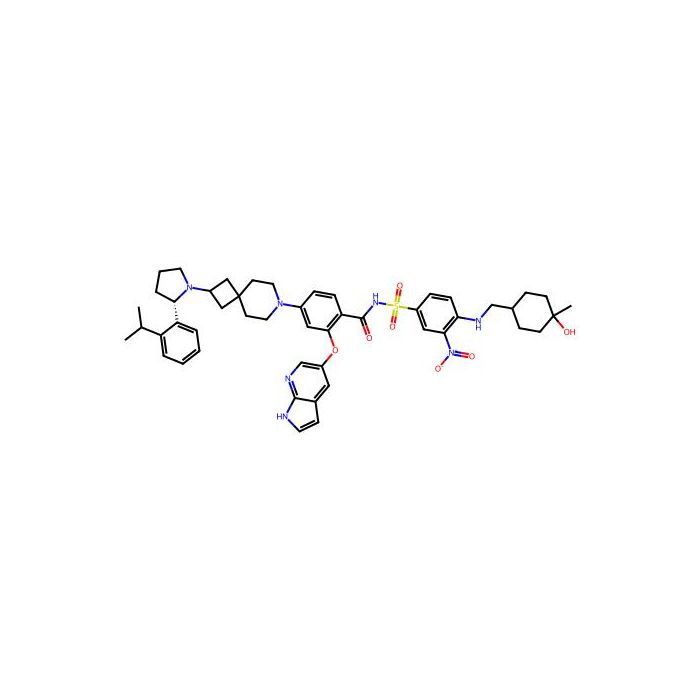
Sonrotoclax is a potent, orally active Bcl2 inhibitor. Sonrotoclax has effective cell killing effect against a variety of lymphoma and leukemia cell lines.
Determine the necessary mass, volume, or concentration for preparing a solution.
Dilution Calculator
Determine the dilution needed to prepare a stock solution.
Reconstitution Calculator
리뷰
고객 리뷰
Application Protocols
No manufacturer‑validated application protocols are provided for this SKU. The following are general, literature‑informed steps for small‑molecule BCL‑2 ligands; optimize to your system.
DMSO stock preparation:
Equilibrate vial to room temperature in a desiccator. Weigh quickly. Add anhydrous DMSO to achieve a convenient concentration (e.g., 10–20 mM). Vortex and, if needed, briefly sonicate to dissolve. Aliquot into low‑bind tubes, purge headspace with inert gas if available, and store at −80 °C.
Prepare serial dilutions in DMSO. Mix with BCL‑2 protein and fluorescent BH3 tracer in assay buffer (e.g., 20–50 mM HEPES, 100–150 mM NaCl, 0.005–0.01% Tween‑20, pH ~7.4). Keep final DMSO consistent across wells. Incubate to equilibrium and read polarization. Fit competitive binding curves to derive Ki/IC50.
Cell‑based apoptosis assay:
Seed cells and allow to adhere/recover. Treat with compound dilutions keeping vehicle constant. After 4–24 h, assess apoptosis (e.g., caspase‑3/7 activity, Annexin V/PI by flow). Include positive control BH3 mimetic and vehicle control.
Analytical QC of working solutions:
Use LC‑MS to confirm concentration and purity after dissolution, especially for long campaigns.
Note: These are example workflows only and not item‑specific validated protocols.
Biological Roles
Biological context (literature/general):
Sonrotoclax is reported as a potent, selective small‑molecule antagonist of the anti‑apoptotic protein BCL‑2, functioning as a BH3 mimetic. By occupying the hydrophobic groove on BCL‑2, BH3 mimetics competitively displace pro‑apoptotic BH3‑only proteins, thereby promoting mitochondrial apoptosis in cells that are BCL‑2 dependent.
Selectivity considerations: Next‑generation BCL‑2 inhibitors are designed to spare BCL‑XL and MCL‑1 to reduce on‑target liabilities associated with these paralogs. Literature describes sonrotoclax as highly potent for BCL‑2 with reduced activity on other family members, though exact potency ratios should be consulted from primary sources.
Pathway positioning: BCL‑2 sits upstream of mitochondrial outer membrane permeabilization (MOMP). Chemical inhibition of BCL‑2 can trigger cytochrome c release, apoptosome formation, and downstream activation of caspase‑9 and executioner caspases.
Research utility:
Probing apoptotic priming and BCL‑2 dependency in cell lines using BH3 profiling and viability/caspase readouts.
Defining synthetic lethal interactions with other pathway modulators (e.g., MCL‑1 or BCL‑XL inhibitors) to map survival circuitry.
Biochemical characterization of binding thermodynamics/kinetics to validate structure‑based design hypotheses.
Notes:
The above roles are literature-based context for BH3 mimetics. This product is supplied strictly for laboratory research; no medical or clinical claims are made or implied.
Buffer Applications
This item is a hydrophobic small‑molecule probe, not a buffering agent. It does not serve as a pH buffer component in standard biochemical protocols.
Practical note:
When using Sonrotoclax in buffered systems, select a biologically compatible buffer (e.g., HEPES, PBS) and introduce the compound via a DMSO stock, keeping final DMSO low and matched across control and treated samples. Ensure the buffer lacks components that precipitate the compound or interfere with the assay readout.
Green Alternatives
As a specialized research ligand, Sonrotoclax itself is not typically replaceable by a “green” alternative without changing biological specificity. However, you can improve the sustainability of workflows surrounding its use.
Greener handling strategies (general):
Stock solvents: Prefer anhydrous DMSO over DMF/NMP when feasible, due to better operator acceptance and lower regulatory scrutiny; keep volumes minimal and use closed systems to reduce exposure.
Working solutions: Minimize organic solvent percentages in aqueous buffers while maintaining solubility and assay fidelity.
Waste reduction: Centralize stock preparation, aliquot to minimize discard from freeze–thaw degradation, and design plate maps to reduce dead volumes.
Energy efficiency: Because storage is at −80 °C, plan batch experiments to reduce door openings and shorten time at ambient, mitigating energy use and material degradation.
Small comparison (context):
DMSO vs DMF/NMP: DMSO offers lower toxicity and better biodegradability profile compared with DMF/NMP; choose DMSO where assay compatibility allows.
Glass vs plastic: Use reusable glass vials for stock solutions where adsorption is manageable; this reduces plastic waste.
Caveat: None of these substitutions alter the intrinsic properties of Sonrotoclax; they address the surrounding solvent, container, and process choices. Validate any change to ensure target engagement and assay performance remain unaffected.
Pharmaceutical Uses
This product is provided solely for research use and is not an excipient or GMP material. No therapeutic or clinical use is claimed or supported.
Research/development contexts (general):
Reference material for analytical method development and qualification in discovery labs (e.g., LC‑MS quantitation in DMPK studies, stability-indicating methods in formulation screens).
Tool compound in preclinical pharmacology experiments to interrogate BCL‑2 pathway dependence, establish exposure–response relationships, and benchmark against other BH3 mimetics.
Formulation exploration for in vivo research (e.g., solubilization in DMSO/PEG/aqueous co‑solvent systems) performed under institutional approvals. Any such work should be guided by internal safety and ethical standards and is outside the scope of the product’s warranted use.
Compliance note:
Not pharmacopeial grade. For any regulated application, source appropriate GMP materials and reference standards. Consult your QA unit to determine suitability for intended nonclinical studies.
Physical Properties
Item-specific physico-chemical specifications are not provided in the product data for this listing.
Appearance: Not specified for this item; refer to CoA/Spec Sheet.
Molecular Weight: Not specified for this item; refer to CoA/Spec Sheet.
Molecular Formula: Not specified for this item; refer to CoA/Spec Sheet.
Melting point: Not specified for this item; refer to CoA/Spec Sheet.
Boiling point: Not applicable for a high-molecular-weight, nonvolatile solid; exact value not specified for this item.
Density: Not specified for this item; refer to CoA/Spec Sheet.
Refractive index: Not applicable to solids; not specified.
pKa/logP: Not specified for this item; refer to CoA/Spec Sheet.
Solubility (general guidance, literature/experience with BH3 mimetics):
Water: typically very low aqueous solubility for BCL‑2 ligands; expect poor direct dissolution in neutral buffers without co‑solvent.
Organic solvents: DMSO is commonly used to prepare concentrated stock solutions (e.g., 10–20 mM) for biochemical/cellular assays; ethanol or DMF may also dissolve depending on formulation. These are literature-based expectations, not specifications for this item.
Practical notes (general):
Warm DMSO gently (room temperature) and vortex/sonicate to aid dissolution; avoid heating above 40 °C unless validated for stability.
Filter small‑molecule working solutions (0.22 µm PTFE) for assay cleanliness when compatible.
Always confirm exact physico‑chemical parameters for your lot from the CoA to establish assay conditions and stability windows.
Quality and Grades
Grade/Purity for this item: Moligand™
Moligand is Aladdin’s designation for small‑molecule ligand/probe quality suitable for research, screening, and mechanism studies. While it is not a clinical/compendial grade, Moligand emphasizes identity, purity, and handling that support reproducible biochemical and cell‑based assays.
What Moligand™ typically conveys (general guidance):
Identity verification by appropriate spectroscopic/analytical methods (e.g., NMR/MS/LC). Exact test suite may vary; consult CoA.
High chemical purity targeted for in vitro and exploratory in vivo research; impurity profiles and residual solvents are controlled per internal specifications. Exact numerical specifications are not provided here.
Packaging designed to minimize moisture/light exposure and to enable accurate weighing/reconstitution for screening workflows.
Item-specific notes (this SKU):
Numerical purity, residual solvent limits, water/peroxide content, metals, and UV cutoff: Not specified for this item; refer to CoA/Spec Sheet.
Stabilizers/additives: Not specified for this item; refer to CoA/Spec Sheet.
Practical advice:
Upon receipt, inspect the container integrity and maintain the indicated ultra‑low temperature storage (−80 °C) to limit degradation.
For screening campaigns, consider preparing a master DMSO stock from a single lot and aliquoting to minimize freeze–thaw cycles and adsorption losses. Record lot/aliquot maps to preserve traceability.
Reaction and Applications
This product is not a general synthetic reagent but a research ligand used primarily as a chemical probe in apoptosis pathway studies.
Target engagement studies with BCL‑2 family proteins using biophysical assays (e.g., fluorescence polarization, TR-FRET, MST, ITC) to quantify binding and competition with BH3 peptides.
Cellular apoptosis assays to characterize pathway modulation: caspase‑3/7 activation, Annexin V/PI staining, cytochrome c release, and mitochondrial outer membrane permeabilization (MOMP) readouts.
Chemogenomic and resistance profiling: mapping dependence on BCL‑2 vs BCL‑XL/MCL‑1 via CRISPR knockouts or combination with selective inhibitors to define apoptotic priming.
SAR benchmarking: compared to first‑generation BH3 mimetics in panel assays to evaluate selectivity windows and potency trends.
Assay implementation tips:
Use DMSO master stocks; keep final DMSO low and consistent across wells.
Include positive controls (e.g., known BCL‑2 inhibitors) and negative controls (vehicle) to anchor assay performance.
For protein binding assays, confirm protein integrity (monodispersity, no aggregation) and use matched buffer conditions (salt, pH, mild detergent if needed) to avoid nonspecific interactions.
Note: No specific manufacturer application text was provided for this SKU. The above reflects general, literature‑based use patterns for BCL‑2–directed small-molecule probes; adapt to your experimental system.
Reaction Conditions
Not typically applicable. Sonrotoclax is supplied as a research probe, not as a reagent or catalyst for synthetic transformations.
Assay preparation conditions (general guidance):
Stock preparation: Dissolve in anhydrous DMSO at room temperature with vortexing/brief sonication. Avoid excessive heating; verify complete dissolution visually.
Working concentrations: Prepare serial dilutions in DMSO, then dilute into assay buffer or media to reach the desired final concentration while maintaining a consistent vehicle percentage (commonly 0.1–0.5% DMSO, assay‑dependent).
Light/moisture: Protect solutions from light and minimize exposure to air/humidity to reduce potential degradation.
These guidelines are general and should be adapted to your specific biochemical or cellular assay. For any synthetic applications, this compound is not recommended as a reagent.
Safety and Handling
Safety data specific to this SKU are not detailed in the provided Product Data. Handle this research chemical using standard small‑molecule laboratory precautions.
Research Use: For research use only; not for human or veterinary use.
GHS information for this item:
Signal word: Not specified for this item; refer to SDS.
Hazard statements (H‑codes): Not specified for this item; refer to SDS.
Pictograms/Classification: Not specified for this item; refer to SDS.
Potential hazards (general, for lipophilic bioactive ligands):
May cause irritation upon contact or inhalation; avoid dust/aerosols.
Many BH3-mimetic scaffolds are organic solids with limited volatility but can pose risks if ingested or absorbed; minimize exposure.
PPE: Lab coat, safety glasses, and suitable chemically resistant gloves (e.g., nitrile). Use in a fume hood when weighing and when preparing solutions.
Storage incompatibilities: Keep away from strong oxidizers and strong acids/bases unless compatibility is known. Protect from light and moisture.
First aid (overview; defer to SDS):
Skin/eye contact: Rinse with water for 15 minutes; remove contaminated clothing; seek medical attention if irritation persists.
Inhalation: Move to fresh air; seek medical attention if symptoms occur.
Ingestion: Rinse mouth; do not induce vomiting; get medical attention.
Waste: Dispose in accordance with institutional chemical waste procedures; do not release to drains.
Transport: This product ships on dry ice/cold packs as provided; maintain cold-chain to preserve quality.
Solvent Selection
Sonrotoclax is a hydrophobic, heteroatom‑containing small molecule typical of BH3 mimetics; practical dissolution behavior is dominated by lipophilicity with limited aqueous solubility.
Primary stock solvent (practice):
DMSO is generally preferred for high‑concentration stocks due to strong solvation of polyaromatic/heteroaromatic frameworks.
Alternative organic solvents (as compatible with your assay system):
DMF, NMP: strong polar aprotic solvents that can aid dissolution for difficult solids.
Ethanol or isopropanol: sometimes acceptable for lower‑concentration working solutions; check target/assay tolerance.
Aqueous handling:
Direct dissolution in aqueous buffers is typically poor; use co‑solvent strategies (e.g., 0.1–1% DMSO final) and surfactant‑free conditions unless your assay requires otherwise.
Practical tips:
Prepare a concentrated DMSO master stock (e.g., 10–20 mM) at room temperature; vortex/brief sonication to dissolve, then sterile‑filter if needed (0.22 µm PTFE).
Avoid adsorptive losses: use low‑bind plastics or glass vials; pre‑rinse tips/vials with diluted stock for sub‑µM work.
Verify compatibility of the final solvent percentage with biochemical/cellular systems (typical DMSO tolerance 0.1–0.5% v/v, assay‑dependent).
Note: No item‑specific solubility, logP, or dielectric data are provided. The above guidance reflects general experience with BCL‑2 ligands and should be validated in your system.
Upon receipt, keep frozen until use. Allow the container to equilibrate to room temperature in a desiccator before opening to prevent moisture condensation.
Prepare concentrated DMSO stock solutions for routine use. Immediately aliquot stocks into single‑use portions to avoid repeated freeze–thaw cycles.
Protect from light and moisture during storage; use amber vials or foil wrap as needed.
Stability notes:
Item‑specific stability, hygroscopicity, and solution shelf‑life are Not specified for this item; refer to CoA/Spec Sheet.
General practice: Store DMSO stocks at −80 °C; minimize freeze–thaw by using small aliquots. For working solutions in buffer/media, prepare fresh on the day of use when possible.
Reconstitution guidance (general):
Add a measured volume of anhydrous DMSO to achieve the desired concentration. Vortex until fully dissolved; if necessary, brief sonication can assist. Do not overheat.
If particulate persists, confirm identity and purity by LC‑MS and consider alternate solvents (e.g., DMF) or gentle warming to room temperature before retrying dissolution.
Structure and Identity
Sonrotoclax is a research-grade small-molecule ligand in Aladdin’s Moligand series, typically used as a chemical probe for apoptosis pathway studies.
Item identifiers (this product):
SKU: S1497416
Product Name: Sonrotoclax
CAS: 2383086-06-2
Grade: Moligand™
Category: Small-molecule/compound library (研究用)
Structure descriptors:
Molecular Formula: Not specified for this item; refer to CoA/Spec Sheet.
Molecular Weight: Not specified for this item; refer to CoA/Spec Sheet.
SMILES: Not specified for this item; refer to CoA/Spec Sheet.
InChIKey: Not specified for this item; refer to CoA/Spec Sheet.
Structural features (general, literature):
Sonrotoclax (literature synonym: BGB‑11417) is reported as a next‑generation BH3-mimetic designed to bind the anti‑apoptotic protein BCL‑2.
Typical BH3 mimetics feature polycyclic, heteroatom-rich scaffolds with multiple aromatic rings, amide/urea or related H‑bonding motifs, and topologies optimized for the BCL‑2 hydrophobic groove.
The 2D representation generally includes several fused/linked aryl systems, at least one heteroaromatic ring, and polar handles to tune solubility and target engagement.
Notes:
The exact constitutional formula, stereochemistry, and line notations for this specific catalog item are not specified here; please consult the product CoA/SDS for definitive identity attributes. Literature descriptors are provided for scientific context only and do not constitute item-specific specifications.
Synthetic Utility
Sonrotoclax is a finished bioactive molecule and is not typically employed as a synthetic building block or reagent.
Context and limitations:
The scaffold comprises multiple fused/linked aromatic and heteroatom‑bearing fragments tailored for BCL‑2 binding. Such molecules are rarely used as intermediates because functional group density, stereochemical complexity, and high molecular weight limit downstream diversification without loss of target affinity.
If analog synthesis is of interest, route design generally proceeds from modular fragments (e.g., aryl halides/boronates, heteroaryl cores, amide/urea couplers) assembled by cross‑coupling (Suzuki–Miyaura, Buchwald–Hartwig), amide/urea formations, and late‑stage heteroatom installation. Sonrotoclax itself would serve as a comparison standard rather than a synthon.
Practical recommendation:
Use Sonrotoclax as a reference control in screening or as an analytical benchmark while conducting medicinal chemistry on related BH3‑mimetic chemotypes. Procure intermediate building blocks specifically designed for SAR exploration rather than attempting derivatization of the final molecule.
Target Specificity
Target information (literature/general context):
Primary target: BCL‑2 (B‑cell lymphoma 2), an anti‑apoptotic member of the BCL‑2 protein family. Sonrotoclax (literature name BGB‑11417) is described as a highly potent, selective BH3-mimetic antagonist of BCL‑2.
Selectivity landscape: Designed to favor BCL‑2 over BCL‑XL and MCL‑1 to achieve desired apoptotic modulation with reduced off‑target engagement among anti‑apoptotic paralogs. Literature reports low‑nanomolar potency on BCL‑2; consult primary sources for quantitative IC50/Ki values and selectivity ratios.
Mechanistic note: Binds within the canonical BH3 binding groove, displacing pro‑apoptotic BH3 peptides and facilitating mitochondrial outer membrane permeabilization in BCL‑2–dependent contexts.
Important:
The above reflects public literature context and does not represent item‑specific functional certification. This product is supplied without a guaranteed biological activity specification unless explicitly stated on the CoA. Verify activity in your assay system and consider running side‑by‑side controls with known standards.
자주 묻는 질문
What is Moligand??
Moligand? is one of Aladdin Scientific's premium product lines, formulated for high-purity applications across multiple workflows. Compared to standard grades in the same workflow, Moligand? products typically offer tighter specifications, more rigorous QC, and stronger lot-to-lot consistency.
How should this product be stored?
Store at ?80 °C. Ultra-low temperature storage is required to maintain the specified shelf life.
How is this product shipped?
This product ships frozen with dry ice and cold packs. Unpack on arrival and transfer it to the storage condition stated above; handle dry ice with insulated gloves in a ventilated area.
What are the CAS number, molecular formula and molecular weight?
The CAS Number is 2383086-06-2, the molecular formula is C49H59N7O7S, and the molecular weight is 890.10 g/mol.
What documentation is provided?
Available product documentation, including Certificates of Analysis (COA), Safety Data Sheets (SDS), and specification sheets, is shown in the product document area. Document availability and access follow the current site policy.
등급 선택에 도움이 필요하신가요?
당사의 등급 선택 가이드는 카탈로그의 모든 변형 제품에 대해 순도, 안정제 상태 및 용도 적합성을 다룹니다.
Products are supplied to verified businesses, institutions, and qualified professionals for research and development use only. Not for use in humans, animals, diagnosis, or therapy.