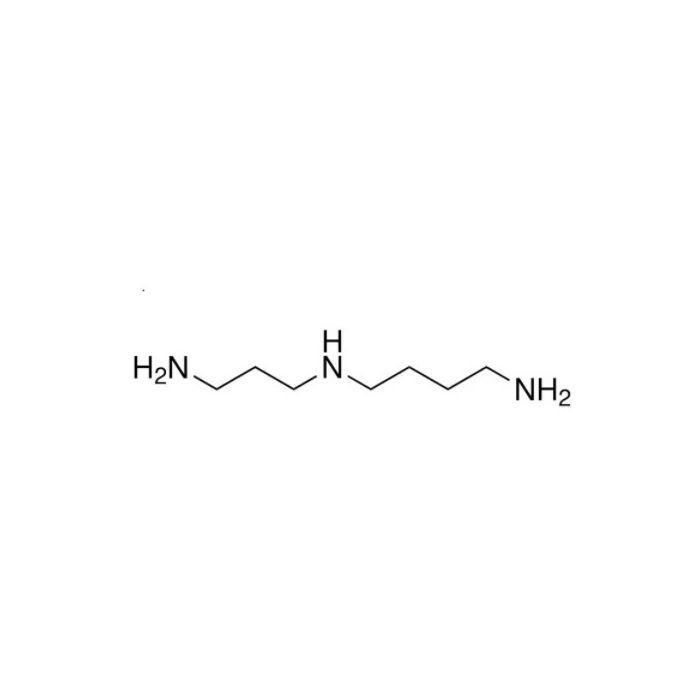
Spermidine - UltraBio™, Suitable for molecular biology, ≥99.5%(GC) , CAS No.124-20-9

CAS: 124-20-9 Cat. No.: S755738 분자식: C7H19N3 분자량: 145.25 Beilstein Registry Number: 1698591 EC 번호: 204-689-0
주문 가능
GRADE & PURITY UltraBio™ ? UltraBio™ — Aladdin's line for molecular-biology applications. Use for nuclease-free, high-consistency reagents across molecular workflows. Suitable for molecular biology ? Molecular-biology grade — free of nucleases and contaminants that degrade DNA/RNA. Use in cloning, PCR, and nucleic-acid work needing clean reagents. ≥99.5%(GC)
Synonyms
1,8-Diamino-4-azaoctane, N-(3-Aminopropyl)-1,4-diaminobutane | 1,8-Diamino-4-azaoctane | N-(3-Aminopropyl)-1,4-diaminobutane | N1-(3-Aminopropyl)butane-1,4-diamine
Storage
Store at 2-8°C,Protected from light,Argon charged
Shipped In
Wet ice
★
Size
USA
독일 (EU)*
Price
Qty
1g
S755738-1g
주문제작 · 8~12주
US$184.90
5g
S755738-5g
주문제작 · 8~12주
US$637.90
Enter a quantity for the sizes you want to add.
🧪
Why this grade

UltraBio™, Suitable for molecular biology, ≥99.5%(GC) Suitable for molecular biology,UltraBio™ for sensitive chromatographic and analytical workflows requiring minimal baseline interference.

🌡

Storage & shipping

Store at 2-8°C,Protected from light,Argon charged Ships Wet ice Check lot-specific COA for exact specifications.

📋

Quality documents

SDS, COA, datasheet, and spec sheet available for download. Lot-specific COA accessible via lot number lookup.

📚

Literature proof

Cited in 58 peer-reviewed publications across chromatography, organic synthesis, and cross-coupling reactions.

개요

Spermidine is a polyamine and a trivalent organic cation.Spermidine is a naturally occurring polyamine compound with diverse biochemical properties. It plays a vital role in gene expression, participating in DNA replication, transcription, and translation processes. Spermidine is crucial for cell growth, proliferation, and differentiation, influencing cell cycle progression and tissue development. It possesses antioxidant activity, safeguarding cells against oxidative stress by scavenging free radicals. Spermidine also stimulates autophagy, promoting the turnover of damaged organelles and protein aggregates for cellular homeostasis. With neuroprotective effects, it supports neuronal survival, synaptic plasticity, and guards against neurodegenerative diseases. Additionally, spermidine modulates cellular signaling pathways involved in inflammation and immune responses.

Application:

Spermidine has been used:
  • as a component of chromosome isolation buffer
  • as a component of transcription buffer
  • as a component of homogenization buffer

Specifications

동의어
1,8-Diamino-4-azaoctane, N-(3-Aminopropyl)-1,4-diaminobutane | 1,8-Diamino-4-azaoctane | N-(3-Aminopropyl)-1,4-diaminobutane | N1-(3-Aminopropyl)butane-1,4-diamine
사양 및 순도
UltraBio™, Suitable for molecular biology, ≥99.5%(GC)
생화학 및 생리적 메커니즘
Inhibits neuronal nitric oxide synthase (nNOS). Binds and precipitates DNA; Stimulates T4 polynucleotide kinase activity. Inhibits neuronal nitric oxide synthase (nNOS). Binds and precipitates DNA; may be used for purification of DNA binding proteins. Sti
보관 조건
Store at 2-8°C,Protected from light,Argon charged
배송
Wet ice
이 제품은 콜드 체인 배송이 필요합니다.지상 및 기타 경제 서비스는 사용할 수 없습니다.
등급
Suitable for molecular biology, UltraBio™
순수함
≥99.5%(GC)
이름과 식별자
PH
12.0-13.5 (25 °C, 1 M in H 2 O)
정식 스마일
NCCCCNCCCN
IUPAC Name
N'-(3-aminopropyl)butane-1,4-diamine
InChIKey
ATHGHQPFGPMSJY-UHFFFAOYSA-N
INCHI
1S/C7H19N3/c8-4-1-2-6-10-7-3-5-9/h10H,1-9H2
이성체 SMILES
C(CCNCCCN)CN
WGK 독일
3
UN 번호
2735
분자량
145.25
Beilstein
1698591

Documentation

📋 Safety Data Sheet (SDS)

Comprehensive hazard, handling, storage, and regulatory compliance document.

Download SDS →

✅ Certificate of Analysis (COA)

Lot-specific quality data. Enter your lot number to retrieve the exact COA.

Look up COA →

📊 Datasheet

Quick-reference summary of product specifications and applications.

View datasheet →

🔬 Specification Sheet

Full quality attributes and acceptance criteria for this grade.

View spec sheet →

Advanced Data

Taxonomic Classification

Taxonomy Tree

KingdomOrganic compounds
SuperclassOrganic nitrogen compounds
분류Organonitrogen compounds
SubclassAmines
Intermediate Tree Nodes Secondary amines
Direct ParentDialkylamines
Alternative Parents Organopnictogen compounds  Monoalkylamines  Hydrocarbon derivatives  
Molecular FrameworkAliphatic acyclic compounds
Substituents Secondary aliphatic amine - Organopnictogen compound - Hydrocarbon derivative - Primary amine - Primary aliphatic amine - Aliphatic acyclic compound
설명This compound belongs to the class of organic compounds known as dialkylamines. These are organic compounds containing a dialkylamine group, characterized by two alkyl groups bonded to the amino nitrogen.
External Descriptors triamine - polyazaalkane
3D 구조
상호 작용 화학 구조 모델


인증서(CoA, COO, BSE/TSE 및 분석 차트)
C of A & Other Certificates(BSE/TSE, COO):
Analytical Chart:
화학 및 물리적 특성
용해성H 2 O: 1 M at 20 °C, clear, colorless
감도Light sensitive;Moisture sensitive;Light sensitive
굴절률1.4785-1.4805
발화점(°F)230°F
발화점(°C)>110°
끓는점(°C)128-130°C
녹는점(°C)22-25°C
분자량145.250 g/mol
XLogP3-1.000
Hydrogen Bond Donor Count3
Hydrogen Bond Acceptor Count3
Rotatable Bond Count7
Exact Mass145.158 Da
Monoisotopic Mass145.158 Da
Topological Polar Surface Area64.099 Ų
Heavy Atom Count10
Formal Charge0
Complexity56.800
Isotope Atom Count0
Defined Atom Stereocenter Count0
Undefined Atom Stereocenter Count0
Defined Bond Stereocenter Count0
Undefined Bond Stereocenter Count0
The total count of all stereochemical bonds0
Covalently-Bonded Unit Count1
자주 묻는 질문과 기사
UltraBio™: Defining Excellence in Molecular Biology Applications
Molecular Biology Grade
Principles and Application Strategies of Common PCR Enhancers
Furin: A Review of Its Structural Features, Substrate Recognition, and Research Applications
Experimental Judgment in mRNA In Vitro Transcription: Template Design, 5′ Capping, and dsRNA Control
What Are Polyamines? Structural Features, Classification and Representative Compounds, Applications, and Synthetic Strategies
Autophagy Signaling Pathways and Selective Autophagy Research
Sources, Host-Regulatory Mechanisms, and Tumor-Immune Effects of Gut Microbiota-Derived Metabolites
Regulatory Mechanisms of Aging-Related Nutrient Sensing, Inflammation, and Homeostatic Signaling Pathways
Citations of This Product
솔루션 계산기
리뷰

고객 리뷰

Shall we send you a message when we have discounts available?

Remind me later

Thank you! Please check your email inbox to confirm.

Oops! Notifications are disabled.