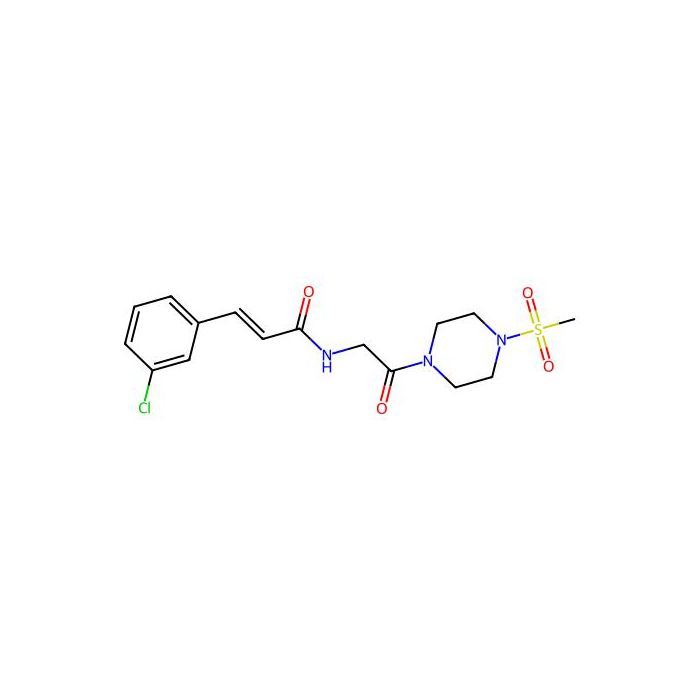
SR15006 is a inhibitor of Krüppel-like factor 5 (KLF5) with an IC 50 of 41.6 nM in DLD-1/pGL4.18hKLF5p cells).
In Vitro
SR15006 (1 μM or 10 μM; DLD-1 CRC cells) causes a significant reduction in the levels of tested cyclins over the course of 72 hours. MCE has not independently confirmed the accuracy of these methods. They are for reference only.
Form:Solid
사양
사양 및 순도
≥99%
생화학 및 생리적 메커니즘
SR15006 is a inhibitor of Krüppel-like factor 5 (KLF5) with an IC 50 of 41.6 nM in DLD-1/pGL4.18hKLF5p cells).
Determine the necessary mass, volume, or concentration for preparing a solution.
Dilution Calculator
Determine the dilution needed to prepare a stock solution.
Reconstitution Calculator
리뷰
고객 리뷰
Application Protocols
No tested applications are listed for this item. The following is general, non-clinical guidance for handling small-molecule screening compounds.
Preparing stock solutions (general)
Bring vial to room temperature in the dark to prevent moisture condensation; open under low light.
Dissolve in anhydrous DMSO to 10–50 mM if solubility permits. Vortex and sonicate gently; filter through 0.22 µm PTFE if needed.
Aliquot into amber tubes (e.g., 10–50 µL) to avoid repeat freeze–thaw.
Serial dilutions and dosing (general)
Prepare intermediate dilutions in DMSO, then into assay buffer/media to reach target concentrations with ≤0.5–1% DMSO final.
Include vehicle controls matched to the highest DMSO used.
Inspect for precipitation after dilution; mix thoroughly.
Plate-based assays (general)
For 96/384-well formats, dose with acoustic or pin tools when possible to minimize solvent.
Record lot numbers, stock concentrations, and dilution schemes for reproducibility.
Stability checks
Because Product Data indicates light sensitivity and −80°C storage, minimize light exposure during preparation and keep on ice during setup where feasible.
Item-specific, validated protocols are not provided; consult the CoA or contact Technical Support for any lot-specific instructions.
Biological Roles
No target, pathway, or mode-of-action information is provided for SR15006 in the current Product Data.
Item-specific
Target specificity, agonist/antagonist/inhibitor classification: Not specified for this item; refer to CoA/Spec Sheet or literature associated with CAS 2505001-54-5.
General considerations for small-molecule library members (general knowledge)
Such compounds are commonly employed as tool molecules in exploratory screening to probe cellular phenotypes or biochemical activities. Any biological role is context-dependent and must be experimentally validated.
Off-target effects can occur; include appropriate vehicle and negative controls, and consider orthogonal assays to confirm on-target activity.
Recommendations
If working toward a biological hypothesis, perform preliminary profiling (e.g., broad-panel binding or selectivity assays) before intensive studies.
Maintain rigorous documentation of lot numbers and preparation history to ensure reproducibility.
Note: All uses are for research only; no clinical or diagnostic applications are supported.
Buffer Applications
This product is not a buffering agent, and no acid/base characteristics or pKa data are provided. Therefore, buffer preparation guidance is not typically applicable.
Practical note (general)
If diluting DMSO stocks into aqueous buffers for biological assays, choose a buffer compatible with your system (e.g., PBS, HEPES, Tris) and keep final DMSO ≤0.5–1% v/v where possible.
Monitor for precipitation upon dilution; adjust ionic strength or add small amounts of co-solvent if necessary.
For dedicated buffer system guidance, refer to buffering reagents rather than this small-molecule library compound.
Green Alternatives
Green chemistry considerations for handling small-molecule screening compounds focus on solvent choice, minimization of hazardous waste, and right-sizing of experiments. Without compound-specific reactivity/solubility, alternatives are discussed generally.
Dissolution for assays (general)
Preference: DMSO stocks due to broad compatibility and low volatility, enabling micro-volume dosing and reduced solvent emissions.
Alternative co-solvents: Ethanol or aqueous buffers with small % DMSO can reduce overall DMSO usage where compatible with the assay.
Greener practices (general knowledge)
Use microscale solubility tests (≤1 mg) to avoid waste.
Employ sealed, low-dead-volume reservoirs to limit evaporative loss.
Choose ambient-temperature operations where stability allows; Product Data requires −80°C storage but brief room-temperature handling is acceptable if minimized.
Comparison snapshot (general)
DMSO vs DMF: DMSO is preferred from an EHS perspective; DMF poses greater worker and environmental concerns.
ACN vs MeOH/Ethanol: MeOH/ethanol are generally greener than ACN; select based on assay tolerance and solubility.
Item-specific note
No route-of-synthesis or solvent-of-manufacture details are provided. For greener sourcing or alternative formats (e.g., pre-dissolved stocks to reduce on-site solvent use), contact Technical Support.
Pharmaceutical Uses
No pharmacopeial status, excipient role, or GMP-related information is provided for SR15006. This product is supplied strictly for research use only.
Item-specific
Research Use Note: For research use only (non-clinical, non-diagnostic).
Grade/Purity: Not specified for this item; refer to CoA/Spec Sheet.
General guidance (non-clinical)
Screening compounds like SR15006 may be used in preclinical discovery assays to generate structure–activity insights. They are not intended for human or veterinary administration, and no formulation guidance for therapeutic use is provided.
If you require a material suitable for regulated development, inquire about availability of additional quality documentation, impurity profiles, and stability data under ICH guidelines.
No medical or clinical claims are made or implied.
Physical Properties
Because structural/analytical descriptors are not provided, definitive physicochemical values cannot be specified here.
Item-specific data
Appearance: Not specified for this item; refer to CoA/Spec Sheet.
Molecular Weight: Not specified for this item; refer to CoA/Spec Sheet.
Molecular Formula: Not specified for this item; refer to CoA/Spec Sheet.
Literature/computed properties
Not available without a defined structure. Typical parameters such as MP, BP, density, logP/logD, pKa, and refractive index require structural information.
General guidance for small-molecule library members (general knowledge)
Stock solutions: 10–50 mM in dry DMSO are commonly used for screening libraries when solubility allows. Filter (0.22 µm PTFE) if particles persist.
Light/temperature sensitivity: Product Data indicates “Protected from light” and storage at −80°C; handle under subdued light and avoid prolonged room-temperature exposure.
Notes
Do not treat any generalized values as specifications. For exact values and optical/electrochemical data (if tested), consult the item’s CoA/Spec Sheet.
Quality and Grades
Item-specific (from Product Data)
Grade/Purity: Not specified for this item; refer to CoA/Spec Sheet.
What to expect on the CoA for small-molecule library members (general guidance)
Typical release tests may include: HPLC/UPLC purity (% area, single or multi-wavelength), identity by HRMS and/or 1H NMR, water content by Karl Fischer (if solid), residual solvents (GC), and appearance.
If provided as a DMSO solution (some libraries), concentration verification by UV/HPLC may be listed. For neat solids, mass balance and counterion content may appear where applicable.
Understanding grades (general knowledge)
Screening/Discovery-grade compounds are intended for research assays and method development, not for GMP manufacturing. They are typically optimized for chemical identity and purity rather than bio/pharma compendial compliance.
Stabilizers: None are specified for this item. If a stabilizer or salt form is used (e.g., HCl salt to improve stability/solubility), it will be explicitly listed on the CoA/label.
Practical recommendations
Verify purity and concentration against your assay’s sensitivity (e.g., confirm by LC–MS if trace impurities could confound biological readouts).
If batch-to-batch consistency is critical, request lot-specific chromatograms and spectra from Technical Support before large screening campaigns.
Reaction and Applications
This product is categorized as a small-molecule library member for research screening. It is not primarily sold as a synthetic reagent, and no manufacturer application notes are provided in the Product Data.
Applicability
Synthetic reaction use: Not typically applicable. Without structural information, guidance on reactivity, functional group compatibility, or role in named reactions cannot be provided.
Research applications (general, non-therapeutic)
In vitro biochemical screening (enzyme or binding assays) using DMSO stocks and serial dilutions.
Cell-based phenotypic assays to generate preliminary SAR signals when combined with related analogs.
Practical considerations (general)
Confirm identity/purity before screening to avoid misleading hits.
Track vehicle concentration and light exposure; Product Data indicates light protection is required.
For reaction chemistry or derivatization uses, request full structure and impurity profile first; absent that, no reaction-specific recommendations can be responsibly made.
Reaction Conditions
Not applicable in the absence of a defined synthetic context. This product is intended as a screening library compound rather than a reagent.
No item-specific data on reaction solvents, catalysts, temperatures, or yields are provided.
General advice (only if derivatization is contemplated after structure disclosure)
Start with small-scale scouting reactions (≤10 mg) and monitor by LC–MS.
Control light and temperature per Product Data (protect from light; avoid prolonged warming).
For reaction-chemistry planning, obtain the full structure and stability profile first.
Safety and Handling
Safety information specific to this item is limited in the provided data. Always consult the product SDS for authoritative guidance before use.
Item-specific (from Product Data)
Storage: Store at −80°C, protected from light.
Shipping: Dry ice packs + cold packs.
GHS Classification, Signal Word, Pictograms, H-statements: Not specified for this item; refer to SDS.
General laboratory precautions (general knowledge)
PPE: Lab coat, safety glasses, and appropriate chemically resistant gloves (e.g., nitrile). Use in a fume hood to avoid inhalation of dust/aerosols.
Light sensitivity: Keep container tightly closed and shielded from ambient light (wrap in foil or use amber vials).
Avoid: Skin/eye contact, ingestion, inhalation of dust. Do not pipette by mouth.
Incompatibilities: Unknown; until defined, avoid strong oxidizers and acids/bases during handling. Keep away from reactive metals if the compound is halogenated or strongly acidic/basic (verify upon receipt).
First-aid overview (refer to SDS for details)
Inhalation: Move to fresh air; seek medical attention if symptoms persist.
Skin/eye contact: Rinse with water for at least 15 minutes; remove contaminated clothing; obtain medical advice.
Ingestion: Rinse mouth; do not induce vomiting; seek medical attention.
Spill and disposal
Small spills: Absorb with inert material; collect as chemical waste.
Disposal: Follow institutional and local regulations; treat as research chemical waste.
Note
Absence of SDS hazard statements here does not imply non-hazardous status.
Solvent Selection
With no structural/solubility data provided, solvent choice should follow a conservative screening workflow suitable for diverse small molecules.
Primary dissolution strategy (general guidance)
Start with anhydrous DMSO (most broadly compatible with screening assays). Target 10–50 mM stocks if solubility permits.
If solubility is limited in DMSO, test: DMF, ethanol, methanol, acetonitrile. For aqueous use, prepare dilutions into buffer with ≤1% v/v DMSO to minimize vehicle effects.
Miscibility and polarity context (general knowledge)
DMSO: Highly polar, miscible with water and organics; excellent for hydrophobic/hydrophilic compounds but can affect cells above 0.5–1%.
Ethanol/MeOH: Useful for moderately polar compounds; watch cellular tolerance in bioassays.
ACN: Good for moderately nonpolar compounds; limited water miscibility compared to DMSO.
Practical tips
Warm gently (ambient to 37°C) and vortex/sonicate to aid dissolution; avoid prolonged heating or light exposure.
Filter through 0.22 µm PTFE if particulates persist.
For buffers, add compound stock last while vortexing; check for precipitation after dilution (visual inspection and UV or DLS if critical).
Small comparison (general)
DMSO vs 2‑MeTHF: DMSO is preferred for assay stocks; 2‑MeTHF is a greener reaction solvent, not typically used for assay stock solutions.
Item-specific
No item-specific solvent data are provided; consult the CoA for any known solubility/stability notes.
Storage and Reconstitution
Item-specific storage (from Product Data)
Store at −80°C.
Protect from light at all times (use amber containers or wrap in foil).
Shipped on dry ice packs + cold packs to maintain low temperature.
Reconstitution guidance (general best practices for small molecules)
Before opening, allow the sealed container to equilibrate to room temperature in the dark to prevent moisture condensation.
If supplied as a solid or film: Dissolve in anhydrous DMSO to prepare concentrated stocks (e.g., 10–50 mM, as solubility allows). If supplied pre-dissolved, verify concentration on the label/CoA.
Aliquot stocks into small amber vials (10–50 µL) to avoid repeated freeze–thaw cycles.
Short- and long-term handling
Working solutions in aqueous buffers should be prepared fresh and used the same day; discard remaining solutions according to waste procedures.
DMSO stocks: Store at −20°C to −80°C, protected from light and moisture. Avoid more than 2–3 freeze–thaw cycles.
Document preparation date, solvent, and concentration on each aliquot.
Stability notes
No formal stability data are provided for this item; refer to CoA/Spec Sheet. Given the light protection requirement, minimize exposure to ambient or UV light during all operations.
Materials compatibility
Use amber glass when possible. DMSO stocks are generally compatible with PP tubes but verify for long-term storage.
For lot-specific guidance (including any known solubility or stability caveats), consult the CoA.
Structure and Identity
Brief overview: SR15006 (SKU S651425) is listed as a small-molecule library member. Structural identifiers are not supplied in the current product data.
Item-specific (from Product Data)
Product Name: SR15006
SKU: S651425
CAS: 2505001-54-5
Category: Small molecules and compound library (小分子和化合物库)
Molecular Formula: Not specified for this item; refer to CoA/Spec Sheet.
Molecular Weight: Not specified for this item; refer to CoA/Spec Sheet.
SMILES: Not specified for this item; refer to CoA/Spec Sheet.
InChIKey: Not specified for this item; refer to CoA/Spec Sheet.
Chemical Name (IUPAC/common): Not specified for this item; refer to CoA/Spec Sheet.
Structural features
Functional groups, ring systems, stereochemistry: Not specified for this item. Without a provided structure, functional group analysis and 2D description cannot be determined. Please consult the CoA/SDS or contact Technical Support for structural documentation linked to the CAS number above.
Practical note
If you require structure-based compatibility (e.g., acidic/basic behavior, photosensitivity), request the structural file (SDF/MOL) or SMILES from the CoA before protocol development.
Synthetic Utility
Synthetic-chemistry use is not the primary intent for this library compound, and no structural information is provided to discuss functional-group reactivity or named-reaction participation.
Current limitations
Without SMILES/structure, we cannot comment on electrophilicity/nucleophilicity, heteroatom content, or protecting-group strategies.
General note (for users considering derivatization)
Obtain structural data and impurity profile first.
Assess stability under common conditions (acid/base, redox, light) on milligram scale before any modification.
If salts or solvates are used, confirm stoichiometry before planning transformations.
For targeted synthetic applications, please request the structural dossier or consider ordering a related building block with defined functionality.
Target Specificity
No target or selectivity information is provided for SR15006.
Item-specific
Target(s), pathway(s), species selectivity, Kd/IC50: Not specified for this item; refer to CoA/Spec Sheet or primary literature associated with CAS 2505001-54-5.
Given the lack of data, users should treat SR15006 as a general screening compound until target engagement is independently verified.
자주 묻는 질문
What is the purity of this product?
This product is supplied at ≥99% purity (chemical assay). Lot-specific values are stated on the Certificate of Analysis.
How should this product be stored?
Store at ?80 °C, protected from light. The material is light-sensitive — keep it in its original opaque or amber container.
How is this product shipped?
This product ships frozen with dry ice and cold packs. Unpack on arrival and transfer it to the storage condition stated above; handle dry ice with insulated gloves in a ventilated area.
What are the CAS number, molecular formula and molecular weight?
The CAS Number is 2505001-54-5, the molecular formula is C16H20ClN3O4S, and the molecular weight is 385.87 g/mol.
What documentation is provided?
Available product documentation, including Certificates of Analysis (COA), Safety Data Sheets (SDS), and specification sheets, is shown in the product document area. Document availability and access follow the current site policy.
Products are supplied to verified businesses, institutions, and qualified professionals for research and development use only. Not for use in humans, animals, diagnosis, or therapy.