Room temperature,Desiccated Normal 출고. 정확한 사양은 로트별 COA를 확인하세요.
📋
품질 문서
SDS, COA, 데이터시트, 사양서를 다운로드할 수 있습니다. 로트별 COA는 로트 번호 조회를 통해 확인할 수 있습니다.
📚
문헌적 근거
크로마토그래피, 유기 합성 및 교차 커플링 반응 분야의 동료 심사 논문 1편에서 인용되었습니다.
개요
Usually used to study the behaviour of dipalmitoylphosphatidylcholine mixed with stearonitrile at the air–water interface by surface pressure–area measurements and by direct visualisation of monolayers by Brewster angle microscopy,and also used to study the phase behaviour of stearic acid mixed with stearonitrile, in bulk and in a monolayer at the air–water interface.
This compound belongs to the class of organic compounds known as nitriles. These are compounds having the structure RC#N; thus C-substituted derivatives of hydrocyanic acid, HC#N.
External Descriptors
Not available
1. Djoumbou Feunang Y, Eisner R, Knox C, Chepelev L, Hastings J, Owen G, Fahy E, Steinbeck C, Subramanian S, Bolton E, Greiner R, and Wishart DS. ClassyFire: Automated Chemical Classification With A Comprehensive, Computable Taxonomy. Journal of Cheminformatics, 2016, 8:61.
Determine the necessary mass, volume, or concentration for preparing a solution.
Dilution Calculator
Determine the dilution needed to prepare a stock solution.
Reconstitution Calculator
리뷰
고객 리뷰
Application Protocols
Not applicable. No validated biological assay protocols (e.g., WB, IHC, IF, FC) are associated with this small-molecule chemical. For synthetic procedures, see the Reaction Conditions and Synthetic Utility sections for general literature guidance.
Biological Roles
General biochemical context (literature; no clinical claims)
Long-chain aliphatic nitriles like stearonitrile are not common endogenous metabolites, but they relate structurally to fatty acids and amides. In environmental and biotechnological contexts, specific microorganisms express nitrile hydratases and amidases that convert fatty nitriles to the corresponding amides and acids under mild, aqueous conditions.
Biodegradation: The hydrophobic C18 chain can partition into membranes or organic phases; microbial consortia adapt to utilize such substrates slowly, with rate-limiting mass transfer and enzyme accessibility.
Membrane interactions: Due to the long alkyl chain, derivatives (e.g., octadecylamine, stearamide) are known to incorporate into lipid assemblies; the nitrile itself is less interactive than ionic or amide counterparts but still highly hydrophobic.
Biotechnological utility
As a substrate for nitrile hydratase screening and biocatalyst development directed at hydrophobic nitriles.
As a hydrophobic handle in constructing lipid-mimetic probes once converted to amines/amides that can be further functionalized.
Safety note
Any biological handling should be limited to research use under appropriate containment; consult the SDS and institutional biosafety guidelines.
Buffer Applications
This compound is a hydrophobic organic building block and is not used as a buffering agent. It is essentially insoluble in water and aqueous buffers. For aqueous work, dissolve or disperse derivatives in suitable co-solvents/surfactants, or transform to more polar functionalities (e.g., amide, amine) prior to buffer-based experiments.
Green Alternatives
Greener considerations for stearonitrile focus on solvent/catalyst choices and biocatalytic routes rather than replacing the C18 nitrile itself.
Greener transformations (literature/general)
Nitrile hydration to stearamide: Use nitrile hydratase enzymes (aqueous, mild temperatures, near-neutral pH) as an alternative to concentrated acid/base hydrolysis.
Reduction to octadecylamine: Prefer catalytic hydrogenation (H2, Raney Ni or Pd/C) in ethanol or water/ethanol mixtures over stoichiometric LiAlH4 in ethers.
Ketone synthesis from nitrile: Employ Grignard reactions in 2-methyltetrahydrofuran (2-MeTHF) instead of THF/Et2O when compatible with reactivity.
| Use case | Conventional choice | Greener alternative | Trade-offs |
|---|---|---|---|
| Grignard to nitrile | THF, Et2O | 2-MeTHF, CPME | Similar reactivity; better safety and renewability; check initiation and solubility. |
| Hydrogenation | Toluene, THF | EtOH, iPrOH, water/EtOH | Reduced toxicity; catalyst compatibility varies. |
| Workup/extraction | CH2Cl2 | EtOAc, MTBE | Lower toxicity/ozone impact; may need larger volumes. |
Process intensification
Use continuous flow hydrogenation to reduce solvent and catalyst inventories.
Exploit melt-phase processing near the compound’s melting temperature to minimize solvent use where feasible.
Note: Select alternatives based on your system’s reactivity, safety, and regulatory requirements; validate performance and impurity profiles before scale-up.
Pharmaceutical Uses
Item-specific regulatory status: Not specified for this item; refer to CoA/Spec Sheet.
General formulation/manufacturing context (no therapeutic claims)
Stearonitrile itself is not commonly used as an excipient. However, it serves as a precursor to C18 derivatives widely encountered in pharmaceutical manufacturing and formulation, such as stearamide and octadecylamine, which can function as lubricants, slip agents, antistatic agents, or hydrophobic tails in ionizable lipids and surfactants.
In medicinal chemistry, the C18 chain introduced via nitrile-to-amine/amide transformations can modulate permeability, membrane affinity, and PK of experimental compounds; such usage is at the intermediate stage, not as a finished excipient.
Process notes (general)
If used in GMP settings as an intermediate, control of chain-length distribution and residual impurities (acids, amides, amines) is important. Analytical controls typically include GC, IR (CN stretch), and NMR.
Residual solvent and catalyst controls should align with ICH Q3C/Q3D guidelines when applicable to downstream products.
Physical Properties
Item-specific values
Appearance: Not specified for this item; refer to CoA/Spec Sheet.
Molecular Formula: Not specified for this item; refer to CoA/Spec Sheet.
Molecular Weight: Not specified for this item; refer to CoA/Spec Sheet.
Literature/general properties (for reference; not item-specific specifications)
Physical state: typically a waxy solid at ambient temperature for long-chain nitriles of this length.
Solubility profile (qualitative, literature):
Insoluble to very sparingly soluble in water due to long hydrophobic chain.
Soluble in nonpolar and moderately polar organic solvents such as hexanes, heptane, toluene, chloroform, dichloromethane; improved solubility on gentle warming.
Volatility: very low at room temperature; high boiling range typical of C18 molecules (distillation often requires high vacuum).
Partitioning: expected high hydrophobicity (high logP) due to C18 alkyl chain.
Phase behavior: may soften/melt near moderately elevated temperatures; gentle heating can aid transfer and dissolution.
Note: Exact numeric values for melting point, boiling point, density, refractive index, UV cutoff, and pKa are not provided for this item. Consult the CoA/Spec Sheet or primary literature for numerical specifications if required for your method validation.
Quality and Grades
Item-specific quality information
Grade/Purity: Not specified for this item; refer to CoA/Spec Sheet.
How to interpret grades for this compound class (general guidance)
Research-grade long-chain nitriles are typically supplied with assay by GC or HPLC, and impurity profiling may include residual fatty nitriles of neighboring chain lengths (C16/C20), residual starting acids/amides, and trace solvent.
“High-purity” or “GC ≥98%” designations (when provided) indicate suitability for synthetic transformations where side-chain length distribution affects product properties (e.g., surfactant intermediates, surface monolayer assembly). If UV applications are intended, low-UV-absorbing solvent residues are preferred.
Stabilizers: Fatty nitriles generally do not require added stabilizers; the absence or presence of stabilizers should be explicitly indicated on the CoA when relevant.
Recommended quality checks (practical tips)
Verify chain-length distribution by GC-FID or GC-MS after derivatization if necessary (e.g., silylation of any adventitious alcohols/acids).
Confirm identity by IR (sharp CN stretch near ~2240–2260 cm−1, literature) and 1H/13C NMR (terminal –CH2–CN carbon resonates downfield vs internal methylenes).
Water/peroxide/metal limits: Not specified for this item; refer to CoA/Spec Sheet.
Reaction and Applications
Stearonitrile (octadecanenitrile) is a versatile hydrophobic nitrile used mainly as a building block for C18-functional materials and surfactant/lipid-like derivatives.
Reduction to primary amine: Catalytic hydrogenation (e.g., Raney Ni, Pd/C) or hydride reduction (LiAlH4) yields octadecylamine, a key intermediate for quaternary ammonium surfactants, phase-transfer agents, and surface modifiers.
Hydrolysis/hydration: Acid/base hydrolysis affords stearic acid; selective hydration (nitrile hydratase or chemical catalysts) yields stearamide, widely used in polymer processing and slip agents.
Nucleophilic addition: Reaction with organomagnesium or organolithium reagents delivers the corresponding imine/imine salt, which upon hydrolysis gives ketones bearing a C18 side chain — useful for tailoring hydrophobicity of fragrances, materials, and ligands.
Conversion to amidoximes/oximes: Treatment with hydroxylamine yields amidoximes, enabling further heterocycle construction.
Materials and surface applications (general)
As a source of linear C18 tails, derivatives are used to assemble monolayers, modify nanoparticles, and adjust LCST/phase behavior in polymer systems.
Practical tips
Ensure anhydrous conditions for organometallic additions; thoroughly dry the nitrile and solvent.
For hydrogenation, pre-wet catalysts and control temperature to suppress over-reduction or side reactions; long chains can adsorb strongly to catalysts, affecting rates.
Due to low volatility, reactions often benefit from higher-boiling solvents (toluene, xylene) or sealed-vessel operation.
Reaction Conditions
The following are general literature guidance ranges for reactions of long-chain aliphatic nitriles; optimize for your specific setup.
Reduction to octadecylamine
Catalytic hydrogenation: H2 (10–50 bar), Raney Ni or Pd/C, solvent such as EtOH, iPrOH, or toluene, 25–100 °C, 2–16 h. Monitor for full conversion; ammonia is not required for primary amine selectivity with simple alkylnitriles.
Hydride reduction: LiAlH4 in anhydrous THF/Et2O, 0–25 °C addition then reflux as needed, aqueous workup cautiously. Stoichiometric and less green.
Hydration/hydrolysis
Nitrile hydratase (biocatalytic): Aqueous buffer, 20–40 °C, pH ~6–8, gives stearamide; may require emulsifiers or biphasic setups for mass transfer.
Acidic hydrolysis to stearic acid: Mineral acid (e.g., H2SO4), refluxing aqueous-organic mixtures; hours to overnight. Basic hydrolysis also possible but may proceed via amide.
Ketone synthesis via organometallic addition
Grignard (RMgX) addition: Prepare RMgX in anhydrous ether/THF, 0 °C to reflux; add to stearonitrile, then acidic aqueous workup to give the ketone R–C(O)–R′. Typical times: 1–4 h addition, 1–6 h stir.
Amidoxime formation
Hydroxylamine (NH2OH·HCl) with base in EtOH/MeOH or aqueous alcohol, 25–60 °C, several hours to overnight.
Note: Reported yields vary with chain transfer and mass transport; vigorous stirring, phase-transfer aids, or surfactants can improve rates for hydrophobic substrates.
Safety and Handling
Item-specific hazard data
GHS Classification: Not specified for this item; refer to SDS.
Signal Word: Not specified for this item; refer to SDS.
H-Statements: Not specified for this item; refer to SDS.
Pictograms: Not specified for this item; refer to SDS.
General safety considerations for long-chain aliphatic nitriles (literature/general; defer to SDS)
Hazards: Long-chain nitriles have low volatility, but can be irritating to skin/eyes on contact and may cause irritation if inhaled as dust/aerosol. Avoid ingestion and inhalation. Combustible as an organic solid.
Peroxide formation: Not a concern (no ether functionality).
Thermal decomposition: Can produce irritating or toxic fumes (e.g., HCN, NOx) if strongly heated or burned; use appropriate fire-fighting media (dry chemical, CO2, foam) and SCBA in a fire scenario.
PPE and handling
Wear lab coat, safety glasses, and appropriate chemical-resistant gloves (e.g., nitrile). Avoid dust generation; handle in a fume hood when weighing or heating.
Hygroscopicity is low, but the product is best kept desiccated as per item storage guidance.
Incompatibilities and storage notes
Store away from strong oxidizers and strong acids/bases that could promote hydrolysis or side reactions under forcing conditions.
Always consult the product SDS for authoritative hazard classification, exposure limits, first-aid measures, and spill/fire-fighting guidance.
Solvent Selection
This product is a hydrophobic, long-chain solid and is not itself used as a solvent. Solvent selection therefore refers to choosing appropriate media to dissolve or process stearonitrile.
Polarity and miscibility (general)
Highly nonpolar overall; dissolves well in nonpolar to moderately polar organic solvents.
Typical good solvents: hexanes, heptane, isooctane, toluene, xylene, chlorinated solvents (CH2Cl2, CHCl3), and ethyl acetate; THF and acetone may require warming.
Poor solvents: water and aqueous buffers.
Practical selection by task
Reaction media: For nucleophilic additions (e.g., Grignard to nitriles), use anhydrous ethereal solvents (THF, diethyl ether). For catalytic hydrogenation to amines, use alcohols, toluene, or acetic acid depending on catalyst system.
Purification: Crystallization from alcohols or acetone/toluene mixtures can be effective; for high hydrophobicity, normal-phase silica chromatography with hexane/EtOAc gradients may be employed.
Processing/handling: Gentle warming (30–60 °C, as compatible with your method) increases solubility and eases transfer.
Brief comparison (general)
Hexane vs toluene: Hexane maximizes hydrophobic solubility and low polarity; toluene offers higher boiling point for elevated-temperature reactions.
CH2Cl2 vs EtOAc: CH2Cl2 offers rapid dissolution and low viscosity; EtOAc provides a greener profile but may require heating for full dissolution.
Storage and Reconstitution
Item-specific storage and shipping
Storage Conditions: Room temperature, Desiccated, Cool (per Product Data). Keep container tightly closed to limit moisture and particulate contamination.
Shipped In: Normal (ambient) conditions.
General handling tips for long-chain nitriles
As a waxy/solid hydrophobic material, warming the container to modest temperatures (e.g., 30–50 °C) can facilitate weighing, transfer, or dissolution. Avoid prolonged overheating.
If the material becomes semi-solid during cool storage, gently re-warm to homogenize before subsampling to maintain lot-to-lot consistency in your experiments.
Use dry utensils and anhydrous solvents when material will be used in moisture-sensitive reactions (e.g., Grignard additions).
Reconstitution
No reconstitution is required. For solution preparation, dissolve in a suitable organic solvent (e.g., hexane, toluene, CH2Cl2, or THF) with gentle warming and stirring as needed. Filter if particulate matter is present.
Stability
Long-chain nitriles are generally stable under recommended storage. Avoid strong acids/bases and oxidizers. For long-term storage, protect from light and heat to minimize any slow degradation or contamination.
Research Use Note: For research use only.
Structure and Identity
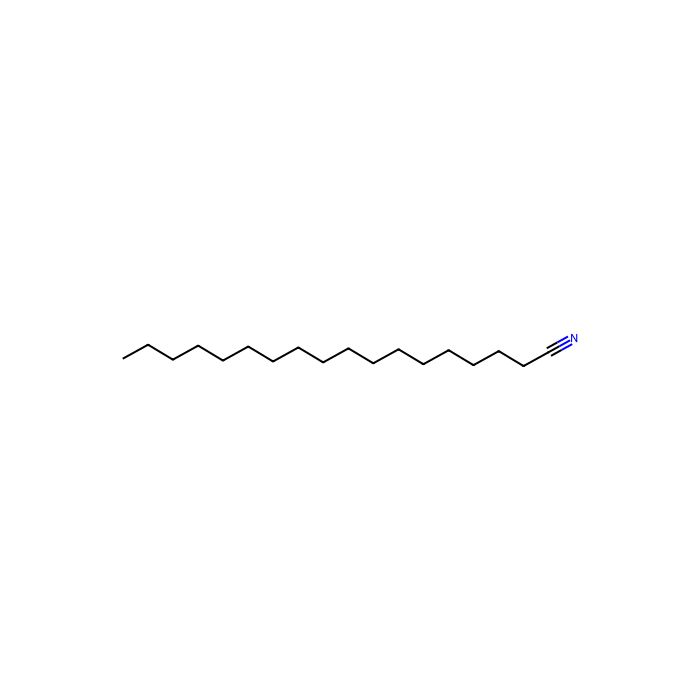
Stearonitrile (octadecanenitrile) is a long-chain, saturated aliphatic nitrile derived from stearic acid, featuring a terminal cyano group on an n-octadecyl backbone.
Item-specific identifiers (from Product Data)
SKU: S161378
Product Name: Stearonitrile
CAS: 638-65-3
CID: 12532
InChIKey: 316647 (as provided)
SMILES: Not specified for this item; refer to CoA/Spec Sheet.
Literature/computed identifiers and formula (for reference; not item-specific specifications)
Preferred IUPAC name (literature): Octadecanenitrile
Representative SMILES (literature): CCCCCCCCCCCCCCCCC#N (unbranched C18 chain ending in –C≡N)
Structural features (general chemistry description)
Functional groups: one terminal nitrile (–C≡N); no heteroatoms elsewhere in the chain.
Saturation: fully saturated C18 linear alkyl chain (no rings, no unsaturation aside from the nitrile triple bond).
Polarity profile: amphiphilic motif with a highly nonpolar hydrocarbon tail and a polar, weakly basic nitrile headgroup.
2D description: a straight, 17-carbon methylene sequence terminating in a carbon bearing a nitrile triple bond to nitrogen (–CH2–C≡N). No stereocenters present.
Synthetic Utility
Functional group reactivity (literature/general)
Nitrile (–C≡N) serves as a masked carbonyl equivalent. Key manifolds:
Reduction to primary amine (R–CH2–NH2) via catalytic hydrogenation or hydride reagents.
Hydrolysis/hydration to amide (R–CONH2) or acid (R–CO2H) under acid/base or biocatalytic conditions.
Addition of organometallics (RMgX, RLi) to form imines that hydrolyze to ketones (R–C(O)–R′).
Cyclization chemistry via amidoxime formation enabling heterocycles after activation.
Strategic value of the C18 chain
Introduces a linear hydrophobic tail that drives self-assembly, surfactancy, and interactions with hydrophobic domains in polymers and membranes. Useful for preparing amphiphiles, phase-transfer catalysts (post-quaternization), ionic liquids, and surface modifiers.
Retrosynthetic roles
As a convergent handle: install the C18 fragment late-stage by coupling a carbonyl synthone to the nitrile (e.g., Grignard to nitrile to furnish target ketone with C18 appendage).
As a protecting/masking strategy: the nitrile can be retained through conditions where amides/acids might be less robust, then unmasked at the end.
Practical considerations
Limited solubility at room temperature; employ warm, high-boiling, or ethereal solvents as needed. Ensure rigorous exclusion of water for organometallic additions.
Purify by crystallization or short-path distillation under high vacuum if thermally stable; the low volatility aids handling.
Target Specificity
Not applicable. This product is a small-molecule chemical building block and is not an antibody, enzyme, or affinity reagent. No target/epitope specificity data are relevant.
Products are supplied to verified businesses, institutions, and qualified professionals for research and development use only. Not for use in humans, animals, diagnosis, or therapy.

 D2623661