SU-5614 - ≥98%(HPLC) , CAS No.1055412-47-9

CAS: 1055412-47-9 Cat. No.: S131847 분자식: C15H13ClN2O 분자량: 272.73 EC 번호: 686-026-9 PubChem CID: 6536806
주문 가능
GRADE & PURITY ≥98%(HPLC)
Synonyms
AC-36026 | BDBM50415432 | EX-A821 | (Z)-5-Chloro-3-((3,5-dimethyl-1H-pyrrol-2-yl)methylene)indolin-2-one | PLAFIBRIDE [MART.] | 5-CHLORO-3-(3,5-DIMETHYL-1H-PYRROL-2-YLMETHYLENE)-1,3-DIHYDRO-INDOL-2-ONE | 5-chloro-3-(3,5-dimethyl-1h-pyrrol-2-ylmethylene)-1
Storage
Store at -20°C
Shipped In
Ice chest + Ice pads
★
Size
USA
독일 (EU)*
Price
Qty
5mg
S131847-5mg
3 재고 있음
—
US$9.90
10mg
S131847-10mg
3 재고 있음
—
US$10.90
25mg
S131847-25mg
3 재고 있음
—

US$16.90

US$25.90
저장 US$9.00 (34.75%)
50mg
S131847-50mg
3 재고 있음
—

US$30.90

US$46.90
저장 US$16.00 (34.12%)
100mg
S131847-100mg
주문제작 · 8~12주

US$53.90

US$80.90
저장 US$27.00 (33.37%)
Enter a quantity for the sizes you want to add.
🧪
Why this grade

≥98%(HPLC) for sensitive chromatographic and analytical workflows requiring minimal baseline interference.

🌡

Storage & shipping

Store at -20°C Ships Ice chest + Ice pads Check lot-specific COA for exact specifications.

📋

Quality documents

SDS, COA, datasheet, and spec sheet available for download. Lot-specific COA accessible via lot number lookup.

📚

Literature proof

Cited in 0 peer-reviewed publications across chromatography, organic synthesis, and cross-coupling reactions.

개요

(Z)-SU5614 is a potent FLT3 inhibitor and selectively induces growth arrest, apoptosis, and cell cycle arrest in Ba/F3 and AML cell lines expressing a constitutively activated FLT3.

Specifications

동의어
AC-36026 | BDBM50415432 | EX-A821 | (Z)-5-Chloro-3-((3,5-dimethyl-1H-pyrrol-2-yl)methylene)indolin-2-one | PLAFIBRIDE [MART.] | 5-CHLORO-3-(3,5-DIMETHYL-1H-PYRROL-2-YLMETHYLENE)-1,3-DIHYDRO-INDOL-2-ONE | 5-chloro-3-(3,5-dimethyl-1h-pyrrol-2-ylmethylene)-1
사양 및 순도
≥98%(HPLC)
생화학 및 생리적 메커니즘
SU5614 is a FMS-like tyrosine kinase 3 (FLT3) inhibitor; selective inhibitor of VEGF and PDGF receptor tyrosine kinases.
보관 조건
Store at -20°C
배송
Ice chest + Ice pads
이 제품은 콜드 체인 배송이 필요합니다.지상 및 기타 경제 서비스는 사용할 수 없습니다.
순수함
≥98%(HPLC)
이름과 식별자
Pubchem Sid
Pubchem Sid Url
https://pubchem.ncbi.nlm.nih.gov/substance/504764274
정식 스마일
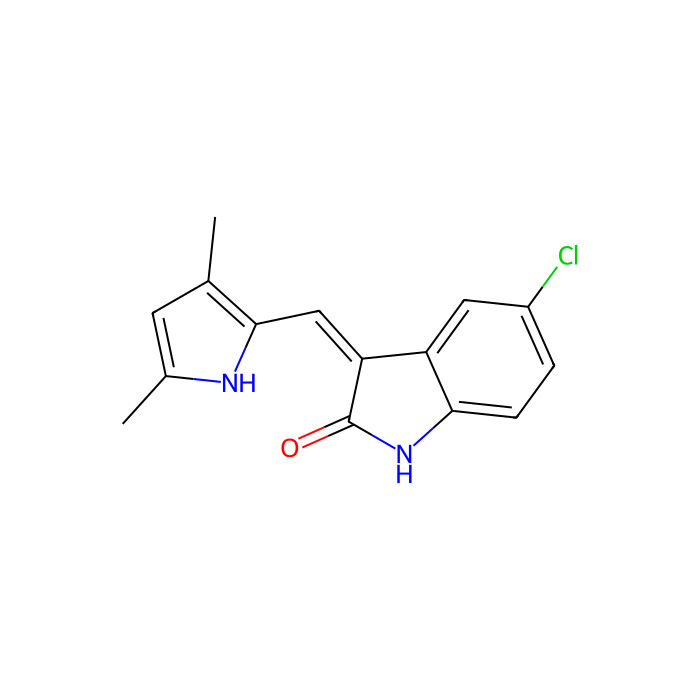
CC1=CC(=C(N1)C=C2C3=C(C=CC(=C3)Cl)NC2=O)C
IUPAC Name
(3Z)-5-chloro-3-[(3,5-dimethyl-1H-pyrrol-2-yl)methylidene]-1H-indol-2-one
InChIKey
XLBQNZICMYZIQT-GHXNOFRVSA-N
INCHI
1S/C15H13ClN2O/c1-8-5-9(2)17-14(8)7-12-11-6-10(16)3-4-13(11)18-15(12)19/h3-7,17H,1-2H3,(H,18,19)/b12-7-
이성체 SMILES
CC1=CC(=C(N1)/C=C\2/C3=C(C=CC(=C3)Cl)NC2=O)C
WGK 독일
3
PubChem CID
6536806
분자량
272.73

Documentation

📋 Safety Data Sheet (SDS)

Comprehensive hazard, handling, storage, and regulatory compliance document.

Download SDS →

✅ Certificate of Analysis (COA)

Lot-specific quality data. Enter your lot number to retrieve the exact COA.

Look up COA →

📊 Datasheet

Quick-reference summary of product specifications and applications.

View datasheet →

🔬 Specification Sheet

Full quality attributes and acceptance criteria for this grade.

View spec sheet →

Advanced Data

Taxonomic Classification

Taxonomy Tree

KingdomOrganic compounds
SuperclassOrganoheterocyclic compounds
분류Indoles and derivatives
SubclassIndolines
Intermediate Tree Nodes Not available
Direct ParentIndolines
Alternative Parents Substituted pyrroles  Benzenoids  Aryl chlorides  Heteroaromatic compounds  Secondary carboxylic acid amides  Lactams  Azacyclic compounds  Organopnictogen compounds  Organonitrogen compounds  Organochlorides  Organic oxides  Hydrocarbon derivatives  Carbonyl compounds  
Molecular FrameworkAromatic heteropolycyclic compounds
Substituents Dihydroindole - Aryl chloride - Aryl halide - Benzenoid - Substituted pyrrole - Heteroaromatic compound - Pyrrole - Carboxamide group - Lactam - Secondary carboxylic acid amide - Carboxylic acid derivative - Azacycle - Organonitrogen compound - Organochloride - Organohalogen compound - Hydrocarbon derivative - Organic oxide - Organopnictogen compound - Carbonyl group - Organic oxygen compound - Organooxygen compound - Organic nitrogen compound - Aromatic heteropolycyclic compound
설명This compound belongs to the class of organic compounds known as indolines. These are compounds containing an indole moiety, which consists of pyrrolidine ring fused to benzene to form 2,3-dihydroindole.
External Descriptors organochlorine compound - oxindole - pyrroles
3D 구조
상호 작용 화학 구조 모델


작용 메커니즘
인증서(CoA, COO, BSE/TSE 및 분석 차트)
C of A & Other Certificates(BSE/TSE, COO):
Analytical Chart:

Find and download the COA for your product by matching the lot number on the packaging.

5 results found

Lot NumberCertificate Type날짜항목
L2209635Certificate of AnalysisOct 28, 2022 S131847
L2209636Certificate of AnalysisOct 28, 2022 S131847
L2209637Certificate of AnalysisOct 28, 2022 S131847
L2209638Certificate of AnalysisOct 28, 2022 S131847
L2209639Certificate of AnalysisOct 28, 2022 S131847
화학 및 물리적 특성
분자량272.730 g/mol
XLogP33.100
Hydrogen Bond Donor Count2
Hydrogen Bond Acceptor Count1
Rotatable Bond Count1
Exact Mass272.072 Da
Monoisotopic Mass272.072 Da
Topological Polar Surface Area44.900 Ų
Heavy Atom Count19
Formal Charge0
Complexity409.000
Isotope Atom Count0
Defined Atom Stereocenter Count0
Undefined Atom Stereocenter Count0
Defined Bond Stereocenter Count1
Undefined Bond Stereocenter Count0
The total count of all stereochemical bonds1
Covalently-Bonded Unit Count1
솔루션 계산기
리뷰

고객 리뷰

Application Protocols

No tested/validated applications or protocols are provided for this item in the Product Data. The following notes indicate general, non-validated practices used with small-molecule tool compounds; adapt only after internal validation.

Not specified for this item; refer to CoA/Spec Sheet.

General, non-validated workflow (for internal method development only):

  • Prepare a 10–20 mM DMSO stock. Confirm complete dissolution visually and by LC–MS if critical.
  • Generate serial dilutions in DMSO, then dilute into assay buffer to achieve the desired final concentration with constant DMSO across wells (e.g., 0.1–0.5% v/v).
  • Include vehicle controls and, if available, a positive control reference compound with known activity.
  • After dosing, inspect for precipitation. If observed, adjust concentration, temperature, or co-solvent fraction.

These steps are illustrative and are not validated for SU-5614 specifically.

Biological Roles

Item-specific biological target(s) or roles for SU-5614 are not provided in the Product Data. Avoid assuming pharmacology without consulting primary literature or the CoA/technical note for this SKU.

General considerations for small-molecule tool compounds:

  • Putative role: Many SU-series small molecules have been developed as enzyme (often kinase) binders/inhibitors. Whether SU-5614 follows this paradigm must be confirmed from authoritative sources before use as a pathway probe.
  • Assay context: If used as a tool compound, characterize concentration–response, on-target versus off-target effects, and time-dependence in your chosen cellular model. Include counter-screens to deconvolute polypharmacology.
  • Biochemical characterization: Determine in vitro potency (IC50/Ki), mechanism (competitive/noncompetitive), and kinetic parameters only after confirming the exact structure and purity for this lot.

Experimental guidance (general):

  • Start with well-controlled DMSO-matched vehicle controls.
  • Use orthogonal assays (biochemical and cellular) to triangulate on-target effects.
  • Consider protein binding and solubility limitations when interpreting apparent potency.

Note: No medical or therapeutic claims are made. This product is for research use only, as stated in the Product Data.

Buffer Applications

This product is not a buffer reagent. However, when preparing assay solutions involving SU-5614, buffer selection can affect solubility, stability, and biological readouts.

General guidance (not item-specific):

  • Common assay buffers: Phosphate-buffered saline (PBS), HEPES (pH 7.2–7.6), or Tris-buffered saline (TBS) are frequently compatible with small-molecule tool compounds when introduced from DMSO stocks.
  • pH range: Many enzyme/cell assays operate near physiological pH 7.2–7.6. If the compound has ionizable groups (unknown here), verify stability across the intended pH.
  • Additives: 0.01–0.05% non-ionic surfactant (e.g., Tween 20) or 0.1% BSA can sometimes reduce nonspecific adsorption; validate to avoid assay interference.
  • Organic co-solvent: Keep DMSO final concentration constant across wells (e.g., 0.1–0.5% v/v) to prevent solvent-driven artifacts.

Practical tips:

  • Pre-wet plastic labware with buffer containing the same DMSO fraction to reduce adsorption.
  • Inspect for precipitation after dilution; warm gently and mix to redissolve if compatible with assay.

Item-specific buffer compatibility and formulations: Not specified for this item; refer to CoA/Spec Sheet and pilot studies.

Green Alternatives

Because SU-5614 is a discrete bioactive compound rather than a solvent or reagent class, “green alternatives” focus on greener handling and assay media rather than substituting the compound itself.

Greener handling strategies (general):

  • Solvent minimization: Prepare the highest practical concentration stock in DMSO to reduce total solvent volume introduced into assays.
  • Aqueous-first workflows: Where feasible, dilute into buffered aqueous media directly from DMSO with minimal organic content (e.g., ≤0.1–0.5% v/v DMSO in final assay) to lower VOC emissions.
  • Micro-scale operations: Use low-dead-volume plates and sealed vials to minimize waste and exposure.
  • Analytical greener choices: For LC, consider water-rich gradients and MS-friendly buffers (e.g., ammonium formate/acetate) at low concentrations to reduce salt/solvent burden.

Tradeoffs:

  • Reducing DMSO may increase risk of precipitation or adsorption; verify compound remains in solution and bioavailable at reduced co-solvent levels.
  • Substituting DMSO with “greener” solvents (e.g., PEG 400, propylene glycol) can alter bioavailability and assay compatibility; validate thoroughly.

Waste management:

  • Collect DMSO- and ACN-containing waste separately for appropriate disposal. Adopt on-plate quenching and miniaturization to minimize hazardous waste generation.
Pharmaceutical Uses

No pharmacopeial status, excipient role, or drug product use is provided for SU-5614 in the Product Data. This product is supplied strictly for research use only.

General, non-clinical contexts where such compounds appear:

  • Reference standard: Can serve as an internal or external standard in analytical method development for related chemical series once identity/purity are confirmed.
  • Process/analytical development: Employed in preclinical research laboratories for target validation, SAR exploration, and as controls in bioassays.

Important restrictions:

  • Not for human or veterinary use. No therapeutic, diagnostic, or clinical claims are made or implied.
  • Do not use in manufacturing of active pharmaceutical ingredients without establishing full regulatory compliance, specifications, and validated analytical methods.

If a pharmacopeial monograph or formal specification exists for the exact substance (not provided here), align to that document for acceptance criteria. Otherwise, define internal specifications appropriate to your intended laboratory use (identity, purity, potency, residual solvents, stability).

Physical Properties

Only item-specific properties explicitly provided may be treated as specifications. All values below are either “Not specified for this item” or general literature guidance that must be verified for SU-5614 specifically.

Item-specific (Product Data):

  • Molecular weight: Not specified for this item; refer to CoA/Spec Sheet.
  • Molecular formula: Not specified for this item; refer to CoA/Spec Sheet.
  • Appearance: Not specified for this item; refer to CoA/Spec Sheet.

Literature/general expectations for small-molecule kinase inhibitors (not SU-5614–specific; verify):

  • Physical state: Often crystalline solid or amorphous powder.
  • Solubility: Frequently sparingly soluble in water; commonly soluble in high-boiling polar aprotic solvents (DMSO, DMF, NMP). Determine actual solubility empirically.
  • Partitioning: Many such scaffolds are moderately lipophilic (cLogP ~2–5, literature range), but SU-5614-specific logP is not provided here.
  • Melting point / decomposition: Often 100–250 C for related scaffolds; SU-5614 value is not provided and must be measured or sourced from primary data.
  • Spectral properties: UV absorption in the 230–350 nm region is common for heteroaromatic systems; SU-5614 UV-Vis parameters not provided.

Do not treat any literature/general ranges as specifications. For method development, perform a small-scale solvent screening (water, buffer, MeOH, ACN, DMSO) and record actual solubility and stability at intended temperatures and pH.

Quality and Grades

Item-specific grade/purity and stabilizers are not listed in the Product Data for SKU S131847.

  • Grade/Purity: Not specified for this item; refer to CoA/Spec Sheet for assay (%), HPLC area %, and any residual solvent limits.
  • Stabilizers/Inhibitors: Not specified for this item; refer to CoA/Spec Sheet.

General guidance on quality interpretation (literature/practice):

  • Screening/HTS grade: Emphasizes identity and functional integrity; HPLC purity commonly ≥95%, but verify the stated spec for this SKU.
  • Analytical grade vs. bioactive grade: For quantitative biology or in vivo-like mechanistic studies (in vitro), impurities and counter-ions can influence potency and solubility. Confirm salt form, water content, and polymorph if applicable.
  • Documentation: Request CoA with chromatogram, mass spectrum, and water/volatile content (e.g., Karl Fischer, LOD). If UV cutoff or residual metals are critical to your application, confirm explicitly—do not assume values.

Practical tips:

  • Upon receipt, document appearance and quickly check a small HPLC/LC–MS run to benchmark purity and retention. Archive aliquots for stability trending.
  • If you will compare activity to literature, match salt form and solvent system to avoid potency shifts due to form differences.
Reaction and Applications

This product is supplied as a discrete small molecule intended for research screening and reference use, not as a general synthetic reagent. No item-specific reaction roles are provided in the Product Data.

Research applications (general for small-molecule libraries):

  • Chemical biology: Use as a tool compound candidate in target/pathway interrogation, dose–response studies, time-course experiments, and structure–activity comparison within a panel. Ensure target identity and selectivity are verified from primary literature for SU-5614 specifically before drawing mechanistic conclusions.
  • Assay development: Serve as a positive control or reference standard once activity is confirmed. Calibrate assay window and investigate DMSO tolerance.
  • Analytical applications: Use as a retention-time and mass reference in LC–MS method development when analyzing related analogs.

Good practices:

  • Confirm identity/purity by LC–MS and HPLC prior to biological use.
  • Establish solubility and stability in your assay vehicle; check for adsorption to plastics and precipitation on dilution.
  • If a specific target is intended, corroborate binding/enzymatic inhibition using orthogonal readouts (e.g., biochemical assay and cellular phosphorylation readout) to mitigate off-target interpretations.

Note: No named synthetic transformations or catalyst roles are attributed to SU-5614 in the Product Data. It is not typically employed as a reagent in bond-forming reactions.

Reaction Conditions

No synthetic reaction conditions are associated with SU-5614 in the Product Data, and the compound is not offered as a reagent or catalyst. Therefore, this section provides only general guidance relevant to handling in solution during experiments.

General solution handling (not item-specific):

  • Stock preparation: Dissolve in anhydrous DMSO to 10–50 mM as solubility permits. Filter (0.2 μm PTFE) if particulates remain. Record exact concentration by weight-in/volume or by UV if extinction coefficient is known (not provided here).
  • Working solutions: Dilute into assay buffers with thorough mixing. Maintain consistent DMSO across controls and test wells.
  • Temperature: Room temperature handling is typical; avoid elevated temperatures unless stability has been verified.
  • Light sensitivity: Unknown. If degradation is suspected, work under low light and use amber vials.
  • Stability: Conduct short-term bench stability checks (e.g., 24–48 h at RT and 4°C) and freeze–thaw cycling tests of aliquots.

Note: Do not treat these as specifications. Establish fit-for-purpose conditions empirically for your laboratory setting.

Safety and Handling

Authoritative safety information resides in the product SDS. The following consolidates what is provided and adds general laboratory best practices.

Item-specific (Product Data):

  • GHS classification: Not specified for this item; refer to SDS.
  • Signal word: Not specified for this item; refer to SDS.
  • H-statements / pictograms: Not specified for this item; refer to SDS.
  • Storage: Store at −20°C (Product Data). Shipments are sent refrigerated (ice chest + ice pads).

General laboratory safety for small-molecule screening compounds (literature/best practice):

  • PPE: Wear lab coat, safety glasses, and appropriate chemically resistant gloves (e.g., nitrile). Avoid inhalation of dust and contact with skin/eyes.
  • Engineering controls: Handle powders in a fume hood or ventilated enclosure to minimize aerosolization. For solution work, avoid open-vessel sonication that may form aerosols.
  • Incompatibilities: Unknown for this specific item. As a conservative default, segregate from strong oxidizers and acids/bases until compatibility is known.
  • First aid (overview; defer to SDS): Eye/skin contact—rinse with water for ≥15 min; remove contaminated clothing. Inhalation—move to fresh air. Ingestion—rinse mouth; seek medical attention.
  • Spill/cleanup: Avoid dust generation. Absorb solutions with inert material; dispose according to institutional hazardous waste procedures.
  • Waste: Collect solid and solution waste in designated organic hazardous waste containers.

Note: If the compound is light- or moisture-sensitive (not specified), protect from light and humidity during handling and storage.

Solvent Selection

Item-specific solubility data are not provided. For small-molecule library members like SU-5614, the following general solvent selection strategy is commonly effective; verify experimentally for your assay conditions.

  • Primary stock solvent (general practice): DMSO is the default for hydrophobic bioactives due to broad solubilizing power and biological compatibility at ≤0.1–1% v/v in many assays. Begin with 10–50 mM stocks, adjusting to solubility limits.
  • Secondary solvents: DMF or NMP may dissolve particularly stubborn compounds for analytical work; for biological assays, DMSO is preferred. For chromatography, MeOH and ACN are typical eluents.
  • Aqueous compatibility: Many kinase-type scaffolds have low aqueous solubility; dilute DMSO stocks into buffer with vigorous mixing to avoid precipitation. Include a small percentage of co-solvent (e.g., 0.1–0.5% DMSO final) uniformly across controls.
  • pH effects: If the molecule has ionizable groups (unknown here), solubility can vary with pH. Screen pH 6–8 for assay buffers.
  • Light/oxygen sensitivity: Not specified. If instability is suspected, prepare fresh solutions, exclude light, and use inert gas overlays.

Comparative considerations (general):

  • DMSO vs. DMF: DMSO has better biocompatibility; DMF may extract lab plastics and is generally avoided in bioassays.
  • MeOH/ACN: Useful for analytical dilutions and HPLC, but may not maintain solubility on dilution into water; pre-test to avoid carryover precipitation.
Storage and Reconstitution

Item-specific (Product Data):

  • Storage: Store at −20°C.
  • Shipping: Ice chest with ice pads.

Item-specific details not provided and must be confirmed from CoA/Spec Sheet:

  • Appearance, exact purity/grade, stabilizers, water content, and salt form.

General best practices (not item-specific):

  • Upon receipt: Allow container to equilibrate to room temperature in a desiccator before opening to avoid condensation. Record appearance.
  • Aliquoting: Prepare small, single-use aliquots (solid or DMSO stock) to minimize freeze–thaw cycles. Use amber vials if light sensitivity is suspected.
  • Reconstitution: For stock solutions, dissolve in anhydrous DMSO to 10–50 mM as solubility allows. Mix thoroughly and, if necessary, gently warm (<40°C) briefly to assist dissolution. Filter through 0.2 μm PTFE if particulates persist.
  • Storage of solutions: Store DMSO stocks at −20°C or −80°C in tightly sealed vials under inert gas if possible. Avoid repeated freeze–thaw; discard if turbidity, color change, or new LC–MS peaks appear.
  • Stability checks: Periodically verify concentration and purity by HPLC/LC–MS, especially before critical experiments.

Note: This product is for research use only, as stated in the Product Data.

Structure and Identity

Item-specific identifiers provided for this product lot are limited. Where key structural identifiers are missing, consult the CoA/SDS or authoritative databases before planning experiments.

  • Product name: SU-5614 (catalog reference name)
  • CAS: 1055412-47-9 (Product Data)
  • PubChem CID: 6536806 (Product Data)
  • InChIKey: 420680 (as provided; appears truncated — verify against CoA/authoritative sources)
  • SMILES: Not specified for this item; refer to CoA/Spec Sheet.
  • Molecular formula: Not specified for this item; refer to CoA/Spec Sheet.
  • Molecular weight: Not specified for this item; refer to CoA/Spec Sheet.

Structural features (general, literature context):

  • SU-series compounds are typically small-molecule heteroaromatic kinase-targeted scaffolds. Exact ring systems, substituents, and stereochemistry for SU-5614 must be verified from the primary structural record (literature/CoA).
  • 2D description (literature/general): usually a polyaromatic/heteroaromatic core bearing donor/acceptor functionality optimized for ATP-pocket engagement. Specific functional groups for SU-5614 are not stated here and should not be assumed.

Identity verification guidance (general best practice):

  • Confirm identity via LC–MS (exact mass), 1H/13C NMR, and HPLC purity prior to biological testing.
  • Cross-check CAS 1055412-47-9 and CID 6536806 with a trusted database to retrieve the complete InChIKey and structural formula before reporting results.
Synthetic Utility

SU-5614 is provided as a discrete small molecule for screening; it is not positioned as a general-purpose reagent or building block in the Product Data. Consequently, it has limited direct synthetic utility.

General comments (literature/practice):

  • If functional handles are present (unknown here), the molecule might be derivatized for SAR or probe development (e.g., installation of linkers, tags, or photoaffinity groups). Such modifications require knowledge of the exact structure, reactive sites, and stability.
  • As an analytical comparator, SU-5614 may help develop LC–MS and HPLC methods for a chemical series, supporting impurity profiling and stability studies.

Cautions:

  • Without confirmed structure/functional groups, do not assume compatibility with common coupling conditions (amide couplings, SNAr, cross-couplings, etc.).
  • Protect potential liability motifs (e.g., anilines, electron-rich heterocycles) from oxidative conditions during any modification—this is general guidance and not SU-5614–specific.

Conclusion: Treat SU-5614 primarily as a research tool/reference compound. For any derivatization or conjugation work, obtain the complete structural dossier and perform small-scale feasibility experiments.

Target Specificity

Item-specific biological target(s), binding constants, or selectivity data for SU-5614 are not provided in the Product Data.

  • Target, pathway, species reactivity, and assay modality: Not specified for this item; refer to CoA/Spec Sheet and primary literature.
  • If used as a tool compound, independently confirm specificity via orthogonal assays and counter-screens to rule out off-target or assay-interference mechanisms.

No claims of selectivity or potency are made here.

Shall we send you a message when we have discounts available?

Remind me later

Thank you! Please check your email inbox to confirm.

Oops! Notifications are disabled.