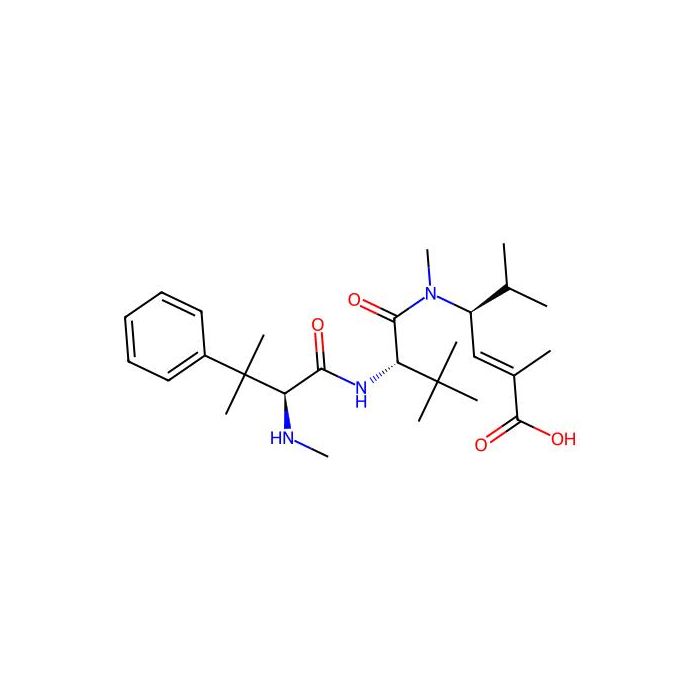
Taltobulin - 10mM in DMSO , CAS No.228266-40-8

CAS: 228266-40-8 Cat. No.: T655576 분자식: C27H43N3O4 분자량: 473.65 PubChem CID: 6918637
주문 가능
등급 & 순도 10mM in DMSO
Storage
Store at -80°C
Shipped In
Dry ice packs + Cold packs
★
크기
USA
독일 (EU)*
가격
수량
1ml
T655576-1ml
2 재고 있음
—
US$506.90
Enter a quantity for the sizes you want to add.
🧪
이 등급을 선택하는 이유

10mM in DMSO 최소한의 기준선 간섭이 필요한 민감한 크로마토그래피 및 분석 워크플로우용.

🌡

보관 및 배송

Store at -80°C Dry ice packs + Cold packs 출고. 정확한 사양은 로트별 COA를 확인하세요.

📋

품질 문서

SDS, COA, 데이터시트, 사양서를 다운로드할 수 있습니다. 로트별 COA는 로트 번호 조회를 통해 확인할 수 있습니다.

📚

문헌적 근거

크로마토그래피, 유기 합성 및 교차 커플링 반응 분야의 동료 심사 논문 0편에서 인용되었습니다.

개요

Taltobulin (HTI-286), a synthetic analogue of the tripeptide hemiasterlin, is a potent antimicrotubule agent that circumvents P-glycoprotein-mediated resistance in vitro and in vivo. Taltobulin inhibits the polymerization of purified tubulin, disrupts microtubule organization in cells, and induces mitotic arrest, as well as apoptosis

In Vitro

Taltobulin (HTI-286; 0.2-7.3 nM; 3 days) inhibits the growth of 18 tumor cell lines (leukemia, ovarian, NSCLC, breast, colon, and melanoma cell lines) with an average IC 50 of 2.5±2.1 nM and a median value of 1.7 nM. MCE has not independently confirmed the accuracy of these methods. They are for reference only. Cell Proliferation AssayCell Line: Leukemia CCRF-CEM cell line; ovarian 1A9 cell line; NSCLC A549 and NCI-H1299 cell lines; breast MX-1W and MCF-7 cell lines; colon HCT-116, DLD-1, Colo205, KM20, SW620, S1, HCT-15 and Moser cell lines; melanoma A375, Lox and SK-Mel-2 cell lines Concentration: 0.2-7.3 nM Incubation Time: 3 days Result: Inhibited the growth of tumor cell lines with IC 50 s of 0.2±0.03 nM (for leukemia CCRF-CEM cell line), 0.6±0.1 nM (for ovarian 1A9 cell line), 1.1±0.5 and 6.8±6.1 nM ( for NSCLC A549 and NCI-H1299 cell lines), 1.8±0.6, 7.3±2.3 nM (for breast MX-1W, MCF-7 cell lines), 0.7±0.2, 1.1±0.4, 1.5±0.6, 1.8±0.6, 3.6±0.8, 3.7±2.0, 4.2±2.5, and 5.3±4.1 nM ( for colon HCT-116, DLD-1, Colo205, KM20, SW620, S1, HCT-15, and Moser cell lines), 1.1±0.8, 1.4±0.6 and 1.7±0.5 nM (for melanoma A375, Lox and SK-Mel-2 cell lines).

In Vivo

Taltobulin (HTI-286; 1.6 mg/kg i.v.) inhibits the growth of human tumor xenografts (e.g., HCT-15, DLD-1, MX-1W, and KB-8-5) in athymic nu/nu female mice . ?\nTaltobulin (HTI-286; 3 mg/kg; p.o. gavage) inhibits growth by 97.3 % and 82% in athymic nu/nu female mice with Lox melanoma xenografts and KB-3-1 epidermoid xenograft model, respectively . MCE has not independently confirmed the accuracy of these methods. They are for reference only. Animal Model: Athymic nu/nu female mice with Lox melanoma model (5-6 weeks of age) Dosage: 1.6 mg/kg Administration: Administered i.v.;for 35 days Result: Growth of Lox tumors was inhibited by 96-98% on day 12 compared with vehicle-treated controls. Growth of KB-8-5 tumors was inhibited by 84% on day 14 compared with vehicle-treated controls. Growth of MX-1W tumors was inhibited by 97% compared with vehicle-treated controls. Growth of DLD-1 and HCT-15 tumors was inhibited by 80 and 66%, respectively.

IC50& Target:Traditional Cytotoxic Agents

사양

사양 및 순도
10mM in DMSO
생화학 및 생리적 메커니즘
Taltobulin (HTI-286), a synthetic analogue of the tripeptide hemiasterlin, is a potent antimicrotubule agent that circumvents P-glycoprotein-mediated resistance in vitro and in vivo. Taltobulin inhibits the polymerization of purified tubulin, disrupts mic
보관 조건
Store at -80°C
배송
Dry ice packs + Cold packs
이 제품은 콜드 체인 배송이 필요합니다.지상 및 기타 경제 서비스는 사용할 수 없습니다.
이름과 식별자
이성체 SMILES
CC(C)[C@@H](/C=C(\C)/C(=O)O)N(C)C(=O)[C@H](C(C)(C)C)NC(=O)[C@H](C(C)(C)C1=CC=CC=C1)NC
PubChem CID
6918637
분자량
473.65

문서

📋 안전 데이터 시트(SDS)

위험성, 취급, 보관 및 규제 준수를 포괄하는 종합 문서.

<<<<<<< HEAD SDS 다운로드 → ======= SDS 다운로드 → >>>>>>> release248-p3

✅ 분석 성적서(COA)

로트별 품질 데이터. 로트 번호를 입력하여 정확한 COA를 확인하세요.

COA 조회 →

📊 데이터시트

제품 사양 및 응용 분야에 대한 빠른 참조 요약.

데이터시트 보기 →

🔬 사양서

이 등급의 전체 품질 특성 및 합격 기준.

사양서 보기 →

고급 데이터

인증서(CoA, COO, BSE/TSE 및 분석 차트)
C of A & Other Certificates(BSE/TSE, COO):
Analytical Chart:

Find and download the COA for your product by matching the lot number on the packaging.

1 results found

Lot NumberCertificate Type날짜항목
I2604212I2604212Certificate of AnalysisSep 07, 2026 T655576
솔루션 계산기
리뷰

고객 리뷰

Application Protocols

Only item-specific, tested protocols should be listed here.

  • Validated applications, recommended dilutions, and positive controls: Not specified for this item; refer to CoA/Spec Sheet or application notes available from Aladdin Scientific.

General suggestion

  • For initial use, perform a small pilot study to determine solubility and potency in your system (e.g., 8–12 point dose–response, constant DMSO ≤0.1–0.2% v/v, replicate wells, and appropriate solvent/positive controls). Document handling steps to ensure reproducibility.
Biological Roles

Scope: For research use only. The following summarizes literature-level biological context for microtubule-targeting tool compounds; it is not an item-specific performance claim.

General mechanism and cellular effects (literature/general knowledge)

  • Primary target class: Tubulin and microtubule cytoskeleton. Compounds of this class disrupt polymerization dynamics, impairing spindle formation and intracellular transport.
  • Cell cycle impact: Perturbation commonly induces G2/M arrest, enabling studies of mitotic control, spindle assembly checkpoint signaling, and chromosome segregation fidelity.
  • Downstream biology: Microtubule disruption can activate apoptotic pathways, alter mitochondrial dynamics, and modulate stress-activated kinases (e.g., JNK, p38). Autophagy and proteostasis responses may also be engaged.
  • Cytoskeletal crosstalk: Changes in microtubules can secondarily affect the actin cytoskeleton and focal adhesion dynamics, influencing cell motility and morphology.

Use cases in chemical biology

  • Probe for pathway mapping: Time-resolved analysis of phosphorylation cascades, transcriptional responses, and proteome remodeling after cytoskeletal stress.
  • Phenotypic screening: Benchmark compound in high-content imaging to quantify microtubule architecture, spindle defects, and cell rounding.
  • Transport and trafficking: Evaluate roles of microtubules in endocytic trafficking, organelle positioning, and vesicular transport.

Notes and cautions

  • Response magnitudes vary with cell type, compound exposure time, and protein binding in the medium. Always establish assay-specific concentration ranges and solvent tolerances. No medical or clinical uses are implied.
Buffer Applications

Not a buffering reagent. However, buffer choice is critical for biological assays using Taltobulin.

General guidance for preparing working solutions (literature/practice; not item specifications)

  • Stocks: Prepare concentrated DMSO stocks (e.g., 10–50 mM) and store at −80°C.
  • Assay buffers/media: Dilute stocks into cell culture medium or physiological buffers such as PBS or HEPES-buffered saline. Maintain final DMSO ≤0.1–0.2% v/v for sensitive cells.
  • Additives: If precipitation occurs on dilution, consider 0.01–0.1% nonionic surfactant (e.g., Tween-80) or the presence of serum proteins to increase apparent solubility.
  • pH and osmolarity: Use standard cell culture conditions (pH 7.2–7.4, ~300 mOsm) unless your model requires deviations.
  • Sterility: For sterile applications, 0.22 µm filter working solutions if compatible with the compound.

Electrophoresis or biochemical assay buffers

  • When monitoring downstream effects (e.g., tubulin polymerization assays in vitro), use manufacturer-recommended polymerization buffers (e.g., PIPES/Mg2+/GTP systems) and include solvent controls matched to the DMSO percentage of Taltobulin solutions.

Documentation

  • Record exact buffer composition, DMSO percentage, and incubation times to ensure reproducibility.
Green Alternatives

Scope note: This section typically addresses greener choices for reaction solvents or reagents. Taltobulin is a bioactive small molecule used as a research probe, not a process solvent or commodity reagent. Consequently, classical “green replacement” guidance is not directly applicable to the compound itself.

Practical sustainability considerations for handling bioactive small molecules (general)

  • Minimize solvent volumes: Use concentrated DMSO stocks and small assay volumes to reduce solvent waste.
  • Aqueous-first dilutions: When compatible with assay performance, keep final organic content low (e.g., ≤0.1–0.2% DMSO). Consider cyclodextrin-assisted delivery to reduce organic solvents.
  • Waste management: Segregate halogenated versus non-halogenated organic waste; capture any wash solvents used during vial rinsing.
  • Energy use: Adhere to recommended −80°C storage but avoid unnecessary door openings and employ aliquots to limit repeated freeze–thaw cycles and product loss.

Alternatives within the tool-compound space

  • If the scientific goal is “microtubule disruption,” there are multiple mechanistic classes (e.g., colchicine-site ligands, vinca-site ligands). Selection should be driven by biological mechanism, off-target profile, and stability rather than generic green metrics. Use the least hazardous effective concentration and consult institutional green chemistry guidelines for screening campaigns.
Pharmaceutical Uses

No therapeutic or clinical claims are made. This product is supplied strictly for research use only.

Formulation and development research context (general; not item-specific claims)

  • Reference/working standard: May be used as a research reference compound in preclinical discovery to benchmark microtubule-targeting activity across assays.
  • In vitro ADME tools: Suitable for exploratory studies of permeability, plasma protein binding, and metabolic stability to develop SAR hypotheses for related scaffolds. Confirm identity and purity rigorously when using as an internal/external control in LC–MS-based assays.
  • Formulation feasibility (lab-scale): Solubilization strategies typically involve DMSO cosolvent systems, lipid/surfactant vehicles, or cyclodextrin inclusion; any in vivo formulation exploration must follow institutional approvals and is outside the scope of this listing.
  • Regulatory status: No pharmacopeial monograph or excipient status is implied.

Best practices

  • Document salt/counter-ion form if applicable, as it affects mass, solubility, and stability.
  • For quantitative bioanalytical method development, verify extinction coefficients and detector response factors empirically; do not assume equivalence to other tubulin modulators.
Physical Properties

Item-specific physical properties (from Product Data)

  • Appearance: Not specified for this item; refer to CoA/Spec Sheet.
  • Molecular Formula / Molecular Weight: Not specified for this item; refer to CoA/Spec Sheet.
  • Other specs (bp, mp, density, refractive index, UV cutoff, metal/peroxide/water limits): Not specified for this item; refer to CoA/Spec Sheet.

Literature/general expectations for handling bioactive small molecules (not item specifications)

  • Physical state: Many tubulin-active small molecules are obtained as crystalline or amorphous solids at ambient temperature; some are delivered as film or powder for ease of dissolution.
  • Solubility: Frequently soluble in high-permittivity organic solvents (e.g., DMSO) with limited aqueous solubility; aqueous working solutions are commonly prepared by dilution of DMSO stock into buffer or medium, sometimes with surfactants (e.g., 0.01–0.1% Tween-80) or serum proteins to mitigate precipitation.
  • pKa/logP: These parameters are scaffold-dependent; consult the CoA or a validated reference for this specific item.
  • Stability: Many microtubule-targeting agents are light- and moisture-sensitive to varying degrees; minimize repeated warming and exposure to ambient humidity.

Practical notes

  • Prepare concentrated DMSO stocks (e.g., 10–50 mM) under dry conditions, then aliquot and store as recommended. Inspect diluted aqueous solutions for haze/precipitation; filter (0.22 µm) if compatible with your assay to ensure reproducibility.
  • For analytical purposes, reversed-phase HPLC/UPLC with UV and/or MS detection is routinely suitable to assess purity and solution stability.
Quality and Grades

Item-specific quality information (from Product Data)

  • Grade/Purity: Not specified for this item; refer to CoA/Spec Sheet.

How to interpret grades (general guidance; not item-specific claims)

  • Screening/Library grade: Prioritizes chemical identity and functional purity suited for high-throughput or phenotypic assays; typically accompanied by purity verification (e.g., HPLC/UPLC-UV or LC–MS). Low nonvolatile residue and minimal interfering impurities are desirable for cellular assays.
  • Analytical/Reference grade: Intended for quantitative bioanalysis or as a reference standard; commonly features rigorous characterization (multi-solvent HPLC, HRMS, full NMR, residual solvent profiling) and tight impurity limits.

What to check on the CoA/Spec Sheet

  • Assay method and result (e.g., HPLC area % and chromatographic conditions).
  • Identity confirmation (NMR, MS, sometimes IR), and any data on isomer ratio/stereochemistry when relevant.
  • Residual solvents/water by GC–MS/KF if reported.
  • Stability notes (light, temperature) and recommended storage.

Stabilizers/additives

  • Stabilizer content: Not specified for this item; refer to CoA/Spec Sheet. If no stabilizer is present, minimize exposure to light, air, and repeated freeze–thaw to preserve integrity.

Fit-for-purpose considerations

  • For cell-based assays, confirm lot-specific purity and endotoxin background (if applicable) and run pilot dose–response curves. For mass spectrometry reference use, verify salt form and counter-ions to ensure mass accuracy.
Reaction and Applications

Applicability: As a bioactive probe, Taltobulin is not typically employed as a synthetic reagent or solvent. Its “applications” in research are primarily as a chemical tool compound.

Research applications (literature/general knowledge; not item-specific claims)

  • Tubulin/microtubule modulation: Widely used to perturb microtubule dynamics for studies of the cytoskeleton, mitosis, intracellular trafficking, and cell morphology.
  • Cell cycle studies: Enables induction of G2/M arrest in many cell types, facilitating synchronization experiments and evaluation of mitotic checkpoints.
  • Apoptosis and stress signaling: Employed to trigger apoptotic pathways downstream of microtubule disruption, allowing time-course mapping of caspase activation, mitochondrial events, and kinase signaling.
  • Chemical genetics and synergy screens: Serves as a positive control or tool compound to assess pathway dependencies and drug–drug interactions with kinase inhibitors, proteostasis modulators, and DNA-damaging agents.
  • Imaging assays: Used with immunofluorescence (e.g., anti-α/β-tubulin antibodies) or live-cell reporters to visualize microtubule depolymerization and spindle defects.

Practical considerations

  • Prepare DMSO stocks (e.g., 10–20 mM), store as aliquots at −80°C, protect from light, and minimize freeze–thaw.
  • Determine cell line–specific IC50/EC50 empirically via dose–response (e.g., 8–12 point, 3-fold serial dilutions).
  • Include solvent-only and orthogonal control compounds (e.g., taxanes or vinca-site ligands) to benchmark assay dynamic range.
Reaction Conditions

Not typically applicable. Taltobulin is a research-use bioactive compound rather than a reagent for synthetic transformations.

For researchers conducting biology/biochemistry assays (general guidance; not item-specific specifications)

  • Stock preparation: Dissolve in anhydrous DMSO to 10–50 mM under low light; vortex/sonicate briefly if needed.
  • Working concentrations: Establish empirically by dose–response in your model system; microtubule-active compounds often show cellular effects in the low-nanomolar to micromolar range depending on cell type and assay duration.
  • Incubation conditions: Typical cell culture assays are run at 37°C, 5% CO2; pretreat cells 1–24 h depending on endpoint (mitotic arrest vs apoptosis markers).
  • Controls: Include solvent-only controls and, where appropriate, orthogonal microtubule modulators for benchmarking. Maintain constant final DMSO across all wells.

For chemical analysis

  • HPLC/UPLC: Start with C18 columns, aqueous buffer with 0.1% formic acid and acetonitrile or methanol gradient; monitor by UV and MS. Adjust as needed once retention and purity are known.

Always adapt to your laboratory SOPs and validate conditions for your specific assay or analytical platform.

Safety and Handling

Item-specific hazard information (from Product Data)

  • Signal Word / H-Statements / GHS Classification / Pictograms: Not specified for this item; refer to SDS.

General safety guidance for bioactive tubulin modulators (literature/general knowledge; not item-specific)

  • Toxicological profile: Compounds that disrupt microtubules are commonly cytotoxic and may be harmful if inhaled, ingested, or upon skin contact. Handle in a chemical fume hood using good laboratory practice.
  • PPE: Lab coat, safety glasses or face shield, and disposable nitrile gloves. For weighing/milling, consider double-gloving and using antistatic tools to avoid aerosolization.
  • Engineering controls: Weigh and dissolve in a ventilated enclosure. Use closed containers and secondary containment for transport within the lab.
  • Incompatibilities: Avoid strong oxidizers and strong acids/bases unless required by a validated procedure. Keep away from light and moisture when stability is uncertain.
  • First-aid overview: If on skin, wash with soap and water; remove contaminated clothing. If in eyes, rinse cautiously with water for several minutes. If inhaled, move to fresh air; if swallowed, rinse mouth. Seek medical attention per institutional policy.
  • Spill/accidental release: Avoid dust/solution contact; absorb liquids with inert material, collect solids with HEPA-filtered vacuum or damp wipes; dispose as hazardous chemical waste.
  • Disposal: Treat as hazardous organic waste per local regulations; do not discharge to drains.

Always consult the product-specific SDS supplied by Aladdin Scientific for authoritative hazard, handling, and emergency information.

Solvent Selection

Applicability: Taltobulin is a bioactive small molecule; solvent choice primarily concerns preparation of stock solutions for biochemical or cellular assays rather than use as a reaction solvent.

General guidance (literature/practice; not item specifications)

  • Primary solvent: DMSO is the standard due to high solvating power for hydrophobic scaffolds and compatibility with most biological assays at ≤0.1–0.5% v/v in the final medium.
  • Secondary solvents/cosolvents: Ethanol or DMF may dissolve the compound; for aqueous work, dilute DMSO stocks into buffer or culture medium. To improve apparent solubility, consider 0.01–0.1% nonionic surfactants (e.g., Tween-80) or serum-containing media.
  • Aqueous vehicles: Phosphate- or HEPES-buffered saline with ≤0.1% DMSO; cyclodextrin complexation can be evaluated if very low DMSO is required.

Polarity/miscibility context

  • DMSO (dielectric ~47, miscible with water) supports high-concentration stocks (e.g., 10–50 mM) and reliable dilution behavior.
  • Ethanol (dielectric ~24, water-miscible) is an alternative but may have greater biological effects at comparable v/v.

Practical tips

  • Warm gently (room temperature) and vortex/sonicate to aid dissolution; avoid prolonged heating.
  • Filter sterilize working solutions (0.22 µm PTFE/PES) when compatible with assay and molecule stability.
  • Keep final DMSO ≤0.1–0.2% for sensitive cell lines unless otherwise validated.

Comparison (general)

  • DMSO: highest solvency, low assay interference at low %.
  • Ethanol: acceptable alternative but higher biological impact.
  • Aqueous + cosolvent/surfactant: best for in vivo-like media when minimal organic content is needed.
Storage and Reconstitution

Item-specific (from Product Data)

  • Storage Conditions: Store at −80°C.
  • Shipped In: Dry ice packs + Cold packs.

General best practices for this compound type (literature/practice; not item-specific guarantees)

  • Reconstitution solvent: Use anhydrous DMSO to prepare concentrated stock solutions (e.g., 10–50 mM). Record exact concentration, solvent, and date of preparation on the vial.
  • Aliquoting: Divide into small, single-use aliquots (e.g., 10–50 µL) in inert, low-bind vials to avoid repeated freeze–thaw and adsorption losses.
  • Handling: Allow vials to equilibrate to room temperature in a desiccator before opening to prevent moisture condensation. Maintain low light exposure if the scaffold is photosensitive.
  • Freeze–thaw: Avoid; repeated cycling can degrade sensitive compounds. Thaw only what is needed for immediate use.
  • Short-term storage: If necessary, keep thawed DMSO stocks on ice and return unused portions to −80°C promptly; discard aliquots that show precipitation or degradation by HPLC/LC–MS.
  • Aqueous working solutions: Prepare fresh immediately before use. If stability permits, keep at 2–8°C for the duration of the experiment only.

Not specified for this item; refer to CoA/Spec Sheet

  • Stabilizers, exact solubility limits in various solvents, light sensitivity, and solution stability window should be confirmed from the lot-specific documentation.
Structure and Identity

Brief description: Taltobulin is a research-use small molecule commonly employed as a tubulin-acting probe in chemical biology and screening collections.

Item-specific (from Product Data)

  • Product Name: Taltobulin (SKU: T655576)
  • CAS: 228266-40-8
  • PubChem CID: 6918637
  • InChIKey: Not specified for this item; refer to CoA/Spec Sheet.
  • SMILES: Not specified for this item; refer to CoA/Spec Sheet.
  • Molecular Formula: Not specified for this item; refer to CoA/Spec Sheet.
  • Molecular Weight: Not specified for this item; refer to CoA/Spec Sheet.

General structural notes (literature/general knowledge; not item specifications)

  • Compound class: Synthetic small molecule; widely referenced as a microtubule/tubulin-targeting agent in the literature.
  • Likely features: Aromatic cores and amide/urea-like linkages are common in this scaffold class; exact functional groups for this lot are not specified here.
  • Stereochemistry: Reported analogs may possess defined stereocenters; item-specific stereochemistry is not provided here.

2D-structure description (general, literature-level)

  • Taltobulin analogs are typically composed of multiple aromatic/heteroaromatic rings connected by short linkers bearing polar functionalities (e.g., amide-like). Such architectures promote binding to tubulin through a combination of hydrophobic contacts and H-bonding. The exact substitution pattern and heteroatom placement for this specific item should be verified against the Certificate of Analysis (CoA) or structure data supplied with your order.

Identity confirmation guidance (general best practice)

  • Verify identity by orthogonal methods (e.g., HRMS, 1H/13C NMR, and, when applicable, HPLC/UPLC retention time matching to a qualified reference).
Synthetic Utility

Applicability note: Taltobulin is a finished bioactive small molecule used as a tool compound; it is not typically employed as a reagent, catalyst, or protecting group in synthesis.

General synthetic context (literature-level; not item-specific)

  • Scaffold assembly: Molecules in this class are often constructed via convergent coupling of aromatic/heteroaromatic fragments using amide/urea formation, aryl–aryl coupling (e.g., Suzuki–Miyaura, Buchwald–Hartwig), and selective functional group interconversions.
  • Analytical characterization: Purity is commonly established by reversed-phase HPLC/UPLC with UV detection; identity by HRMS and full NMR. Chiral HPLC may be required if stereocenters are present.

When a chemist might engage synthetically

  • Analogue synthesis: To explore SAR, one might vary aryl substitution, linker length, or heteroatom placement to modulate tubulin-binding potency and solubility.
  • Prodrug/salt strategies: Modifications to improve solubility or stability (e.g., salt screening) are common in lead optimization.

Takeaway

  • If your project requires derivatization or immobilization of this scaffold (e.g., for target engagement assays), confirm exact structure, reactive handles, and stereochemistry from the CoA or primary literature and design routes accordingly.
Target Specificity

Only item-specific information should be listed here.

  • Target details, binding site, and selectivity: Not specified for this item; refer to CoA/Spec Sheet and primary literature for Taltobulin.

Note: While microtubules/tubulin are commonly cited in the literature for this class of compounds, no item-specific target data are provided in the Product Data for SKU T655576.

Shall we send you a message when we have discounts available?

Remind me later

Thank you! Please check your email inbox to confirm.

Oops! Notifications are disabled.