
Determine the necessary mass, volume, or concentration for preparing a solution.
| Activity Type | Relation | Activity value | Units | Action Type | Journal | PubMed Id | doi | Assay Aladdin ID |
|---|
Information
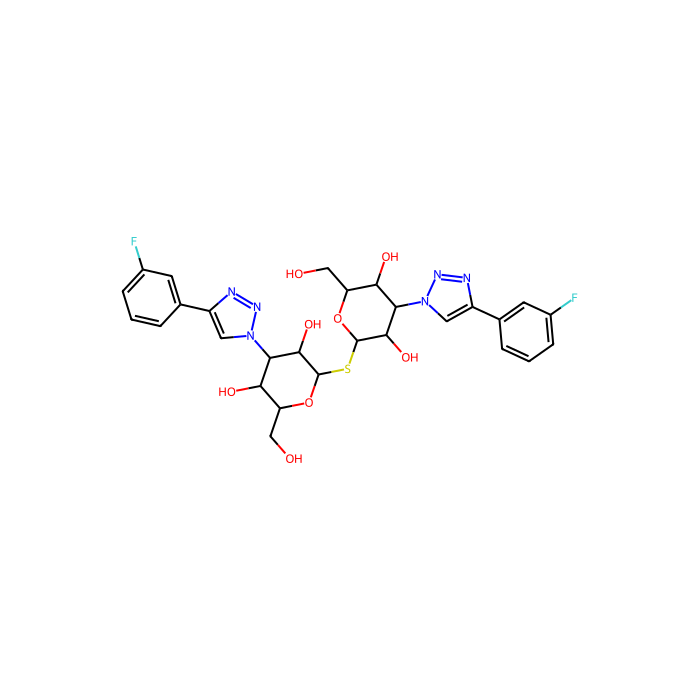
TD-139 TD-139 (GB0-139) is a potent and selective inhibitor of galectin-3 with Kd of 0.036 µM over galectin-1 and galectin-7 with Kd of 2.2 µM and 32 µM, respectively. TD-139 is used potentially for the treatment of idiopathic pulmonary fibrosis (IPF).
Targets
galectin-3 (Cell-free assay); galectin-1 (Cell-free assay); galectin-7 (Cell-free assay) 0.036 μM(Kd); 2.2 μM(Kd); 32 μM(Kd)
Taxonomy Tree
| Kingdom | Organic compounds |
|---|---|
| Superclass | Organic oxygen compounds |
| 분류 | Organooxygen compounds |
| Subclass | Carbohydrates and carbohydrate conjugates |
| Intermediate Tree Nodes | Not available |
| Direct Parent | Disaccharides |
| Alternative Parents | Phenyl-1,2,3-triazoles Fluorobenzenes Oxanes Aryl fluorides Monothioacetals Heteroaromatic compounds Secondary alcohols Sulfenyl compounds Oxacyclic compounds Azacyclic compounds Primary alcohols Organonitrogen compounds Organofluorides Hydrocarbon derivatives |
| Molecular Framework | Aromatic heteromonocyclic compounds |
| Substituents | Disaccharide - Phenyltriazole - Phenyl-1,2,3-triazole - Fluorobenzene - Halobenzene - Benzenoid - Oxane - Aryl fluoride - Aryl halide - Monocyclic benzene moiety - Heteroaromatic compound - 1,2,3-triazole - Triazole - Azole - Monothioacetal - Secondary alcohol - Organoheterocyclic compound - Oxacycle - Sulfenyl compound - Azacycle - Hydrocarbon derivative - Alcohol - Organic nitrogen compound - Organohalogen compound - Organofluoride - Organonitrogen compound - Organosulfur compound - Primary alcohol - Aromatic heteromonocyclic compound |
| 설명 | This compound belongs to the class of organic compounds known as disaccharides. These are compounds containing two carbohydrate moieties linked to each to each other through a glycosidic bond, no set of three or more glycosidically linked carbohydrate units. |
| External Descriptors | Not available |
| Activity Type | Relation | Activity value | Units | Action Type | Journal | PubMed Id | doi | Assay Aladdin ID |
|---|
| DMSO(mg/mL) 최대 용해도 | 100 |
|---|---|
| DMSO(mM) 최대 용해도 | 154.16872224963 |
| 물(mg/mL) 최대 용해도 | ˂1 |
| 분자량 | 648.6 |
| XLogP3 | 0.200 |
| Hydrogen Bond Donor Count | 6 |
| Hydrogen Bond Acceptor Count | 15 |
| Rotatable Bond Count | 8 |
| Exact Mass | 648.181 Da |
| Monoisotopic Mass | 648.181 Da |
| Topological Polar Surface Area | 227.000 Ų |
| Heavy Atom Count | 45 |
| Formal Charge | 0 |
| Complexity | 903.000 |
| Isotope Atom Count | 0 |
| Defined Atom Stereocenter Count | 10 |
| Undefined Atom Stereocenter Count | 0 |
| Defined Bond Stereocenter Count | 0 |
| Undefined Bond Stereocenter Count | 0 |
| The total count of all stereochemical bonds | 0 |
| Covalently-Bonded Unit Count | 1 |
No tested applications or recommended dilutions are provided in the Product Data for this item.
General protocol suggestions for small-molecule ligands (for adaptation to your assay):
Please consult the CoA/Spec Sheet and SDS for any item-specific instructions that supersede these general recommendations.
This Moligand™ entry is offered as a small-molecule research ligand for target and pathway studies. The Product Data do not specify a biological target or mechanism for this specific item; therefore, the following guidance is general and should be adapted to your research context.
Important: No medical or clinical claims are made. This product is for research use only, and any biological role must be experimentally determined for the specific system under study.
While TD-139 is not a buffering agent, buffers are central to its successful use in biochemical and cellular assays.
Practical guidance (general):
Electrophoresis/cell culture notes:
Green chemistry considerations for this item focus on solvent usage during handling and assays rather than replacement of the compound itself.
Small comparison (general, not item-specific specifications):
Operational tips to reduce environmental impact:
Note: No greener “alternative compound” is suggested here because the molecular identity and target use of this catalog entry are item-specific and not substitutable without altering research aims.
This product is supplied strictly for research use and is not intended for human or veterinary use, diagnostics, or clinical applications.
Formulation and development context (general, not item-specific specifications):
Manufacturing/CMC notes (general):
Reminder: Do not deploy this material in any clinical setting. All handling should remain within research laboratories with appropriate approvals.
Item-specific physicochemical parameters are not disclosed in the Product Data and should be confirmed on the CoA/Spec Sheet for your lot.
Literature/computational notes (general, not item-specific specifications):
Key quality considerations for this item:
Practical guidance:
This product is positioned as a research ligand (Moligand™) rather than a synthetic reagent. Consequently, classical synthetic reaction applications (e.g., cross-couplings, condensations) are not the primary use case.
Relevant applications for this item in discovery workflows:
Practical notes:
If you intend to use the compound in chemical synthesis, treat it as a complex substrate with potentially sensitive functional groups; no specific reactivity guidance is provided for this item.
Classical reaction-condition guidance is not applicable because this product is not offered as a reagent for performing named organic reactions. However, for operations related to handling and preparing the compound for assays, the following practical conditions are typical (general, not item-specific specs):
If you plan to use the compound in chemical synthesis despite the above positioning, you will need to determine compatible solvents, temperatures, and catalysts empirically after establishing the exact structure; no literature reaction conditions are asserted for this item.
Safety information for this item is limited in the Product Data; consult the SDS for authoritative guidance.
General laboratory precautions (good practice for small-molecule ligands):
Special risks/handling tips:
Given the lack of item-specific solubility data, solvent selection should follow best practices for small-molecule screening ligands.
Comparison (general guidance):
Tips:
Item-specific storage and shipping conditions are provided in the Product Data.
Research use note: For research use only. Not for use in humans or clinical diagnostics.
Brief overview: TD-139 is supplied as a research-use small molecule entry in the Moligand™ collection. Only limited structural identifiers are provided for this specific catalog item.
Structural features (general context):
2D structure description (general guidance):
This item is supplied as a finished small-molecule ligand for screening and is not positioned as a building block or reagent.
Bottom line: Treat TD-139 in this catalog entry as a research ligand rather than a synthetic synthon. If a functionalized precursor is needed, consider requesting custom synthesis or searching for designated building blocks with defined reactive handles.
Target/epitope information is not specified in the Product Data for this item.
Guidance:
당사의 등급 선택 가이드는 카탈로그의 모든 변형 제품에 대해 순도, 안정제 상태 및 용도 적합성을 다룹니다.
Moligand™ 등급 가이드 보기 →