GRADE & PURITYMoligand™?Moligand™ — Aladdin's line of ligands and bioactive small molecules. Use for receptor, pathway, and binding studies needing defined small-molecule tools.10mM in DMSO
Moligand™, 10mM in DMSO Moligand™ for sensitive chromatographic and analytical workflows requiring minimal baseline interference.
🌡
Storage & shipping
Store at -80°C Ships Dry ice packs + Cold packs Check lot-specific COA for exact specifications.
📋
Quality documents
SDS, COA, datasheet, and spec sheet available for download. Lot-specific COA accessible via lot number lookup.
📚
Literature proof
Cited in 0 peer-reviewed publications across chromatography, organic synthesis, and cross-coupling reactions.
개요
Information
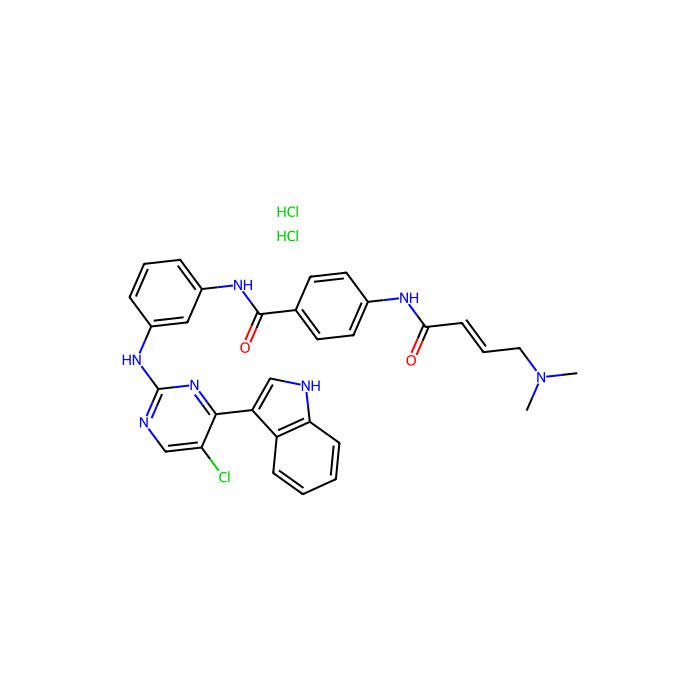
THZ1 is a covalentCDK7inhibitor which has the unprecedented ability to target a remote cysteine residue located outside of the canonical kinase domain, providing an unanticipated means of achieving selectivity for CDK7. In vitro
THZ1 uses a unique mechanism, combining ATP-site and allosteric covalent binding, as a means of attaining potency and selectivity for CDK7. THZ1 irreversibly inhibits RNAPII CTD phosphorylation by covalently targeting a unique cysteine located outside the kinase domain of CDK7. THZ1, but not THZ1-R, completely inhibits the phosphorylation of the established intracellular CDK7 substrate RNAPII CTD at Ser\u20095 and Ser\u20097, with concurrent loss of Ser\u20092 phosphorylation at 250\u2009nM in Jurkat cells. THZ1 exhibits strong antiproliferative effects across a broad range of cancer cell lines from various cancer types. In Jurkat cells, low-dose THZ1 has a profound effect on a small subset of genes, including the key regulator RUNX1, thus contributing to subsequent loss of the greater gene expression program and cell death. THZ1 causes defects in Pol II(polymerase II) phosphorylation, co-transcriptional capping, promoter proximal pausing, and productive elongation.
In vivo
THZ1 reduces the proliferation of KOPTK1 T-ALL cells in a human xenograft mouse model. THZ1 is well tolerated at 10 mg/kg with no observable body weight loss or behavioural changes, suggesting that it causes no overt toxicity in the animals. Cell Data
THZ1 is a covalent CDK7 inhibitor which has the unprecedented ability to target a remote cysteine residue located outside of the canonical kinase domain, providing an unanticipated means of achieving selectivity for CDK7.
보관 조건
Store at -80°C
배송
Dry ice packs + Cold packs
이 제품은 콜드 체인 배송이 필요합니다.지상 및 기타 경제 서비스는 사용할 수 없습니다.
등급
Moligand™
작업 유형
INHIBITOR
작동 메커니즘
Inhibitor of cyclin dependent kinase 7
이름과 식별자
분자량
638.97
Documentation
📋 Safety Data Sheet (SDS)
Comprehensive hazard, handling, storage, and regulatory compliance document.
Solubility (25°C) In vitro DMSO: 63 mg/mL warmed with 50ºC Water: bath (199.74 mM); Water: Insoluble; Ethanol: Insoluble;
솔루션 계산기
Molarity Calculator
Determine the necessary mass, volume, or concentration for preparing a solution.
Dilution Calculator
Determine the dilution needed to prepare a stock solution.
Reconstitution Calculator
리뷰
고객 리뷰
자주 묻는 질문
What is Moligand??
Moligand? is one of Aladdin Scientific's premium product lines, formulated for high-purity applications across multiple workflows. Compared to standard grades in the same workflow, Moligand? products typically offer tighter specifications, more rigorous QC, and stronger lot-to-lot consistency.
How should this product be stored?
Store at ?80 °C. Ultra-low temperature storage is required to maintain the specified shelf life.
How is this product shipped?
This product ships frozen with dry ice and cold packs. Unpack on arrival and transfer it to the storage condition stated above; handle dry ice with insulated gloves in a ventilated area.
What are the CAS number, molecular formula and molecular weight?
The CAS Number is 1604810-83-4(freebase), the molecular formula is C31H30Cl3N7O2, and the molecular weight is 638.97 g/mol.
What documentation is provided?
Available product documentation, including Certificates of Analysis (COA), Safety Data Sheets (SDS), and specification sheets, is shown in the product document area. Document availability and access follow the current site policy.
Need help choosing the grade?
Our grade selection guide covers purity, stabilizer status, and application suitability for all variants in our catalog.
We use cookies to ensure the website functions properly and, where permitted, to improve your experience. You can manage your preferences at any time in Settings. Learn more in our Cookie Policy.
Shall we send you a message when we have discounts available?
Remind me later
Thank you! Please check your email inbox to confirm.
Products are supplied to verified businesses, institutions, and qualified professionals for research and development use only. Not for use in humans, animals, diagnosis, or therapy.