등급 & 순도Moligand™?Moligand™ — Aladdin's line of ligands and bioactive small molecules. Use for receptor, pathway, and binding studies needing defined small-molecule tools.≥98%
Synonyms
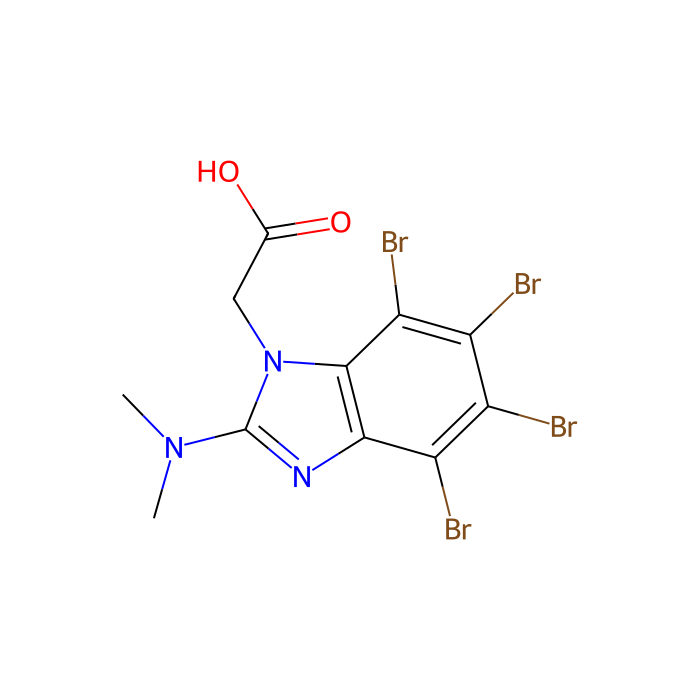
TMCB|CK2/ERK8-IN-1|Casein Kinase II Inhibitor VI|2-[4,5,6,7-tetrabromo-2-(dimethylamino)benzimidazol-1-yl]acetic acid|[4,5,6,7-Tetrabromo-2-(Dimethylamino)-1h-Benzimidazol-1-Yl]acetic Acid|2-(4,5,6,7-Tetrabromo-2-(dimethylamino)-1H-benzo[d]imidazol-1-yl)acetic acid|ERK8 Inhibitor I|Casein Kinase II Inhibitor VI, TMCB - CAS 905105-89-7|K66|4,5,6,7-Tetrabromo-2-(dimethylamino)-1H-benzimidazole-1-acetic acid
Store at Room Temperature. The product can be stored for up to 12 months.
사양
동의어
TMCB | CK2/ERK8-IN-1 | Casein Kinase II Inhibitor VI | 2-[4,5,6,7-tetrabromo-2-(dimethylamino)benzimidazol-1-yl]acetic acid | [4,5,6,7-Tetrabromo-2-(Dimethylamino)-1h-Benzimidazol-1-Yl]acetic Acid | 2-(4,5,6,7-Tetrabromo-2-(dimethylamino)-1H-benzo[d]imidazol-1-yl)acetic acid | ERK8 Inhibitor I | Casein Kinase II Inhibitor VI, TMCB - CAS 9 Show more
사양 및 순도
Moligand™, ≥98%
생화학 및 생리적 메커니즘
CK2 inhibitor (K i = 0.25 μM), more selective than DMAT. Unlike DMAT, TMCB displays selectivity over PIM1, HIPK2 and DYRK1a (K i values are 8.65, 15.25 and 11.90 μM, respectively) and a more favourable selectivity profile over a range of other kinases.
보관 조건
Room temperature
배송
Normal
등급
Moligand™
작업 유형
INHIBITOR
작동 메커니즘
Inhibitor of casein kinase 2; alpha 1 polypeptide subunit;Inhibitor of casein kinase 2; alpha prime polypeptide subunit
참고
Wherever possible, you should prepare and use solutions on the same day. However, if you need to make up stock solutions in advance, we recommend that you store the solution as aliquots in tightly sealed vials at -20°C. Generally, these will be useable for up to one month. Before use, and prior to opening the vial we recommend that you allow your product to equilibrate to room temperature for at least 1 hour. Need more advice on solubility, usage and handling? Please visit our frequently asked questions (FAQ) page for more details.
This compound belongs to the class of organic compounds known as alpha amino acids and derivatives. These are amino acids in which the amino group is attached to the carbon atom immediately adjacent to the carboxylate group (alpha carbon), or a derivative thereof.
External Descriptors
Not available
1. Djoumbou Feunang Y, Eisner R, Knox C, Chepelev L, Hastings J, Owen G, Fahy E, Steinbeck C, Subramanian S, Bolton E, Greiner R, and Wishart DS. ClassyFire: Automated Chemical Classification With A Comprehensive, Computable Taxonomy. Journal of Cheminformatics, 2016, 8:61.
Determine the necessary mass, volume, or concentration for preparing a solution.
Dilution Calculator
Determine the dilution needed to prepare a stock solution.
Reconstitution Calculator
리뷰
고객 리뷰
Application Protocols
Item-specific, validated application protocols are not provided for TMCB. The following are general, non-item-specific suggestions for small-molecule screening compounds:
Stock preparation: Weigh accurately, dissolve in anhydrous DMSO to a convenient concentration (e.g., 10–50 mM). Vortex and sonicate if needed. Filter through 0.22 µm PTFE for particulate removal if required by your assay.
Working solutions: Dilute into assay buffer or media to the desired final concentration while keeping DMSO ≤ assay tolerance (commonly 0.1–1%). Prepare serial dilutions freshly to minimize adsorption and degradation.
Stability checks: Assess freeze–thaw stability and bench-top stability by LC–MS/LC–UV over the assay time course. Protect from light if chromophores are suspected.
For detailed, item-specific protocols, consult the CoA/SDS or contact Aladdin Scientific technical support.
Biological Roles
Item-specific biological roles or targets for TMCB are not provided. Without a defined structure or mechanistic annotation, no endogenous role can be assigned.
General context for small-molecule screening compounds (not item-specific):
Such molecules are used as chemical probes or starting points for structure–activity relationship (SAR) development. Any observed biological activity is context- and assay-dependent and must be confirmed with orthogonal methods.
Off-target risks and assay interference (fluorescence, redox cycling, colloidal aggregation) should be evaluated during screening to avoid false positives.
ADME-relevant properties (logD, pKa, TPSA) guide permeability and protein binding assessments; these require a known structure and should be computed/measured before biological interpretation.
Note: This product is designated For research use only; it is not intended for diagnostic, therapeutic, or clinical applications.
Buffer Applications
TMCB is a small organic compound and is not a buffering reagent. No buffer systems or pKa values are provided in the Product Data.
Guidance (general):
If preparing assay solutions, dissolve in an appropriate stock solvent (commonly DMSO), then dilute into the working buffer (e.g., PBS, HEPES, or Tris) ensuring the final organic solvent percentage is compatible with your assay.
If ionizable groups are later confirmed, buffer selection may influence solubility and stability; evaluate pH-dependent solubility and perform compatibility checks.
For exact buffering recipes or pH ranges, refer to established buffer reagents; this product is not intended as a buffer component.
Green Alternatives
Because solvent and process details for TMCB are not provided, the following guidance addresses greener choices in common scenarios for small-molecule handling (general recommendations):
Stock solutions: Prefer water or buffered aqueous media if compound solubility and stability allow. When organic is required, consider bio-based or lower-toxicity solvents.
Comparison (general, not item-specific):
DCM/CHCl3 (traditional) vs. EtOAc/Me-THF/CPME (greener):
Ethyl acetate and 2-methyltetrahydrofuran offer lower toxicity and, in many cases, comparable extraction and reaction performance.
DMF/NMP vs. Cyrene/PC/GBL:
Cyrene (dihydrolevoglucosenone) can replace DMF in some coupling reactions; propylene carbonate (PC) and gamma-butyrolactone (GBL) are higher-boiling, less volatile options.
Acetonitrile vs. ethanol/isopropanol (for precipitation/recrystallization): Alcohols may be preferable from a safety/green perspective if they meet performance requirements.
Practical steps:
Minimize DMSO concentration in biological assays; validate lowest effective %.
Use micro-scale assays to reduce solvent waste and employ closed-vial handling to limit emissions.
Tradeoffs:
Greener solvents can change selectivity, rates, and solubility. Conduct small pilot experiments and verify analytical comparability before scale-up.
Pharmaceutical Uses
No pharmacopeial status or excipient role is provided for this item. TMCB is supplied for research use only and is not intended for human or veterinary use.
General formulation context (not item-specific):
Screening compounds are typically formulated only as laboratory stocks (e.g., DMSO solutions) for in vitro testing. If preclinical enabling studies are contemplated, comprehensive CMC characterization (polymorph, solvate, stability, impurity profile) and toxicology are required—but such activities are outside the scope of this catalog entry.
What is specified for this item:
Research Use Note: For research use only
Storage Conditions: Room temperature
No claims are made here regarding therapeutic use, dosage forms, or regulatory status.
Physical Properties
Item-specific properties (from Product Data):
Appearance: Not specified for this item; refer to CoA/Spec Sheet.
Melting point (MP): Not specified for this item; refer to CoA/Spec Sheet.
Boiling point (BP): Not specified for this item; refer to CoA/Spec Sheet.
Density: Not specified for this item; refer to CoA/Spec Sheet.
Refractive index: Not specified for this item; refer to CoA/Spec Sheet.
Solubility profile: Not specified for this item; refer to CoA/Spec Sheet.
logP/logD, pKa: Not specified for this item; refer to CoA/Spec Sheet.
Literature/computational context (general):
For small-molecule screening ligands, solubility is commonly assessed in DMSO (10–50 mM stock) and subsequently diluted into assay buffers. Hygroscopicity, polymorphism, or hydrate/solvate formation may affect apparent physical constants; verify with lot-specific data.
Practical notes:
If solid: gently warm and sonicate when preparing DMSO stocks; avoid water ingress until solubility is confirmed.
If liquid: determine density prior to volumetric dosing; use mass-based addition when possible.
Always base method development on measured, lot-specific data from the CoA (LC purity, residual solvent content, and water by KF, if available).
Quality and Grades
Item-specific details (from Product Data):
Grade: Moligand™
Purity specification: Not specified for this item; refer to CoA/Spec Sheet.
What Moligand™ typically implies (general context, not item-specific):
Moligand™ is used to denote compounds curated for molecular recognition studies and screening workflows (e.g., HTS, fragment or ligand discovery). Emphasis is usually placed on identity verification (NMR, LC–MS) and practicality for screening stock preparation (e.g., DMSO compatibility). Exact acceptance criteria (purity %, residual solvents, counterions, water content) are lot-dependent—consult the CoA for this item.
Analytical considerations (recommended best practices):
Verify identity by orthogonal methods (LC–MS and 1H NMR). If UV use is anticipated (e.g., HPLC detection), request UV spectra or cutoffs.
If performing SAR or hit confirmation, determine purity by quantitative methods (qNMR, LC–UV at multiple wavelengths) and check for tautomer/rotamer mixtures where applicable.
What is not specified for this item:
Water content, inorganic residue/metal limits, stabilizers, and UV absorbance characteristics: Not specified for this item; refer to CoA/Spec Sheet.
Reaction and Applications
Item-specific reactivity and application notes are not provided in the Product Data. The following guidance reflects general best practices for small-molecule screening library members (not item-specific claims):
Discovery workflows: Typical uses include hit identification/validation, selectivity profiling, and chemoinformatic benchmarking. Prepare accurately quantified DMSO stocks, verify purity (LC–UV/LC–MS), and assess stability under assay conditions (light, pH, temperature).
Analytical development: Build LC methods across orthogonal systems (reverse-phase C18 and HILIC) to detect degradants. Use multi-wavelength detection (e.g., 210/254/280 nm) or MS.
If synthetic elaboration is planned: Without a known structure, route scouting should begin with functional-group reconnaissance via spectroscopic characterization (1H/13C NMR, FTIR, HRMS). Establish whether salts, solvates, or tautomers are present.
Assay interference controls: Screen for fluorescence/absorbance interference and redox activity (PAINS/Ro5 filters) where applicable. Include detergent controls to mitigate aggregation artifacts.
For concrete, reaction-specific guidance, the chemical structure and functional groups must be known. Please consult the CoA/SDS or request the structure file from Aladdin Scientific.
Reaction Conditions
No item-specific reaction conditions are available for TMCB. If you intend to use it as a substrate, reagent, or intermediate, determine the functional groups first and proceed with conditions appropriate to those motifs.
General guidance (not item-specific):
Couplings: For aryl halides, typical Suzuki–Miyaura conditions include Pd(PPh3)4 or Pd-PEPPSI catalysts in aqueous ethanol/THF or 2-MeTHF with K2CO3/Cs2CO3 at 50–90°C.
Amide formation: HATU/DIPEA or EDCI/HOBt alternatives in DMF/MeCN or greener media (EtOAc, 2-MeTHF) at rt–40°C.
Reductive amination: NaBH(OAc)3 or hydrogenation (Pd/C) in MeOH/MeCN at rt–40°C.
Heteroatom alkylation/acylation: Use mild bases (K2CO3, DIPEA) in acetone/MeCN/DMF; monitor by LC–MS.
Analytical control:
Track reactions with LC–MS and TLC; confirm identity by NMR and HRMS. Evaluate stability under heat/base/acid as needed.
These are literature-style examples and must be adapted once the structure of TMCB is confirmed.
Safety and Handling
Item-specific hazard information:
GHS Classification: Not specified for this item; refer to SDS.
Signal Word: Not specified for this item; refer to SDS.
H-Statements: Not specified for this item; refer to SDS.
Pictograms: Not specified for this item; refer to SDS.
General laboratory safety (not item-specific; follow institutional SOPs):
PPE: lab coat, safety glasses, appropriate chemically resistant gloves (e.g., nitrile), and closed-toe shoes. Handle powders in a fume hood to minimize inhalation exposure.
Incompatibilities: Unknown for this item. Until defined, avoid strong oxidizers/reducers and strong acids/bases. Segregate according to your chemical hygiene plan.
First aid (general): Inhalation—move to fresh air; Skin—wash with soap and water; Eyes—rinse with water for 15 minutes; Ingestion—rinse mouth. Seek medical advice. Defer to SDS for definitive measures.
Spill response: Contain, avoid dust/aerosol formation, collect with inert absorbent, and dispose per local regulations.
Waste: Accumulate in a compatible container with proper labeling; do not sewer. Follow local hazardous waste procedures.
Note: Always consult the item-specific SDS for authoritative hazard classification, exposure limits, and reactive hazard information prior to use.
Solvent Selection
Item-specific solubility and solvent compatibility are not provided. Use the following general decision path for small-molecule screening compounds:
Primary stock solvent: DMSO is the default for discovery compounds; begin with 10–50 mM tentative stock concentration. If insoluble, consider DMF, NMP, or PEG-400 for intermediate concentrates, then dilute into assay medium.
Aqueous work: Evaluate co-solvent tolerance (e.g., ≤0.5–1% DMSO in biochemical assays). Use surfactant-containing buffers (0.01–0.05% Tween-20) only if compatible with your assay readout.
Miscibility and polarity (general):
Polar aprotic: DMSO, DMF, acetonitrile—good for many heteroaromatics and polar scaffolds.
Protic: methanol, ethanol—useful for ionizable molecules; may affect bioassays.
Nonpolar: dichloromethane, toluene, ethyl acetate—use for extractions or nonpolar scaffolds.
Comparison guide (general):
DMSO vs DMF: DMSO is less volatile and broadly biocompatible at low %; DMF can improve solubility for certain amide-rich scaffolds but is less desirable in biology.
Acetonitrile vs methanol (chromatography): ACN offers lower backpressure and UV transparency; MeOH can modulate selectivity, especially for H-bonding analytes.
Always confirm solvent choice and concentration with small-scale solubility tests and your specific assay tolerances.
Storage and Reconstitution
Item-specific information (from Product Data):
Storage Conditions: Room temperature
Shipped In: Normal
Additional details:
Appearance: Not specified for this item; refer to CoA/Spec Sheet.
Stabilizers or special additives: Not specified for this item; refer to CoA/Spec Sheet.
General best practices (not item-specific):
Store tightly sealed in the original container at ambient temperature, dry, and protected from excessive light. Use desiccation if hygroscopicity is suspected.
For stock solution preparation, DMSO is commonly used for discovery compounds. Prepare single-use aliquots to avoid repeated freeze–thaw. If aqueous solubility permits, consider aqueous buffers; verify stability first.
Label stocks with concentration, solvent, preparation date, and storage conditions. For long-term storage of solutions, 2–8°C or −20°C may be beneficial depending on stability; confirm empirically.
Always defer to the item’s CoA and SDS for definitive storage and handling instructions.
Structure and Identity
Item-specific identifiers (from Product Data):
SKU: T275633
Product Name: TMCB
CAS: 905105-89-7
PubChem CID: 46943415
InChIKey: 277181 (as provided)
SMILES: Not specified for this item; refer to CoA/Spec Sheet.
Molecular formula: Not specified for this item; refer to CoA/Spec Sheet.
Molecular weight: Not specified for this item; refer to CoA/Spec Sheet.
Notes on structural features:
Structural motifs, ring systems, functional groups, and stereochemistry cannot be described because no structural string (SMILES/InChI) or formula is provided in the Product Data. Please consult the CoA/SDS or contact Aladdin Scientific for the definitive structure file (SDF/MOL).
General guidance (literature/computational context):
With the CAS and CID provided, structural files are typically retrievable from public databases; however, for regulated catalog content, defer to the supplied CoA to ensure lot-specific identity verification (NMR, LC-MS, HRMS).
Synthetic Utility
Item-specific functional groups and reactivity are not provided; therefore, concrete synthetic roles cannot be assigned.
General approaches if derivatization is desired (not item-specific):
Establish functional-group profile via spectroscopic methods (1H/13C NMR, HSQC/HMBC, HRMS, IR). Identify handles amenable to diversification (halides for cross-coupling, amines/acids for amide coupling, alcohols for esterification/alkylation, nitriles/azides for further transformations).
If aromatic/heteroaromatic cores are present, consider Pd-catalyzed cross-coupling (Suzuki–Miyaura, Buchwald–Hartwig, Sonogashira) to rapidly build SAR libraries.
If carbonyl functionality exists, reductive amination and Ugi/Passerini multicomponent reactions can generate analogs efficiently.
Protecting-group strategy should be minimized for discovery speed; leverage chemoselective methods where possible.
Please request the structural file or CoA to tailor a specific synthetic plan for TMCB.
Target Specificity
Not applicable. This product is a small molecule and not an antibody, protein, or nucleic acid reagent. No target, epitope, clone, or species reactivity information is provided in the Product Data. Any biological target engagement should be determined experimentally in your specific assay context.
자주 묻는 질문
What is the purity of this product?
This product is supplied at ≥98% purity (chemical assay). Lot-specific values are stated on the Certificate of Analysis.
What is Moligand??
Moligand? is one of Aladdin Scientific's premium product lines, formulated for high-purity applications across multiple workflows. Compared to standard grades in the same workflow, Moligand? products typically offer tighter specifications, more rigorous QC, and stronger lot-to-lot consistency.
How should this product be stored?
Store at room temperature.
How is this product shipped?
This product ships under standard ambient conditions. No temperature-controlled packaging is required.
What are the CAS number, molecular formula and molecular weight?
The CAS Number is 905105-89-7, the molecular formula is C11H9Br4N3O2, and the molecular weight is 534.82 g/mol. InChIKey PHAOTASRLQMKBE-UHFFFAOYSA-N.
What documentation is provided?
Available product documentation, including Certificates of Analysis (COA), Safety Data Sheets (SDS), and specification sheets, is shown in the product document area. Document availability and access follow the current site policy.
등급 선택에 도움이 필요하신가요?
당사의 등급 선택 가이드는 카탈로그의 모든 변형 제품에 대해 순도, 안정제 상태 및 용도 적합성을 다룹니다.
Products are supplied to verified businesses, institutions, and qualified professionals for research and development use only. Not for use in humans, animals, diagnosis, or therapy.