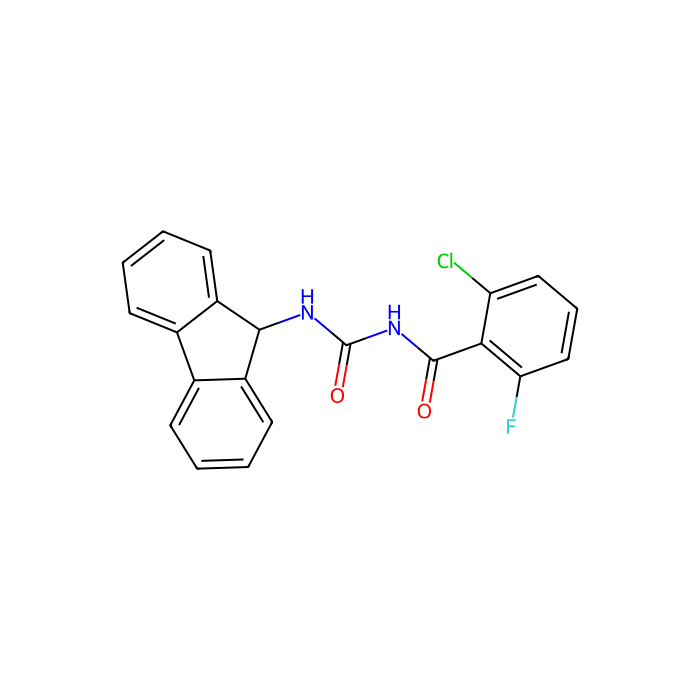
This compound belongs to the class of organic compounds known as fluorenes. These are compounds containing a fluorene moiety, which consists of two benzene rings connected through either a cyclopentane, cyclopentene, or cyclopenta-1,3-diene.
External Descriptors
Not available
1. Djoumbou Feunang Y, Eisner R, Knox C, Chepelev L, Hastings J, Owen G, Fahy E, Steinbeck C, Subramanian S, Bolton E, Greiner R, and Wishart DS. ClassyFire: Automated Chemical Classification With A Comprehensive, Computable Taxonomy. Journal of Cheminformatics, 2016, 8:61.
Solvent:DMSO, Max Conc. mg/mL: 15.23, Max Conc. mM: 40
분자량
380.800 g/mol
XLogP3
5.000
Hydrogen Bond Donor Count
2
Hydrogen Bond Acceptor Count
3
Rotatable Bond Count
2
Exact Mass
380.073 Da
Monoisotopic Mass
380.073 Da
Topological Polar Surface Area
58.200 Ų
Heavy Atom Count
27
Formal Charge
0
Complexity
552.000
Isotope Atom Count
0
Defined Atom Stereocenter Count
0
Undefined Atom Stereocenter Count
0
Defined Bond Stereocenter Count
0
Undefined Bond Stereocenter Count
0
The total count of all stereochemical bonds
0
Covalently-Bonded Unit Count
1
솔루션 계산기
Molarity Calculator
Determine the necessary mass, volume, or concentration for preparing a solution.
Dilution Calculator
Determine the dilution needed to prepare a stock solution.
Reconstitution Calculator
리뷰
고객 리뷰
Application Protocols
No tested applications or validated protocols are provided for TMN 355.
General small-molecule handling protocol (example guidance)
Stock solution: Weigh accurately in a dry environment. Prepare a 10–50 mM stock in anhydrous DMSO. Vortex and, if necessary, sonicate briefly to fully dissolve.
Aliquoting: Dispense into low-bind microtubes or glass vials (amber if light-sensitive). Label with compound name, lot, concentration, solvent, and date.
Working solutions: Dilute stock into assay buffer or media with thorough mixing, targeting a final DMSO fraction ≤1% v/v (literature practice). Prepare fresh daily unless stability data support reuse.
Controls: Include vehicle controls, and if applicable, positive/negative controls relevant to the assay. Confirm absence of precipitation visually and by light scattering or filtration.
Documentation: Record storage conditions, freeze–thaw cycles, and any observations of color change or turbidity.
Please consult the CoA/Spec Sheet and SDS for any item-specific instructions once available.
Biological Roles
No biological function, target, or pathway information is provided for TMN 355 in the current product data.
General notes
This product is supplied strictly for research use only (item-specific). It is not for human or veterinary use, and no clinical or diagnostic claims are made.
Without a disclosed structure or annotation, no assertions can be made regarding mechanism of action, selectivity, metabolism, or ADME properties.
Recommendations for researchers
If biological testing is intended, first obtain or confirm structural information and purity via CoA plus orthogonal analytics (LC–MS, NMR).
Establish solubility and stability in the intended assay buffer and at the working temperature. Verify that the final co-solvent concentration (e.g., DMSO) does not perturb the system.
Include appropriate vehicle controls and, if applicable, counter-screens to identify assay interference (e.g., redox cycling, aggregation, fluorescence/absorbance overlap). PAINS/aggregation checks require structural data.
Document storage, handling, and passage number of stocks to ensure experimental reproducibility and traceability.
Buffer Applications
Specific buffer systems are not applicable without knowledge of the compound’s ionization state and intended assay.
Practical guidance for using small molecules in buffers (general)
Stock preparation: Prepare a concentrated stock in DMSO (e.g., 10–50 mM), then dilute into the target buffer with rapid mixing to a final DMSO content typically ≤0.1–1% v/v (literature practice) to limit matrix effects.
Solubility checks: After dilution, inspect for haze or precipitation; if observed, increase mixing time, modestly raise temperature, or reduce final concentration.
pH considerations: If the molecule has acidic/basic groups (requires structure), small pH adjustments can rescue solubility. Avoid large ionic strength changes that may destabilize proteins.
Surfactants: For sticky/hydrophobic analytes, 0.01–0.05% nonionic surfactant (e.g., Tween 20 or Pluronic) can mitigate adsorption to plastics; validate that surfactant does not affect the assay.
Filtration: If appropriate, 0.22 μm filtration removes particulates. Confirm no significant analyte loss to the membrane.
Record the exact buffer composition, pH, and co-solvent fraction on sample logs for reproducibility.
Green Alternatives
With no structure-specific hazards or solvent requirements provided, green considerations focus on dissolution, handling, and analytical workflows.
Greener solvent considerations (general)
Prefer biorenewable or lower-toxicity solvents when feasible: ethanol, isopropanol, acetone, ethyl acetate, and water-based systems outperform chlorinated solvents from a sustainability perspective (literature).
For nonpolar needs, consider cyclopentyl methyl ether (CPME) or 2-methyltetrahydrofuran (2-MeTHF) instead of MTBE/THF; both offer better stability and favorable safety profiles (literature) but verify solubility and UV transparency for analytics.
Replace DMF/NMP with alternatives like propylene carbonate or Cyrene where compatible; note viscosity and polarity differences.
Illustrative comparison (literature)
DCM vs EtOAc: EtOAc is less toxic and has a better environmental profile; however, DCM can provide superior solubility for some halogenated aromatics—test case-by-case.
ACN vs ethanol/water: ACN offers low viscosity and UV transparency; ethanol/water blends are greener but may change selectivity and detection limits.
Operational practices
Minimize solvent volumes by using concentrated stocks and microplate-based assays.
Recover and segregate solvent waste to facilitate recycling/disposal.
Use amberware and low-temperature storage to extend shelf life, reducing waste from degradation.
Pharmaceutical Uses
No pharmacopeial status, excipient role, or formulation use is specified for TMN 355. This product is for research use only and is not manufactured under GMP for human use.
General, non-clinical context
If used in pre-formulation research, first confirm the structure, purity, and solid-state form (polymorph/solvate) via CoA and analytical characterization.
Evaluate solubility across biorelevant media (FaSSIF/FeSSIF, pH 1–7.5 buffers) only as exploratory data; such studies are not a substitute for regulated development.
Assess chemical stability under stress (light, heat, oxidative conditions) to guide protection strategies and packaging. Use amber vials and inert headspace where indicated.
No claims are made regarding safety, efficacy, or dosage. Any downstream pharmaceutical development requires independent sourcing and GMP qualification.
Physical Properties
Item-specific constants are not included in the current product data.
Molecular Weight: Not specified for this item; refer to CoA/Spec Sheet.
Molecular Formula: Not specified for this item; refer to CoA/Spec Sheet.
Appearance: Not specified for this item; refer to CoA/Spec Sheet.
Melting Point: Not specified for this item; refer to CoA/Spec Sheet.
Boiling Point: Not specified for this item; refer to CoA/Spec Sheet.
Density/Refractive Index: Not specified for this item; refer to CoA/Spec Sheet.
Solubility: Not specified for this item; refer to CoA/Spec Sheet.
logP/logD, pKa: Not specified for this item; refer to CoA/Spec Sheet.
General/literature guidance for unknown small molecules
Solubility screening (literature best practices): test DMSO first (10–50 mM trial stocks), then DMF, ethanol, isopropanol, and water/buffer mixtures; use mild heating (30–40°C) and brief sonication. Document any precipitation upon dilution into aqueous media.
Ionizable compounds: if acidic/basic groups are present (verify from structure), assess solubility in pH-adjusted buffers (pH 2–3 for bases; pH 8–9 for acids) and convert to neutral pH post-dilution if compatible.
Solid-state behavior: if a defined MP is provided on the CoA, use it to verify identity and assess polymorphs. DSC/TGA can reveal solvent of crystallization or hydrates.
Analytical confirmation: LC–MS and 1H NMR are recommended to corroborate identity and purity before critical studies.
Quality and Grades
Grade/Purity: Not specified for this item; refer to CoA/Spec Sheet.
Appearance: Not specified for this item; refer to CoA/Spec Sheet.
Interpreting grade (general guidance)
Research grade: Suitable for exploratory R&D, screening, and method development. Impurity profiles are typically controlled via CoA but may not meet pharmacopeial monographs.
HPLC grade solvents vs. reagent grade reagents: If solvents are needed for dissolution or chromatography, select low-UV/HPLC grade solvents for analytical work to minimize background.
Stabilizers/antioxidants: If the compound is peroxide- or air-sensitive (information not provided here), stabilizers may be present; any stabilizer will be declared on the CoA if used.
Quality verification workflow
Identity: Confirm by LC–MS and 1H NMR against reference data (when structure is available). Use exact mass and isotopic pattern for high-confidence ID.
Purity: Assess by HPLC/UPLC at multiple wavelengths (210–400 nm). If chromophores are absent, use ELSD/CAD.
Water/Residual solvents: Use KF and GC headspace as needed; specifications, if any, will be listed on the CoA.
Batch traceability: Retain the SKU (T287318), lot number, and CoA for records; this product is for research use only (item-specific note).
Reaction and Applications
Manufacturer-specified applications are not provided for TMN 355 beyond categorization as a small-molecule/compound library member.
Potential research applications (general guidance)
Screening/assay development: Utilize as a test article in biochemical or chemical assays once structure and purity are confirmed. Maintain careful DMSO controls and verify solubility at working concentrations.
Analytical method development: Use to develop LC–MS methods (gradient scouting, ionization optimization) after establishing the compound’s ionization behavior.
Reference standard/internal standard (conditional): If structural data and stability permit, may serve as an internal standard in targeted analyses; confirm absence of interference and stability in matrix.
Chemical reactivity studies: If the structure contains reactive handles (unknown here), it could be explored in derivatization or conjugation workflows. Confirm functional groups before attempting reactions.
Practical tips
Always confirm identity/purity by LC–MS/NMR prior to key experiments.
Conduct small-scale solubility and stability tests (light, air, pH, temperature) to define handling windows.
Document batch, concentration, solvent system, and storage history to support data integrity.
Reaction Conditions
No reaction condition guidance can be item-specifically provided without structural information.
General guidance for small-molecule handling and testing
Stability scouting: Examine stability at ambient, 4°C, and 37°C in intended solvents (DMSO, ACN, ethanol, buffer) for 24–72 h by LC–MS to detect degradation.
Light/oxidation: If chromophores or oxidation-prone moieties are present (unknown here), protect from light and air. Use amber vials and inert gas blanket for long incubations.
Adsorption: Hydrophobic or cationic compounds may adsorb to plastics; consider glass vials or silanized glass. Include adsorption controls in low-concentration studies.
Reaction screening (if derivatization is intended after structure is known): begin with small-scale (≤0.05 mmol) trials; document solvent, temperature, catalyst/base/acid, and time. Typical ranges: 0–80°C, 0.5–24 h, atmospheric pressure unless otherwise required.
Always verify any conditions against the known functional groups once the structure is available.
Safety and Handling
Safety data fields are not populated in the current listing.
GHS Classification: Not specified for this item; refer to CoA/Spec Sheet and SDS.
Signal Word / H-Statements / Pictograms: Not specified for this item; refer to SDS.
General laboratory safety (good practice)
PPE: lab coat, safety glasses, and appropriate chemically resistant gloves (e.g., nitrile). Handle powders in a fume hood to avoid inhalation of dust/aerosols.
Storage: Store at −20°C (item-specific). Keep tightly closed in the original container. Allow container to equilibrate to room temperature before opening to minimize condensation.
Incompatibilities: Unknown for this item. As a precaution, segregate from strong oxidizers, strong acids/bases, and ignition sources until specific SDS guidance is available.
Hygiene: Avoid ingestion, inhalation, and skin/eye contact. Wash hands thoroughly after handling. Do not pipette by mouth.
First aid (overview; defer to SDS): in case of skin/eye contact, rinse with water for at least 15 minutes; remove contaminated clothing. If inhaled, move to fresh air. If ingested, rinse mouth and seek medical advice.
Spill response: Contain solid with inert absorbent, minimize dust generation, and clean area with appropriate solvent as compatible; dispose in accordance with institutional and local regulations.
Waste: Collect as organic chemical waste; classification depends on structure—consult SDS and local rules.
Solvent Selection
Because TMN 355 structural and physicochemical details are not provided, solvent choice should be guided by a tiered solubility assessment.
Suggested dissolution strategy (general guidance)
Primary solvent: DMSO, targeting 10–50 mM stock solutions. Verify clarity by visual inspection and UV/Vis baseline if applicable.
Secondary solvents: DMF, NMP, ethanol, isopropanol, acetonitrile. For water-incompatible compounds, co-solvent systems (e.g., 10–30% DMSO or ACN in buffer) can help.
Aqueous use: After preparing a concentrated organic stock, dilute into assay buffer with vigorous mixing. Keep final DMSO ≤1% v/v when possible (literature practice) to minimize biological assay interference.
pH leverage: If the molecule is acidic or basic (confirm from structure), adjust buffer pH temporarily to enhance solubility, then readjust if needed.
Comparison notes (general)
DMSO vs DMF: DMSO is broadly solvating and more benign to many plastics; DMF can offer higher solubility for some neutral/heteroaromatics but is more regulated for waste.
ACN vs ethanol: ACN mixes readily with water and minimizes UV background; ethanol is less toxic and may be preferred for greener profiles, but has higher UV absorbance below ~210 nm (literature).
Record the exact solvent composition and concentration on vial labels to maintain reproducibility.
Storage and Reconstitution
Storage Conditions: Store at −20°C (item-specific). Maintain in a tightly closed container. Minimize exposure to ambient humidity by allowing the vial to warm to room temperature before opening.
Shipping: Shipped in an ice chest with ice pads (item-specific) to preserve integrity during transit.
Stability: Specific stability and shelf-life data are not provided; refer to CoA/Spec Sheet. As a precaution, protect from light and moisture.
Reconstitution and handling (general guidance)
Solvent selection: If structure is unknown, begin with anhydrous DMSO for stock preparation. Alternative solvents (DMF, ethanol, ACN) may be evaluated if needed.
Concentrated stocks: Typical research stocks are 10–50 mM in DMSO. Filter through 0.22 μm PTFE if particulates persist and the compound is not adsorbed by the membrane.
Aliquoting: Prepare single-use aliquots to avoid repeated freeze–thaw. Store aliquots at −20°C in amber vials when light sensitivity is suspected.
Freeze–thaw: Avoid multiple cycles. Thaw on ice or at room temperature, mix gently, and use promptly. Discard aliquots showing precipitation or discoloration unless stability studies indicate acceptability.
Labeling and traceability: Record lot number, concentration, solvent, preparation date, and operator initials on each aliquot.
For any missing item-specific parameters (appearance, purity, MF/MW), please consult the CoA/Spec Sheet prior to critical experiments.
Structure and Identity
Brief overview: TMN 355 (SKU T287318) is listed in our small-molecule/compound library category. Structural identifiers are limited in the product data.
CAS: 1186372-20-2 (item-specific)
PubChem CID: 44249042 (item-specific)
InChIKey: 334643 (as provided; note: typical InChIKeys are 27 characters. Please verify on CoA/SDS) (item-specific)
SMILES: Not specified for this item; refer to CoA/Spec Sheet.
Molecular Formula: Not specified for this item; refer to CoA/Spec Sheet.
Molecular Weight: Not specified for this item; refer to CoA/Spec Sheet.
Structural features
Item-specific structural depiction and functional groups are not provided in the current listing. If structure is required for cheminformatics or method development, request the Spec Sheet/CoA or consult the referenced CAS/CID.
2D structural description (general guidance)
Without a SMILES or formula, a definitive 2D description cannot be provided. If available from the Spec Sheet, describe ring systems (aromatic/heteroaromatic), heteroatom content (N/O/S/halogens), and any ionizable centers, as these properties drive solubility, stability, and analytical behavior.
Synthetic Utility
Synthetic transformations cannot be prescribed without a disclosed structure. The following is general guidance for planning with unknown or proprietary small molecules:
Functional group reconnaissance: Once structure is available, map nucleophiles/electrophiles, redox-active motifs, and potential protecting-group liabilities. This drives decisions on coupling, oxidation/reduction, or late-stage diversification.
Late-stage functionalization (general): If aromatic C–H bonds are present, consider directed C–H activation or Minisci-type methods (structure-dependent). For amine-containing scaffolds, acylation, sulfonylation, or carbamate formation enables SAR expansion.
Handle compatibility: Verify tolerance to bases, acids, and transition metals before cross-coupling, amidation, or click-type reactions.
Purification planning: Use orthogonal methods (normal/reverse-phase chromatography, crystallization) informed by polarity and pKa once known.
Analytical tracking: Monitor reactions by LC–MS, especially for heteroatom-rich scaffolds that ionize well under ESI conditions.
Please consult the Spec Sheet/CoA for structural details before attempting any derivatization or synthetic modification.
Target Specificity
No target, enzyme/receptor, or pathway specificity is provided for TMN 355 in the current product data.
Target/epitope: Not specified for this item; refer to CoA/Spec Sheet.
Species reactivity/biological selectivity: Not specified for this item; refer to CoA/Spec Sheet.
Researchers should avoid making mechanistic or selectivity assumptions without primary data and a confirmed structure. If pursuing target profiling, consider orthogonal assays (binding, activity, and cellular readouts) alongside counter-screens to detect assay interference.
자주 묻는 질문
What documentation is provided?
Available product documentation, including Certificates of Analysis (COA), Safety Data Sheets (SDS), and specification sheets, is shown in the product document area. Document availability and access follow the current site policy.
Products are supplied to verified businesses, institutions, and qualified professionals for research and development use only. Not for use in humans, animals, diagnosis, or therapy.

 C2620163