≥99.6 atom% D for sensitive chromatographic and analytical workflows requiring minimal baseline interference.
🌡
Storage & shipping
Protected from light,Room temperature,Argon charged Ships Normal Check lot-specific COA for exact specifications.
📋
Quality documents
SDS, COA, datasheet, and spec sheet available for download. Lot-specific COA accessible via lot number lookup.
📚
Literature proof
Cited in 8 peer-reviewed publications across chromatography, organic synthesis, and cross-coupling reactions.
개요
Toluene-d8 is a deuterated NMR solvent useful in NMR-based research and analyses. Spin–lattice relaxation time (T 1), viscosity and density have been measured over -35 to 200°C range. The temperature dependent chemical shifts in the proton NMR spectra of α,,β-unsaturated ketones in toluene-d8 has been studied.
This compound belongs to the class of organic compounds known as toluenes. These are compounds containing a benzene ring which bears a methane group.
External Descriptors
Not available
1. Djoumbou Feunang Y, Eisner R, Knox C, Chepelev L, Hastings J, Owen G, Fahy E, Steinbeck C, Subramanian S, Bolton E, Greiner R, and Wishart DS. ClassyFire: Automated Chemical Classification With A Comprehensive, Computable Taxonomy. Journal of Cheminformatics, 2016, 8:61.
Determine the necessary mass, volume, or concentration for preparing a solution.
Dilution Calculator
Determine the dilution needed to prepare a stock solution.
Reconstitution Calculator
리뷰
고객 리뷰
Application Protocols
NMR sample preparation (general, literature guidance)
Sample dissolution
Dry analyte as needed. Add an appropriate volume of toluene‑d₈ (typically 0.5–0.7 mL for 5 mm tubes). Aim for 5–30 mg analyte for 1H/13C depending on sensitivity; adjust for multinuclear experiments.
Tube and atmosphere
Use clean, dry NMR tubes; cap promptly. For air/moisture-sensitive samples, backfill the tube headspace with inert gas and use a J. Young valve if available.
Referencing and lock
Use the deuterium signal for spectrometer lock. Chemical shift referencing can be external (TMS) or internal if compatible; note residual solvent peaks (literature: aromatic ~7.0–7.2 ppm; benzylic ~2.0–2.2 ppm) for secondary reference.
Shimming and baseline
Allow temperature equilibration (5–10 min in magnet). Optimize shim on the 2H lock; verify line shape with a quick 1H scan.
Water and oxygen control
If required, pre-dry solvent over activated sieves. Briefly sparge with inert gas or perform freeze–pump–thaw to remove dissolved oxygen for sensitive experiments.
Disposal and recovery
After acquisition, collect solvent in dedicated waste or recover for non-critical runs if purity remains acceptable (verify by a blank spectrum).
These are general guidelines; adapt parameters to instrument field strength, nucleus of interest, and sample properties.
Biological Roles
This product is a deuterated organic solvent and has no intrinsic biological role. The following points are provided as general background and do not imply biological or clinical use of this item.
Deuterium effects (literature)
Deuterium substitution slows certain C–H bond cleavage processes (kinetic isotope effect), which is exploited in mechanistic studies in vitro. However, for toluene‑d₈ used as a bulk solvent, biological interactions are not a typical consideration.
Use in biochemical analytics
Deuterated solvents enable high-resolution NMR of biomolecules that are soluble in nonpolar media (e.g., hydrophobic ligands, lipid-like small molecules). Toluene‑d₈ is occasionally used for lipophilic natural products.
Metabolism/toxicity context
Toluene (protiated) is metabolized primarily via hepatic oxidation in mammals; deuteration does not eliminate solvent-related hazards. Such information is for laboratory risk assessment only and not for therapeutic implication.
Conclusion: Choose toluene‑d₈ strictly as an analytical medium for hydrophobic analytes; it is not a buffer component, nutrient, or biological modulator.
Buffer Applications
Toluene‑d₈ is a nonpolar, water-immiscible organic solvent and is not used to prepare aqueous buffers. For NMR of aqueous samples, select deuterated water (D2O) or appropriate deuterated buffer systems. For hydrophobic analytes requiring nonpolar media, see Solvent Selection and Application Protocols sections.
Green Alternatives
Toluene‑d₈ is a volatile aromatic hydrocarbon. While non-halogenated, it remains a flammable VOC with environmental and health considerations. Selection should balance analytical needs (NMR lock, minimal 1H background) against greener principles.
Greener or alternative choices (literature perspective)
CDCl3 is not greener (halogenated, potential to release HCl); avoid when halogenated waste is restricted.
2‑MeTHF‑d (scarce) or deuterated cyclopentyl methyl ether (CPME‑d) are conceptually greener ethers but are not widely available at high isotopic enrichment and may introduce peroxide risk.
Benzene‑d6 has higher toxicity; toluene‑d8 is generally a safer aromatic choice among deuterated aromatics.
Minimize use to essential volumes; recover/repurpose for routine NMR when purity allows.
Implement closed transfers, cold traps, and solvent recycling where compatible with isotopic purity needs.
For non-NMR applications, consider non-deuterated toluene or greener ethers/aromatics if isotopic labeling is not required.
Pharmaceutical Uses
No therapeutic or clinical uses are claimed. In the pharmaceutical laboratory context (general, literature):
Role in analytics and QC
Commonly used as a deuterated solvent for NMR analysis of nonpolar drug substances, impurities, and intermediates, facilitating 2H lock and minimizing 1H background.
Suitable for variable-temperature NMR due to higher bp relative to CDCl3, aiding characterization of conformational processes.
Formulation/excipient status
Toluene (protiated) is not an approved excipient for human formulations; toluene‑d₈ is likewise not used in dosage forms. Use is confined to research and quality control environments.
Regulatory documentation
Pharmacopeial monographs generally exist for common protiated solvents; deuterated analogs are governed by supplier specifications and internal QC acceptance criteria. For this item’s certified attributes, consult the CoA/Spec Sheet (grade, isotopic enrichment, residual 1H, water, and impurity limits: Not specified for this item; refer to CoA/Spec Sheet).
Physical Properties
Item-specific specifications for this product are not provided in the Product Data. Refer to the CoA/Spec Sheet for certified values. The following are literature/typical properties for toluene‑d₈ (for reference only):
Appearance: colorless liquid (literature)
Boiling point: ~111–112 °C at 1 atm (literature; slightly higher than protiated toluene)
Melting point: ~−95 °C (literature)
Density: ~0.94–0.95 g/mL at 20–25 °C (literature)
Refractive index n20/D: ~1.495–1.498 (literature)
Vapor pressure: comparable to toluene at ambient temperatures (literature)
Solubility: insoluble in water; miscible with most nonpolar and moderately polar organic solvents (literature)
Exact values can vary with isotopic substitution and measurement conditions; consult the item’s CoA for reportable specifications.
Residual non-deuterated content and trace impurities can subtly shift refractive index and density; these are controlled by isotopic enrichment grade (not specified for this item; refer to CoA/Spec Sheet).
Quality and Grades
Item-specific grade/purity: Not specified for this item; refer to CoA/Spec Sheet.
Deuterated solvent considerations (general)
Isotopic enrichment (atom% D) governs residual 1H signal intensity and suitability for high-sensitivity NMR. Common literature grades include 98.0–99.5 atom% D and higher for specialty work.
Trace water, oxygen, and non-deuterated toluene affect baseline, shimming, and reactive sample stability. Vendors may supply material under inert gas (this item: argon charged) to preserve quality during storage.
For quantitative NMR (qNMR), low non-volatile residue and known residual proton content are important; consult CoA for residual 1H, water, and common impurity levels (Not specified for this item; refer to CoA/Spec Sheet).
Stabilizers
Toluene-d₈ typically ships without stabilizers; absence/presence of stabilizers for this item is not specified. If stabilizers are present, they can introduce additional NMR peaks; verify on the CoA.
UV and chromatographic use
HPLC-grade deuterated toluene is uncommon; if using as a nonpolar eluent or UV reference, ensure low UV-absorbing impurities (Not specified for this item; refer to CoA/Spec Sheet).
Practical selection
Match isotopic enrichment and residual 1H specifications to your experiment (e.g., multinuclear NMR, NOE, diffusion). Request up-to-date CoA for specific batch data.
Reaction and Applications
NMR spectroscopy (primary use)
Solvent for 1H/13C/15N/31P NMR of hydrophobic analytes; provides a 2H lock signal while minimizing proton background. Literature residual signals (may vary by batch): aromatic residual ~7.0–7.2 ppm; benzylic CH3 residual ~2.0–2.2 ppm; 13C solvent peaks near ~137, 129, 125, and 21–22 ppm.
Suitable for elevated-temperature NMR experiments due to higher bp than CDCl3; verify tube pressure/venting precautions.
Mechanistic and kinetic studies
Used as a non-exchanging, nonpolar medium to probe kinetic isotope effects and hydrogen–deuterium scrambling, and as a deuterated matrix for EPR/photochemistry where reduced 1H relaxation pathways are desired (literature context).
As a reaction solvent (literature/general)
For homogeneous catalysis and organometallics where aromatic, nonpolar media are beneficial (e.g., certain Friedel–Crafts, radical reactions, or metal-catalyzed processes), toluene‑d₈ can be employed when in situ NMR monitoring is desired. Note that isotopic substitution has negligible effect on bulk solvent behavior but raises cost; use only when deuteration is required.
Practical notes
Dry and degas before moisture/oxygen-sensitive studies. Verify absence of acidic impurities that can affect acid-sensitive substrates.
For quantitative work, account for any residual proton content by integration against an internal standard with certified purity.
Reaction Conditions
General guidance from literature for work conducted in toluene or toluene‑d₈; item-specific performance parameters are not specified and should be validated experimentally:
Solvent and temperature
Temperature range: −78 °C (with appropriate cooling) to reflux (~111–112 °C for toluene‑d₈). Elevated temperatures are common for aromatic-substrate reactions; sealed tubes/NMR tubes require pressure precautions.
Atmosphere
Many organometallic/catalytic processes require inert gas; this item is supplied argon charged (Product Data). Maintain inert atmosphere for air/moisture-sensitive work.
Water/oxygen control
Dry over 3Å/4Å sieves or distill from drying agents if necessary; for NMR, confirm dryness by absence of broad residual 1H/17O-coupled signals or by Karl Fischer if quantitative data are needed (Not specified for this item; refer to CoA/Spec Sheet).
Catalysts and additives (examples; literature)
Friedel–Crafts acylations/alkylations: AlCl3, FeCl3, or strong Brønsted acids; monitor for possible H/D exchange at benzylic positions under strongly acidic conditions.
Cross-couplings (e.g., Suzuki, Negishi) occasionally run in toluene or mixed solvents; base choice and temperature govern solubility and rate.
Expected outcomes
Reaction rates in toluene‑d₈ are comparable to protiated toluene; isotope effects on bulk properties are minimal.
Always run small-scale trials to verify compatibility with substrates and catalysts, and consult primary literature for reaction-specific conditions and yields.
Safety and Handling
Item-specific hazard classifications (GHS, H‑statements, pictograms, signal word): Not specified for this item; refer to SDS.
General hazards (literature-based for deuterated toluene)
Highly flammable liquid and vapor; forms explosive mixtures with air.
Harmful if inhaled; causes drowsiness or dizziness; may cause skin and eye irritation with prolonged contact.
Deuteration does not meaningfully change acute hazards relative to toluene.
Storage guidance
From Product Data: Store at room temperature, protected from light, under argon (argon charged).
Keep container tightly closed; use septum-cap bottles when feasible to limit moisture/air ingress. Segregate from strong oxidizers and strong acids.
Handling/PPE
Use in a well-ventilated fume hood. Avoid breathing vapors.
First-aid overview (refer to SDS for full instructions)
Inhalation: move to fresh air; monitor respiration; seek medical attention if symptoms persist.
Skin: wash with soap and water; remove contaminated clothing.
Eyes: rinse cautiously with water for several minutes; remove contact lenses if present and easy to do; seek medical advice if irritation continues.
Fire-fighting: use dry chemical, CO2, or alcohol-resistant foam; water spray to cool containers only.
Waste
Collect as halogen-free flammable organic waste; do not discharge to drains. Follow institutional and regulatory guidance.
Solvent Selection
Polarity and miscibility (literature)
Nonpolar aromatic solvent; dielectric constant ~2.38 (20 °C). Immiscible with water; miscible with nonpolar and moderately polar organics (ethers, esters, chlorinated solvents, aromatics).
When to choose toluene‑d₈
As an NMR solvent for hydrophobic compounds where CDCl3 is unsuitable (e.g., acid-sensitive substrates, halogen-avoidance, or higher boiling solvent needed for elevated-temperature NMR).
For 2H-lock in NMR while minimizing 1H background, especially for samples with signals near 7–7.2 ppm (consider potential overlap with residual aromatic signals).
As a reaction or kinetics medium when probing isotope effects or avoiding hydrogen exchange (literature context).
Comparison to common deuterated solvents (literature)
CDCl3: lower bp (61 °C), more polarizable/halogenated; good general solvent but can decompose to HCl and affects acid-sensitive analytes. Toluene‑d₈ is non-halogenated, higher bp, less polar.
C6D6: very nonpolar; aromatic signals at ~7.16 ppm; toxicity concerns higher than toluene‑d₈; lower bp than toluene‑d₈. Toluene‑d₈ offers slightly greater solubility for aliphatic and benzylic substrates.
DMSO‑d6: highly polar, dissolves salts; very different application space; high bp complicates recovery.
Practical tips
Drying can be achieved by passing through activated alumina or storing over molecular sieves (3Å/4Å), verifying background by NMR before critical measurements.
Degas by freeze–pump–thaw cycles if oxygen sensitivity is a concern.
Storage and Reconstitution
Item-specific storage from Product Data
Store protected from light, at room temperature, under argon (argon charged).
Shipped under normal conditions.
General handling
Keep container tightly closed to minimize air/moisture ingress. For frequent access, consider a septum-sealed bottle to allow syringe withdrawals under inert gas.
Avoid prolonged exposure to light and heat sources. Store away from oxidizers and acids.
Stability
Deuterated aromatic solvents are generally stable under recommended storage. Isotopic purity can slowly decrease if exposed to protic contaminants; maintain dryness.
Reconstitution
Not applicable; product is supplied as a ready-to-use liquid. If drying is required for sensitive analyses, store over activated 3Å/4Å molecular sieves or pass through activated alumina. Verify background by running a blank NMR spectrum prior to critical measurements.
Research use
For research use only (per Product Data). Consult the CoA/Spec Sheet and SDS for batch-specific specifications and safety before use.
Structure and Identity
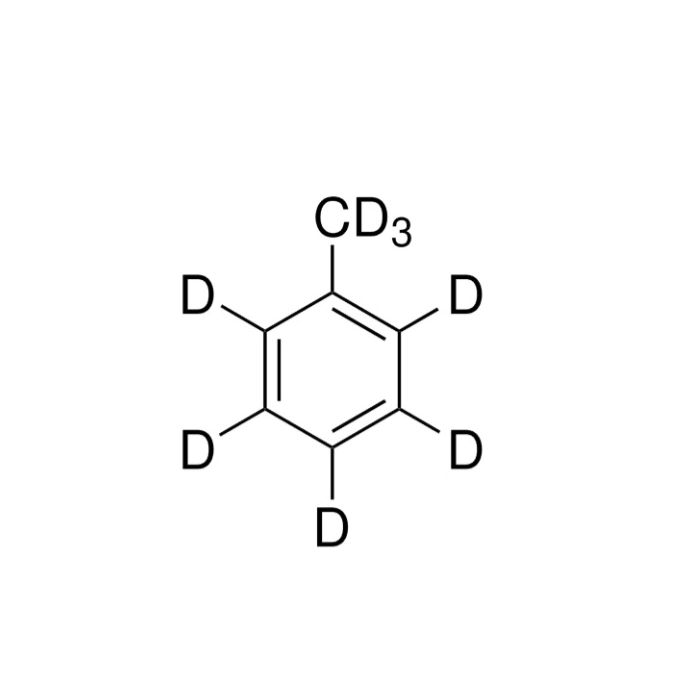
Toluene‑d₈ is the fully deuterated isotopologue of toluene (C6D5–CD3), used primarily as a deuterated NMR solvent and nonpolar medium for mechanistic studies.
Item-specific identifiers (from Product Data)
SKU: T102274
CAS: 2037-26-5
CID: 74861
InChIKey: 449318 (as provided)
Literature identifiers and descriptors (for reference; not item-specific specs)
Molecular formula (literature): C7D8
Molecular weight (literature): ~100.19 g/mol (C7H8 + 8×1.0063 for D)
Aromatic ring (benzene) bearing a methyl substituent at the para descriptor position in 2D line notation; all eight hydrogens are replaced by deuterium (five on the ring, three on the benzylic methyl).
Functional groups: aromatic hydrocarbon, benzylic CD3 group; no heteroatoms or additional functionality.
Stereochemistry: none (planar aromatic system; no stereogenic centers).
Isotopic labeling: high deuterium incorporation enables deuterium lock in NMR and minimizes 1H background.
Synthetic Utility
While deuterated toluene is primarily an analytical solvent, its chemical behavior mirrors protiated toluene and can serve in niche synthetic or mechanistic roles (literature/general):
Reaction medium
Nonpolar aromatic solvent compatible with many organometallic and catalytic transformations (e.g., Friedel–Crafts alkylations/acylations, radical reactions, hydrosilylations). Deuteration does not significantly change solvent polarity or coordinating ability.
Isotopic tracing
Because benzylic and aromatic C–D bonds are relatively robust under neutral conditions, toluene‑d₈ is generally not a convenient deuterium donor. However, under strongly activating conditions (e.g., metalation or radical abstractions), limited H/D exchange at benzylic/aromatic positions can occur; this is sometimes exploited for mechanistic probes rather than for labeling at scale.
In situ spectroscopy
Enables direct NMR monitoring of reactions without solvent suppression, aiding kinetic studies, intermediate observation, and quantitative analysis of hydrophobic substrates.
Caveats
High cost relative to protiated solvent dictates use only when isotopic labeling is necessary (e.g., NMR, MAS rotor filling for solid–liquid studies).
Verify that residual 1H content does not interfere with target resonances; pre-run a blank spectrum and, if needed, purify or dry the solvent to reduce background signals.
Target Specificity
Not applicable. This product is a small-molecule solvent, not a bioaffinity reagent. No antigen/epitope, clone, isotype, or species reactivity is relevant.
We use cookies to ensure the website functions properly and, where permitted, to improve your experience. You can manage your preferences at any time in Settings. Learn more in our Cookie Policy.
Shall we send you a message when we have discounts available?
Remind me later
Thank you! Please check your email inbox to confirm.
Products are supplied to verified businesses, institutions, and qualified professionals for research and development use only. Not for use in humans, animals, diagnosis, or therapy.

 A2510569