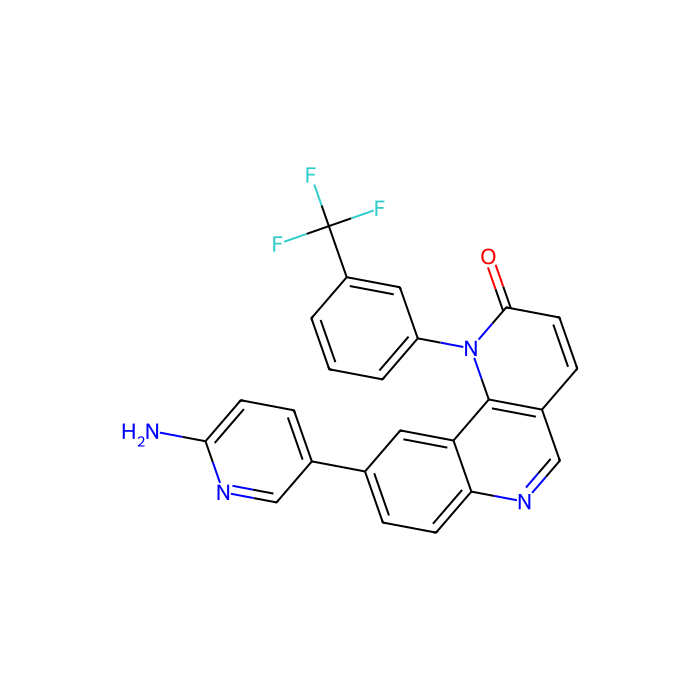
Torin 2 - Moligand™, 10mM in DMSO , Inhibitor of mechanistic target of rapamycin kinase;Inhibitor of phosphatidylinositol 3-kinase catalytic subunit type 3;Inhibitor of phosphatidylinositol-4;5-bisphosphate 3-kinase catalytic subunit delta;Inhibitor of ph, Inhibitor of mechanistic target of rapamycin kinase;Inhibitor of phosphatidylinositol 3-kinase catalytic subunit type 3;Inhibitor of phosphatidylinositol-4;5-bisphosphate 3-kinase catalytic subunit delta;Inhibitor of phosphatidylinositol 4-kinase beta;Inh
Torin 2 - Moligand™, 10mM in DMSO , Inhibitor of mechanistic target of rapamycin kinase;Inhibitor of phosphatidylinositol 3-kinase catalytic subunit type 3;Inhibitor of phosphatidylinositol-4;5-bisphosphate 3-kinase catalytic subunit delta;Inhibitor of ph, Inhibitor of mechanistic target of rapamycin kinase;Inhibitor of phosphatidylinositol 3-kinase catalytic subunit type 3;Inhibitor of phosphatidylinositol-4;5-bisphosphate 3-kinase catalytic subunit delta;Inhibitor of phosphatidylinositol 4-kinase beta;Inh
GRADE & PURITYMoligand™?Moligand™ — Aladdin's line of ligands and bioactive small molecules. Use for receptor, pathway, and binding studies needing defined small-molecule tools.10mM in DMSO
Moligand™, 10mM in DMSO Moligand™ for sensitive chromatographic and analytical workflows requiring minimal baseline interference.
🌡
Storage & shipping
Store at -80°C Ships Dry ice packs + Cold packs Check lot-specific COA for exact specifications.
📋
Quality documents
SDS, COA, datasheet, and spec sheet available for download. Lot-specific COA accessible via lot number lookup.
📚
Literature proof
Cited in 0 peer-reviewed publications across chromatography, organic synthesis, and cross-coupling reactions.
개요
Information
Torin 2 is a potent and selectivemTORinhibitor withIC50of 0.25 nM in p53−/− MEFs cell line; 800-fold greater selectivity for mTOR than PI3K and improved pharmacokinetic properties. Inhibition ofATM/ATR/DNA-PKwithEC50of 28 nM/35 nM/118 nM,in PC3 cell lines In vitro
Torin 2 has the same binding mode as PI3Kγ, V882 serves as a hinge binding point and in the inner hydrophobic pocket Y867, D841 and D964 provide three more hydrogen bonds with aminopyridine side chain analogous to Y2225, D2195 and D2357 of mTOR. Torin 2 inhibits mTORC1, thus activates TFEB by promoting its nuclear translocation with EC50 of 1.666 mM. Torin 2(< 50 nM) causes a significant reduction in viability of both MZ-CRC-1 and TT cells. Torin 2 (100 nM) exerts a significant reduction of migration of both MZ-CRC-1 and TT cells.
In vivo
Torin 2 exhibits >95% pharmacodynamic response and half-time of 11.7 min in the mouse liver microsome stability study. Torin 2 exhibits the best bioavailability (51%), short half-life (0.72 hours) and low clearance(19.6 mL/min/kg) in male Swiss albino mice following intravenous and oral administration. Torin 2(20mg/kg) ablates MYCN tumors with reduction in MYCN protein levels and induction of apoptosis in Th-MYCN mice. Cell Data
Torin 2 is a potent and selective mTOR inhibitor with IC50 of 0.25 nM in p53−/− MEFs cell line; 800-fold greater selectivity for mTOR than PI3K and improved pharmacokinetic properties. Inhibition of ATM/ATR/DNA-PK with EC50 of 28 nM/35 nM/118 nM,in PC3 ce
보관 조건
Store at -80°C
배송
Dry ice packs + Cold packs
이 제품은 콜드 체인 배송이 필요합니다.지상 및 기타 경제 서비스는 사용할 수 없습니다.
등급
Moligand™
작업 유형
INHIBITOR
작동 메커니즘
Inhibitor of mechanistic target of rapamycin kinase;Inhibitor of phosphatidylinositol 3-kinase catalytic subunit type 3;Inhibitor of phosphatidylinositol-4;5-bisphosphate 3-kinase catalytic subunit delta;Inhibitor of phosphatidylinositol 4-kinase beta;Inh
Determine the necessary mass, volume, or concentration for preparing a solution.
Dilution Calculator
Determine the dilution needed to prepare a stock solution.
Reconstitution Calculator
리뷰
고객 리뷰
Application Protocols
No vendor‑validated application protocols are provided in the Product Data for this item.
General guidance for small‑molecule probes (research use only):
Stock preparation: Dissolve the compound in anhydrous DMSO to a convenient concentration (e.g., 10–50 mM), vortex and, if necessary, brief sonication. Filter if particulates persist.
Aliquoting: Dispense into single‑use, airtight microtubes or 96‑well plates to avoid repeated freeze–thaw.
Storage: Keep frozen per product guidance (see Storage & Reconstitution). Thaw quickly at room temperature, use promptly, and return unused aliquots to cold storage or discard.
Assay setup: Add stocks to assay media last to achieve target concentrations while keeping DMSO constant across treatments and controls.
For detailed, validated protocols (e.g., enzyme inhibition assays, cell-based readouts), consult the primary literature and adapt to your instrumentation and SOPs.
Biological Roles
Item-specific biological target(s) and mechanistic details are not provided in the Product Data for this SKU.
General note: Torin‑class compounds are widely used in research as small‑molecule tools in cell signaling and enzymology contexts; however, without item-level target confirmation provided here, no specific biological role or mechanism is asserted for this listing. Consult peer‑reviewed literature linked to the CAS 1223001‑51‑1 or PubChem CID 51358113 for mechanistic context (literature research recommended).
Research use only: Not for human or veterinary use, clinical diagnostics, or as a food/household chemical.
For rigorous studies, verify activity and selectivity under your assay conditions (biochemical, cellular) using appropriate positive/negative controls and orthogonal readouts. Always record and report the exact lot, solvent system, and final vehicle concentration to support reproducibility.
Buffer Applications
This product is a small‑molecule research compound and does not function as a buffering agent.
Practical handling in buffers (general):
Prepare concentrated DMSO stocks and dilute into the desired buffer (e.g., PBS, HEPES, TRIS) immediately before use.
Maintain low final DMSO content (commonly ≤0.1–0.5% v/v) to minimize vehicle effects on cells/enzymes; validate for your system.
If precipitation occurs upon dilution, add more co‑solvent, reduce compound concentration, or pre‑warm and vortex; consider surfactants compatible with the assay where appropriate.
Buffer recipes, pH ranges, and buffering capacities are not applicable to this product.
Green Alternatives
Green-chemistry substitution is generally discussed for reaction solvents or bulk reagents. For a specialized research small molecule like this, there is no direct “green alternative” to the compound itself.
Green handling considerations (general):
Use minimal DMSO volumes and prepare concentrated stocks to reduce solvent waste.
Adopt microscale assay formats (e.g., 384/1536‑well plates) to lower compound and solvent consumption.
Implement solvent recycling where feasible (analytical HPLC-grade solvents).
If used in synthesis/derivatization (uncommon): prefer greener solvents (e.g., EtOAc, 2‑MeTHF, CPME, MeCN over DMF/NMP where compatible) and catalytic conditions. These choices must be validated for the specific chemistry and compound stability.
Conclusion: No like‑for‑like greener substitute exists for the compound; sustainability gains come from assay miniaturization, careful stock management, and greener solvent choices in any ancillary operations.
Pharmaceutical Uses
No pharmacopeial status or excipient/formulation role is provided in the Product Data, and this product is sold strictly for research use only.
Intended use: Research and laboratory investigations (screening, chemical biology). Not for therapeutic administration, diagnostic procedures, or GMP manufacturing.
If used in preformulation research (in vitro only): general considerations include solubility in DMSO, stability upon dilution into aqueous media, and adsorption to plastics; these must be empirically determined for your system. Item‑specific data are Not specified for this item; refer to CoA/Spec Sheet.
Regulatory note: No claims of safety, efficacy, or clinical suitability are made or implied. For any work beyond basic research, obtain appropriate regulatory guidance and compound provenance documentation.
Physical Properties
Item-specific physicochemical parameters have not been provided in the Product Data.
Appearance: Not specified for this item; refer to CoA/Spec Sheet.
Melting point: Not specified for this item; refer to CoA/Spec Sheet.
Boiling point: Not applicable/Not typically reported for nonvolatile research solids; Not specified for this item.
Density: Not specified for this item; refer to CoA/Spec Sheet.
Solubility: For practical handling, small-molecule library compounds like this are commonly prepared as DMSO stock solutions (e.g., 10–50 mM) before dilution into assay buffers (literature, general). Item-specific solubility limits are Not specified for this item; refer to CoA/Spec Sheet.
logP/logD, pKa, refractive index, UV cutoff: Not specified for this item; refer to CoA/Spec Sheet.
Handling tips (general):
Prepare fresh aliquots in dry, anhydrous DMSO to minimize freeze–thaw cycles.
Protect from moisture and light as a conservative practice for heteroaromatic research compounds (literature, general).
What this typically implies (general): Moligand™ designations are used for small‑molecule screening compounds intended for discovery biology and medicinal chemistry workflows. Emphasis is on identity verification and suitability for high‑throughput screening or probe studies, often supplied with analytical data such as LC/MS or HPLC purity on the Certificate of Analysis (literature/brand-general). Item‑specific purity % and analytical limits: Not specified for this item; refer to CoA/Spec Sheet.
Appearance: Not specified for this item; refer to CoA/Spec Sheet.
Stabilizers/additives: Not specified for this item; refer to CoA/Spec Sheet.
Documentation: For each lot, consult the CoA for identity confirmation (e.g., MS, retention time), purity assessment, and any residual solvent or counter‑ion information.
Suitability: Appropriate for research applications including biochemical/biophysical assays, cell-based screening, and chemical biology studies. Not certified for clinical or diagnostic use.
Recommendation: For sensitive assays (e.g., enzymology, cell signaling), review the CoA chromatogram and confirm acceptance criteria (purity threshold, identification) against your lab’s method suitability requirements.
Reaction and Applications
This material is supplied as a finished small‑molecule research compound and is not primarily intended as a synthetic reagent or solvent.
Research applications (general):
Use as a reference compound or probe in biochemical and cell‑based assays, high‑throughput screening, target validation studies, and chemical biology experiments (research use only).
Common workflows include dose–response characterization, time‑course studies, and orthogonal assay confirmation using DMSO stocks (literature, general).
Synthetic applications: Not typically applicable; the compound is generally used as‑received. If derivatization is contemplated (e.g., linker installation for affinity matrices), verify functional handles and stability via analytical scouting; no item‑specific functional group data are provided here.
Practical tips:
Prepare single‑use aliquots to limit freeze–thaw.
Confirm identity/purity with orthogonal methods (LC/MS, HPLC) when deploying in critical assays.
Note: Manufacturer “Applications” field contains no additional specifics in the Product Data; the above serves as general guidance for handling small‑molecule probes.
Reaction Conditions
Not typically applicable. This product is supplied as a final small‑molecule research compound rather than a reagent used to promote or mediate chemical reactions.
If used in ancillary chemistry (rare; e.g., tagging/immobilization), reaction conditions must be developed de novo based on the confirmed structure and targeted transformation. No general temperature, catalyst, or solvent recommendations can be offered without structural disclosure.
For assay workflows (non-synthetic context), typical handling conditions include:
Preparing concentrated DMSO stocks (e.g., 10–50 mM; literature, general) and diluting into assay buffers immediately before use.
Keeping the final vehicle concentration low (≤0.1–0.5% v/v DMSO; literature, general) and equilibrating to assay temperature to avoid precipitation.
Item-specific reaction condition data: Not applicable/Not specified for this item.
Safety and Handling
Safety information specific to this SKU has not been provided in the Product Data. Always consult the SDS for authoritative information.
GHS classification, pictograms, signal word, H‑statements: Not specified for this item; refer to SDS.
Likely hazards (general for small-molecule research reagents): May cause skin/eye irritation; avoid inhalation of dusts or aerosols. Handle in a fume hood with appropriate containment (literature, general).
PPE: Lab coat, safety glasses or face shield, and appropriate chemically resistant gloves (e.g., nitrile). Use respiratory protection if dust/aerosol generation cannot be controlled per institutional EHS guidance.
First-aid overview (general):
Inhalation: Move to fresh air; seek medical attention if symptoms persist.
Skin: Wash with soap and water; remove contaminated clothing.
Eyes: Rinse cautiously with water for several minutes; remove contact lenses if present and easy to do; continue rinsing.
Ingestion: Rinse mouth; seek medical advice. Do not induce vomiting unless directed by medical personnel.
Incompatibilities (general): Strong oxidizers, strong acids/bases may degrade heteroaromatic organics. Avoid prolonged exposure to light/heat.
Waste: Dispose of according to local regulations for organic laboratory chemicals; segregate halogenated vs non-halogenated waste streams.
Note: This product is for research use only.
Solvent Selection
This product is a non-volatile small molecule typically handled as concentrated stock solutions rather than used as a reaction solvent.
Practical dissolution (general, literature):
Preferred stock solvent: DMSO due to high solvating power for heteroaromatic/kinase-tool chemotypes and compatibility with most biochemical assays at ≤0.1–1% v/v final DMSO.
Alternative solvents for method development: DMF, NMP, ethanol, or methanol, subject to compound stability and assay tolerance. Aqueous buffers generally require co‑solvent and/or surfactant for dissolution.
Miscibility/use:
DMSO stocks can be diluted into aqueous assay buffers (PBS, HEPES, TRIS) while keeping final DMSO low to mitigate solvent effects (commonly ≤0.5% v/v; literature, general). Optimize for your assay.
Tips:
Filter or centrifuge stocks if visible particulates persist after dissolution.
Use dry, anhydrous solvent for long‑term frozen stocks to minimize hydrolysis/oxidation risk.
Note: Item‑specific solubility limits, hygroscopicity, and stability in each solvent system are Not specified for this item; refer to CoA/Spec Sheet and perform a small‑scale solubility test before large experiments.
Storage and Reconstitution
Storage conditions: Store at −80°C (product data). Protect from moisture and light as a conservative practice for small‑molecule probes (general).
Shipping: Dry ice packs + Cold packs (product data) to maintain low temperature during transit.
Reconstitution: Not specified for this item; refer to CoA/Spec Sheet. General practice is to dissolve in anhydrous DMSO to prepare concentrated stocks (e.g., 10–50 mM; literature, general). Mix thoroughly (vortex), and, if needed, sonicate briefly. Inspect for complete dissolution and clarity.
Aliquoting: Prepare single‑use aliquots in solvent‑resistant tubes or plates, flush headspace with inert gas if feasible, and cap tightly.
Freeze–thaw: Minimize cycles. Thaw rapidly at room temperature, mix, and keep on ice during assay setup if prolonged handling is expected.
Stability: Item-specific stability, hygroscopicity, and light sensitivity are Not specified for this item; refer to CoA/Spec Sheet. If stability is unknown, plan to use freshly thawed aliquots and avoid extended bench exposure.
Note: For long-term projects, confirm concentration and purity of working stocks by LC/UV or LC/MS at defined intervals to ensure reproducibility.
Structure and Identity
Brief description: Torin 2 is a cataloged small‑molecule research compound supplied in Aladdin’s Moligand™ format for screening libraries and chemical biology workflows.
Preferred name: Torin 2
CAS: 1223001-51-1 (product data)
PubChem CID: 51358113 (product data)
Molecular formula: Not specified for this item; refer to CoA/Spec Sheet.
Molecular weight: Not specified for this item; refer to CoA/Spec Sheet.
InChIKey: Not specified for this item; refer to CoA/Spec Sheet.
SMILES: Not specified for this item; refer to CoA/Spec Sheet.
Structural features (general, literature-level description without asserting a specific structure for this item):
Torin-class molecules are typically heteroatom-rich, polyaromatic kinase-tool chemotypes bearing multiple H‑bond donors/acceptors and planarity-interrupting substituents to tune physicochemical properties (literature, general).
2D features often include multiple ring systems and at least one basic site that supports dissolution in polar aprotic solvents for stock solutions (literature, general).
Note: Exact structural descriptors for this catalog item should be confirmed against the item-specific CoA/SDS or primary databases (linked by the provided CAS and CID).
Synthetic Utility
This listing is for a finished small‑molecule research compound; it is not positioned as a building block or reagent.
General note: Without item-specific functional group disclosure, predictive reactivity or derivatization routes cannot be responsibly recommended here. If derivatization is required (e.g., to create affinity probes or immobilized analogs), first confirm the structure and identify modifiable positions via literature on the CAS/CID, then perform small‑scale scouting with robust analytical controls (LC/MS, NMR).
Stability considerations (general): Heteroaromatic research compounds can be sensitive to strong acids/bases, oxidants, and prolonged heating. Protect from moisture and light during synthetic manipulations.
Conclusion: Treat the material as a terminal probe compound unless literature supports selective modification strategies. No item‑specific synthetic utility claims are made.
Target Specificity
Target, selectivity profile, and off‑target information are not provided in the Product Data for this SKU.
No claims are made here regarding molecular targets, potency, or kinase selectivity for this item. For researchers seeking detailed target information, consult peer‑reviewed literature and public databases linked to CAS 1223001‑51‑1 and PubChem CID 51358113, and verify activity in‑house under your assay conditions.
Always include appropriate controls and consider orthogonal assay formats to confirm target engagement and selectivity in your specific system.
Need help choosing the grade?
Our grade selection guide covers purity, stabilizer status, and application suitability for all variants in our catalog.
We use cookies to ensure the website functions properly and, where permitted, to improve your experience. You can manage your preferences at any time in Settings. Learn more in our Cookie Policy.
Shall we send you a message when we have discounts available?
Remind me later
Thank you! Please check your email inbox to confirm.
Products are supplied to verified businesses, institutions, and qualified professionals for research and development use only. Not for use in humans, animals, diagnosis, or therapy.