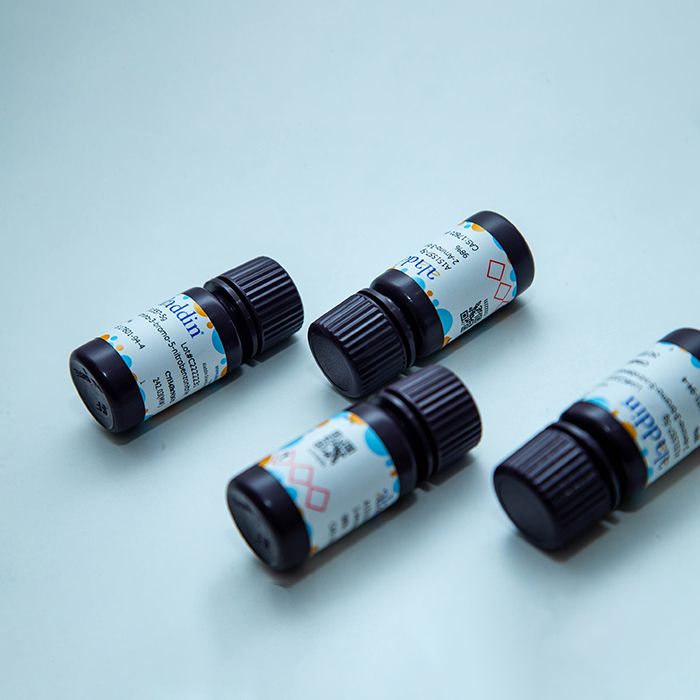
≥98% for sensitive chromatographic and analytical workflows requiring minimal baseline interference.
🌡
Storage & shipping
Store at -20°C Ships Ice chest + Ice pads Check lot-specific COA for exact specifications.
📋
Quality documents
SDS, COA, datasheet, and spec sheet available for download. Lot-specific COA accessible via lot number lookup.
📚
Literature proof
Cited in 0 peer-reviewed publications across chromatography, organic synthesis, and cross-coupling reactions.
개요
TrkA-IN-3 is a potent, subselective and allosteric TrkA inhibitor, with an IC 50 of 22.4 nM. TrkA-IN-3 shows more than 8000-fold selectivity for TrkA over TrkB and TrkC . TrkA-IN-3 can be used for the research of pain.
Appearance:Solid
IC50& Target:TrkA 22.4 nM (IC 50 )
In Vitro:TrkA-IN-3 (compound 5) demonstrates 73.9% and 64.8% of kinase inhibition towards TrkA at concentrations of 1 μM and 0.1 μM , respectively. MCE has not independently confirmed the accuracy of these methods. They are for reference only.
Biological Activity:TrkA-IN-3 is a potent, subselective and allosteric TrkA inhibitor, with an IC 50 of 22.4 nM. TrkA-IN-3 shows more than 8000-fold selectivity for TrkA over TrkB and TrkC . TrkA-IN-3 can be used for the research of pain.
Determine the necessary mass, volume, or concentration for preparing a solution.
Dilution Calculator
Determine the dilution needed to prepare a stock solution.
Reconstitution Calculator
리뷰
고객 리뷰
Application Protocols
No tested application protocols are provided in the product data for this item.
General example workflows (for planning purposes only; adjust to your system):
Biochemical kinase assay: prepare serial dilutions in assay buffer with matched DMSO (≤1%). Pre-incubate enzyme with compound, initiate with ATP/substrate, and quantify activity via luminescent ADP detection or radiometric transfer. Include positive/negative controls.
Cell-based signaling assay: treat cells with compound or vehicle for 0.5–2 h, stimulate with ligand if applicable, lyse, and analyze phospho-proteins by Western blot or ELISA. Normalize to total protein.
Viability/proliferation assay: dose cells in 96- or 384-well plates with a dilution series; read after 48–96 h using resazurin, ATP-luminescence, or imaging. Confirm on-target effects with pathway biomarkers.
Important: These are general templates. No item-specific concentrations, incubation times, or positive controls are provided—consult your assay SOPs and confirm solubility/stability for this item.
Biological Roles
Context (general literature information; not item-specific claims):
TrkA (tropomyosin receptor kinase A), encoded by NTRK1, is a receptor tyrosine kinase primarily activated by nerve growth factor (NGF). Upon ligand binding, TrkA dimerizes and autophosphorylates, initiating downstream signaling through MAPK/ERK, PI3K/AKT, and PLCγ pathways.
TrkA signaling contributes to neuronal differentiation, survival, and neurite outgrowth. In non-neuronal contexts, RTK signaling can influence cell cycle progression and cytoskeletal dynamics.
In oncology research, aberrant activation of Trk family members (including NTRK gene fusions) is studied for its role in proliferative signaling; however, specific activity of any given small molecule must be verified experimentally.
Use of small-molecule tools (general guidance):
Chemical probes nominally targeting TrkA can help differentiate NGF-dependent versus independent signaling, map feedback loops, and benchmark biomarker responses (e.g., phospho-TrkA Y490/Y674/675 levels) in cell models.
Selectivity profiling across kinome panels is essential to interpret phenotypes; off-targets (if any) determine pathway crosstalk and toxicity signals.
Important: This catalog entry does not provide target validation, potency, or selectivity data for the specific lot supplied. Treat the compound as “research use only” and confirm activity in your assay system before drawing mechanistic conclusions.
Buffer Applications
This product is a bioactive small molecule rather than a buffering agent. It is not intended to establish or maintain solution pH.
Practical notes for assay buffers (general guidance, not item-specific):
Common assay buffers for receptor tyrosine kinase studies include 20–50 mM HEPES or Tris, 100–150 mM NaCl, 0.01–0.05% nonionic detergent, and Mg2+/Mn2+ if enzyme activity assays are performed.
Maintain consistent DMSO percentage between samples and controls; pre-dilute compound stocks into buffer to minimize precipitation.
Filter-sterilize working solutions (0.22 µm) for cell-based assays when compatible with the compound and protocol.
For buffer compositions specific to this item (e.g., pH stability, solubility), consult the CoA/Spec Sheet if available.
Green Alternatives
Because this product is a bioactive small molecule rather than a process solvent or bulk reagent, “green alternatives” primarily concern solvent choices for dissolution and assay workflows rather than replacement of the molecule itself.
Prefer aqueous-compatible systems: employ the minimum feasible DMSO content and buffer at physiological pH to reduce organic solvent use.
Evaluate ethanol or 2-propanol as co-solvents when compatible with the assay, noting their lower toxicity profiles relative to DMF.
Solubilization aids: hydroxypropyl-β-cyclodextrin or serum proteins can reduce required DMSO fractions, but assess binding artifacts.
Illustrative solvent comparison (general, not item-specific):
DMSO: excellent solubility, high boiling point, common in screening; potential assay interference at >1%.
Ethanol: greener profile, volatile; lower solvating power for highly lipophilic scaffolds.
2-MeTHF/CPME: greener ethers for synthetic work; typically not used for biological dosing stocks.
Waste minimization:
Scale assays in microplates to minimize compound consumption and solvent waste.
Consolidate rinses and dispose of organic waste per local regulations.
Note: No alternative “greener analog” of the active scaffold is provided; molecular substitution would change biological properties and must be guided by SAR.
Pharmaceutical Uses
Formulation and development context (general, non-therapeutic, research-use only):
As a small-molecule tool compound, this item may be used in early discovery workflows such as target validation, hit confirmation, and lead optimization assays. It is not approved for human or veterinary use.
Preformulation considerations typically include solubility in biocompatible vehicles (e.g., DMSO, PEG-containing systems), chemical stability (hydrolysis/oxidation), and solid form (salt selection, polymorph control) if scale-up studies are pursued.
For in vivo exploratory research (if permitted by your institution and regulations), researchers often evaluate tolerability of vehicles like 10–20% PEG400 with acidified water, or 10% DMSO/40% PEG300/saline. These are general examples; no vehicle or dosing guidance is provided or implied for this specific item.
Regulatory note:
No pharmacopeial status, excipient designation, or GMP-grade information is provided for this listing. Do not use for diagnostic or therapeutic purposes. Obtain all necessary approvals and conduct independent safety assessments for any non-routine applications.
Physical Properties
Only limited item-specific physico-chemical data are provided for this listing.
Appearance: Not specified for this item; refer to CoA/Spec Sheet.
Melting point: Not specified for this item; refer to CoA/Spec Sheet.
Boiling point: Not applicable/unknown for a solid bioactive; refer to CoA/Spec Sheet.
Density: Not specified for this item; refer to CoA/Spec Sheet.
Solubility: Not specified for this item; refer to CoA/Spec Sheet.
LogP/logD: Not specified for this item; refer to CoA/Spec Sheet.
pKa: Not specified for this item; refer to CoA/Spec Sheet.
Refractive index: Not applicable for solids; refer to CoA/Spec Sheet if provided.
Practical notes (general, literature-level guidance for small-molecule screening compounds; not item-specific specifications):
Many kinase-targeted tool compounds are supplied as crystalline or amorphous solids and are commonly reconstituted in anhydrous DMSO to a 10–50 mM stock for in vitro use; final working media may contain 0.1–1% DMSO. Confirm solubility for this specific item before use.
If hygroscopicity or polymorphism affects handling, this will be stated on the CoA; check for any notes about form (free base vs salt), hydrates/solvates, or particle size.
Light and moisture sensitivity vary by scaffold; protect from light until item-specific stability data are confirmed.
Quality and Grades
Grade/purity: Not specified for this item; refer to CoA/Spec Sheet.
Stabilizers/inhibitors: Not specified for this item; refer to CoA/Spec Sheet.
Interpreting grades (general guidance):
Screening-library or bioactive-tool grade typically emphasizes identity, purity (often by HPLC/LC-MS), and batch-to-batch consistency suitable for discovery research. When stated, residual solvent limits, water content (Karl Fischer), and salt/form determination may be included.
If “HPLC grade” is mentioned for solvents or “>98% (HPLC)” for solids, it pertains to analytical purity by chromatographic methods and low UV background—verify the chromatogram on the CoA.
If salt form (e.g., HCl, mesylate) is specified on the CoA, dosing calculations must use the correct molecular weight for the counterion-containing form.
What is specific to this listing:
The present catalog entry does not include an assay method, purity threshold, or stabilizer information. Obtain the batch-specific CoA prior to regulated experiments or high-sensitivity assays.
Practical QA tips:
Request lot-specific spectral data (1H NMR, LC-MS, HPLC trace) when available.
Verify identity by an orthogonal method (e.g., HRMS) if using in mechanism-of-action or SAR-critical studies.
Reaction and Applications
This item is supplied as a bioactive small molecule for research and screening. It is not typically used as a synthetic reagent or catalyst.
Research applications (general guidance for discovery tools; not item-specific claims):
Target/pathway interrogation: small-molecule modulators are commonly employed to study receptor tyrosine kinase signaling, downstream phosphorylation cascades, feedback regulation, and resistance mechanisms in cellular systems.
Chemical biology: time-resolved dosing enables dissection of acute versus chronic pathway responses; combine with phospho-proteomics or reporter assays to quantify pathway modulation.
SAR and profiling: use as a reference tool in comparative panels to benchmark potency/selectivity trends within a chemotype.
Practical tips:
Prepare fresh DMSO stocks and limit freeze–thaw cycles by aliquoting.
Include vehicle controls matched for DMSO fraction, and titrate across log-scale concentrations to establish IC50/EC50 in your assay context.
Validate readouts with orthogonal endpoints (e.g., Western blot for phospho-proteins, kinase activity assays, or RT-qPCR of immediate-early genes).
Note: No item-specific potency, selectivity, or off-target data are provided in this listing—consult the CoA/SDS and primary literature if available for “TrkA-IN-3” or the exact structural analog you have in hand.
Reaction Conditions
Not applicable in the traditional synthetic sense: this item is a bioactive screening compound rather than a reagent for chemical transformations.
Assay-condition guidance (general, not item-specific):
Stock preparation: commonly 10–50 mM in anhydrous DMSO; filter if needed through PTFE syringe filters. Verify actual solubility for this item.
Working concentrations: titrate across a broad range (e.g., 0.1–10,000 nM) depending on assay sensitivity; include vehicle controls.
Incubation: pre-incubate compound with enzyme or cells to reach steady-state interaction before endpoint measurement (e.g., 15–60 min for acute signaling readouts). Optimize per assay.
Temperature: standard cell culture conditions (37°C, 5% CO2) or biochemical assay temperatures (25–30°C) as appropriate.
Expected outcomes:
No item-specific potency, kinetics, or selectivity data are provided. Establish concentration–response curves and validate on-target engagement (e.g., target phosphorylation markers) in your system.
Safety and Handling
Item-specific hazard classifications are not listed in the product data. Always consult the SDS for authoritative guidance.
GHS classification: Not specified for this item; refer to SDS.
Signal word / H-statements / pictograms: Not specified for this item; refer to SDS.
General laboratory precautions (good practice for small-molecule bioactives):
PPE: lab coat, safety glasses, and appropriate chemical-resistant gloves (e.g., nitrile). Avoid inhalation of dust and contact with skin/eyes.
Engineering controls: handle powders in a fume hood or ventilated enclosure to minimize dusting; weigh using anti-static measures.
Incompatibilities: Unknown for this item; avoid strong oxidizers and acids/bases until compatibility is confirmed via SDS.
First aid (general): rinse affected area with water for 15 minutes for skin/eye contact; move to fresh air if inhaled; seek medical attention as needed. Provide SDS to healthcare personnel.
Environmental precautions: prevent release to drains; collect spills with inert absorbent and dispose according to institutional and local regulations.
Transport: Shipped in an ice chest with ice pads as listed; keep container upright and closed.
Note on potency: Tool compounds targeting signaling pathways can be biologically active at low concentrations; minimize exposure and follow your institution’s handling protocols.
Solvent Selection
Item-specific solubility and solvent compatibility are not provided.
General guidance for small-molecule tool compounds (literature-level, not item-specific specifications):
Primary stock solvent: anhydrous DMSO is commonly used due to broad solvating power and biocompatibility at low percentages.
Alternative solvents: DMF, ethanol, or aqueous co-solvent systems with surfactants (e.g., 0.5–2% v/v Tween 80) may assist dissolution when permitted by the assay. Always confirm compound stability in the chosen solvent.
Aqueous use: prepare concentrated DMSO stocks and dilute into buffered media; maintain final DMSO ≤0.1–0.5% for sensitive cellular assays when possible.
Avoid adsorption: for hydrophobic compounds, pre-wet plasticware with dilute DMSO or use glass vials to reduce binding losses.
When to choose alternatives:
If DMSO interference is a concern (e.g., with certain enzyme assays), evaluate ethanol or buffered cyclodextrin formulations; verify assay compatibility.
For in vitro kinase biochemistry, low salt HEPES buffers with 0.01–0.05% detergent can help maintain solubility on dilution.
Note: Confirm compound-specific solubility limits, pH stability, and precipitation risk from the CoA/Spec Sheet before scaling experiments.
Storage and Reconstitution
Storage condition (from product data): Store at -20°C.
Shipping: Ice chest + ice pads (from product data). Inspect for integrity upon receipt.
Item-specific details not provided:
Appearance, form (free base vs salt), and recommended reconstitution solvent/concentration: Not specified for this item; refer to CoA/Spec Sheet.
General best practices (for small-molecule bioactives; not item-specific specifications):
Allow vial to equilibrate to room temperature in a desiccator before opening to avoid moisture condensation.
Reconstitution: if appropriate for the compound, dissolve in anhydrous DMSO to prepare a concentrated stock (e.g., 10–50 mM), vortex/sonicate gently if needed, and pass through a 0.2 µm PTFE filter only if particulate persists.
Aliquoting: dispense single-use aliquots to minimize freeze–thaw cycles; store aliquots at -20°C or below in tightly sealed, inert-cap vials.
Stability: avoid repeated freeze–thaw and prolonged exposure to light. Track preparation date and number of freeze–thaw cycles in your LIMS.
Precipitation on dilution: to mitigate, add stock slowly with mixing into pre-warmed buffer/media; maintain consistent DMSO percentage across samples.
Always defer to the lot-specific CoA/SDS for definitive storage and handling instructions.
Structure and Identity
Overview: This product is a small-molecule entry from a screening library. Item-specific structural identifiers are not provided in the product data.
Product name: TrkA-IN-3 (catalog name)
CAS: T659232 (internal placeholder in this catalog entry)
Molecular formula: Not specified for this item; refer to CoA/Spec Sheet.
Molecular weight: Not specified for this item; refer to CoA/Spec Sheet.
SMILES: Not specified for this item; refer to CoA/Spec Sheet.
InChIKey: Not specified for this item; refer to CoA/Spec Sheet.
Synonyms: Not specified for this item.
Structural features (general guidance):
Item-specific functional groups, ring systems, and stereochemistry are not provided. Consult the CoA/Spec Sheet for definitive identifiers and any chiral information.
If you need to register this item internally (ELN/LIMS), request the full structure package (SMILES/InChIKey) from the CoA/SDS bundle to ensure unambiguous compound tracking.
2D structure description:
Not available in the current listing. Obtain the vendor structure file (SDF/MOL) where available for depiction and computational use.
Synthetic Utility
This product is supplied as a bioactive small molecule and is not intended primarily as a synthetic building block.
General considerations (not item-specific):
Without a disclosed structure, planning transformations, protecting-group strategies, or diversification chemistry is not feasible from this listing alone.
If structural information becomes available (e.g., via CoA/SDF), typical late-stage diversification could include amide coupling, heteroaryl cross-coupling, or N-alkylation to probe SAR—subject to the scaffold’s functional groups.
Recommendation:
Use this item as received for biological experiments. For analog synthesis or derivatization, request the full structural dossier or consult primary literature for the named series, then procure suitable intermediates with known synthetic handles.
Target Specificity
Only information explicitly present in the product data may be listed here.
Target name, epitope, species reactivity, clone/isotype: Not specified for this item; refer to CoA/Spec Sheet.
Note: Although the catalog name suggests relevance to TrkA, this listing does not provide verified specificity, potency, or selectivity metrics. Confirm target engagement experimentally using orthogonal assays (e.g., phospho-specific readouts, binding assays, or broad kinome profiling) before making mechanistic conclusions.
자주 묻는 질문
What is the purity of this product?
This product is supplied at ≥98% purity (chemical assay). Lot-specific values are stated on the Certificate of Analysis.
How should this product be stored?
Store at ?20 °C. Freezer storage is required to maintain the specified shelf life.
How is this product shipped?
This product ships in an insulated container with ice pads. Unpack on arrival and transfer it to the storage condition stated above.
What are the CAS number, molecular formula and molecular weight?
The CAS Number is T659232, the molecular formula is C24H17F3N4O3, and the molecular weight is 466.41 g/mol.
What documentation is provided?
Available product documentation, including Certificates of Analysis (COA), Safety Data Sheets (SDS), and specification sheets, is shown in the product document area. Document availability and access follow the current site policy.
Products are supplied to verified businesses, institutions, and qualified professionals for research and development use only. Not for use in humans, animals, diagnosis, or therapy.