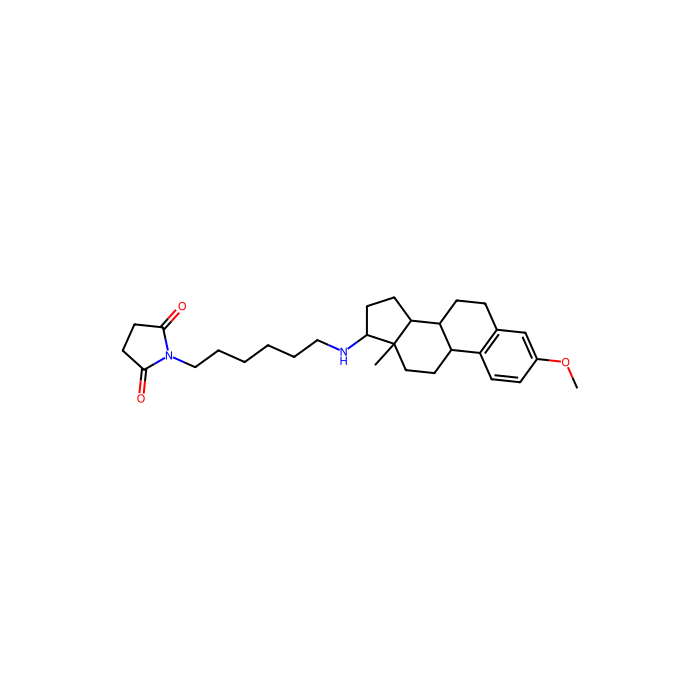
U-73343 - ≥98% , CAS No.142878-12-4

CAS: 142878-12-4 Cat. No.: U276451 분자식: C29H42N2O3 분자량: 466.7 EC 번호: 634-320-2 PubChem CID: 114825
주문 가능
등급 & 순도 ≥98%
Synonyms
2,5-PYRROLIDINEDIONE, 1-(6-(((17.BETA.)-3-METHOXYESTRA-1,3,5(10)-TRIEN-17-YL)AMINO)HEXYL)-|1-(6-(((17.BETA.)-3-METHOXYESTRA-1,3,5(10)-TRIEN-17-YL)AMINO)HEXYL)-2,5-PYRROLIDINEDIONE|1-(6-((17BETA-3-METHOXYESTRA-1,3,5(10)-TRIEN-17-YL)-AMINO)HEXYL-2,5-PYRROLIDINE-DIONE|1-(6-((17beta-3-Methoxyestra-1,3,5(10)-triene-17-yl)amino)hexyl)-2,5-pyrrolidinedione|U-73343 - CAS 142878-12-4|1-(6-(((8R,9S,13S,14S,17S)-3-methoxy-13-methyl-7,8,9,11,12,13,14,15,16,17-decahydro-6H-cyclopenta[a]phenanthren-17-yl)amino)hexyl)pyrrolidine-2,5-dione|2,5-Pyrrolidinedione, 1-(6-(((17beta)-3-methoxyestra-1,3,5(10)-trien-17-yl)amino)hexyl)-|1-[6-[[(8R,9S,13S,14S,17S)-3-methoxy-13-methyl-6,7,8,9,11,12,14,15,16,17-decahydrocyclopenta[a]phenanthren-17-yl]amino]hexyl]pyrrolidine-2,5-dione|U 73343|1-(6-(((17beta)-3-methoxyestra-1,3,5(10)-trien-17-yl)amino)hexyl)-2,5-Pyrrolidinedione|u73343|u-73343
Storage
Store at -20°C,Argon charged
Shipped In
Ice chest + Ice pads
★
크기
USA
독일 (EU)*
가격
수량
5mg
U276451-5mg
2 재고 있음
—
US$103.90
10mg
U276451-10mg
2 재고 있음
—
US$176.90
25mg
U276451-25mg
2 재고 있음
—
US$352.90
50mg
U276451-50mg
2 재고 있음
—
US$630.90
Enter a quantity for the sizes you want to add.

개요

Product description:

U-73343, works as a protonophore, is an inactive analog of U-73122 and can be used as a negative control. U-73343 dose-dependently inhibits acid secretion irrespective of the stimulant. U-73122 is a phospholipase C (PLC) and 5-LO (5-lipoxygenase) inhibitor with an IC50 of 1-2.1 µM for PLC。


Application:

U-73343 has been used for studying the role of phospholipase C (PLC) signaling in modulating epithelial Na+ channel (ENaC) function in gerbil Reissner′s membranes (RMs). U-73343 has also been used as a negative control for PLC inhibition in mechanically stimulated (MS) and its neighboring (NB) cells.

U-73343 has been used in measuring the fluorescence of intracellular Ca2+.

사양

동의어
2,5-PYRROLIDINEDIONE, 1-(6-(((17.BETA.)-3-METHOXYESTRA-1,3,5(10)-TRIEN-17-YL)AMINO)HEXYL)- | 1-(6-(((17.BETA.)-3-METHOXYESTRA-1,3,5(10)-TRIEN-17-YL)AMINO)HEXYL)-2,5-PYRROLIDINEDIONE | 1-(6-((17BETA-3-METHOXYESTRA-1,3,5(10)-TRIEN-17-YL)-AMINO)HEXYL-2,5-PYRROLIDINE-DIONE | 1-(6-((17beta-3-Methoxyestra-1,3,5(10)-triene-17-yl)amino)hexyl)-2,5 Show more
사양 및 순도
≥98%
생화학 및 생리적 메커니즘
Negative control for phospholipase C (PLC) inhibitor U73122 .
보관 조건
Store at -20°C,Argon charged
배송
Ice chest + Ice pads
이 제품은 콜드 체인 배송이 필요합니다.지상 및 기타 경제 서비스는 사용할 수 없습니다.
참고
Wherever possible, you should prepare and use solutions on the same day. However, if you need to make up stock solutions in advance, we recommend that you store the solution as aliquots in tightly sealed vials at -20°C. Generally, these will be useable for up to one month. Before use, and prior to opening the vial we recommend that you allow your product to equilibrate to room temperature for at least 1 hour. Need more advice on solubility, usage and handling? Please visit our frequently asked questions (FAQ) page for more details.
순수함
≥98%
이름과 식별자
Pubchem Sid
Pubchem Sid Url
https://pubchem.ncbi.nlm.nih.gov/substance/504756725
SMILES
CC12CCC3C(C1CCC2NCCCCCCN4C(=O)CCC4=O)CCC5=C3C=CC(=C5)OC
IUPAC Name
1-[6-[[(8R,9S,13S,14S,17S)-3-methoxy-13-methyl-6,7,8,9,11,12,14,15,16,17-decahydrocyclopenta[a]phenanthren-17-yl]amino]hexyl]pyrrolidine-2,5-dione
InChIKey
CJHWFIUASFBCKN-ZRJUGLEFSA-N
InChI
1S/C29H42N2O3/c1-29-16-15-23-22-10-8-21(34-2)19-20(22)7-9-24(23)25(29)11-12-26(29)30-17-5-3-4-6-18-31-27(32)13-14-28(31)33/h8,10,19,23-26,30H,3-7,9,11-18H2,1-2H3/t23-,24-,25+,26+,29+/m1/s1
이성체 SMILES
C[C@]12CC[C@H]3[C@H]([C@@H]1CC[C@@H]2NCCCCCCN4C(=O)CCC4=O)CCC5=C3C=CC(=C5)OC
PubChem CID
114825
분자량
466.7

고급 데이터

Taxonomic Classification

Taxonomy Tree

KingdomOrganic compounds
SuperclassLipids and lipid-like molecules
분류Steroids and steroid derivatives
SubclassAzasteroids and derivatives
Intermediate Tree Nodes Not available
Direct ParentAzasteroids and derivatives
Alternative Parents Estrane steroids  Phenanthrenes and derivatives  Tetralins  Anisoles  Alkyl aryl ethers  Aralkylamines  Pyrrolidine-2-ones  N-substituted carboxylic acid imides  N-alkylpyrrolidines  Dicarboximides  Amino acids and derivatives  Lactams  Dialkylamines  Azacyclic compounds  Carbonyl compounds  Hydrocarbon derivatives  Organic oxides  Organopnictogen compounds  
Molecular FrameworkAromatic heteropolycyclic compounds
Substituents 20-azasteroid - Estrane-skeleton - Azasteroid - Phenanthrene - Tetralin - Anisole - Alkyl aryl ether - Aralkylamine - Carboxylic acid imide, n-substituted - Pyrrolidone - 2-pyrrolidone - N-alkylpyrrolidine - Benzenoid - Carboxylic acid imide - Dicarboximide - Pyrrolidine - Amino acid or derivatives - Lactam - Carboxylic acid derivative - Azacycle - Secondary aliphatic amine - Organoheterocyclic compound - Secondary amine - Ether - Amine - Organic nitrogen compound - Carbonyl group - Hydrocarbon derivative - Organic oxygen compound - Organopnictogen compound - Organic oxide - Organooxygen compound - Organonitrogen compound - Aromatic heteropolycyclic compound
설명This compound belongs to the class of organic compounds known as azasteroids and derivatives. These are steroid derivatives in which one carbon atom in the steroidal skeleton has been substituted with a nitrogen atom.
External Descriptors Not available
3D 구조
상호 작용 화학 구조 모델


관련 대상(인간)
DRD1 Tclin Dopamine D1 receptor (9720 Activities)
Activity TypeRelationActivity valueUnitsAction TypeJournalPubMed IddoiAssay Aladdin ID
ARSA Tbio Cerebroside-sulfatase (655 Activities)
Activity TypeRelationActivity valueUnitsAction TypeJournalPubMed IddoiAssay Aladdin ID
MTOR Tclin Serine/threonine-protein kinase mTOR (13850 Activities)
Activity TypeRelationActivity valueUnitsAction TypeJournalPubMed IddoiAssay Aladdin ID
SH-SY5Y (11521 Activities)
Activity TypeRelationActivity valueUnitsAction TypeJournalPubMed IddoiAssay Aladdin ID
HEK293 (82097 Activities)
Activity TypeRelationActivity valueUnitsAction TypeJournalPubMed IddoiAssay Aladdin ID
ATAD5 Tbio ATPase family AAA domain-containing protein 5 (122566 Activities)
Activity TypeRelationActivity valueUnitsAction TypeJournalPubMed IddoiAssay Aladdin ID
관련 대상(비인간)
Saccharomyces cerevisiae (19171 Activities)
Activity TypeRelationActivity valueUnitsAction TypeJournalPubMed IddoiAssay Aladdin ID
pfk 6-phospho-1-fructokinase (7870 Activities)
Activity TypeRelationActivity valueUnitsAction TypeJournalPubMed IddoiAssay Aladdin ID
Txnrd1 Thioredoxin reductase 1, cytoplasmic (45279 Activities)
Activity TypeRelationActivity valueUnitsAction TypeJournalPubMed IddoiAssay Aladdin ID
hsp60 Chaperonin GroEL (Thermosome, HSP60 family) (16 Activities)
Activity TypeRelationActivity valueUnitsAction TypeJournalPubMed IddoiAssay Aladdin ID
작용 메커니즘
인증서(CoA, COO, BSE/TSE 및 분석 차트)
C of A & Other Certificates(BSE/TSE, COO):
Analytical Chart:

Find and download the COA for your product by matching the lot number on the packaging.

5 results found

Lot NumberCertificate Type날짜항목
C2514308C2514308Certificate of AnalysisSep 07, 2026 U276451
K2219255K2219255Certificate of AnalysisSep 07, 2026 U276451
K2219260K2219260Certificate of AnalysisSep 07, 2026 U276451
K2219259K2219259Certificate of AnalysisSep 07, 2026 U276451
K2219256K2219256Certificate of AnalysisSep 07, 2026 U276451
화학 및 물리적 특성
용해성DMSO (Slightly, Heated, Sonicated), Ethanol (Slightly, Heated), Methanol (Slightly)
녹는점(°C)139- 141° C
분자량466.7
XLogP33.600
Hydrogen Bond Donor Count1
Hydrogen Bond Acceptor Count4
Rotatable Bond Count9
Exact Mass466.32 Da
Monoisotopic Mass466.32 Da
Topological Polar Surface Area58.600 Ų
Heavy Atom Count34
Formal Charge0
Complexity725.000
Isotope Atom Count0
Defined Atom Stereocenter Count5
Undefined Atom Stereocenter Count0
Defined Bond Stereocenter Count0
Undefined Bond Stereocenter Count0
The total count of all stereochemical bonds0
Covalently-Bonded Unit Count1
안전 및 위험(GHS)
픽토그램(들)
신호
Warning
위험 문구

H315:Causes skin irritation

H319:Causes serious eye irritation

H335:May cause respiratory irritation

주의 문구

P261:Avoid breathing dust/fume/gas/mist/vapors/spray.

P264:Wash hands [and …] thoroughly after handling.

P271:Use only outdoors or in a well-ventilated area.

P280:Wear protective gloves/protective clothing/eye protection/face protection.

P321:Specific treatment (see ... on this label).

P302+P352:IF ON SKIN: wash with plenty of water.

P304+P340:IF INHALED: Remove person to fresh air and keep comfortable for breathing.

P305+P351+P338:IF IN EYES: Rinse cautiously with water for several minutes. Remove contact lenses if present and easy to do - continue rinsing.

P362+P364:Take off contaminated clothing and wash it before reuse.

P405:Store locked up.

P403+P233:Store in a well-ventilated place. Keep container tightly closed.

P501:Dispose of contents/container to an approved waste disposal plant.

P264+P265:Wash hands [and …] thoroughly after handling. Do not touch eyes.

P337+P317:If eye irritation persists: Get medical help.

P332+P317:If skin irritation occurs: Get medical help.

P319:Get medical help if you feel unwell.

솔루션 계산기
리뷰

고객 리뷰

Application Protocols

No vendor-tested protocols are provided in the Product Data. The following is general guidance for using U-73343 as a control compound in cell-signaling assays. Adjust to your system.

Example workflow (general):

  1. Stock solution: Prepare 10–50 mM in dry DMSO. Aliquot and store at −20°C under inert gas as per Product Data.
  2. Cell preparation: Plate cells to desired density and allow to adhere/equilibrate. Maintain consistent serum conditions.
  3. Dosing: Add U-73343 to cells to match the concentration of U-73122 used in parallel (e.g., 1–10 μM typical starting range). Keep final DMSO ≤0.1–0.5% v/v.
  4. Incubation: Preincubate for 10–30 minutes at 37°C unless literature for your pathway suggests otherwise.
  5. Stimulation: Apply receptor agonist or stimulus to activate PLC-dependent signaling.
  6. Readouts: Measure IP1/IP3, intracellular Ca2+ (e.g., Fluo-4), DAG sensors, or downstream phosphorylation. U-73343 should not reproduce U-73122’s inhibitory pattern if effects are PLC-specific.
  7. Controls: Include vehicle-only control and, if possible, an orthogonal PLC pathway control.

Notes:

  • Confirm no cytotoxicity of U-73343 at the selected concentration using viability assays.
  • Verify compound solubility in your media to avoid precipitation artifacts.
Biological Roles

Context (literature/general):

  • U-73343 is widely cited as the inactive or negative-control analog of U-73122, a nominal phospholipase C (PLC) inhibitor. U-73343 is used to control for non-specific effects in PLC-focused studies.
  • Typical use cases include monitoring phosphoinositide hydrolysis, DAG/IP3 signaling, and calcium mobilization following receptor activation, where U-73343 helps attribute effects specifically to PLC inhibition vs unrelated perturbations.

Key considerations:

  • Although described as “inactive” toward PLC in many reports, off-target interactions at elevated concentrations or in specific cell types have been noted in the literature. Users should verify neutrality in their assay context via concentration-response testing.
  • Serum protein binding and cellular uptake can modulate apparent potency or neutrality; maintain consistent protein content and exposure conditions across control and active analog treatments.

Experimental design suggestions (general):

  • Pair U-73343 with U-73122 at matched concentrations and exposure times.
  • Include vehicle-only controls to account for DMSO or solvent effects.
  • Where possible, corroborate PLC pathway involvement with orthogonal readouts (e.g., IP1 accumulation assays, biosensors) and genetic controls.
Buffer Applications

Not typically applicable. U-73343 is not a buffering agent and is not used to set or maintain pH.

Practical note:

  • For biological assays, dissolve in DMSO to prepare a concentrated stock, then dilute into your chosen buffer or culture medium immediately before use. Verify that the buffer composition (salt, protein, detergent) does not precipitate the compound and that the final DMSO content is compatible with your assay.
Green Alternatives

Not a solvent or process reagent; “green alternative” considerations are generally not applicable. For cellular assays, reduction of DMSO content and careful solvent choice can improve environmental and safety profiles.

General tips (assay context):

  • Minimize DMSO percentage in final assay media (≤0.1–0.2% v/v when feasible) to reduce solvent burden on cells and waste streams.
  • Use glass vials or solvent-resistant plastics to reduce leachables and facilitate solvent recycling where applicable.
  • If scaling biochemical assays, consider aqueous-compatible delivery systems (e.g., cyclodextrin carriers) where scientifically justified to reduce organic solvent use.

Because U-73343 is a bioactive tool compound rather than a commodity solvent, greener “substitutes” should be evaluated in terms of experimental design (controls, concentrations) rather than replacement chemicals.

Pharmaceutical Uses

This product is supplied strictly for research use only. No medical, diagnostic, or therapeutic uses are intended or implied.

Formulation/processing context (general for research compounds):

  • For in vitro assays, U-73343 is typically formulated as DMSO stock solutions (e.g., 10–50 mM) and dispensed into aqueous assay media at low final DMSO percentages.
  • For in vivo research (if pursued under appropriate approvals), vehicles often comprise DMSO/PEG/saline or similar systems; however, specific vehicles, dose forms, or pharmacopeial status are not provided for this item and must be developed and risk-assessed by the investigator.

Regulatory note:

  • No pharmacopeial monograph or excipient status is indicated. Any mention of pharmaceutical contexts here is strictly about general formulation practice for research compounds; do not construe as clinical guidance.
Physical Properties

Item-specific specifications:

  • Appearance: Not specified for this item; refer to CoA/Spec Sheet.
  • Grade/Purity: Not specified for this item; refer to CoA/Spec Sheet.

Literature/general property guidance (do not treat as specifications):

  • Phase: U-73343 is typically supplied as a solid small molecule for screening collections and dissolved in polar aprotic solvents (e.g., DMSO) to prepare stock solutions.
  • Solubility (qualitative, literature): Commonly soluble in DMSO; aqueous solubility is limited and usually achieved by DMSO cosolvent dilution into buffers or media. Actual solubility and stability depend on lot and should be confirmed experimentally.
  • pKa/logP, MP/BP, density, refractive index: Not available here. Consult primary literature or analytical certificate for definitive values.

Practical notes (general):

  • Stock solutions are typically prepared at 10–50 mM in anhydrous DMSO and stored aliquoted at low temperature to minimize freeze–thaw.
  • The product is specified to be stored under argon at −20°C (Product Data). This suggests sensitivity to oxidation and/or moisture; avoid prolonged exposure to air and elevated temperatures.

Always treat the above as guidance only. For exact numeric properties and acceptance criteria, rely on the lot-specific CoA and SDS.

Quality and Grades

Item-specific quality details:

  • Grade/Purity: Not specified for this item; refer to CoA/Spec Sheet for assay, impurity profile, and acceptance criteria.

Interpretation and implications (general for screening compounds):

  • Research-grade small molecules are typically qualified by identity (NMR/MS), purity (HPLC/UPLC, often ≥95% for screening collections), and sometimes water/solvent content (KF/GC). Exact targets vary by supplier and batch.
  • For mechanistic or screening work, higher chemical purity and well-characterized identity reduce off-target artifacts and ensure reproducibility.
  • If provided, stabilizers or salt forms may influence solubility and mass assay. No stabilizer is specified for this item in the Product Data.

Recommendations:

  • Request and review the lot-specific CoA for: assay/purity method and value, residual solvent profile, water content, and structural confirmation (MS/NMR). Confirm salt/base form if relevant.
  • If using in quantitative biology, qualify a working reference lot and retain retained samples for cross-study comparability.
  • If UV-based readouts are used, check for compound intrinsic absorbance/fluorescence in the assay window and adjust controls accordingly.
Reaction and Applications

This product is not typically used as a reaction solvent or synthetic reagent. It is a research tool compound employed in cell-signaling and biochemical studies.

Relevant applications (general/literature):

  • Used as a negative-control analog alongside U-73122 to distinguish PLC-dependent signaling from off-target or vehicle effects.
  • Employed in studies probing phosphoinositide turnover, intracellular Ca2+ mobilization, and GPCR/RTK-coupled PLC pathways, where U-73343 serves to control for non-PLC-related perturbations.

Good practices when deploying in experiments:

  • Use matched vehicle controls and concentration-matched U-73343 vs U-73122 to interpret PLC-specific effects.
  • Confirm that U-73343 does not affect your assay readout at the chosen concentration (pilot titrations recommended), as some off-target effects may appear at high micromolar levels depending on system.
  • Document exposure times, temperature, and serum conditions, as adsorption/binding to plastic and proteins can impact effective free concentration.

Note: No item-specific mechanistic claims are made here. Consult primary literature for detailed assay designs and confirm with your system.

Reaction Conditions

Not applicable as a reaction solvent or stoichiometric reagent.

Assay handling conditions (general guidance for small-molecule tool compounds):

  • Stock preparation: Dissolve in anhydrous DMSO (typical 10–50 mM). Vortex and sonicate briefly if needed. Filter sterilize (0.22 μm PTFE) for cell culture use.
  • Working concentrations: Commonly used in the low-to-mid micromolar range in cell-based assays, matched to U-73122 concentrations when used as a negative control. Determine the minimal concentration that provides a clean control without affecting readouts in your system.
  • Temperature/time: Equilibrate stocks to room temperature before opening to avoid moisture condensation. Dose cells shortly before stimulation in signaling assays; exposure times vary from minutes to hours depending on endpoint.
  • Controls: Include vehicle-only and, where applicable, pathway orthogonal controls to validate specificity of observations.

These are literature/practice-based guidelines; optimize empirically for your assay.

Safety and Handling

Authoritative safety data: Not specified for this item in the Product Data. Always consult the SDS for definitive hazard classification and first-aid measures.

Provided Product Data:

  • Storage conditions: Store at −20°C, argon charged.
  • Shipping: Ice chest + ice pads.
  • Research use: For research use only.
  • GHS signal word/H-statements/classification/pictograms: Not specified for this item; refer to SDS.

General laboratory safety (good practice; not a substitute for SDS):

  • PPE: Lab coat, safety glasses, and suitable gloves (e.g., nitrile). Handle in a fume hood to avoid inhalation of dust/aerosols and solvent vapors.
  • Incompatibilities (general): Avoid strong oxidizers and strong acids/bases during handling and storage unless compatibility is known. Keep away from moisture and air when the container is open; reseal under inert gas.
  • First aid (generic): If inhaled, move to fresh air; if on skin or in eyes, rinse with water for at least 15 minutes; if ingested, seek medical attention. Remove contaminated clothing and wash before reuse.
  • Spill/cleanup: Absorb with inert material, collect in appropriate waste container, and ventilate area. Prevent release to drains.
  • Waste: Dispose in accordance with institutional chemical waste procedures and local regulations. Segregate halogenated vs non-halogenated solvent waste if applicable.

Note on peroxidation/volatility: Not an ether solvent; no special peroxide hazard is implied by the Product Data. Follow the SDS for any specific risks.

Solvent Selection

Applicability: U-73343 is a small-molecule tool compound, typically handled as concentrated DMSO stock solutions for biological assays rather than as a bulk reaction solvent.

General solvent guidance (literature/practice; not specifications):

  • Primary stock solvent: Anhydrous DMSO is commonly used due to good solubilizing power for hydrophobic screening compounds.
  • Alternative solvents: DMF, ethanol, or isopropanol can sometimes be used; verify compatibility with your assay and compound stability.
  • Aqueous use: Dilute DMSO stocks into buffer or cell culture media immediately before use. Maintain final DMSO typically ≤0.1–0.5% v/v in cell assays to minimize vehicle effects.
  • Polarity profile: Expected amphiphilic behavior; actual partitioning and solubility are structure- and lot-dependent. Confirm empirically.

Practical tips:

  • Prepare small aliquots (e.g., single-use) to avoid multiple freeze–thaw cycles.
  • Filter sterile stocks through 0.22 μm PTFE when aseptic handling is required. Avoid cellulose-ester filters if using strong organic solvents.
  • Verify no precipitation upon dilution into aqueous buffers; pre-warm media or add dropwise with mixing to minimize local supersaturation.
Storage and Reconstitution

From Product Data:

  • Storage conditions: Store at −20°C, argon charged. Reseal promptly under inert gas after use.
  • Shipping: Ice chest + ice pads.
  • Research use: For research use only.

General handling guidance:

  • Keep container tightly closed. Allow vial to warm to room temperature in a desiccator before opening to prevent moisture condensation.
  • If supplied as a solid: Prepare concentrated stocks in anhydrous DMSO. Typical working stocks: 10–50 mM. Mix thoroughly to ensure complete dissolution.
  • Aliquoting: Divide into single-use aliquots to minimize freeze–thaw cycles. Store aliquots at −20°C or below, protected from air and, if applicable, light.
  • Stability: Actual shelf life and solution stability depend on lot and solvent; verify by LC–MS/HPLC at intervals if using over extended periods. Discard if precipitation, discoloration, or degradation is observed.
  • Thawing: Thaw on ice or at room temperature. Briefly spin down condensate and mix before use. Avoid repeated warming/cooling cycles.

Always consult the product’s CoA and SDS for definitive storage limits, stability data, and any special precautions.

Structure and Identity

Overview: U-73343 is a research-grade small-molecule tool compound commonly used as the negative-control analog of the phospholipase C (PLC) inhibitor U-73122 in cell-signaling studies.

Item-specific identifiers (from Product Data):

  • CAS: 142878-12-4
  • InChIKey: 45695 (as provided; abbreviated/not standard — consult CoA/SDS for the full identifier)
  • SMILES: Not specified for this item; refer to CoA/Spec Sheet.
  • Molecular formula: Not specified for this item; refer to CoA/Spec Sheet.
  • Molecular weight: Not specified for this item; refer to CoA/Spec Sheet.

Structural features (general/literature description):

  • U-73343 is reported in the literature as a structural analog of U-73122 designed to lack PLC inhibitory activity; it is often described as a “negative control” compound in PLC-related experiments.
  • Functional-group level description (literature, qualitative): amphiphilic small molecule with a hydrophobic scaffold and a polar/ionizable region; exact substitution pattern should be verified against the primary reference or supplier CoA.

2D structure in words (general):

  • Core hydrophobic framework with appended heteroatom-containing substituents; lacks the electrophilic functionality associated with U-73122’s activity. Exact ring system and stereochemistry should be confirmed from an authoritative structure source (e.g., PubChem CID 114825).
Synthetic Utility

Not a general building block or synthetic reagent. U-73343 is a bioactive tool compound used primarily as a control analog in biological experiments.

If chemical modification is of interest (general remarks):

  • Derivatization for probe development (e.g., biotinylation or photoaffinity tagging) may be feasible depending on available handles in the scaffold, but specific functionalization strategies require the confirmed structure and should be guided by SAR literature.
  • Analytical characterization after modification should include LC–MS and NMR to verify integrity, as small structural changes may impact biological neutrality relative to U-73122.
Target Specificity

Context for small molecules (literature/general):

  • Primary intended context: Negative control for U-73122, a compound reported to inhibit phospholipase C (PLC). U-73343 itself is generally reported as inactive against PLC and is used to control for non-specific effects of the chemotype.
  • Selectivity considerations: While considered PLC-inactive, reports note potential off-target or system-dependent effects at higher concentrations. Users should verify lack of activity in their specific assay.

Item-specific binding/target data:

  • Not specified for this item; refer to primary literature or the supplier’s technical notes if available.

Recommendation:

  • When interpreting data, treat U-73343 as a negative control specific to the U-73122 chemotype, not as a universally inert compound. Include appropriate concentration-matched controls and replicate across cell types if possible.

자주 묻는 질문

What is the purity of this product?
This product is supplied at ≥98% purity (chemical assay). Lot-specific values are stated on the Certificate of Analysis.
How should this product be stored?
Store at ?20 °C under argon. It is supplied under an argon blanket; reseal under inert gas after each use.
How is this product shipped?
This product ships in an insulated container with ice pads. Unpack on arrival and transfer it to the storage condition stated above.
What are the CAS number, molecular formula and molecular weight?
The CAS Number is 142878-12-4, the molecular formula is C29H42N2O3, and the molecular weight is 466.7 g/mol. InChIKey CJHWFIUASFBCKN-ZRJUGLEFSA-N.
What documentation is provided?
Available product documentation, including Certificates of Analysis (COA), Safety Data Sheets (SDS), and specification sheets, is shown in the product document area. Document availability and access follow the current site policy.

Shall we send you a message when we have discounts available?

Remind me later

Thank you! Please check your email inbox to confirm.

Oops! Notifications are disabled.