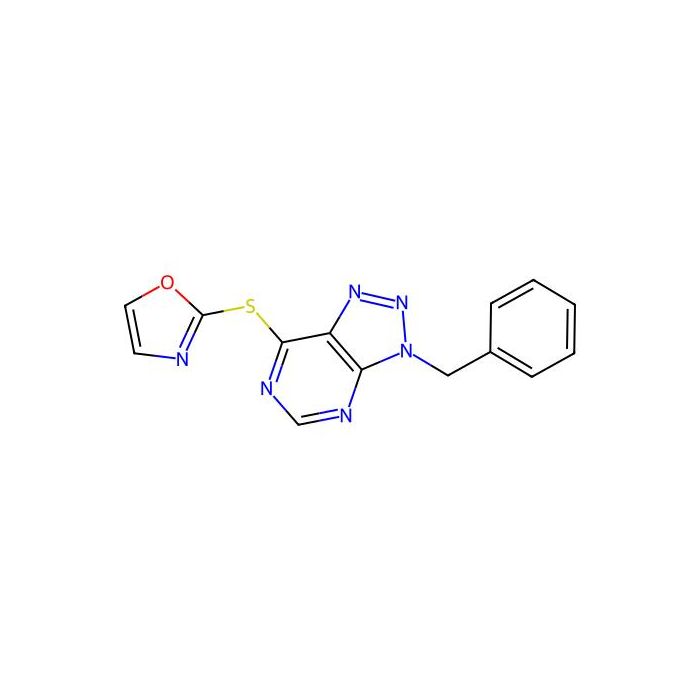
VAS 3947, a specific NADPH oxidase (NOX) inhibitor, exerts a potent antiplatelet effect. VAS3947 induces apoptosis independently of anti-NOX activity, via UPR activation, mainly due to aggregation and misfolding of proteins.
In Vitro
VAS3947 consistently inhibits NADPH oxidase activity in low micromolar concentrations, and interferes neither with ROS detection nor with XOD or eNOS activities. VAS3947 (30 µM) does not interfere with xanthine/XOD-derived L012 signals, suggesting this compound is free of antioxidant or scavenging effects relevant to ROS detection. In CaCo-2 cell homogenates, VAS3947 completely blocks NADPH-dependent ROS production with an IC 50 of 12 µM. VAS3947 triggers cell proliferation arrest and death independently of anti-NOX activity. The IC 50 values of the different cell lines ranges from 2.6 ± 0.6 µM for the most sensitive cell line MV-4-11 to 4.9 µM for THP-1, the least sensitive. VAS3947 decreases ROS levels. VAS3947 triggers endoplasmic reticulum (ER) stress and consequent unfolding protein response (UPR). VAS3947 attenuates platelet activation and thrombus formation via a NOX-independent pathway downstream of PKC 3] . MCE has not independently confirmed the accuracy of these methods. They are for reference only.
In Vivo
NADPH 氧化酶抑制剂 MCE has not independently confirmed the accuracy of these methods. They are for reference only.
사양
사양 및 순도
10mM in DMSO
생화학 및 생리적 메커니즘
VAS 3947, a specific NADPH oxidase (NOX) inhibitor, exerts a potent antiplatelet effect. VAS3947 induces apoptosis independently of anti-NOX activity, via UPR activation, mainly due to aggregation and misfolding of proteins.
Determine the necessary mass, volume, or concentration for preparing a solution.
Dilution Calculator
Determine the dilution needed to prepare a stock solution.
Reconstitution Calculator
리뷰
고객 리뷰
Application Protocols
No tested or recommended protocols are provided for this item in the product data.
General research-use guidance for small molecules:
Stock preparation: Prepare a concentrated stock in anhydrous DMSO (e.g., 10–50 mM) if compatible, then dilute into assay media maintaining a constant vehicle concentration. Verify solubility visually and by LC–MS or UV.
Plate-based assays: Use serial dilutions spanning at least 6–10 concentrations for robust curve fitting. Include vehicle controls and, where possible, positive/negative control compounds.
Analytical methods: Develop LC–MS methods with at least two orthogonal detection modes (UV and MS). Validate linearity, carryover, and stability in autosampler conditions.
Stability checks: Assess bench-top, freeze–thaw, and in-matrix stability prior to large studies.
For any specialized application (e.g., photochemistry, electrochemistry), first obtain the exact structure and consult domain-specific protocols.
Biological Roles
Endogenous role: None. VAS 3947 is a synthetic small molecule; it does not occur naturally in known metabolic pathways.
Mechanism/targets: Not specified for this item. If literature assigns a target or MOA to CAS 869853-70-3 (CID 7471335), verify independently and confirm with in-house controls before drawing conclusions.
Use in research biology (general guidance):
Can be evaluated as a chemical probe candidate or a reference tool in cell-free or cellular assays. Ensure orthogonal assays to avoid false positives (e.g., redox cycling, PAINS-like behavior, aggregation), using detergent controls and spectral interference checks.
Consider physicochemical liabilities that affect cell penetration, efflux, or nonspecific binding; confirm free concentration in complex media if quantitative pharmacology is required.
Off-target and liability assessment:
Run panel screens (e.g., broad enzyme or receptor counterscreens) if selectivity is claimed in literature. Monitor cytotoxicity separately from primary activity readouts.
Data integrity:
Record exact lot, preparation route, and vehicle composition. Replicate across batches where critical decisions depend on activity.
Note: No clinical or diagnostic claims are made. This product is provided strictly for research use only.
Buffer Applications
This item is a small organic molecule, not a buffering reagent. Therefore it is not typically used to prepare or maintain pH in biochemical systems.
Practical notes for assay buffers when dosing small molecules:
Maintain constant vehicle concentration (e.g., 0.1–1% v/v DMSO) across control and treated wells to isolate compound effects from solvent effects.
Use validated assay buffers (e.g., HEPES, PBS, Tris) appropriate to your biological system; add surfactant (e.g., 0.01–0.05% Tween-20) if aggregation is suspected and compatible with the assay.
Filter buffers (0.2 µm) and equilibrate to temperature before compound addition to minimize precipitation.
For pH-sensitive compounds (unknown here), prepare buffers at the pH that maximizes solubility/stability consistent with assay biology; verify by small-scale titration tests.
Green Alternatives
Greener choices primarily relate to solvent use and workflow design, since compound identity is fixed.
Stock/dilution solvents:
Prefer ethanol or methanol over DMF/NMP when feasible for analytics; for bioassays, DMSO remains common but consider limiting to the lowest effective percentage in the final assay volume.
Explore greener dipolar aprotics for method development (e.g., Cyrene or propylene carbonate) where compatible; validate assay/analytical performance.
Chromatography and purification:
If purifying or analyzing, choose lower-toxicity eluents (EtOAc/heptane instead of DCM/hexane; ACN/water over MeOH/chloroform) and minimize solvent volumes via efficient gradients and columns.
Process minimization:
Adopt microscale solubility and assay feasibility screens to reduce solvent and material usage.
Waste handling:
Segregate halogenated from non-halogenated waste; neutralize acids/bases before disposal when permitted. Implement solvent recycling where infrastructure exists.
Comparison (general, literature-informed):
DMSO vs Cyrene:
DMSO: very high solvency, broadly assay-compatible; fossil-derived; distinctive odor; benign acute toxicity profile but can carry contaminants through skin.
Cyrene: bio-based, lower toxicity profile; viscosity and water miscibility can complicate high-throughput handling; assay compatibility must be validated case-by-case.
Trade-offs: Maintain data quality as the primary constraint; adopt greener media when they do not compromise reproducibility or target engagement.
Pharmaceutical Uses
No excipient role, monograph status, or pharmaceutical application is specified for this item. The product is designated for research use only.
Relevant research-only contexts:
Analytical reference: May be employed as a reference standard in method development for LC–MS, stability-indicating assays, and impurity tracking once identity/purity are confirmed.
Preformulation studies (non-clinical): Solubility, stability, and compatibility screening in common vehicles (DMSO, PEG/aqueous cosolvents) to inform discovery-stage in vivo tool compound work. Any such use requires appropriate approvals and is outside the scope of this product listing.
Compliance reminder:
Not intended for human or veterinary use, diagnostic procedures, or clinical manufacturing. No pharmacopoeial grade is implied or provided. Consult your institutional review and compliance processes for any regulated applications.
Physical Properties
Item-specific values are not listed in this entry. Use the batch CoA/SDS for authoritative specifications.
Appearance: Not specified for this item; refer to CoA/Spec Sheet.
Melting point: Not specified for this item; refer to CoA/Spec Sheet.
Boiling point: Not specified for this item; refer to CoA/Spec Sheet.
Density: Not specified for this item; refer to CoA/Spec Sheet.
Refractive index: Not applicable/unknown (solid vs liquid not specified).
Solubility: Not specified for this item; refer to CoA/Spec Sheet.
logP/logD: Not specified for this item; refer to CoA/Spec Sheet.
pKa: Not specified for this item; refer to CoA/Spec Sheet.
Literature/computed guidance (non-item-specific):
For many screening compounds, initial dissolution in anhydrous DMSO (10–50 mM) is typical, followed by dilution into assay media with the final DMSO kept at ≤0.1–1% v/v as compatible with biology and readout.
If PubChem (CID 7471335) lists computed physicochemical parameters (e.g., cLogP, TPSA), use these only as screening heuristics; confirm experimentally (e.g., kinetic solubility, shake-flask logD, thermogravimetry).
Practical notes:
Conduct micro-scale solubility checks in several solvents (DMSO, DMF, MeOH, EtOH, water + cosolvent, buffers) before committing to large formulation or assay campaigns.
If hygroscopic or light-sensitive behavior is suspected, minimize atmospheric exposure and protect from light during handling (see Storage & Reconstitution).
Quality and Grades
Grade/purity: Not specified for this item; refer to CoA/Spec Sheet.
Interpretation and guidance:
In the absence of an explicit grade, assume research-use quality suited for discovery chemistry or screening. Request the batch CoA to verify purity (e.g., HPLC area %, NMR) and residual solvents.
Typical analytical controls for small molecules include:
HPLC/UPLC purity by UV and/or MS detection.
1H NMR (and 13C where appropriate) for structural confirmation and impurity profiling.
HRMS for exact mass confirmation.
Water and residual solvent by KF and GC, respectively, when relevant to the application.
If UV transparency is critical (e.g., photophysical assays), request UV–Vis spectra and impurity profiles; for bioassays, endotoxin is generally not applicable to small molecules but ensure absence of reactive impurities that could confound results.
Stabilizers: None specified for this item. If the compound is known to be oxidation- or hydrolysis-prone, consider storing under inert gas with desiccant and light protection.
Documentation: Always match lot/batch number to CoA/SDS to ensure traceability in regulated environments (even if used outside GMP).
Reaction and Applications
Scope in research workflows (general, non-item-specific due to limited data):
Chemical biology and screening:
Employed as a small-molecule library member in target discovery, phenotypic screens, or probe development. Use matched vehicle and negative/positive controls to interpret activity.
Analytical applications:
May serve as a reference standard to qualify LC–MS/UPLC methods, retention time windows, and ionization behavior when authenticated by CoA and independent QC.
Assay development best practices:
Establish concentration–response curves across several logs of concentration with constant vehicle.
Confirm activity across orthogonal readouts to rule out assay interference (fluorescence quenching, redox activity, aggregation). Consider counter-screens such as detergent-insensitive assays and redox reporter assays when relevant.
Reaction chemistry (if used as a substrate/intermediate):
Without structure, specific reactivity cannot be stated. If derivatization is intended, obtain structural data (SMILES/InChI) and consult functional-group reactivity to select protective atmospheres, bases/acids, or catalysts appropriately.
Note: No target, mechanism, or biological activity is specified for this item in the product data; avoid overinterpretation and rely on primary sources tied to CAS 869853-70-3 or CID 7471335.
Reaction Conditions
No reaction conditions are item-specific for this listing because the structure and reactive functional groups are not provided.
General guidance if derivatization or stability studies are planned after confirming the structure from primary sources:
Solvent: Select based on solubility and functional groups (e.g., polar aprotic for nucleophilic substitutions, alcohols for solvolysis studies). Begin with DMSO, DMF, or ACN for test reactions; switch to greener alternatives when feasible.
Temperature: Screen ambient to 60 °C for most transformations; avoid prolonged heating unless thermal stability is confirmed by DSC/TGA.
Atmosphere: Use inert gas (N2/Ar) for oxygen/moisture-sensitive motifs; include desiccants for anhydrous conditions.
Catalysts/bases/acids: Choose only after mapping functional groups. Without structure, avoid strong, non-specific conditions that may cause uncontrolled degradation.
Monitoring: LC–MS and UPLC with diode-array detection allow rapid tracking of conversion and impurity profiles in small-scale trials.
Expected yields and kinetics cannot be stated without structural context. Validate each condition empirically and document observations for reproducibility.
Safety and Handling
Safety details specific to this item are not provided in this listing. Always consult the SDS for authoritative information and risk assessment.
GHS classification: Not specified for this item; refer to SDS.
Signal word / pictograms / H-statements: Not specified for this item; refer to SDS.
General laboratory precautions:
Handle in a certified fume hood; avoid inhalation, ingestion, and skin contact.
Avoid generating dust or aerosols. Use closed containers and secondary containment during weighing/transfer.
Storage incompatibilities: Unknown for this item; as a prudent measure, segregate from oxidizers, acids/bases, and reactive metals until specific incompatibilities are known from the SDS.
Environmental precautions: Prevent release to drains. Collect waste in appropriate labeled containers per institutional procedures.
First-aid overview (general):
Skin/eye contact: Rinse with water for at least 15 minutes; remove contaminated clothing; seek medical attention.
Inhalation: Move to fresh air; monitor breathing; seek medical attention.
Ingestion: Rinse mouth; do not induce vomiting unless directed by medical personnel.
Special risks: Unknown. If the compound is moisture-/air-/light-sensitive (not specified here), work under inert atmosphere and protect from light. Defer to SDS for any thermal decomposition hazards.
Research use only; not for human or veterinary use.
Solvent Selection
Because item-specific solubility is not provided, begin with a rational, staged solvent screen common for small-molecule library members.
Primary stock solvents (general practice):
DMSO (anhydrous) is the default for screening stocks (10–50 mM). Compatible with most biochemical and cell-based assays at final ≤0.1–1% v/v.
DMF and NMP can dissolve challenging, polar/heteroatom-rich structures; verify assay compatibility.
Methanol or ethanol provide volatile, lower-toxicity options for certain analytical workflows.
Aqueous handling:
Direct water solubility is compound-dependent. Use co-solvent approaches (DMSO → buffer titration) or surfactants (e.g., 0.01–0.05% Tween-20) when appropriate for the assay.
Maintain final co-solvent content constant across controls to deconvolute vehicle effects.
Polarity considerations (general):
If the compound is highly lipophilic (high cLogP in literature databases), favor DMSO or mixed solvent systems; consider cyclodextrin inclusion for biological assays.
For ionizable compounds (pKa from literature/computations), adjust pH to the ionized state to improve aqueous solubility, within assay constraints.
Practical tips:
Warm slightly (≤40 °C) and sonicate gently to aid dissolution; avoid prolonged heating.
Use low-binding plasticware or glass vials to minimize adsorption losses.
Filter 0.2 µm if particulate persists and filtration is compatible with the use case.
Storage and Reconstitution
Item-specific conditions:
Storage: Store at -80°C (per product data).
Shipping: Shipped on dry ice packs + cold packs.
Best practices for small-molecule solids and DMSO stocks (general guidance):
Upon receipt: Keep sealed at -80°C until use. Allow containers to equilibrate to room temperature in a desiccator before opening to prevent moisture condensation.
Aliquoting: If supplied as a solid, divide into single-use aliquots in dry, inert conditions (glovebox or dry N2 purge) to minimize moisture/oxygen exposure. For solutions, aliquot into amber vials to avoid repeated freeze–thaw.
Reconstitution: If compatible, dissolve in anhydrous DMSO to prepare a concentrated stock (e.g., 10–50 mM). Mix gently; brief sonication and mild warming (≤40 °C) can aid dissolution. Filter (0.2 µm PTFE) if particulates persist and filtration is acceptable.
Light/moisture protection: Use amber glassware and desiccants as prudent measures if sensitivity is suspected.
Stability: No item-specific stability data are provided; perform small-scale stability checks (bench-top, refrigerated, and autosampler) and avoid multiple freeze–thaw cycles by storing single-use aliquots.
Labeling: Record lot, concentration, solvent, date of preparation, and storage conditions on each aliquot.
Note: For research use only. Defer to the SDS and batch CoA for any additional, item-specific storage or handling details.
Structure and Identity
Brief overview: VAS 3947 is sold here as a small-molecule research reagent from a compound library entry. Limited item-specific structural data are provided in this listing; consult the CoA/SDS and primary literature for definitive identifiers.
Product name: VAS 3947 (SKU: V656761)
CAS: 869853-70-3
PubChem CID: 7471335
InChIKey: Not specified for this item; refer to CoA/Spec Sheet.
SMILES: Not specified for this item; refer to CoA/Spec Sheet.
Molecular formula: Not specified for this item; refer to CoA/Spec Sheet.
Molecular weight: Not specified for this item; refer to CoA/Spec Sheet.
Structural features (general guidance):
This product is categorized under small molecules/compound libraries. Specific functional groups, ring systems, or stereochemistry are not provided in the product data. Verify structure via supplier CoA, NMR, HRMS, and (if needed) single-crystal or LC–MS retention/HRMS matching to a certified reference.
2D description: Without a provided SMILES or structure, only a generic description is possible. For structure-based work (docking, SAR, or analytical method development), obtain the exact structure using the CAS or PubChem CID and confirm against the batch-specific CoA.
Identity/traceability best practices:
Cross-reference CAS and CID across databases (supplier CoA, PubChem, Reaxys) to ensure the intended isomer/tautomer.
Record batch number and verify purity/identity by orthogonal techniques (LC–UV, LC–MS, NMR).
Synthetic Utility
With no disclosed structure or functional groups in this listing, VAS 3947 should not be presumed to be a general synthetic building block.
Potential utility in a synthetic/analytical laboratory (general):
Reference or spike standard: Useful for validating analytical methods (e.g., LC–MS retention time, ionization response, recovery from matrices) once authenticated via CoA and in-house QC.
Derivatization studies: If structure is obtained (via CAS 869853-70-3 or CID 7471335), transformation opportunities can be mapped based on recognized functional groups (e.g., halide → cross-coupling; amide → activation; phenol → etherification). Do not proceed without confirmed structural information.
Stability profiling: Conduct forced-degradation mapping (acid/base, oxidative, thermal, photolytic) to understand liabilities; this informs storage and handling even for purely analytical use.
Caveats:
Do not assume compatibility with standard coupling or protection strategies without structure verification.
Any synthetic manipulation should treat the purchased material as a reference point and may require re-purification to remove byproducts or stabilizers (none specified here).
Target Specificity
Target, binding site, and selectivity information are not provided for this item.
No antigen/epitope, enzyme, receptor, or pathway specificity is listed in the product data.
If literature associates CAS 869853-70-3 (CID 7471335) with a particular target, independently verify with orthogonal assays and include appropriate counterscreens to exclude assay interference.
Conclusion: No target specificity can be claimed or implied for this product as listed. It is supplied for research use only.
자주 묻는 질문
How should this product be stored?
Store at ?80 °C. Ultra-low temperature storage is required to maintain the specified shelf life.
How is this product shipped?
This product ships frozen with dry ice and cold packs. Unpack on arrival and transfer it to the storage condition stated above; handle dry ice with insulated gloves in a ventilated area.
What are the CAS number, molecular formula and molecular weight?
The CAS Number is 869853-70-3, the molecular formula is C14H10N6OS, and the molecular weight is 310.33 g/mol.
What documentation is provided?
Available product documentation, including Certificates of Analysis (COA), Safety Data Sheets (SDS), and specification sheets, is shown in the product document area. Document availability and access follow the current site policy.
Products are supplied to verified businesses, institutions, and qualified professionals for research and development use only. Not for use in humans, animals, diagnosis, or therapy.