Sino-atrial node function modulator; blocks the hyperpolarisation activated inward current I f . Also inhibits I h in central neurons and inhibits synaptic transmission.
보관 조건
Store at -20°C,Desiccated
배송
Ice chest + Ice pads
이 제품은 콜드 체인 배송이 필요합니다.지상 및 기타 경제 서비스는 사용할 수 없습니다.
참고
Wherever possible, you should prepare and use solutions on the same day. However, if you need to make up stock solutions in advance, we recommend that you store the solution as aliquots in tightly sealed vials at -20°C. Generally, these will be useable for up to one month. Before use, and prior to opening the vial we recommend that you allow your product to equilibrate to room temperature for at least 1 hour. Need more advice on solubility, usage and handling? Please visit our frequently asked questions (FAQ) page for more details.
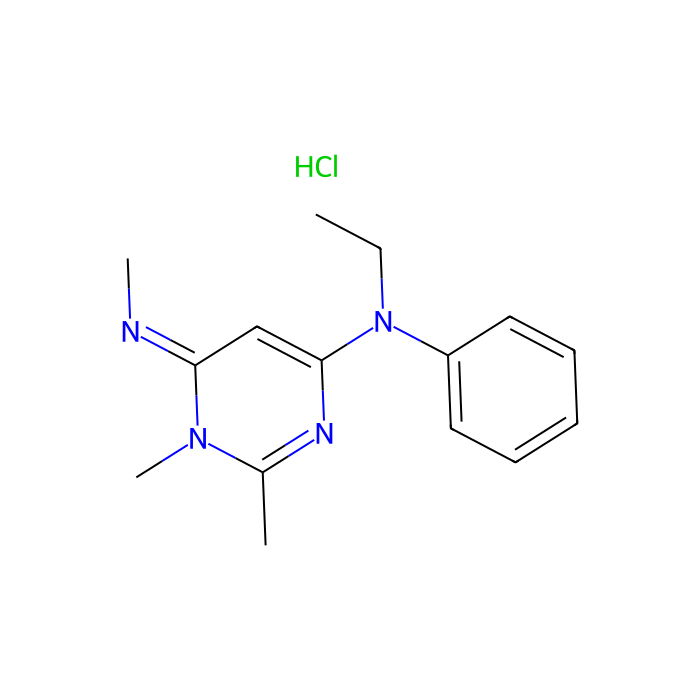
This compound belongs to the class of organic compounds known as alkyldiarylamines. These are tertiary alkylarylamines having two aryl and one alkyl groups attached to the amino group.
External Descriptors
Not available
1. Djoumbou Feunang Y, Eisner R, Knox C, Chepelev L, Hastings J, Owen G, Fahy E, Steinbeck C, Subramanian S, Bolton E, Greiner R, and Wishart DS. ClassyFire: Automated Chemical Classification With A Comprehensive, Computable Taxonomy. Journal of Cheminformatics, 2016, 8:61.
Determine the necessary mass, volume, or concentration for preparing a solution.
Dilution Calculator
Determine the dilution needed to prepare a stock solution.
Reconstitution Calculator
리뷰
고객 리뷰
Application Protocols
No tested application protocols are provided in the Product Data for this item.
Recommended dilutions, incubation times, and positive controls: Not specified for this item; refer to CoA/Spec Sheet.
General guidance (literature-based, non-validated by Aladdin Scientific):
Prepare concentrated DMSO stocks (10–100 mM), dilute into recording buffer to desired micromolar range, and allow adequate equilibration time when studying ion-channel currents. Include vehicle controls matching final DMSO content. Optimize concentration and timing empirically for your preparation.
Biological Roles
Context for use as a laboratory research tool (literature/general knowledge; no clinical claims):
ZD7288 is widely used in electrophysiology as a selective small-molecule modulator of hyperpolarization-activated cyclic nucleotide–gated (HCN) channels that underlie the “Ih/If” current in excitable cells (literature). Its utility is to probe contributions of HCN conductance to membrane excitability, pacemaking behavior, and synaptic integration in vitro.
In patch-clamp experiments, ZD7288 is typically applied extracellularly in buffered saline at low-to-mid micromolar concentrations to suppress Ih/If and isolate other currents (literature). Time- and voltage-dependence of block and incomplete reversibility upon washout have been reported; experimenters should plan adequate equilibration and wash steps.
Off-target considerations (literature): At higher concentrations, partial effects on additional conductances have been noted in some systems. Rigorous vehicle controls and concentration–response characterization are recommended.
Experimental workflows: Combine with current-clamp/voltage-clamp protocols, pharmacological dissection using complementary channel modulators, and genetic controls to validate specificity of observed effects.
Note: No item-specific bioassay data or potency parameters are provided in the Product Data. Users should consult primary literature for quantitative parameters relevant to their cell type, temperature, and ionic composition.
Buffer Applications
Although ZD7288 is not a buffer, it is frequently prepared and delivered via aqueous buffers in electrophysiological studies (literature guidance).
Stock preparation (literature): Dissolve in anhydrous DMSO to 10–100 mM. Vortex and, if necessary, warm gently (≤37°C). Filter sterilization is typically unnecessary for acute electrophysiology use but may be applied through PTFE (0.2 µm) if particulate is present.
Working solutions: Dilute stock into pre-warmed, well-stirred buffer such as ACSF, HEPES-buffered saline, or PBS immediately prior to use. Target final DMSO ≤0.1–0.5% v/v to minimize vehicle effects.
pH and ionic strength: Maintain physiological pH (∼7.2–7.4) and standard ionic compositions appropriate for your prep (e.g., NaCl/KCl/CaCl2/MgCl2/HCO3 − systems for ACSF). Avoid abrupt pH shifts during addition to prevent precipitation.
Stability in solution: Prepare fresh daily working solutions where possible. If extended experiments require, keep solutions protected from light and at 2–8°C during the day; discard at end of session unless stability is independently verified.
Adsorption mitigation: Use low-bind tubes and pre-rinse with buffer containing the working concentration to reduce wall losses when operating at low micromolar levels.
Item-specific buffer compatibility and stability are not provided in the Product Data; verify empirically under your exact conditions.
Green Alternatives
Green solvent or reagent substitution is generally not applicable to this product, which is a defined small-molecule probe used as an analyte/ligand rather than as a process solvent or reagent.
Environmental impact reduction can instead focus on:
Minimizing DMSO volume in stock solutions and choosing the least hazardous co-solvent compatible with the assay.
Employing microscale assays to reduce chemical use and waste.
Using closed, low-headspace vials to limit evaporative losses of organic vehicles.
Consolidating waste streams to optimize disposal.
Because activity is compound-specific, there is no direct “green alternative” that reproduces the same binding profile. Selection of alternative tool compounds (if needed) should be guided by target pharmacology and assay tolerance to vehicles, documented in the primary literature.
Pharmaceutical Uses
This product is supplied strictly for research use only. No pharmacopeial status, GMP grade, or excipient role is provided in the Product Data.
Formulation/excipient status: Not specified for this item; refer to CoA/Spec Sheet.
Manufacturing/clinical use: Not for human or veterinary use. No clinical, diagnostic, or therapeutic claims are made or implied.
If your workflow involves preclinical formulation screening (in vitro), standard practice is to evaluate DMSO stock compatibility, potential precipitation on dilution, and adsorption to dosing apparatus. Any in vivo or clinical applications are outside the permitted use and scope of this product.
Physical Properties
Item-specific physicochemical specifications are not supplied in the Product Data. Do not treat literature values as product specifications.
Appearance: Not specified for this item; refer to CoA/Spec Sheet.
Molecular Weight: Not specified for this item; refer to CoA/Spec Sheet.
Molecular Formula: Not specified for this item; refer to CoA/Spec Sheet.
Melting point (MP): Not specified for this item; refer to CoA/Spec Sheet.
Boiling point (BP): Not specified for this item; refer to CoA/Spec Sheet.
Density: Not specified for this item; refer to CoA/Spec Sheet.
Refractive index: Not applicable to solids; Not specified for this item; refer to CoA/Spec Sheet.
LogP/logD, pKa: Not specified for this item; refer to CoA/Spec Sheet.
Solubility (qualitative, literature): Commonly prepared as concentrated stock solutions in DMSO and diluted into aqueous buffers (e.g., physiological saline, ACSF) for electrophysiology assays. Aqueous solubility is typically limited without co-solvent or vehicle (literature). Final working solutions generally keep DMSO ≤0.1–0.5% v/v to minimize vehicle effects (literature guidance).
Practical implications (general):
For accurate solution preparation, determine solubility empirically in your specific solvent system and temperature. Filter sterilize only if compatible; adsorptive losses to membranes may occur with hydrophobic bases.
Verify hygroscopicity and polymorphism, if relevant to your application, by DSC/TGA and PXRD; not specified for this item.
Quality and Grades
Item-specific grade/purity is not included in the Product Data; do not assume unstated specifications.
Grade/Purity: Not specified for this item; refer to CoA/Spec Sheet.
How to interpret grade (general guidance):
Research-grade small molecules are typically qualified by identity (NMR/HRMS), purity (HPLC/UPLC, area %), and residual solvent/volatile profile (GC). If low-UV applications (e.g., bioassay readouts) are sensitive to impurities, request chromatograms and absorbance scans.
For ion-channel probe work, batch-to-batch consistency (assay purity, polymorph) can influence potency and solubility. Confirm via CoA and, if necessary, re-verify with in-house HPLC and melting behavior.
Stabilizers/additives:
No stabilizer information is provided for this item. If stabilizers are relevant to your assay, request disclosure or perform independent analytical screening (e.g., 1H NMR in DMSO-d6 for residual BHT/phenols).
Reaction and Applications
This product is a small-molecule research tool compound and is not typically employed as a reagent, catalyst, or building block in synthetic transformations.
Not commonly used in named organic reactions or as a stoichiometric/catalytic agent.
If derivatization or prodrug design is of interest, consult the primary literature for synthetic analogs; the parent compound itself is generally used as-received for bioassay purposes.
For laboratory use, see the sections on Biological Roles, Buffer Applications, and Application Protocols for guidance relevant to electrophysiology and ion-channel research contexts.
Reaction Conditions
Not applicable. This item is supplied as a research tool compound rather than as a reagent or catalyst; no reaction-condition guidance is relevant.
For laboratory use scenarios, refer to Solvent Selection and Buffer Applications for solution preparation and assay delivery considerations.
Safety and Handling
Safety information specific to this catalog item is not provided in the Product Data; consult the SDS for authoritative guidance.
GHS Classification / Pictograms / H-Statements / Signal Word: Not specified for this item; refer to SDS.
Primary hazards (general): Small-molecule organic research chemical; may cause irritation upon contact or inhalation. Avoid ingestion and exposure to mucous membranes. Handle as a potentially harmful substance under the precautionary principle.
PPE: Use lab coat, nitrile gloves, and safety glasses. Employ chemical fume hood when weighing solids, dissolving, or aliquoting DMSO stocks.
Storage incompatibilities: Segregate from strong oxidizers and acids/bases until compatibility is known. Avoid moisture ingress for materials stored desiccated.
Handling notes:
Prepare concentrated stocks in dry, anhydrous DMSO or other suitable solvent; cap promptly to minimize moisture uptake.
When diluting into aqueous buffers, add stock slowly with vigorous mixing to avoid local supersaturation/precipitation.
First-aid overview (general): Skin/eye contact—rinse with water for ≥15 min; remove contaminated clothing. Inhalation—move to fresh air. Ingestion—rinse mouth; do not induce vomiting. Seek medical attention in all cases. Defer to SDS.
Waste: Collect solutions and contaminated disposables as organic hazardous waste according to institutional and local regulations.
Solvent Selection
ZD7288 is typically used as a research tool compound rather than as a reaction solvent. Solvent considerations therefore focus on stock preparation and assay compatibility (literature/generic guidance).
Primary stock solvent (literature): DMSO is commonly used due to broad solubilizing power and compatibility with aqueous dilution. DMF, ethanol, or methanol may also dissolve the compound but can be less desirable for biological assays.
Aqueous dilution: Dilute DMSO stocks into buffered saline (e.g., PBS, HEPES, or ACSF) with vigorous mixing. Maintain final DMSO ≤0.1–0.5% v/v where assay sensitivity to vehicle is expected (literature practice).
pH considerations: If the compound exhibits basic or neutral character (literature reports vary by salt/form), keep assay buffers within physiological pH to avoid precipitation upon dilution. Empirically verify at working concentrations.
Adsorption/carryover: Hydrophobic molecules can bind plastics; prefer low-bind polypropylene or glass vials. Pre-rinse tips/vials with working solution to condition surfaces when working at low micromolar concentrations.
Co-solvents/surfactants: Where aqueous solubility is limiting, small amounts of co-solvent (DMSO) or 0.01–0.05% w/v nonionic surfactant (e.g., Pluronic F-127) are sometimes employed in research settings; validate for your assay.
Note: No item-specific solubility, pKa, or logP is provided; determine empirically for your conditions.
Storage and Reconstitution
Follow the item-specific storage guidance provided; do not deviate without stability data.
Storage Conditions (as provided): Store at −20°C, desiccated.
Shipping: Shipped in ice chest + ice pads.
Container management: Keep tightly capped under dry, inert conditions where feasible. Minimize freeze–thaw by aliquoting upon first opening.
Reconstitution (general):
Bring vial to room temperature in a desiccator before opening to avoid moisture condensation.
Prepare concentrated stocks in anhydrous DMSO. Record exact mass and solvent volume for traceable concentration.
Filter if necessary through PTFE (0.2 µm). Avoid cellulose ester membranes which may adsorb hydrophobic compounds.
In-use stability: Working aqueous solutions should be prepared fresh. If short-term storage is required, protect from light and keep at 2–8°C; discard if precipitation or discoloration occurs.
Documentation: For any extended storage or alternative solvents, establish in-house stability indicating methods (HPLC/UPLC) since item-specific stability data are not provided.
Research Use Note: For research use only.
Structure and Identity
Brief identity overview for the small-molecule research tool ZD7288 (CAS 133059-99-1).
Product Name: ZD7288 (SKU: Z274826)
CAS: 133059-99-1
PubChem CID: 123983 (literature identifier)
InChIKey: 73474 (as provided in Product Data)
SMILES: Not specified for this item; refer to CoA/Spec Sheet.
Molecular Formula: Not specified for this item; refer to CoA/Spec Sheet.
Molecular Weight: Not specified for this item; refer to CoA/Spec Sheet.
Structural features (general, literature-based):
ZD7288 is a small, non-peptidic organic molecule commonly used as an ion-channel probe in electrophysiology research (literature). It is not chiral in its widely cited forms (literature), and is typically formulated as a neutral organic solid for stock-solution preparation.
2D structural description (general):
Consists of an aromatic/heteroaromatic scaffold with tertiary/secondary amine functionality reported in literature sources; exact atom connectivity and substituent pattern must be confirmed against the CoA/Spec Sheet for this specific catalog item.
Notes:
Where an exact structure depiction, stereochemistry, or tautomeric form is critical to your work, please consult the item’s CoA/SDS or confirm via independent spectral characterization (NMR, HRMS, IR).
Synthetic Utility
ZD7288 is not typically employed as a synthetic building block or reagent. Its primary value lies in its use as a defined molecular probe in ion-channel research.
No commonly cited roles in cross-coupling, condensation, redox, or catalytic manifolds.
If analog development or SAR expansion is of interest, consult medicinal chemistry literature for scaffold modification strategies; the parent compound here should be considered the target, not a synthon.
For projects requiring chemical modification, isolate and confirm structural details from the CoA/SDS and consider full recharacterization (NMR, HRMS, HPLC) following any derivatization.
Target Specificity
Only product-data-derived details may be listed here. The Product Data provided does not include target, epitope, or binding specificity information.
Target/Mechanism: Not specified for this item; refer to CoA/Spec Sheet.
Species reactivity/Selectivity panel: Not specified for this item; refer to CoA/Spec Sheet.
For research planning, consult the primary literature for mechanistic context appropriate to your assay system.
We use cookies to ensure the website functions properly and, where permitted, to improve your experience. You can manage your preferences at any time in Settings. Learn more in our Cookie Policy.
Shall we send you a message when we have discounts available?
Remind me later
Thank you! Please check your email inbox to confirm.
Products are supplied to verified businesses, institutions, and qualified professionals for research and development use only. Not for use in humans, animals, diagnosis, or therapy.

 D2306559