Aurora B Mouse mAb - Primary antibody, specific to Aurora B, Mouse IgG2b

Cat. No.: Ab184302
AVAILABLE TO ORDER
GRADE & PURITY Carrier Free ? Carrier-free — supplied without added carrier protein/stabilizer. Use when carriers (e.g. BSA) would interfere with conjugation or sensitive assays. Azide Free ? Azide-free — without sodium azide preservative. Use in conjugations, cell work, or assays where azide is toxic or inhibitory. Validated ? Validated grade — performance confirmed in defined applications before release. Use when you want documented assurance the reagent works as stated. High Performance ? High-performance grade with optimized purity and performance characteristics. Use for sensitive analyses where ordinary grades fall short. PBS Only ? PBS-only formulation — supplied in phosphate-buffered saline with no other additives. Use when you need a clean PBS buffer free of stabilizers/carriers. ≥95%(SDS-PAGE) 1.0 mg/mL
Application
WB
Host species
Mouse
Reactive species
Human, Mouse, Rat
Isotype
Mouse IgG2b
Clone Number
GH02/1A10
Conjugation
Unconjugated
★
Size
Germany (EU)
USA*
Price
Qty
10μl
Ab184302-10μl
—
In stock ≥10
€86.69
50μl
Ab184302-50μl
—
2 In stock
€225.53
100μl
Ab184302-100μl
—
1 In stock
€364.36
1ml
Ab184302-1ml
Made to order · 8–12 wks
€2,429.58
Enter a quantity for the sizes you want to add.
🧪
Why this grade

Carrier Free,Azide Free,Validated,High Performance,PBS Only,≥95%(SDS-PAGE),1.0 mg/mL Azide Free,Carrier Free,High Performance,PBS Only,Validated for sensitive chromatographic and analytical workflows requiring minimal baseline interference.

🌡

Storage & shipping

Store at -20°C,Avoid repeated freezing and thawing Ships Ice chest + Ice pads Check lot-specific COA for exact specifications.

📋

Quality documents

SDS, COA, datasheet, and spec sheet available for download. Lot-specific COA accessible via lot number lookup.

📚

Literature proof

Cited in 0 peer-reviewed publications across chromatography, organic synthesis, and cross-coupling reactions.

Overview

Application
WB: 1/1,000 - 1/20,000; Predicted molecular weight: 39.3 KDa

Specifications

Product Name
Aurora B Mouse mAb - Primary antibody, specific to Aurora B, Mouse IgG2b
Synonyms
AIK2 antibody | AIM-1 antibody | AIM1 antibody | ARK-2 antibody | ARK2 antibody | AurB antibody | AURKB antibody | AURKB_HUMAN antibody | Aurora 1 antibody | Aurora and Ipl1 like midbody associated protein 1 antibody | Aurora kinase B antibody | Aurora re
Specifications & Purity
Carrier Free,Azide Free,Validated,High Performance,PBS Only,≥95%(SDS-PAGE),1.0 mg/mL
Host species
Mouse
Specificity
Aurora B
Immunogen
Recombinant full length protein corresponding to Human Aurora B
Positive Control
WB: HeLa, HEK293, MCF-7, HepG2, NIH/3T3 and C6 Whole cell Lysates
Conjugation
Unconjugated
Grade
Azide Free, Carrier Free, High Performance, PBS Only, Validated
Isotype
Mouse IgG2b
Light Chain Type
kappa
SDS-PAGE
150.0 KDa
Purification Method
Protein A purified
Concentration
1.0 mg/mL
Product Line
Biological Products
Storage and Shipping
Form
Liquid
Storage
Store at -20°C,Avoid repeated freezing and thawing
Shipped In
Ice chest + Ice pads
Stability And Storage
Store at 4°C short term (1-2 weeks). Store at -20°C or -80°C. Avoid freeze / thaw cycle.
Images

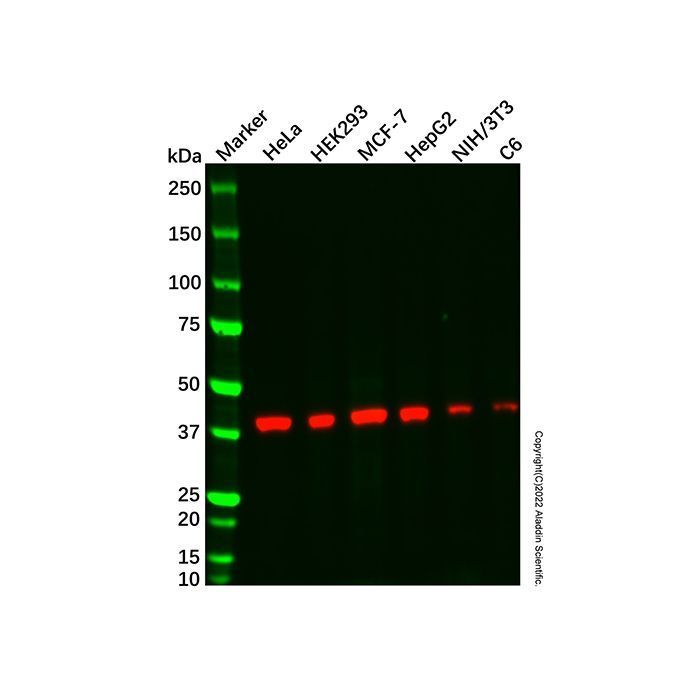
Aurora B Mouse mAb (Ab184302) - Western Blot
All lanes: Aurora B Mouse Antibody (Ab184302) at 1/2000 dilution
Samples: Lysates at 20 µg per lane
Secondary: Goat Anti-Mouse IgG H&L (HRP) at 1/20000 dilution
Predicted band size: 39 kDa
Observed band size: 42 kDa
Exposure time: 7.6 s

Application
Application
Dilution info
WB

1/1,000 - 1/20,000; Predicted molecular weight: 39.3 KDa

Documentation

📋 Safety Data Sheet (SDS)

Comprehensive hazard, handling, storage, and regulatory compliance document.

<<<<<<< HEAD Download SDS → ======= Download SDS → >>>>>>> release248-p3

✅ Certificate of Analysis (COA)

Lot-specific quality data. Enter your lot number to retrieve the exact COA.

Look up COA →

📊 Datasheet

Quick-reference summary of product specifications and applications.

View datasheet →

🔬 Specification Sheet

Full quality attributes and acceptance criteria for this grade.

View spec sheet →

Advanced Data

Associated Targets(Human)
AURKB Tchem Aurora kinase B (0 Activities)
Activity TypeActivity Value -log(M)Mechanism of ActionActivity ReferencePublications (PubMed IDs)
AURKB Tchem Serine/threonine-protein kinase Aurora-B (6805 Activities)
Activity TypeRelationActivity valueUnitsAction TypeJournalPubMed IddoiAssay Aladdin ID
AURKB Tchem Aurora kinase B/Inner centromere protein (233 Activities)
Activity TypeRelationActivity valueUnitsAction TypeJournalPubMed IddoiAssay Aladdin ID
AURKB Tchem Serine/threonine-protein kinase Aurora (2 Activities)
Activity TypeRelationActivity valueUnitsAction TypeJournalPubMed IddoiAssay Aladdin ID
Mechanisms of Action
Certificates (CoA,COO,BSE/TSE and Analysis Chart)
C of A & Other Certificates(BSE/TSE, COO):
Analytical Chart:

Find and download the COA for your product by matching the lot number on the packaging.

3 results found

Lot NumberCertificate TypeDateItem
ZJ24F0606536ZJ24F0606536Certificate of AnalysisMar 18, 2026 Ab184302
ZJ24F0606537ZJ24F0606537Certificate of AnalysisMar 18, 2026 Ab184302
ZJ24F0606538ZJ24F0606538Certificate of AnalysisMar 18, 2026 Ab184302
Documents & Articles
Solution Calculators
Reviews

Customer Reviews

Application Protocols

Tested applications, recommended dilutions, incubation times, antigen retrieval methods, and positive control samples are not specified for this item; refer to the CoA/Spec Sheet.

Because only product‑specific data may be listed here, no generalized dilution ranges or protocols are provided in this section. For conceptual guidance on potential applications (WB, IF/IHC, IP, ELISA, FC) involving Aurora B detection, see Reaction & Applications and Biological Roles.

Biological Roles

Aurora B (AURKB) is a serine/threonine kinase and core component of the chromosomal passenger complex (CPC) together with INCENP, Survivin (BIRC5), and Borealin (CDCA8).

  • Cellular functions (literature)

    • Coordinates chromosome condensation and congression, corrects erroneous kinetochore–microtubule attachments via tension‑sensing phosphorylation of outer kinetochore substrates (e.g., NDC80, DSN1).
    • Regulates spindle assembly checkpoint signaling by modulating kinetochore architecture and recruiting checkpoint proteins.
    • Orchestrates cytokinesis through phosphorylation of midzone/midbody substrates and regulation of the abscission checkpoint.
    • Dynamic localization: centromeres in early mitosis → central spindle/midbody in anaphase/telophase.
  • Pathway context (literature)

    • Interfaces with CDK1‑cyclin B, PLK1, and PP1/PP2A phosphatases to set mitotic phosphorylation balance.
    • Substrates include histone H3 (Ser10/Ser28), MCAK (KIF2C), and components of the KMN network.
  • Research relevance

    • Widely used as a marker of mitotic index (e.g., H3S10 phosphorylation) and for studying chromosome segregation fidelity, error correction mechanisms, and cytokinetic abscission.

Note: This section describes biology of the target protein (Aurora B). It does not represent validation data for this specific antibody SKU. Consult the CoA/Spec Sheet for item‑specific performance information.

Buffer Applications

This product is not a buffering agent. However, buffer choice is critical for antibody performance and stability.

  • Provided matrix

    • PBS Only (per Product Data). Exact pH/composition are not specified for this item; refer to CoA/Spec Sheet.
  • Practical considerations (general)

    • For WB/ELISA: PBS or TBS with 0.05–0.1% Tween‑20 can reduce nonspecific binding; add protein blockers (e.g., BSA, casein) as appropriate—avoid carriers if downstream conjugation is planned.
    • For IF/IHC: Use PBS‑based wash buffers; fixation/permeabilization conditions should preserve Aurora B antigenicity (optimize PFA concentration and detergent type).
    • For IP: Lysis buffers should balance solubilization with preservation of protein complexes; avoid harsh detergents that disrupt CPC interactions unless required by the assay.
  • Storage buffer modifications

    • If you plan long‑term storage or conjugation, validate any buffer changes empirically. Do not assume compatibility without testing. For item‑specific buffer details, see the CoA/Spec Sheet.
Green Alternatives
  • Current formulation attributes

    • PBS Only and Azide Free reduce reliance on toxic preservatives and use an aqueous, biocompatible buffer. Carrier‑free format minimizes additive load.
  • Considerations in a green chemistry context (general)

    • Prefer aqueous buffers over organic solvent systems for assay preparation and cleaning where feasible.
    • Maintain cold chain with reusable ice packs to reduce dry ice usage when not required by stability.
  • Alternative preservative strategies

    • If microbial control is necessary and compatible with downstream use, low‑impact approaches include sterile filtration and aseptic handling rather than chemical preservatives.
  • Tradeoffs

    • Azide‑free improves environmental and biosafety profiles but reduces shelf stability at 2–8°C; freezing aliquots at −20°C or below increases energy demand. Balance storage temperature with experiment cadence.

Small comparison (general)

  • Azide‑containing formulations: Extended bench stability; not suitable for HRP assays/live cells; introduces hazardous waste stream.
  • Azide‑free (this item): Compatible with HRP/live cells; requires stricter sterility and cold‑chain management; reduced hazardous waste.
Pharmaceutical Uses

This product is designated For research use only and is not intended for diagnostic or therapeutic applications.

  • Potential roles in pharmaceutical R&D (general)

    • As an analytical reagent in discovery research to characterize Aurora B levels, localization, or phosphorylation in cell models.
    • Utility in target validation workflows, mechanism‑of‑action studies, or assay development (e.g., ELISA, IF) supporting screening campaigns.
    • Possible use in process development analytics (e.g., monitoring mitotic state in cell‑based manufacturing research), subject to internal qualification.
  • Regulatory status

    • No pharmacopeial monograph or clinical designation is provided for this SKU. Lot‑specific documentation such as CoA is for research QA/QC only.
  • Formulation/excipient context

    • Carrier Free, Azide Free, PBS Only format reduces excipient complexity—advantageous for conjugation or incorporation into custom research‑grade assay kits. Any adaptation for diagnostic manufacture would require separate validation and regulatory review outside the scope of this listing.
Physical Properties
  • Item-specific physical constants

    • Concentration, extinction coefficient, isotype, formulation details: Not specified for this item; refer to CoA/Spec Sheet.
    • Appearance: Not specified for this item; refer to CoA/Spec Sheet.
  • Supplied matrix (from Product Data)

    • Grade/format: Carrier Free, Azide Free, PBS Only (no additional stabilizers indicated).
  • General/literature properties for IgG‑type antibodies (for context; not item‑specific specs)

    • Typical molecular mass: ~150 kDa for intact IgG; Fc fragments ~50 kDa; Fab ~50 kDa; F(ab')2 ~100 kDa.
    • Isoelectric point (pI): commonly ~6–9, isotype‑ and sequence‑dependent.
    • Solubility: Highly soluble in isotonic aqueous buffers (e.g., PBS, TBS); precipitation can occur outside optimal pH/ionic strength.
    • Stability: Sensitive to repeated freeze–thaw, agitation, and elevated temperature; stabilized by neutral pH, moderate ionic strength, and gentle handling.
    • UV characteristics: Protein A280 with typical IgG extinction coefficient ε1% ≈ 13.7 (literature; sequence‑dependent).
  • Storage and shipping (from Product Data)

    • Storage: Store at −20°C; avoid repeated freezing and thawing.
    • Shipping: Ice chest + ice pads.

Note: Values above labeled as literature are typical for antibodies and provided for general guidance only. For lot‑specific characteristics (concentration, exact buffer composition, pH), consult the CoA/Spec Sheet.

Quality & Grades
  • Item-specific designations (from Product Data)

    • Carrier Free: Supplied without protein carriers (e.g., BSA), facilitating conjugation, labeling, and low‑background assays.
    • Azide Free: No sodium azide preservative indicated—compatible with live‑cell or enzymatic applications where azide is inhibitory or toxic.
    • PBS Only: Formulated in phosphate‑buffered saline without additional stabilizers specified.
    • Validated, High Performance: Indicates internal qualification of performance; exact validation data and criteria are not specified for this item—refer to CoA/Spec Sheet for assay results.
  • Practical implications

    • Carrier‑free matrices minimize steric hindrance in conjugation chemistries (e.g., NHS‑ester dyes, maleimide linkers after partial reduction) and reduce non‑specific background in immunoassays.
    • Azide‑free status is essential for HRP‑based detection (azide inhibits peroxidases) and for cell‑based functional assays; maintain sterility to prevent microbial growth in the absence of preservatives.
    • PBS‑only formulations are compatible with most immunoassays; if additional stabilizers (e.g., glycerol, trehalose) are desired for long‑term storage, validate in‑house. Do not add carriers if downstream conjugation is planned.
  • What is not specified for this item

    • Isotype/subclass, clonality details (e.g., clone name), concentration, endotoxin level, and residual host cell proteins are not provided here. Obtain these from the CoA/Spec Sheet.
  • Quality control (general)

    • Typical QC for mAbs includes purity by SDS‑PAGE, binding specificity/affinity by ELISA or cell‑based assays, and absence of aggregates by SEC (literature). Consult product documentation for lot‑specific data.
Reaction & Applications

As a monoclonal antibody, this product functions as a selective binding reagent rather than a reactant in synthetic chemistry. Reaction chemistry is not applicable.

Research applications (general, literature; not item‑specific testing claims):

  • Western blotting (WB): Detection of Aurora B in cell lysates, often cell‑cycle–enriched samples (e.g., nocodazole‑treated cells) to assess expression/phosphorylation state with appropriate phospho‑specific detection when applicable.
  • Immunofluorescence (IF/IHC): Visualization of Aurora B localization to centromeres/kinetochores during prometaphase–metaphase and to the midzone/midbody during anaphase–telophase.
  • Immunoprecipitation (IP): Enrichment of Aurora B and associated CPC components (INCENP, Survivin/BIRC5, Borealin/CDCA8) for downstream kinase assays or MS‑based interactomics.
  • Flow cytometry (FC): Less common but feasible for intracellular staining with permeabilization to monitor mitotic populations.
  • ELISA: Quantitative detection in recombinant systems or assay development.

Practical tips (general)

  • Validate fixation/permeabilization: Aurora B localization is fixation‑sensitive; paraformaldehyde with mild detergent is often preferred for IF.
  • Use appropriate positive controls: Mitotic cells or cells overexpressing AURKB; negative controls include isotype controls and antigen‑competition where possible.
  • Species cross‑reactivity and tested applications for this specific SKU are not provided—determine empirically or consult the CoA/Spec Sheet.
Reaction Conditions

Not applicable to chemical reaction optimization. As a biological affinity reagent, performance depends on assay conditions rather than synthetic reaction parameters.

General assay condition considerations (literature; not item‑specific)

  • Temperature: Keep on ice or at 2–8°C during setup; incubations typically at room temperature or 4°C depending on assay.
  • pH/ionic strength: Near‑physiological conditions (PBS/TBS) generally preserve structure and binding.
  • Detergents/blockers: Use minimal effective concentrations to reduce nonspecific interactions while maintaining epitope accessibility.
  • Incubation times: Determined empirically for each assay; consult the CoA/Spec Sheet for any validated conditions for this SKU (not provided here).
Safety & Handling
  • GHS classification and hazard information (item-specific)

    • Signal word: Not specified for this item; refer to SDS.
    • H‑statements / pictograms: Not specified for this item; refer to SDS.
    • This formulation is Azide Free per Product Data (no sodium azide preservative declared).
  • General laboratory precautions (biological reagent)

    • Handle as a proteinaceous research reagent; avoid ingestion, inhalation of aerosols, and contact with skin/eyes.
    • Wear appropriate PPE: lab coat, safety glasses, and nitrile gloves. Work in a clean area; use a biosafety cabinet if aerosol generation is possible.
    • Avoid microbial contamination; keep containers closed. Use sterile techniques when needed for cell‑based assays.
  • Incompatibilities and stability considerations

    • Avoid repeated freeze–thaw cycles (loss of activity/aggregation). Aliquot upon first thaw.
    • Avoid vigorous vortexing and foaming; mix gently by inversion.
    • Do not expose to extreme pH (<5 or >9) or high ionic detergents unless validated for your assay; can denature or affect binding.
    • Metal surfaces and reactive aldehydes can promote adsorption/modification of proteins—use low‑binding plastics or silanized glass where appropriate.
  • First‑aid overview (general)

    • Skin/eye contact: Rinse with water for several minutes; remove contaminated clothing; seek medical advice if irritation persists.
    • Inhalation: Move to fresh air; seek medical attention if symptoms occur.
    • Ingestion: Rinse mouth; seek medical attention.

Always consult the SDS for authoritative, lot‑specific safety information.

Solvent Selection

This product is an aqueous protein reagent rather than a small‑molecule solute. Organic solvent selection is not typically applicable.

  • Applicable medium

    • Supplied in PBS Only (per Product Data). Antibodies are intended for use in aqueous buffers (PBS, TBS) at near‑physiological pH (~7.2–7.6, general literature).
  • Miscibility and compatibility (general)

    • Fully miscible with standard biological buffers. Avoid high percentages of organic solvents (e.g., >20–30% methanol/ethanol) which can denature antibodies unless protocol‑validated (e.g., methanol‑fixed IF).
    • Detergents (Tween‑20, Triton X‑100) may be used at low levels in assay buffers to reduce nonspecific binding; confirm compatibility with your detection system.
  • When to choose alternatives

    • For specialized applications (e.g., antigen retrieval, permeabilization), select buffers that preserve antigenicity and antibody structure. If conjugation is planned, avoid amine‑containing buffers during NHS ester labeling; use bicarbonate or phosphate buffers without primary amines (general guidance).
Storage & Reconstitution
  • Item-specific instructions (from Product Data)

    • Storage temperature: Store at −20°C.
    • Handling caution: Avoid repeated freezing and thawing.
    • Shipping: Ice chest + ice pads.
    • Formulation: Carrier Free, Azide Free, PBS Only. Detailed buffer composition and concentration are not specified for this item; refer to CoA/Spec Sheet.
  • Practical handling guidance (general)

    • Upon receipt: Inspect for container integrity. If frozen, thaw on ice. Mix gently by slow inversion; avoid foaming.
    • Aliquoting: Divide into single‑use aliquots in low‑binding tubes to prevent activity loss from freeze–thaw.
    • Short‑term storage: Keep on ice during use; return promptly to −20°C. For benchtop steps, minimize time at ambient temperature.
    • Long‑term storage: Many antibodies are stable at −20°C or −80°C (literature). Use frost‑free–cycle‑free freezers; avoid door compartments.
    • Sterility: As the product is azide‑free, maintain aseptic technique to mitigate microbial contamination.
  • Reconstitution

    • Reconstitution instructions (e.g., if lyophilized) are not specified for this item; refer to CoA/Spec Sheet. If the product is supplied as a liquid, no reconstitution is required.

Always consult the lot‑specific CoA and SDS for definitive storage, formulation, and handling guidance.

Structure & Identity

This product is a mouse monoclonal antibody (mAb) targeting Aurora B (AURKB). As a biologic macromolecule, small‑molecule identifiers are not applicable.

  • Item-specific identifiers

    • Molecular formula: Not specified for this item; refer to CoA/Spec Sheet.
    • Molecular weight: Not specified for this item; refer to CoA/Spec Sheet.
    • SMILES / InChI / InChIKey / CAS / CID: Not applicable to antibodies and not specified for this item.
    • Clone ID, isotype, sequence, epitope mapping: Not specified for this item; refer to CoA/Spec Sheet.
  • Structural features (general, literature)

    • Typical IgG architecture comprising two identical heavy chains and two identical light chains arranged in a Y‑shaped quaternary structure stabilized by inter- and intrachain disulfide bonds.
    • Variable domains (VH/VL) form the antigen‑binding sites (paratopes); constant domains (CH/CL) determine isotype and effector properties.
    • Glycosylation commonly present on Fc region (e.g., Asn297 in IgG), microheterogeneous and host‑dependent.
    • Approximate mass for an intact IgG is typically ~150 kDa (literature); actual mass depends on isotype and glycoform.
  • Target identity (general)

    • Antigen: Aurora kinase B (AURKB), a serine/threonine kinase and core component of the chromosomal passenger complex.
  • 2D/3D description (general)

    • Antibody domains are β‑sandwich immunoglobulin folds; two Fab arms provide bivalent antigen binding; Fc mediates effector and purification interactions (e.g., Protein G/A binding; isotype‑dependent, literature).
Synthetic Utility

Not applicable. This product is a monoclonal antibody used as a binding reagent in biochemical and cell biological assays, not a synthetic building block or reagent. For practical usage details, see Reaction & Applications and Application Protocols (when available).

Target Specificity
  • Antigen/Target: Aurora B (AURKB), a serine/threonine kinase of the chromosomal passenger complex. (Target inferred from product name.)
  • Antibody type: Mouse monoclonal antibody (mAb) per Product Name.

Item‑specific details not provided for this SKU:

  • Clone ID and isotype/subclass: Not specified for this item; refer to CoA/Spec Sheet.
  • Epitope/region recognized (linear vs conformational): Not specified for this item; refer to CoA/Spec Sheet.
  • Species reactivity (human/mouse/rat/etc.) and cross‑reactivity: Not specified for this item; refer to CoA/Spec Sheet.
  • Affinity/KD and validation data: Not specified for this item; refer to CoA/Spec Sheet.

Notes

  • For experiments requiring species specificity (e.g., multiplex IF with multiple mouse mAbs), verify host/isotype and consider secondary antibody cross‑adsorption accordingly.
  • If phospho‑specificity is required, confirm whether this SKU is phospho‑specific or pan‑Aurora B (not specified here).

Need help choosing the grade?

Our grade selection guide covers purity, stabilizer status, and application suitability for all variants in our catalog.

View Carrier Free grade guide → View Validated grade guide → View Azide Free grade guide → View High Performance grade guide → View PBS Only grade guide →

Related Products

Goat Anti-Mouse IgG H&L Antibody - Secondary antibody, for ELISA,LF,GICA various applications, from Mouse, generated in Goat
Goat Anti-Mouse IgG H&L (HRP) - Secondary antibody, for WB,ELISA,IHC-P various applications, from Mouse, generated in Goat, IgG
Rabbit Anti-Mouse IgG H&L (HRP) - Secondary antibody, IgG
Rabbit Anti-Mouse IgG antibody - Secondary antibody
Goat Anti-Mouse IgG H&L (FITC) - Secondary antibody
Goat Anti-Mouse IgG H&L (TRITC) - Secondary antibody
Goat Anti-Mouse IgG H&L Antibody - Secondary antibody, Goat IgG
Goat Anti-Mouse IgG H&L (Cy5) - Secondary antibody
Goat Anti-Mouse IgG H&L (HRP) - Secondary antibody
Goat Anti-Mouse IgG H&L (Biotin) - Secondary antibody
Recombinant Aurora B Antibody - Primary antibody, specific to AURKB, Rabbit IgG
Rabbit Anti-Mouse IgG (HRP) - Secondary antibody
Rabbit Anti-Mouse IgG (Biotin) - Secondary antibody
Goat Anti-Mouse IgG H&L (HRP) - Secondary antibody, Goat IgG
Goat Anti-Mouse IgG H&L (TRITC) - Secondary antibody, Goat IgG
Goat Anti-Mouse IgG H&L (Biotin) - Secondary antibody, Goat IgG
Goat Anti-Mouse IgG H&L (FITC) - Secondary antibody, Goat IgG
Goat Anti-Mouse IgG H&L (Cy5) - Secondary antibody, Goat IgG
Goat Anti-Mouse IgG H&L (PE) - Secondary antibody, Goat IgG
Goat Anti-Mouse IgG H&L (APC) - Secondary antibody, Goat IgG
Aurora B Mouse mAb - Primary antibody, specific to Aurora B, Mouse IgG2b
Goat Anti-Mouse IgG H&L (Alkaline Phosphatase) - Secondary antibody, Goat IgG
Goat Anti-Mouse IgG H&L (AF405) - Secondary antibody, Goat IgG
Goat Anti-Mouse IgG H&L (AF647) - Secondary antibody, Goat IgG
Goat Anti-Mouse IgG H&L (AF555) - Secondary antibody, specific to Mouse IgG, Goat IgG
Goat Anti-Mouse IgG H&L (AF700) - Secondary antibody, specific to Mouse IgG, Goat IgG
Goat Anti-Mouse IgG H&L (PE-Cy5) - Secondary antibody, specific to Mouse IgG
Centrose patent anti-dysadherin (anti-Dysadherin) - Primary antibody, specific to FXYD5
Goat Anti-Mouse IgG H&L (AF488) - Secondary antibody
Goat Anti-Mouse IgG H&L (PE-Cy7) - Secondary antibody
Goat Anti-Mouse IgG H&L (AF750) - Secondary antibody
Goat Anti-Mouse IgG H&L (AF546) - Secondary antibody
Goat Anti-Mouse IgG H&L (Oregon Green 488) - Secondary antibody
Goat Anti-Mouse IgG H&L (Cy3) - Secondary antibody

Shall we send you a message when we have discounts available?

Remind me later

Thank you! Please check your email inbox to confirm.

Oops! Notifications are disabled.