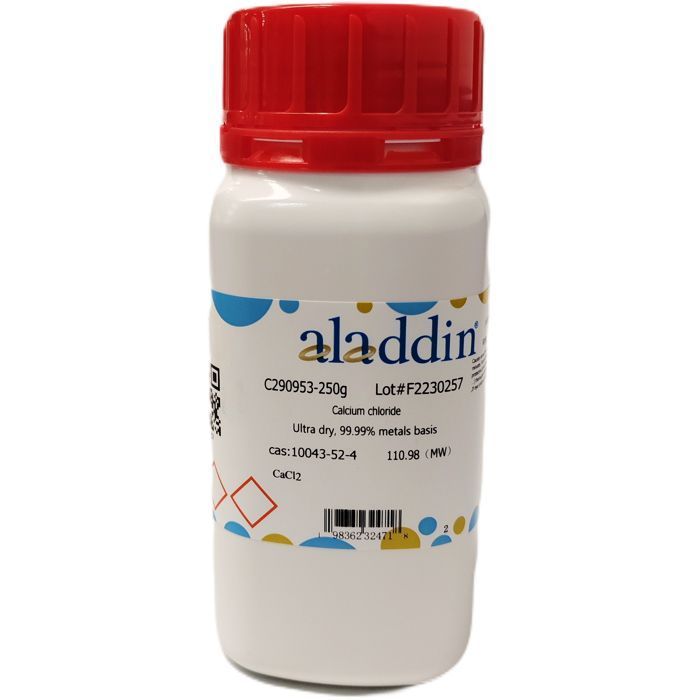
Calcium chloride - PrimorTrace™, Ultra dry, ≥99.99% metals basis , CAS No.10043-52-4

CAS: 10043-52-4 Cat. No.: C290953 Formula: CaCl2 Molecular Weight: 110.98 EC Number: 233-140-8 PubChem CID: 5284359
AVAILABLE TO ORDER
GRADE & PURITY PrimorTrace™ ? PrimorTrace™ — Aladdin's trace-metal-analysis line with ultra-low metal background. Use for ICP/AAS trace-metal work where contamination must be minimal. Ultra dry ? Ultra-dry grade with extremely low water content, packaged to exclude moisture. Use for moisture-sensitive reactions and air-free chemistry. ≥99.99% metals basis
Synonyms
Calcium dichloride|Calcium chloride anhydrous|Dowflake|Liquidow|Peladow|CaCl2|Bovikalc|Calcium Chloride, Anhydrous|Intergravin-orales|Calcium chloride (CaCl2)|Cacl2 (anhydrous)|Calcium(2+) chloride|CHEBI:3312|Calcarea muriatica|INS NO.509|Calcium-45 chlor
Storage
Room temperature,Argon charged,Desiccated
Shipped In
Normal
★
Size
Germany (EU)
USA*
Price
Qty
10g
C290953-10g
—
3 In stock
€164.78
50g
C290953-50g
—
3 In stock
€547.46
250g
C290953-250g
—
1 In stock
€1,791.79
Enter a quantity for the sizes you want to add.
🧪
Why this grade

PrimorTrace™, Ultra dry, ≥99.99% metals basis PrimorTrace™,Ultra dry for sensitive chromatographic and analytical workflows requiring minimal baseline interference.

🌡

Storage & shipping

Room temperature,Argon charged,Desiccated Ships Normal Check lot-specific COA for exact specifications.

📋

Quality documents

SDS, COA, datasheet, and spec sheet available for download. Lot-specific COA accessible via lot number lookup.

📚

Literature proof

Cited in 2874 peer-reviewed publications across chromatography, organic synthesis, and cross-coupling reactions.

Overview

Calcium chloride is used as a drying and dehydrating agent for organic liquids and gases and for solids in desiccators. Common applications include brine for refrigeration plants and ice and dust control on roads. Use of calcium chloride and urea has been reported to significantly increase average fruit weight and ascorbic acid content in pomegranate. The strawberry fruit storability can also be improved by edible coating of calcium chloride. It is used in drying tubes in research laboratories, salt/chemical based dehumidifiers, fire-extinguishers, plastics, ceramic slipware, as flux in the Davy process for the manufacture of sodium and to increase water hardness in swimming pool. It provides inhibition of swelling clays in the water phase of invert emulsion drilling fluids. CaCl2-Pybox (pyridine flanked by two oxazoline groups) has been reported to be an efficient chiral catalyst for asymmetric 1,4-addition reactions of 1,3-dicarbonyl compounds with nitroalkenes, affordi

Specifications

Synonyms
Calcium dichloride | Calcium chloride anhydrous | Dowflake | Liquidow | Peladow | CaCl2 | Bovikalc | Calcium Chloride, Anhydrous | Intergravin-orales | Calcium chloride (CaCl2) | Cacl2 (anhydrous) | Calcium(2+) chloride | CHEBI:3312 | Calcarea muriatica | INS NO.509 | Calcium-45 chlor
Specifications & Purity
PrimorTrace™, Ultra dry, ≥99.99% metals basis
Storage
Room temperature,Argon charged,Desiccated
Shipped In
Normal
Grade
PrimorTrace™, Ultra dry
Purity
≥99.99% metals basis
Names and Identifiers
Pubchem Sid508814240
Canonical Smiles[Cl-].[Cl-].[Ca+2]
IUPAC Namecalcium;dichloride
InChIKeyUXVMQQNJUSDDNG-UHFFFAOYSA-L
INCHI1S/Ca.2ClH/h;2*1H/q+2;;/p-2
Isomeric SMILES [Cl-].[Cl-].[Ca+2]
WGK Germany 1
PubChem CID 5284359
Molecular Weight 110.98

Documentation

📋 Safety Data Sheet (SDS)

Comprehensive hazard, handling, storage, and regulatory compliance document.

Download SDS →

✅ Certificate of Analysis (COA)

Lot-specific quality data. Enter your lot number to retrieve the exact COA.

Look up COA →

📊 Datasheet

Quick-reference summary of product specifications and applications.

View datasheet →

🔬 Specification Sheet

Full quality attributes and acceptance criteria for this grade.

View spec sheet →

Advanced Data

Taxonomic Classification

Taxonomy Tree

KingdomInorganic compounds
SuperclassMixed metal/non-metal compounds
ClassAlkaline earth metal salts
SubclassAlkaline earth metal chlorides
Intermediate Tree Nodes Not available
Direct ParentAlkaline earth metal chlorides
Alternative Parents Inorganic chloride salts  Inorganic calcium salts  
Molecular FrameworkNot available
Substituents Alkaline earth metal chloride - Inorganic calcium salt - Inorganic chloride salt - Inorganic salt
DescriptionThis compound belongs to the class of inorganic compounds known as alkaline earth metal chlorides. These are inorganic compounds in which the largest halogen atom is Chlorine, and the heaviest metal atom is a lanthanide.
External Descriptors inorganic chloride - calcium salt
3D Structure
Interactive Chemical Structure Model


Associated Targets(non-human)
Colletotrichum musae (107 Activities)
Activity TypeRelationActivity valueUnitsAction TypeJournalPubMed IddoiAssay Aladdin ID
Fusarium verticillioides (912 Activities)
Activity TypeRelationActivity valueUnitsAction TypeJournalPubMed IddoiAssay Aladdin ID
Lasiodiplodia theobromae (193 Activities)
Activity TypeRelationActivity valueUnitsAction TypeJournalPubMed IddoiAssay Aladdin ID
Mechanisms of Action
Certificates(CoA,COO,BSE/TSE and Analysis Chart)
C of A & Other Certificates(BSE/TSE, COO):
Analytical Chart:

Find and download the COA for your product by matching the lot number on the packaging.

6 results found

Lot NumberCertificate TypeDateItem
F2230256Certificate of AnalysisApr 03, 2026 C290953
F2230257Certificate of AnalysisApr 03, 2026 C290953
E2523064Certificate of AnalysisJun 07, 2022 C290953
E2526199Certificate of AnalysisJun 07, 2022 C290953
F2230255Certificate of AnalysisJun 07, 2022 C290953
K2309025Certificate of AnalysisJun 07, 2022 C290953
Chemical and Physical Properties
SolubilityFreely soluble in water, ethanol, methanol and acetic acid. Insoluble in liquid ammonia, dimethyl sulfoxide and ethyl acetate.
SensitivityMoisture sensitive
Boil Point(°C)1600°C
Melt Point(°C)782°C
Molecular Weight110.980 g/mol
XLogP3
Hydrogen Bond Donor Count0
Hydrogen Bond Acceptor Count2
Rotatable Bond Count0
Exact Mass109.9 Da
Monoisotopic Mass109.9 Da
Topological Polar Surface Area0.000 Ų
Heavy Atom Count3
Formal Charge0
Complexity0.000
Isotope Atom Count0
Defined Atom Stereocenter Count0
Undefined Atom Stereocenter Count0
Defined Bond Stereocenter Count0
Undefined Bond Stereocenter Count0
The total count of all stereochemical bonds0
Covalently-Bonded Unit Count3
Documents & Articles
Competent E. coli Cell Preparation Using the Calcium Chloride Method
E. coli Competence Protocol for Plasmid Transformation
Ultra-Dry Grade: The Moisture-First Standard for Sensitive Chemistry
Common Protein Gel Staining Methods
Differences Between Transformation and Transfection
Five Key Structural Features of Plasmids
Mag-Fluo-4 AM Magnesium/Calcium Ion Fluorescent Probe: Properties, Experimental Use, and Aladdin Metal Ion Fluorescent Probe Selection Guide
A Practical Guide to Fragrance Compositions: Turning a Black-Box Formula into an Engineerable System—Compatibility, Stability, Controlled Release, Traceability, and Selection
Practical Guide to Sodium Carboxymethyl Cellulose (CMC-Na): Thickening/Stabilizing Mechanisms, Key Controls for Solution Preparation, and Selection Navigation (including Table 1 and Tables A–C)
Selection of Common Research Salts: A Task Map for Alkali Metal Salts & Alkaline Earth Metal Salts (with Product Tables 1–6)
Proteinase K: Frequently Asked Questions
Deoxyribonuclease (DNase): DNA Hydrolytic Cleavage Properties, Methodological Value, and Multi-Context Applications
Chymosin: A Review of Molecular Features, Coagulation Kinetics, and Activity Evaluation
Micrococcal Nuclease (MNase): A Technical Review of Enzymatic Properties, Reaction Control, and Research and Biomanufacturing Applications
Hemicellulases: A Review of Substrate Specificity, Catalytic Systems, and Research and Industrial Applications
Phytase: Enzymological Properties, Mechanism of Action, and Applications in Feed and Food
Chitinases: Substrate-Specific Degradation Mechanisms, Enzymatic Properties, and Application Directions
Whey Protein: Composition Profile, Manufacturing Routes, and Key Product-Type Essentials
Coelenterazine (CTZ) Differences and an Application Overview
Alginate : An Overview of Extraction and Purification Processes, Quality Identification, and Multidomain Applications
Clostridial Proteases: Classification, Molecular Mechanisms, and Research Applications
Furin: A Review of Its Structural Features, Substrate Recognition, and Research Applications
The Key Starting Point for Phosphatidylserine Research: Changes in Membrane Localization, Functional Shifts, and Interpretation of Findings
Functional Framework of Starch Metabolism-Related Enzymes in Food Science Research and Mechanistic Analysis of Quality Regulation
Research Framework for Multi-Enzyme Digestion Strategies and Optimization of Proteomic Coverage
Selection Logic, Operating Parameters, and Application Boundaries of Common Cell Culture Coating Solutions
Key Judgments in Medical Hydrogel R&D: From Polymer Source and Crosslinking Strategy to Sterilization Planning, Scale-Up Feasibility, and Quality Control
From Natural Cellulose to Nanocrystals: Structural Characteristics, Application Directions, and Industrialization Challenges of CNC
Capable of Swelling, Adsorption, and Cation Exchange: What Makes Montmorillonite Clay Different?
Oxalate Metabolism and Degradation Detection Methods: Enzymatic Assays, Chromatography, and Enzymatic Degradation System Analysis
From Structure to Rheology: How Carbomer Forms Gel Structures and Enables Thickening, Suspension, and Auxiliary Emulsion Stabilization
Structure, Properties, and Mechanisms of Powdered Fragrances and Fragrance Delivery Materials: Stability, Release Mechanisms, and Selection Logic
Mechanisms and Troubleshooting of Foam Reduction in Personal and Household Care Formulations: Film Rupture, Weak Interfacial Films, Insufficient Surfactant Supply, and Phase-State Disturbance
Experimental Applications of Carboxymethyl Cellulose (CMC) Solution in Enzyme Assays, Suspension Systems, and Functional Materials
Moisturizing Mechanisms of Tremella fuciformis Polysaccharides: From Polysaccharide Structure and Hydration Rheology to Dynamic Film Formation on the Skin Surface
Mechanistic Basis of Acetyl Hexapeptide-8 in the Management of Expression Lines: SNARE Complex Interference, Constraints on Percutaneous Delivery, and Combination Strategies
Citations of This Product
Solution Calculators
Reviews

Customer Reviews

Shall we send you a message when we have discounts available?

Remind me later

Thank you! Please check your email inbox to confirm.

Oops! Notifications are disabled.