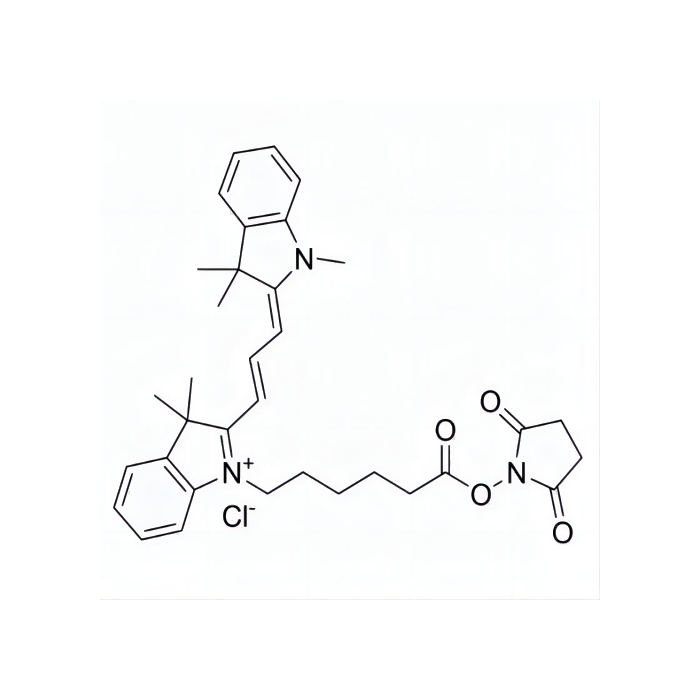
Cy3 NHS ester is a CY dye. CY, short for Cyanine, is a compound consisting of two nitrogen atoms connected by an odd number of methyl units. Cyanine compounds have the characteristics of long wavelength, adjustable absorption and emission, high extinction coefficient, good water solubility and relatively simple synthesis. CY dyes are of en used for the labeling of proteins, antibodies and small molecular compounds. For the labeling of protein antibodies, the combination can be completed through a simple mixing reaction. Below, we introduce the labeling method of protein antibody labeling, which has certain reference significance .
In Vitro
Protocol 1.Protein Preparetion 1) In order to obtain the best labeling effect, please prepare the protein (antibody) concentration as 2 mg/mL. 2) The pH value of protein solution shall be 8.5±0.5. If the pH is lower than 8.0, 1 M sodium bicarbonate shall be used for adjustment. 3) If the protein concentration is lower than 2 mg/mL, the labeling efficiency will be greatly reduced. In order to obtain the best labeling efficiency, it is recommended that the final protein concentration range is 2-10 mg/mL. 4) The protein must be in the buffer without primary amine (such as Tris or glycine) and ammonium ion, otherwise the labeling efficiency will be affected. 2.Dye Preparation (Example for CY3-NHS ester) Add anhydrous DMSO into the vial of CY3-NHS ester to make a 10 mM stock solution. Mix well by pipetting or vortex. 3.Calculation of dye dosage The amount of CY3-NHS ester required for reaction depends on the amount of protein to be labeled, and the optimal molar ratio of CY3-NHS ester to protein is about 10. Example: assuming the required marker protein is 500 μL 2 mg/mL IgG (MW=150,000), use 100 μL DMSO dissolve 1 mg CY3-NHS ester, the required CY3-NHS ester volume is 5.05 μL, and the detailed calculation process is as follows: 1) mmol (IgG) = mg/mL (IgG) ×mL (IgG) / MW (IgG) =2 mg/mL × 0.5 mL / 150,000 mg/mmol= 6.7×10⁻⁶ mmol 2) mmol (CY3-NHS ester) = mmol (IgG) × 10 = 6.7×10⁻⁶ mmol×10 = 6.7 × 10⁻⁵ mmol 3) μL (CY3-NHS ester) = mmol (CY3-NHS ester) ×MW (CY3-NHS ester) / mg/μL (CY3-NHS ester) = 6.7 ×10⁻⁵ mmol ×753.88 mg/mmol / 0.01 mg/μL = 5.05 μL (CY3-NHS ester) 4.Run conjugation reaction 1) A good volume of freshly prepared 10 mg/mL CY3-NHS ester is slowly added to 0.5 mL protein sample In solution, gently shake to mix, then centrifuge briefly to collect the sample at the bottom of the reaction tube. Don'tmix well to prevent protein samples from denaturation and inactivation. 2) The reaction tubules were placed in a dark place and incubated gently at room temperature for 60 minutes at intervals.For 10-15 minutes, gently reverse the reaction tubules several times to fully mix the two reactants and raise the bar efficiency. 5.Purify the conjugation The following protocol is an example of dye-protein conjugate purification by using a SepHadex G-25 column. 1) Prepare SepHadex G-25 column according to the manufacture instruction. 2) Load the reaction mixture (From \Run conjugation reaction\) to the top of the SepHadex G-25 column. 3) Add PBS (pH 7.2-7.4) as soon as the sample runs just below the top resin surface. 4) Add more PBS (pH 7.2-7.4) to the desired sample to complete the column purification. Combine the fractions that contain the desired dye-protein conjugate. MCE has not independently confirmed the accuracy of these methods. They are for reference only.
Form:Solid

 H2631025