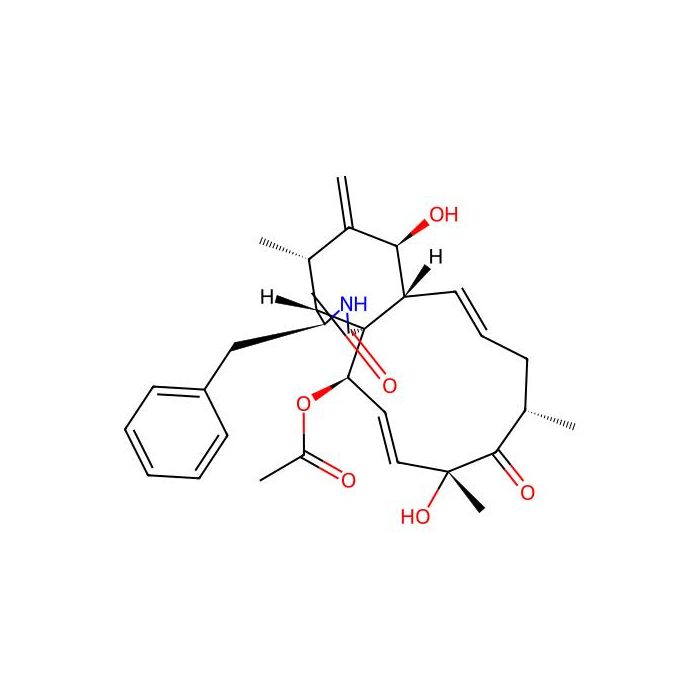
Cytochalasin D - Moligand™, 10 mM in DMSO , CAS No.22144-77-0

CAS: 22144-77-0 Cat. No.: C1499977 Formula: C30H37NO6 Molecular Weight: 507.62 Beilstein Registry Number: 1632828 EC Number: 244-804-1
AVAILABLE TO ORDER
GRADE & PURITY Moligand™ ? Moligand™ — Aladdin's line of ligands and bioactive small molecules. Use for receptor, pathway, and binding studies needing defined small-molecule tools. 10 mM in DMSO
Storage
Store at -80°C
Shipped In
Dry ice packs + Cold packs
★
Size
Germany (EU)
USA*
Price
Qty
1ml
C1499977-1ml
Made to order · 8–12 wks
€891.95
Enter a quantity for the sizes you want to add.

Overview

Cytochalasin D (Zygosporin A) is a potent actin polymerization inhibitor, could be derived from fungus. Cytochalasin D has cell-permeable activity. Cytochalasin D inhibits the G-actin–cofilin interaction by binding to G-actin. Cytochalasin D also inhibits the binding of cofilin to F-actin and decreases the rate of both actin polymerization and depolymerization in living cells. Cytochalasin D can reduce exosome release, in turn reducing the amount of survivin present in the tumour environment. Cytochalasin D induces phosphorylation and cytoplasmic retention of Yap .

Specifications

Specifications & Purity
Moligand™, 10 mM in DMSO
Storage
Store at -80°C
Shipped In
Dry ice packs + Cold packs
This product requires cold chain shipping. Ground and other economy services are not available.
Grade
Moligand™
Names and Identifiers
Isomeric SMILES
C[C@H]1C/C=C/[C@H]2[C@@H](C(=C)[C@H]([C@@H]3[C@@]2([C@@H](/C=C/[C@@](C1=O)(C)O)OC(=O)C)C(=O)N[C@H]3CC4=CC=CC=C4)C)O
WGK Germany
3
RTECS
GZ4850000
UN Number
3172
Packing Group
I
Molecular Weight
507.62
Beilstein
1632828
Reaxys
25133796
Reaxys-RN_link_address
https://www.reaxys.com/reaxys/secured/hopinto.do?context=S&query=IDE.XRN=25133796&ln=

Advanced Data

Certificates (CoA,COO,BSE/TSE and Analysis Chart)
C of A & Other Certificates(BSE/TSE, COO):
Analytical Chart:
Safety and Hazards(GHS)
Pictogram(s)
GHS06,   GHS08
Signal
Danger
Hazard Statements

H300:Fatal if swallowed

H361:Suspected of damaging fertility or the unborn child

Precautionary Statements

P280:Wear protective gloves/protective clothing/eye protection/face protection.

P321:Specific treatment (see ... on this label).

P405:Store locked up.

P501:Dispose of contents/container to an approved waste disposal plant.

P264:Wash hands [and …] thoroughly after handling.

P270:Do not eat, drink or smoke when using this product.

P330:Rinse mouth.

P203:Obtain, read and follow all safety instructions before use.

P301+P316:IF SWALLOWED: Get emergency medical help immediately.

P318:if exposed or concerned, get medical advice.

WGK Germany
3
RTECS
GZ4850000
Reaxys
25133796
Reaxys-RN_link_address
https://www.reaxys.com/reaxys/secured/hopinto.do?context=S&query=IDE.XRN=25133796&ln=
Class
6.1
Documents & Articles
Mechanisms of Action, Research Applications, and Cold-Induced Effects of Colchicine: An Overview
The uPA/uPAR System in Cell Migration and Microenvironment Remodeling
Cytoskeleton in Cell Structure Maintenance, Migration, and Disease Mechanisms
Exosome-Related Ingredients in Skincare Products: Sources and Preparation, Quality Control, Evidence of Efficacy, and Safety Assessment
Receptor Signaling Regulation of Actin Dynamics and Its Role in Cell Behavior and Disease
Mechanisms by Which PDRN Participates in Skin Repair: A2A Receptor-Related Signaling, Nucleotide Salvage, and Extracellular Matrix Remodeling
Molecular Composition, Signal Transduction Mechanisms, and Targeted Regulatory Strategies of the Hippo Signaling Pathway
Why Have YAP/TAZ–TEAD Become a New Breakthrough Point in the Hippo Pathway?
Citations of This Product
Solution Calculators
Reviews

Customer Reviews

Shall we send you a message when we have discounts available?

Remind me later

Thank you! Please check your email inbox to confirm.

Oops! Notifications are disabled.