
Molecular Recognition Basis of Amide Bioisosteric Replacement: Hydrogen Bonding, Linker Geometry, and Receptor Functional Outcomes—Using the AHL–LuxR-Type Quorum-Sensing Receptor System as an Example
Molecular Recognition Basis of Amide Bioisosteric Replacement: Hydrogen Bonding, Linker Geometry, and Receptor Functional Outcomes—Using the AHL–LuxR-Type Quorum-Sensing Receptor System as an Example
Introduction
The amide group possesses both hydrogen-bond donor and hydrogen-bond acceptor capabilities, together with well-defined local conformational characteristics. Resonance restricts rotation about the amide C—N bond relative to an ordinary C—N single bond, and the amide linkage generally exhibits a strong preference for planarity. When an amide is replaced by another functional group, the positions of hydrogen-bond donors and acceptors, linker length, local geometry, and conformational freedom may all change.
N-Acyl-L-homoserine lactones (AHLs) and LuxR-type quorum-sensing (QS) receptors have been extensively investigated through structural biology, site-directed mutagenesis, and structure–activity relationship studies. Structures of LasR in complex with its native ligand have defined the direct interactions involving the AHL amide region; subsequent site-directed mutagenesis experiments further quantified the contributions of different polar interactions to receptor activation. Sulfonamide, urea, and reversed-amide analogues have shown that LuxR-type receptor-modulatory activity can be retained after altering the amide linkage, although functional potency and agonistic or antagonistic properties may change.[1–7]
1. Molecular Recognition of the Amide in the AHL–LasR Complex
1.1 Structure of the Native Ligand OdDHL
LasR from Pseudomonas aeruginosa is a LuxR-type transcriptional regulator. Its native signaling molecule is N-(3-oxododecanoyl)-L-homoserine lactone (OdDHL), also commonly denoted 3-oxo-C12-HSL.[1]
The major structural elements of OdDHL can be represented as:
L-homoserine lactone—NH—C(=O)—CH₂—C(=O)—(CH₂)₈—CH₃
This molecule contains four structural regions closely associated with receptor recognition:
· the homoserine lactone ring;
· the amide NH;
· the amide carbonyl;
· the 3-keto carbonyl of the acyl chain and the hydrophobic long chain.
In 2007, Bottomley et al. determined the 1.8 Å crystal structure of the LasR ligand-binding domain in complex with OdDHL. OdDHL occupies an internal binding cavity in LasR, where polar interactions are formed around the lactone headgroup and amide region, while the long acyl chain extends into a hydrophobic region.[1]
1.2 The Amide NH and Amide Carbonyl Participate in Distinct Interactions
The LasR–OdDHL complex and subsequent structural analyses identified multiple polar interactions associated with recognition of the native ligand.[1,2]
OdDHL structural region | Relevant LasR residue(s) | Interaction features |
Amide NH | Asp73, Thr75 | Asp73 and Thr75 participate in hydrogen-bond recognition of the amide NH region |
Amide carbonyl | Tyr56, Ser129 | Both residues participate in positioning the amide carbonyl |
Lactone carbonyl | Trp60 | Participates in polar recognition of the lactone headgroup |
3-Keto carbonyl | Arg61 and a water-mediated network | Participates in positioning the 3-keto region |
Long acyl chain | Multiple hydrophobic residues | Provides hydrophobic complementarity and constrains the position of the acyl chain |
The amide in OdDHL provides both an NH hydrogen-bond donor and a carbonyl oxygen hydrogen-bond acceptor. The planar conformation of the amide also constrains the relative positions of the lactone headgroup and the proximal portion of the acyl chain. Amide bioisosteric replacement therefore affects three classes of parameters: polar interactions, interatomic distances, and linker geometry.[1,2]
These parameters can make independent functional contributions within a protein binding site. Two linkers with the same numbers of hydrogen-bond donors and acceptors can nevertheless form different combinations of interactions with a receptor if the donor/acceptor positions, bond angles, or dihedral angles differ.
The crystal structure of the LasR–OdDHL complex shows that the polar region of OdDHL is anchored in the binding site through multiple direct or water-mediated hydrogen bonds. The amide carbonyl forms hydrogen bonds with Tyr56 and Ser129; the amide NH forms polar interactions with Asp73 and Thr75; the lactone carbonyl forms a hydrogen bond with Trp60; and the 3-keto carbonyl forms a water-mediated hydrogen bond with Arg61.[1]
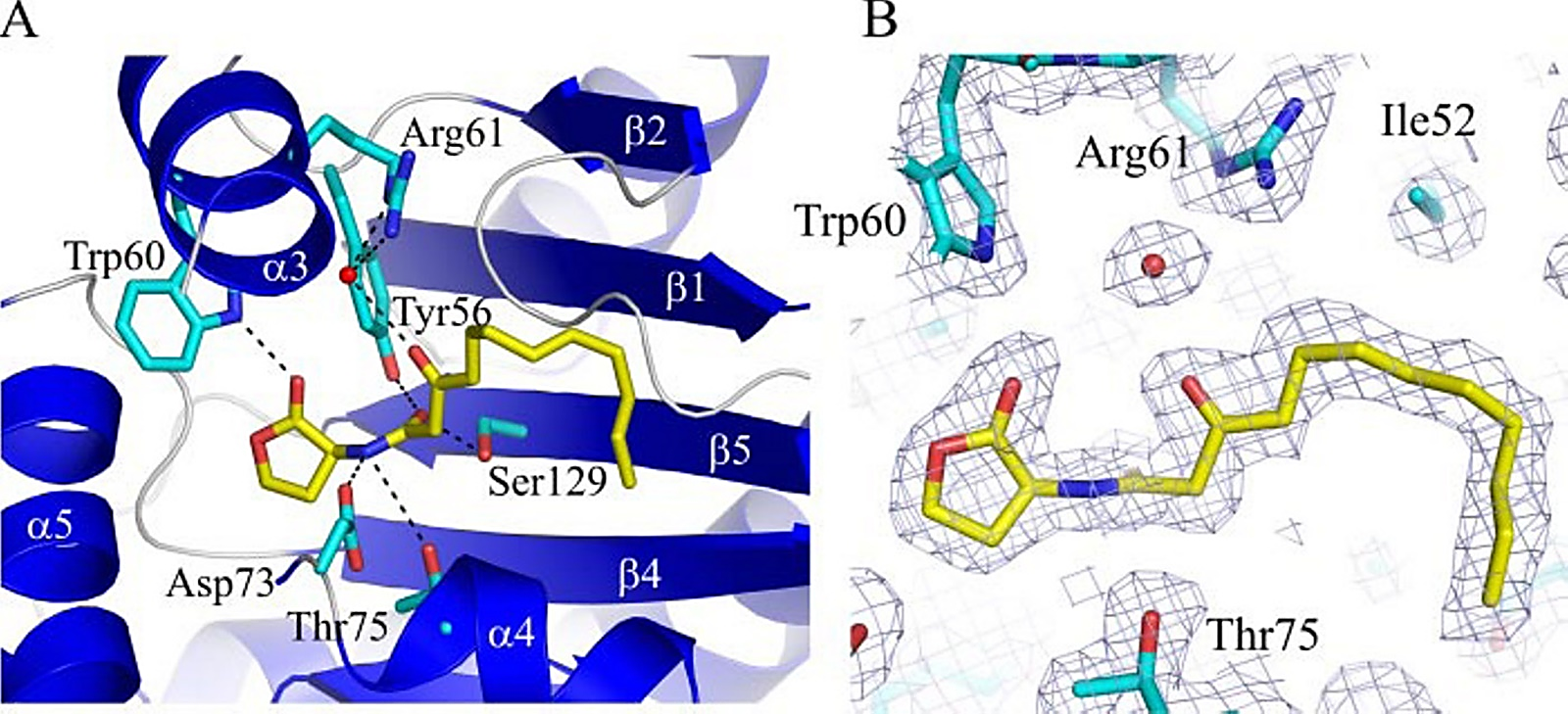
Figure 1. Interactions and electron density of OdDHL in the LasR ligand-binding site.
A, Hydrogen-bond network formed between OdDHL and residues in the LasR binding site; B, electron density of OdDHL and of the water molecule involved in the water-mediated hydrogen bond with the 3-keto carbonyl. Reproduced from Bottomley MJ, Muraglia E, Bazzo R, Carfì A. J Biol Chem. 2007;282:13592–13600, Figure 3. CC BY 4.0.[1]
2. Site-Directed Mutagenesis of LasR Defines the Functional Weight of Different Hydrogen Bonds
2.1 Functional Results for Nine Binding-Site Mutants
Gerdt et al. selected nine polar residues in the LasR ligand-binding region for site-directed mutagenesis: Tyr56, Trp60, Arg61, Asp73, Thr75, Trp88, Tyr93, Thr115, and Ser129. The mutations were designed to preserve side-chain volume as much as possible while reducing or eliminating the hydrogen-bonding capability of the original side chain, for example Tyr→Phe, Thr→Val, and Ser→Ala.[2]
The transcriptional reporter activity of OdDHL differed markedly among the LasR mutants:
LasR mutation | Functional change in OdDHL response | Relationship to native ligand recognition |
Y56F | Similar to wild type | Loss of the Tyr56 hydroxyl group has little effect on the potency of OdDHL-mediated activation |
Y93F | Similar to wild type | The Tyr93 side-chain hydroxyl makes only a minor contribution to activation by the native ligand |
S129A | Moderate decrease in potency | Ser129 participates in positioning the amide carbonyl region |
W60F | Moderate decrease in potency | Trp60 participates in recognition of the lactone headgroup |
R61M | EC50 increased by approximately 60-fold | Arg61-associated interactions make a substantial functional contribution to recognition of the 3-keto region |
T115V | EC50 increased by more than 100-fold | Thr115 contributes to maintenance of the polar interaction network in the ligand-binding region |
T75V | Sensitivity to OdDHL increased by more than 10-fold | Removal of the Thr75 hydroxyl group enhances the functional receptor response |
D73L | No activation detected in the reporter assay | Alteration of Asp73 is associated with severe loss of function |
W88F | No activation detected in the reporter assay | Alteration of Trp88 is associated with severe loss of function |
The lack of response observed for D73L and W88F cannot, by itself, establish that OdDHL has lost the ability to bind. The original study noted that these mutations may also affect correct folding or stability of LasR; therefore, the reporter-gene assay cannot distinguish between impaired ligand binding and disruption of receptor protein structure.[2]
2.2 The Amide NH and Amide Carbonyl Make Different Functional Contributions
Y56F removes the Tyr56 side-chain hydroxyl group, yet the potency of OdDHL-mediated activation remains similar to that observed with wild-type LasR; S129A causes only a moderate effect. Both Tyr56 and Ser129 are located near the amide carbonyl of OdDHL.[1,2]
Asp73 is located near the amide NH. The D73L mutant is unresponsive in functional assays. Although interpretation of this result is also limited by potential effects on protein folding, consideration of the complete mutant series indicates that polar interactions associated with the amide NH show greater functional sensitivity than those associated with the amide carbonyl.[2]
Based on the functional changes of OdDHL across the different mutants, the investigators ranked the relative importance of the major hydrogen bonds in the LasR–OdDHL complex:
Amide NH-associated interactions > 3-keto carbonyl-associated interactions > lactone carbonyl-associated interactions > amide carbonyl-associated interactions.[2]
This ranking applies to the LasR–OdDHL system and does not imply that amide groups in other protein binding sites follow the same order of importance. The contributions of the amide NH and carbonyl in different targets depend on the specific residue composition, solvent environment, and local conformation.[2]
2.3 Direct Ligand Hydrogen Bonds and Intramolecular Protein Hydrogen-Bond Networks Jointly Influence Function
Not all polar residues in the LasR binding site form direct hydrogen bonds with OdDHL. Some residues maintain the local structure of the binding cavity through intramolecular protein interactions.
T115V decreases the functional potency of OdDHL by more than two orders of magnitude, indicating that the local polar network involving Thr115 has a substantial influence on the LasR response. In contrast, T75V makes LasR more sensitive to OdDHL, demonstrating that removal of a polar side chain can also enhance the functional receptor response.[2]
The specific atomic-level basis of the T75V effect has not been directly established by a crystal structure of the corresponding mutant–OdDHL complex. Existing experiments establish that the mutation alters the functional sensitivity of the receptor to OdDHL, but they do not define a unique mode of local conformational change.[2]
The LasR mutagenesis results show that amide replacement must take into account both direct ligand–protein interactions and the interaction network among residues within the binding site. Simply increasing the number of hydrogen-bond donors or acceptors cannot directly predict changes in receptor function.
3. Sulfonamides, Ureas, and Reversed Amides Alter Different Structural Parameters
The AHL amide linkage can be represented as follows, where HSL denotes the L-homoserine lactone moiety and R denotes the acyl side chain:
Native AHL: HSL—NH—C(=O)—R
Three representative replacements are:
Sulfonamide: HSL—NH—S(=O)₂—R
Urea: HSL—NH—C(=O)—NH—R
Reversed amide: HSL—C(=O)—NH—R
These three replacements retain different structural features and alter different structural parameters.
3.1 Sulfonamides Alter the Geometry of the Linkage Center and the Arrangement of Acceptor Atoms
Castang et al. synthesized 11 sulfonamide-type AHL analogues in which the carboxamide linkage of the native AHL was replaced by a sulfonamide, and evaluated their competitive inhibition of the natural signal 3-oxohexanoyl-L-homoserine lactone (3-oxo-C6-HSL) in the Vibrio fischeri LuxR system. Several compounds displayed LuxR antagonistic activity.[4]
The carbonyl carbon of an amide has an approximately trigonal planar geometry, and the amide C—N bond is strongly restricted by resonance. In a sulfonamide, the hexavalent sulfur center has an approximately tetrahedral geometry and bears two sulfonyl oxygens. Replacing an amide with a sulfonamide therefore produces several major changes:
① one carbonyl oxygen is replaced by two sulfonyl oxygens;
② the spatial orientation of the hydrogen-bond acceptors changes;
③ the linkage center changes from the planar character of an amide to a different three-dimensional geometry;
④ the bond angles and relative positions between the HSL headgroup and the side chain change.
The structure–activity relationships reported by Castang et al. further showed that side-chain length and the spacing between an aryl group and the sulfonamide substantially influence antagonistic activity. A representative pentyl-substituted sulfonamide required a concentration of approximately 2 μM to achieve 50% inhibition, whereas further changes in side-chain length reduced activity.[4]
This study established the LuxR antagonistic activity of sulfonamide analogues through biological activity assays. The interpretation that these compounds “interfere with the structural rearrangement required to form the active LuxR dimer” was derived from molecular modeling rather than direct observation from a LuxR–sulfonamide complex crystal structure.[4]
3.2 Ureas Introduce an Additional NH and Extend the Polar Linkage Region
Frezza et al. synthesized 15 N-alkyl- or N-aryl-substituted ureas derived from homoserine lactone and evaluated their activity in the Vibrio fischeri LuxR system. Some N-alkyl ureas bearing alkyl chains of at least four carbon atoms, as well as several urea derivatives containing terminal phenyl groups, displayed pronounced antagonistic activity.[5]
The amide and urea linkages can be represented as:
HSL—NH—C(=O)—R
HSL—NH—C(=O)—NH—R
A urea retains the carbonyl group while introducing an additional NH. This change produces three structural consequences:
1. an additional potential hydrogen-bond donor;
2. extension of the polar linkage region between the HSL headgroup and the hydrophobic side chain;
3. alteration of the orientation and conformation of the side chain relative to the carbonyl and NH groups.
Experiments with an N-butyl urea derivative further showed that its antagonistic activity was associated with inhibition of dimerization of the N-terminal domain of ExpR, a LuxR-family protein.[5] Molecular modeling suggested that the urea group may form additional hydrogen bonds within the AHL-binding cavity that are absent for the native amide; the specific locations of these additional hydrogen bonds are predictions of the structural model.[5]
Experimental results for urea-type AHLs show that introduction of an additional hydrogen-bond donor does not simply convert the compound into a stronger agonist of the native receptor; some compounds instead act as antagonists. There is no fixed relationship between an increased number of polar interactions and enhanced receptor activation.[5]
3.3 Reversed Amides Exchange the Positions of the NH and Carbonyl Relative to the Two Terminal Fragments
Boukraa et al. investigated AHL analogues in which the direction of the amide bond was reversed.[6]
Native AHL linkage:
HSL—NH—C(=O)—R
Reversed-amide linkage:
HSL—C(=O)—NH—R
Both structures contain one NH group and one carbonyl oxygen, but the positions of the hydrogen-bond donor and acceptor are exchanged relative to the HSL headgroup and the hydrophobic side chain.
Some of the reversed-amide analogues in this study retained LuxR antagonistic activity, with the more active compounds exhibiting LuxR antagonism in approximately the 30 μM range.[6]
These results establish that a reversed amide can retain LuxR-modulatory activity, but they do not demonstrate that the reversed amide adopts the same binding pose as a native AHL. Once the positions of the donor and acceptor relative to the two ends of the molecule are exchanged, their pairing with polar receptor residues may also change.
3.4 The Three Types of Replacement Produce Different Molecular Changes
Linkage group | Change in hydrogen-bond donors/acceptors | Major geometric change | Reported LuxR-type functional outcome |
Amide | One NH donor and one carbonyl acceptor | Strong preference for a planar conformation | Native AHL linkage |
Sulfonamide | NH retained; two sulfonyl oxygens introduced | Markedly different three-dimensional geometry at the sulfur center | Multiple LuxR antagonists [4] |
Urea | One additional NH | Extended polar linkage region and altered donor arrangement | Multiple LuxR antagonists; a representative compound affects ExpR dimerization [5] |
Reversed amide | Approximate preservation of donor and acceptor numbers | Positions of NH and C=O exchanged relative to the two terminal fragments | Some LuxR antagonists [6] |
Sulfonamides primarily alter the geometry of the linkage center and the arrangement of acceptor atoms; ureas introduce an additional donor and change the linkage length; reversed amides primarily alter the positions of the donor and acceptor relative to the two terminal molecular fragments. The three replacements therefore represent distinct types of structural perturbation.[4–6]
4. Ligand Binding, Receptor Activation, and Receptor Inhibition Are Distinct Experimental Outcomes
4.1 LuxR Analogues Can Retain Binding While Showing Markedly Reduced Activation
In 1996, Schaefer et al. systematically investigated the relationship between AHL analogues and Vibrio fischeri LuxR. Multiple analogues with altered acyl side chains showed evidence of binding to LuxR, and some exhibited binding capacities approaching that of the native autoinducer. However, not all analogues capable of binding LuxR efficiently activated expression of the luminescence genes. Some analogues with weak or undetectable activation activity were also able to inhibit the action of the native autoinducer.[7]
These experiments distinguish three processes:
Ligand–receptor binding → formation of a receptor functional state capable of driving transcription → downstream gene expression
Binding is one prerequisite for receptor activation, but binding alone does not demonstrate that the receptor has adopted the functional state induced by the native ligand.[7]
4.2 A Single LasR Binding-Site Mutation Can Alter the Agonist/Antagonist Profile of Non-Native Ligands
In 2014, Gerdt et al. investigated the effects of mutations in the LasR binding pocket on the function of non-native AHL analogues. Alterations at Trp60, Tyr56, and Ser129 could cause specific ligands to switch between agonistic and antagonistic activity.[3]
The W60F mutation produced particularly clear functional switching: one ligand that behaved as an inhibitor at wild-type LasR became an activator, whereas another ligand that originally acted as an activator became an inhibitor. An independent fluorescence reporter system produced the same functional switching results.[3]
Tyr56 and Ser129 are located near the amide carbonyl of native OdDHL, whereas Trp60 lies near the lactone headgroup. The fact that alteration of a single binding-site residue can switch the functional profile of a non-native ligand indicates that local positioning of the ligand headgroup and amide region is closely associated with the receptor functional state.[3]
The original study used these results to develop a conformational model of LasR activation and inhibition. The experimentally established result is that changes in individual residues alter ligand functional profiles; the specific process by which local contact changes propagate into global conformational changes in LasR remains a structural mechanistic model and has not yet been directly established by paired high-resolution complex structures of wild-type and mutant receptors in their different functional states.[3]
5. Amide Bioisosteric Replacement Involves Three Interrelated Molecular Levels
5.1 Key Polar Interactions
The NH and carbonyl of the original amide should be evaluated separately. In the LasR–OdDHL system, interactions associated with the amide NH show greater functional sensitivity than those associated with the amide carbonyl.[2]
The hydrogen-bond donor and acceptor within the same amide do not have fixed functional weights. Their specific contributions are jointly determined by binding-site residues, local water molecules, intramolecular protein hydrogen-bond networks, and ligand conformation.
5.2 Three-Dimensional Linker Geometry
Amide replacement may affect one or more of the following structural parameters:
① the position of the hydrogen-bond donor;
② the position of the hydrogen-bond acceptor;
③ the orientations of the donor and acceptor;
④ the distance between the two terminal molecular fragments;
⑤ bond angles and dihedral angles;
⑥ local planarity;
⑦ rotatable bonds and preferred conformations.
Sulfonamides, ureas, and reversed amides alter different combinations of these parameters.[4–6]
A reversed amide and a native amide can have the same number of donors and acceptors yet retain different atomic arrangements; likewise, a urea containing more polar sites does not necessarily produce stronger receptor activation. Structural comparison of amide bioisosteres therefore needs to consider the positions and orientations of specific atoms.
5.3 Receptor Functional State
Experimental outcomes after bioisosteric replacement involve at least two independent levels:
Experimental level | Question addressed |
Direct binding or structural experiments | Whether the new molecule binds, and what binding position and interactions it adopts |
Functional experiments | Whether binding results in agonism, partial agonism, antagonism, or no detectable response |
Studies of LuxR analogues have identified compounds that retain evidence of receptor binding while showing substantially reduced activation capability.[7] Site-directed mutagenesis studies of LasR have also shown that alteration of a single binding-site residue can switch the agonistic/antagonistic properties of a non-native ligand.[3]
Receptor-binding affinity, local interactions, and functional output should be measured separately. Molecular docking and molecular dynamics simulations can be used to develop structural hypotheses, but they cannot replace direct binding measurements, structural biology, or functional experiments for mechanistic validation.
6. Representative Chemicals Related to Amide Bioisosteric Replacement and AHL Quorum-Sensing Research
Table 1. AHL Signaling Molecules and Core Homoserine Lactone Building Blocks
Category | CAS No. | Aladdin Catalog No. | Name | Specification or Purity | Product Features and Applications |
Butanoyl-type short-chain AHL | 67605-85-0 | N-Butanoyl-L-homoserine lactone | Moligand™, ≥98% | AHL with a C4 acyl side chain, used to study short-chain AHL receptor responses, acyl-chain length, and hydrophobic-pocket complementarity. | |
Hexanoyl-type short-chain AHL | 147852-83-3 | N-Hexanoyl-L-homoserine lactone (C6-HSL) | ≥98% | AHL with a C6 acyl side chain; can be paired with a 3-oxohexanoyl-type AHL to compare the effects of the 3-keto carbonyl and acyl-chain structure on LuxR-type receptor responses. | |
3-Oxohexanoyl-type short-chain AHL | 143537-62-6 | N-(3-Oxohexanoyl)homoserine lactone | Moligand™, ≥98% | A classic inducing signal in the Vibrio fischeri LuxR system, used for studies of LuxR activation, competitive antagonism, and activity evaluation of AHL analogues. | |
Octanoyl-type medium-chain AHL | 147852-84-4 | N-Octanoyl-L-homoserine lactone (C8-HSL) | Moligand™, ≥98% | AHL with a C8 acyl side chain, used for studies of medium-chain AHL recognition, receptor selectivity, and paired comparisons of structures with and without a 3-keto carbonyl. | |
3-Oxooctanoyl-type medium-chain AHL | 147795-39-9 | N-(3-Oxooctanoyl)-L-homoserine lactone | ≥97% | The native AHL ligand of TraR from Agrobacterium tumefaciens, used to study 3-oxo-AHL receptor recognition, hydrogen-bond networks, and differences in binding modes among LuxR-type receptors. | |
Decanoyl-type medium-to-long-chain AHL | 177315-87-6 | N-Decanoyl-L-homoserine lactone | Moligand™, ≥96% | AHL with a C10 acyl side chain, used for studies of medium-to-long-chain AHL structure–activity relationships, hydrophobic side-chain length, and receptor selectivity. | |
3-Oxodecanoyl-type medium-to-long-chain AHL | 147795-40-2 | N-(3-Oxodecanoyl)-L-homoserine lactone | ≥98% | Contains a C10 side chain and a 3-keto carbonyl; can be paired with a non-3-oxo C10-AHL to study carbonyl-mediated polar interactions and side-chain-length effects. | |
Dodecanoyl-type long-chain AHL | 137173-46-7 | N-Dodecanoyl-L-homoserine lactone | ≥98% | Long-chain C12 AHL; can be paired with a 3-oxododecanoyl-type AHL to analyze the contributions of the 3-keto carbonyl and long hydrophobic chain to receptor recognition. | |
3-Oxododecanoyl-type LasR ligand | 168982-69-2 | N-(3-Oxododecanoyl)-L-homoserine lactone | ≥97% | The native ligand of LasR from Pseudomonas aeruginosa, used in studies of LasR complex structures, hydrogen bonding involving the amide NH and carbonyl, 3-keto carbonyl recognition, and site-directed mutagenesis. | |
Tetradecanoyl-type long-chain AHL | 202284-87-5 | N-Tetradecanoyl-L-homoserine lactone (C14-HSL) | ≥98% | Long-chain C14 AHL, used to extend AHL acyl-chain-length series and to study matching between long hydrophobic side chains and receptor-binding regions. | |
3-Oxotetradecanoyl-type long-chain AHL | 177158-19-9 | N-(3-Oxotetradecanoyl)-L-homoserine lactone | ≥98% | Contains a C14 side chain and a 3-keto carbonyl, used for studies of long-chain 3-oxo-AHL series and the cooperative recognition of the polar headgroup and hydrophobic tail. | |
Racemic homoserine lactone scaffold | 6305-38-0 | α-Amino-γ-butyrolactone hydrobromide | ≥98%(N)(T) | Racemic lactone scaffold containing a free amino reactive site, used for the synthesis of racemic AHLs, sulfonamide-type AHLs, and urea-type AHL analogues. | |
S-configured homoserine lactone scaffold · hydrobromide | 15295-77-9 | (S)-(-)-α-Amino-γ-butyrolactone hydrobromide | ≥98% | Chiral building block that retains the S configuration of the native AHL headgroup, used for N-acylation, N-sulfonylation, and synthesis of related AHL analogues. | |
S-configured homoserine lactone scaffold · hydrochloride | 2185-03-7 | (S)-α-Amino-γ-butyrolactone hydrochloride | ≥97% | S-configured homoserine lactone amino building block, used to construct AHLs with the native configuration and derivatives of the amide linkage region. |
Table 2. Reagents for Constructing Sulfonamide Bioisosteres
Category | CAS No. | Aladdin Catalog No. | Name | Specification or Purity | Product Features and Applications |
n-Butyl sulfonylation reagent | 2386-60-9 | 1-Butanesulfonyl chloride | ≥98%(GC) | Used to construct C4 linear alkyl sulfonamides for studies of short-chain endpoints in sulfonamide-type AHLs and alkyl-chain-length structure–activity relationships. | |
n-Hexyl sulfonylation reagent | 14532-24-2 | 1-Hexanesulfonyl chloride | ≥95% | Used to construct C6 linear alkyl sulfonamides for comparing the relationship between C4–C9 sulfonamide side-chain length and LuxR antagonistic activity. | |
n-Heptyl sulfonylation reagent | 927-92-4 | 1-Heptanesulfonyl chloride | ≥95% | Used to construct C7 linear alkyl sulfonamides for continuous hydrophobic-chain-length series and studies of binding-pocket fit. | |
n-Octyl sulfonylation reagent | 7795-95-1 | 1-Octanesulfonyl chloride | ≥95%(GC) | Used to construct C8 linear alkyl sulfonamides for studies of medium-to-long-chain sulfonamide analogues and hydrophobic side-chain-length effects. | |
n-Nonyl sulfonylation reagent | 63353-34-4 | 1-Nonanesulfonyl chloride | ≥97% | Used to construct C9 linear alkyl sulfonamides for comparison of long-chain endpoints and chain-length structure–activity relationships in sulfonamide-type AHLs. | |
Phenyl sulfonylation reagent | 98-09-9 | Benzenesulfonyl chloride | ≥98% | The sulfonyl group is directly attached to the phenyl ring; used to construct basic aryl sulfonamides and compare structural differences between aryl and aliphatic-chain sulfonamides. | |
p-Methylphenyl sulfonylation reagent | 98-59-9 | p-Toluenesulfonyl chloride (PTSC) | AR, ≥99% | Introduces a methyl group at the para position of the benzenesulfonyl moiety, for studying the effects of hydrophobic aryl substitution and changes in electronic properties on sulfonamide linkage structures. | |
p-Bromophenyl sulfonylation reagent | 98-58-8 | 4-Bromobenzenesulfonyl chloride | ≥98% | Introduces a bromine atom at the para position of the benzenesulfonyl moiety, for expanding halogenated aryl sulfonamide series and studying aryl-substitution structure–activity relationships. | |
Benzyl sulfonylation reagent | 1939-99-7 | α-Toluenesulfonyl chloride | ≥97% | Contains one methylene group between the phenyl ring and sulfonyl group; used to construct benzyl sulfonamides and study the influence of aryl–sulfonamide spacing on receptor-modulatory activity. | |
Phenethyl sulfonylation reagent | 4025-71-2 | 2-Phenylethanesulfonyl chloride | ≥97% | Contains two methylene groups between the phenyl ring and sulfonyl group, corresponding to a phenylalkyl sulfonamide spacer series; can be used to study the relationship between aryl-group distance and LuxR antagonistic activity. | |
Phenylpropyl sulfonylation reagent | 63014-04-0 | 3-Phenylpropane-1-sulfonyl chloride | ≥97% | An arylalkyl sulfonyl chloride containing three methylene groups between the phenyl ring and sulfonyl group, used to study spacer length and conformational freedom in phenylalkyl sulfonamide series. |
Table 3. Reagents for Constructing Urea and Thiourea Linkages
Category | CAS No. | Aladdin Catalog No. | Name | Specification or Purity | Product Features and Applications |
n-Butyl isocyanate | 111-36-4 | B108063 | n-Butyl isocyanate | ≥98% | Used to construct C4 linear N-alkyl ureas; corresponds to the original studies of butyl urea-type AHLs and can be used to investigate urea linkages, LuxR antagonism, and receptor dimerization. |
n-Pentyl isocyanate | 3954-13-0 | Pentyl isocyanate | ≥97% | Used to construct C5 linear N-alkyl ureas; suitable for continuous butyl, pentyl, and hexyl urea chain-length series and studies of hydrophobic side-chain structure–activity relationships. | |
n-Hexyl isocyanate | 2525-62-4 | Hexyl isocyanate | ≥98%(GC) | Used to construct C6 linear N-alkyl ureas for studies of medium-chain urea-type amide replacements and the influence of alkyl-chain length on receptor antagonistic activity. | |
Benzyl isocyanate | 3173-56-6 | Benzyl isocyanate | ≥99%(GC) | Used to construct benzyl ureas containing one methylene group between the aryl ring and urea group, for studies of aryl-group distance, hydrophobic interactions, and hydrogen-bond arrangements of the urea group. | |
Phenethyl isocyanate | 1943-82-4 | Phenethyl isocyanate | ≥98%(GC) | Used to construct phenethyl ureas containing two methylene groups between the aryl ring and urea group, for studies of spacer distance and LuxR-antagonism structure–activity relationships in arylalkyl urea series. | |
n-Butyl isothiocyanate | 592-82-5 | Butyl isothiocyanate | ≥98% | Used to construct an n-butyl thiourea-type AHL control structure for comparing the effects of replacing a urea carbonyl with a thiocarbonyl on polar interactions and LuxR inhibitory activity; the corresponding butyl thiourea showed no inhibitory activity in the original study. | |
Activated carbamate-forming reagent | 7693-46-1 | 4-Nitrophenyl chloroformate | ≥98%(T) | Used to generate activated carbamate intermediates; in the original urea-type AHL study, it was used to construct urea linkages between arylmethylamine derivatives and homoserine lactone. | |
Curtius rearrangement reagent | 26386-88-9 | Diphenyl phosphoryl azide (DPPA) | ≥97% | Used to generate isocyanate intermediates from carboxylic acids via acyl azides; in the original urea-type AHL study, it was used to generate isocyanates in situ and construct urea linkages. |
Table 4. Side-Chain Starting Materials for Reversed Amides and Rigid Conformational Building Blocks
Category | CAS No. | Aladdin Catalog No. | Name | Specification or Purity | Product Features and Applications |
n-Butyl primary amine | 109-73-9 | n-Butylamine | ≥99.5%(GC) | Used to construct N-butyl reversed-amide side chains for studies of short-chain reversed-amide-type AHLs and receptor modulation following reversal of amide donor/acceptor orientation. | |
n-Hexyl primary amine | 111-26-2 | n-Hexylamine | ≥99% | Used to construct N-hexyl reversed-amide side chains for comparing hydrophobic side-chain length and LuxR antagonistic activity within reversed-amide series. | |
n-Octyl primary amine | 111-86-4 | n-Octylamine | ≥99% | Used to construct N-octyl reversed-amide side chains for studies of medium-to-long-chain reversed-amide analogues and matching between hydrophobic chains and receptor-binding regions. | |
n-Decyl primary amine | 2016-57-1 | Decylamine | ≥98% | Used to construct N-decyl reversed-amide side chains for studies of long-chain reversed-amide series and the effects of side-chain length on receptor-modulatory activity. | |
Rigid cyclopropane dicarboxylic acid building block | 598-10-7 | Cyclopropane-1,1-dicarboxylic acid | ≥98% | Contains a rigid cyclopropane scaffold and two carboxyl reactive sites; used to construct conformationally restricted amides and related linkage structures for studying the effects of interfragment distance, local geometry, and conformational freedom on molecular recognition. |
Note: The products listed above are representative Aladdin products relevant to scientific research. Specific uses should be determined according to product specifications, batch COAs, and the intended reaction or evaluation system. Additional information on product specifications, grades, and COAs can be retrieved from the Aladdin website using the “product name/CAS/catalog number.”
References
[1] Bottomley MJ, Muraglia E, Bazzo R, Carfì A. Molecular insights into quorum sensing in the human pathogen Pseudomonas aeruginosa from the structure of the virulence regulator LasR bound to its autoinducer. Journal of Biological Chemistry. 2007;282(18):13592-13600. doi:10.1074/jbc.M700556200.
[2] Gerdt JP, McInnis CE, Schell TL, Blackwell HE. Unraveling the contributions of hydrogen-bonding interactions to the activity of native and non-native ligands in the quorum-sensing receptor LasR. Organic & Biomolecular Chemistry. 2015;13(5):1453-1462. doi:10.1039/C4OB02252A.
[3] Gerdt JP, McInnis CE, Schell TL, Rossi FM, Blackwell HE. Mutational analysis of the quorum-sensing receptor LasR reveals interactions that govern activation and inhibition by non-lactone ligands. Chemistry & Biology. 2014;21(10):1361-1369. doi:10.1016/j.chembiol.2014.08.008.
[4] Castang S, Chantegrel B, Deshayes C, Dolmazon R, Gouet P, Haser R, Reverchon S, Nasser W, Hugouvieux-Cotte-Pattat N, Doutheau A. N-Sulfonyl homoserine lactones as antagonists of bacterial quorum sensing. Bioorganic & Medicinal Chemistry Letters. 2004;14(20):5145-5149. doi:10.1016/j.bmcl.2004.07.088.
[5] Frezza M, Castang S, Estephane J, Soulère L, Deshayes C, Chantegrel B, Nasser W, Queneau Y, Reverchon S, Doutheau A. Synthesis and biological evaluation of homoserine lactone derived ureas as antagonists of bacterial quorum sensing. Bioorganic & Medicinal Chemistry. 2006;14(14):4781-4791. doi:10.1016/j.bmc.2006.03.017.
[6] Boukraa M, Sabbah M, Soulère L, El Efrit ML, Queneau Y, Doutheau A. AHL-dependent quorum sensing inhibition: synthesis and biological evaluation of α-(N-alkyl-carboxamide)-γ-butyrolactones and α-(N-alkyl-sulfonamide)-γ-butyrolactones. Bioorganic & Medicinal Chemistry Letters. 2011;21(22):6876-6879. doi:10.1016/j.bmcl.2011.09.010.
[7] Schaefer AL, Hanzelka BL, Eberhard A, Greenberg EP. Quorum sensing in Vibrio fischeri: probing autoinducer-LuxR interactions with autoinducer analogs. Journal of Bacteriology. 1996;178(10):2897-2901. doi:10.1128/JB.178.10.2897-2901.1996.
For more related articles, see below: