GRADE & PURITYUltraBio™?UltraBio™ — Aladdin's line for molecular-biology applications. Use for nuclease-free, high-consistency reagents across molecular workflows.≥99.5%(NT)
L-Tryptophan has been used as a nutritional supplement to study its effect on the circadian clock of primary cell lines. It has also been used as a test amino acid aerosol to study the variation in the fluorescence intensity of thermally-exposed bacterial bioaerosols.
Specifications
Specifications & Purity
UltraBio™, ≥99.5%(NT)
Biochemical and Physiological Mechanisms
Tryptophan (Trp) is one of the functional amino acids that are associated with growth, reproduction, maintenance and immunity. Increased Trp availability is necessary for the regulation of mood, cognition and behaviour. It is hypothesised that L-Trp might be useful in inducing sleep in healthy adults against the normal circadian rhythm. Trp uptake by the brain depends on the plasma ratio of Trp to all of the other LNAAs (large neutral amino acids). Higher the Trp:LNAAs ratio, greater is the Trp uptake.
This compound belongs to the class of organic compounds known as indolyl carboxylic acids and derivatives. These are compounds containing a carboxylic acid chain (of at least 2 carbon atoms) linked to an indole ring.
External Descriptors
Common amino acids
1. Djoumbou Feunang Y, Eisner R, Knox C, Chepelev L, Hastings J, Owen G, Fahy E, Steinbeck C, Subramanian S, Bolton E, Greiner R, and Wishart DS. ClassyFire: Automated Chemical Classification With A Comprehensive, Computable Taxonomy. Journal of Cheminformatics, 2016, 8:61.
Determine the necessary mass, volume, or concentration for preparing a solution.
Dilution Calculator
Determine the dilution needed to prepare a stock solution.
Reconstitution Calculator
Reviews
Customer Reviews
Application Protocols
No item-specific, validated application protocols are provided for this SKU. The following are general, literature-based examples for laboratory use; adapt to your system and verify experimentally.
Fluorescence calibration stock (general):
Prepare a 10 mM L-tryptophan stock in 50 mM phosphate buffer, pH 7.4. If dissolution is slow, pre-wet with minimal water and adjust pH slightly acidic, or dissolve in a small volume of buffer warmed to 30–37 °C. Protect from light. Working solutions: 1–100 μM; measure Ex 280 nm, Em 350 nm.
Quenching experiment setup (general):
Prepare 5 μM L-tryptophan in pH 7.4 buffer. Titrate acrylamide (0–0.5 M) and record fluorescence to obtain Stern–Volmer constants; maintain constant ionic strength and temperature.
Cell culture/media compounding (general):
For custom media, dissolve required mass into sterile water or basal medium; adjust pH and osmolarity; filter sterilize (0.22 μm). Typical concentrations are at micromolar-to-low-millimolar range depending on medium design (consult relevant media formulations).
Peptide synthesis note (general):
Use protected derivatives (e.g., Fmoc-L-Trp-OH or Fmoc-L-Trp(Boc)-OH) rather than free L-tryptophan for SPPS to minimize side reactions; standard coupling with HBTU/HATU and DIPEA.
Always perform small-scale trials and consult SDS/CoA for constraints specific to your lot. These are not validated protocols for this particular product.
Biological Roles
General biochemistry (no medical/clinical claims):
Essential amino acid: L-Tryptophan is incorporated into proteins by ribosomes (codon UGG) and contributes to hydrophobic cores and binding pockets via its indole side chain. It often dominates intrinsic protein fluorescence.
Biosynthetic/biotransformational pathways:
Kynurenine pathway: Oxidative cleavage of the indole ring yields kynurenine metabolites, ultimately contributing to nicotinamide adenine dinucleotide (NAD+) biosynthesis.
Serotonin/melatonin pathway: Hydroxylation and decarboxylation produce 5-hydroxytryptamine (serotonin) and downstream indoleamines such as melatonin (organism-dependent enzymes).
Transport and metabolism: At physiological pH, L-tryptophan exists as a zwitterion and is transported by neutral amino acid transporters; binding to serum albumin is significant due to hydrophobic and π–π interactions with the indole.
Structure–function insights:
Indole ring participates in cation–π interactions and hydrogen bonding (via the NH donor), impacting enzyme active sites and receptor interactions.
Fluorescence sensitivity: Emission wavelength and intensity reflect local polarity and quenching microenvironments, making tryptophan residues reporters of conformational change.
Analytical relevance: Used as a standard for determining protein extinction at 280 nm and for calibrating fluorescence instruments.
Note: The above roles are general literature knowledge about L-tryptophan in biochemistry and do not imply any therapeutic or clinical use of this catalog item.
Buffer Applications
L-Tryptophan itself is not a dedicated buffering agent (its acid/base groups are separated by ~7 pH units and it lacks a broad effective buffer range). However, it is frequently used as a functional additive in buffered systems.
Typical uses in buffers (general):
Fluorescence reference in buffered solutions (e.g., phosphate, HEPES, or acetate) for instrument calibration and quenching studies at pH 6–8.
Protein stabilization studies: Inclusion of aromatic amino acids can influence protein folding equilibria; tryptophan can act as a sacrificial UV absorber or interact with hydrophobic patches.
Enzyme assays: Acts as a substrate/ligand analogue in buffers optimized for enzymatic activity (e.g., Tris, phosphate, MOPS), with pH chosen relative to enzyme pH-rate profiles.
Practical preparation (general guidance):
Dissolve in the chosen buffer near the target pH; if solubility is limiting, adjust slightly acidic (pH 2–5) or basic (pH 9–10) for stock, then back-titrate after dilution.
Filter sterilize (0.22 μm) when sterility is required; protect solutions from light using amber vials or foil-wrapped containers.
If a true buffer capacity is needed near pH 6, choose systems such as phosphate (pKa2 ≈ 7.2), MES (pKa ≈ 6.1), or acetate (pKa ≈ 4.76) and use L-tryptophan as a co-solute rather than the buffering agent.
Green Alternatives
Greener considerations for L-tryptophan focus on sourcing, solvent systems, and process conditions rather than substituting the molecule itself (it is a uniquely essential amino acid).
Sourcing and manufacturing (general):
Bio-based production: Industrial L-tryptophan is commonly produced by microbial fermentation, aligning with green chemistry principles (renewable feedstocks, lower E-factor) compared to older synthetic routes.
Waste minimization: Use aqueous media and avoid chlorinated solvents in downstream processing; select crystallization over chromatographic purification when possible.
Solvent and process choices:
Preferred media: Water and buffered aqueous systems are inherently greener. For stock solutions, prioritize direct dissolution in buffer over DMSO where feasible.
Light/oxidation control: Preventive measures (amber containers, inert gas headspace) reduce degradation and waste.
Alternatives for specific roles (balanced view):
Fluorescence probes: If photostability is critical, N-acetyl-L-tryptophanamide (NATA) or 5-hydroxytryptophan may offer altered photophysics; however, they are not functional substitutes in biosynthesis or nutrition contexts.
Stabilizers in formulations: In some protein formulations where tryptophan is used for UV absorbance calibration, consider non-aromatic excipients for greener sourcing only when functionality is maintained.
Comparison snapshot (general):
Water vs DMSO for stock prep: Water/buffer has lower hazard and environmental impact; DMSO provides higher solubility but can complicate biological assays and waste handling. Choose the minimum necessary DMSO fraction and dilute promptly into aqueous media.
Pharmaceutical Uses
Item-specific regulatory/excipient status: Not specified for this item; refer to CoA/Spec Sheet. No medical or therapeutic claims are made for this product; for research use only.
General formulation/manufacturing context (literature/industry practice):
Excipient/function roles:
UV/fluorescence marker: Leveraged for analytical control (e.g., monitoring protein concentration via A280) in development settings.
Stabilization studies: Aromatic amino acids, including L-tryptophan, may be screened as formulation additives to modulate protein aggregation pathways or as sacrificial UV absorbers; applicability is molecule-dependent.
Compendial grades: Separate pharmacopeial monographs for L-tryptophan exist (e.g., USP, EP), but compendial compliance is lot-/product-specific and is not implied by this listing.
Process considerations:
Light sensitivity: Protect solutions and solid from light during manufacturing experiments to minimize oxidative byproducts.
Metal control: Transition metals can catalyze oxidation; use low-metal contact surfaces and chelators where appropriate in development studies.
Analytical methods:
HPLC/UPLC with UV detection (220/280 nm) for assay and related substances.
Fluorescence spectroscopy for identity/impurity profiling related to indole oxidation.
Any use of this material in drug product manufacturing or clinical contexts requires verification of grade, impurity profiles, and regulatory compliance through the lot-specific documentation, which is not provided here.
Physical Properties
Item-specific specifications: Not specified for this item; refer to CoA/Spec Sheet.
Literature/general reference values (typical for L-tryptophan; not product specifications):
Appearance: White to off-white crystalline solid (literature)
Melting/decomposition: ~282–286 °C (decomp.; literature)
Solubility in water: Sparingly soluble at neutral pH (on the order of 10–12 g/L at 25 °C); solubility increases in acidic or basic media due to ionization (literature)
Solubility in organic solvents: Poor in most nonpolar solvents; limited in alcohols; dissolves in DMSO and dilute acids/bases (literature)
pKa values (25 °C, water, literature): pKa1 (–COOH) ≈ 2.4; pKa2 (–NH3+) ≈ 9.4; indole N–H very weakly acidic (pKa ≫ 14, often cited ~16)
Isoelectric point (pI): ~5.89 (literature)
Partition: cLogP for neutral form moderately negative; effective distribution is pH-dependent due to zwitterionic nature (literature)
UV–vis: Strong indole absorption near 280 nm (ε ≈ 5500 M−1·cm−1) and ~218 nm; intrinsic fluorescence (Ex ~280 nm, Em ~350 nm) useful for protein studies (literature)
Density/refractive index: Not commonly tabulated for solids of this class; N/A (literature)
Practical notes (general): Dissolution is facilitated by adjusting pH slightly acidic (e.g., dilute HCl) or basic (dilute NaOH) and by gentle warming with stirring; avoid high temperatures and prolonged light exposure due to potential oxidative degradation of the indole moiety.
Item-specific assay, bioburden/endotoxin, metals, and UV absorbance: Not specified for this item; refer to CoA/Spec Sheet.
Context for professional users (general explanation of grade terminology; not product-specific guarantees):
UltraBio™ (general meaning): Typically denotes a high-purity material intended for life-science research workflows (e.g., biochemical assays, media preparation, protein work), where low organic/inorganic impurities, low particulate, and controlled bioburden are desirable. Such materials are commonly produced under enhanced handling to reduce contamination sources and are packaged to minimize light and moisture exposure.
Implications for application choice:
Fluorescence/optical assays: Indole fluorescence is sensitive to quenchers; choose higher-grade materials to minimize background signals from UV-absorbing impurities.
Cell culture/media compounding: Users often prefer lots with tight control of heavy metals and bioburden; verify with lot-specific CoA.
Peptide synthesis: Trace metals and residual solvents can impact coupling efficiency and color; confirm limits if critical.
Verification and documentation:
For regulated or highly sensitive workflows, request and review the lot-specific CoA and any available specifications (e.g., assay, water content, microbial limits, optical clarity). If pharmacopeial compliance (USP/EP/JP) is required, confirm status explicitly—this product listing does not specify compendial conformity.
Reaction & Applications
L-Tryptophan serves both as a biochemical standard and a versatile synthetic building block due to its indole ring and chiral α-amino acid core.
Biochemical/analytical (general):
Intrinsic fluorescence probe: Indole emission (Ex ~280 nm, Em ~350 nm) enables monitoring of protein folding, ligand binding, and microenvironment polarity (red/blue shifts, quenching by acrylamide or iodide).
Standards and calibrants: Used to calibrate protein assay baselines, fluorescence spectrometers, and to assess photostability or quenching phenomena.
Media/component in life sciences: Ingredient in microbial and mammalian cell culture media, and in enzymology as a substrate or ligand analogue (e.g., tryptophanase assays).
Synthetic chemistry (general):
Peptide synthesis: Protected derivatives (Boc-L-Trp-OH, Fmoc-L-Trp-OH) are staples in SPPS/LPPS. Indole N can be transiently protected (e.g., Boc on indole) to prevent side reactions.
Indole functionalization: Electrophilic substitution at C-3, cross-coupling on prehalogenated indoles, and C–H activation strategies allow diversification. Side-chain transformations (oxidation to kynurenine derivatives) provide access to bioactive scaffolds.
Asymmetric synthesis: The chiral auxiliary potential of the α-center and the directing effects of the indole enable enantioselective transformations.
Practical notes: Indole is sensitive to strong acids/oxidants; use mild conditions for electrophilic steps. During peptide couplings, suppress indole alkylation/nitration by using non-acidic activations (HATU/HBTU) and appropriate base (DIPEA) under inert atmosphere when necessary.
Reaction Conditions
General literature guidance for common transformations with L-tryptophan and its protected derivatives (not product specifications):
Peptide coupling:
Solvents: DMF, NMP, or DCM (for SPPS); for solution-phase, DMF/DCM or mixed aqueous-organic.
Activators: HBTU/HATU/HOAt or PyBOP/DIC–Oxyma; base: DIPEA or NMM.
Conditions: 0.5–2 h at 20–25 °C for SPPS couplings; monitor Kaiser or chloranil tests. Minimize strong acids to avoid indole electrophilic side reactions.
Indole N-protection:
Reagents: Boc2O (0.9–1.2 equiv) with catalytic DMAP; solvent: THF or dioxane/water; base: NaHCO3 or triethylamine.
Conditions: 0–25 °C, 1–4 h; protect from light. N-Alloc or N-SEM alternatives provide orthogonality.
Electrophilic substitution at C-3:
Halogenation: NBS (1.05–1.2 equiv) in DMF or MeCN at 0–25 °C; quench promptly to limit over-bromination.
Friedel–Crafts-type acylation/alkylation under mild Lewis acids (ZnCl2/EtAlCl2 alternatives) on protected indole derivatives.
Cross-coupling (via pre-halogenated indoles):
Suzuki–Miyaura: Pd(PPh3)4 or Pd(dppf)Cl2, base (K2CO3/Cs2CO3), solvent (dioxane/water), 60–90 °C.
Buchwald–Hartwig amination: Pd2(dba)3 with biaryl phosphine ligands; NaOtBu; toluene or dioxane, 80–110 °C.
Oxidation to kynurenine:
m-CPBA or enzymatic indole 2,3-dioxygenase mimics under buffered conditions; temperature ≤25 °C to preserve stereochemistry.
Yields and times are substrate/protecting-group dependent; consult primary literature for the specific derivative employed. Protect the α-stereocenter from racemization by controlling base strength, temperature, and reaction time.
Safety & Handling
Item-specific GHS/SDS fields: Not specified for this item; refer to SDS.
General laboratory safety guidance (for L-tryptophan and related amino acids; not a substitute for SDS):
Hazard overview: L-tryptophan is widely used in research and generally regarded as of low acute toxicity; however, dusts may cause mechanical irritation to eyes/respiratory tract. Avoid ingestion and unnecessary exposure.
PPE: Laboratory coat, safety glasses/goggles, and appropriate gloves (e.g., nitrile). Use dust control and local exhaust if powder handling generates particulates.
Handling: Minimize dust formation. Protect from light (indole ring is photosensitive) and from strong oxidizers. Avoid metal-catalyzed oxidation; use clean glassware and avoid contamination with transition metals when preparing solutions intended for fluorescence work.
Incompatibilities (general): Strong oxidizing agents; electrophilic halogenating agents; prolonged exposure to UV/visible light. In alkaline solution and under light/air, the indole ring can undergo oxidation and discoloration.
First aid (general):
Inhalation: Move to fresh air; seek medical advice if symptoms persist.
Skin: Wash with soap and water.
Eyes: Rinse cautiously with water for several minutes; remove contact lenses if present and easy to do; seek medical attention if irritation continues.
Ingestion: Rinse mouth; seek medical advice if unwell.
Spills/waste: Avoid dust; collect mechanically. Dispose according to local regulations and institutional guidelines.
Always consult the product-specific SDS for authoritative classification, exposure limits, and response measures.
Solvent Selection
L-Tryptophan is a zwitterionic solid; solvent choice is primarily governed by pH and ionic strength rather than conventional polarity scales.
Aqueous systems (general guidance):
Water at neutral pH: Limited solubility; suitable for low- to mid-millimolar solutions.
Acidic aqueous (e.g., 1–100 mM HCl): Increases solubility by protonating the carboxylate; useful for preparing concentrated stocks for biochemical assays.
Basic aqueous (e.g., 1–100 mM NaOH): Increases solubility by deprotonating the ammonium; avoid prolonged exposure to strong base to limit indole oxidation.
Buffers: Phosphate, acetate, citrate, HEPES, and Tris are commonly used; maintain pH near the intended application (pI ≈ 5.9). Avoid high-pH buffers under bright light.
Organic co-solvents:
DMSO: Good solvating power for initial dissolution; dilute promptly into buffer to target concentration; monitor for fluorescence background.
Alcohols: Limited utility; methanol/ethanol can aid wetting but provide marginal solubility.
Nonpolar solvents (e.g., hexanes, toluene, ethers): Not appropriate.
Practical tactics:
Sonication and gentle warming (≤40 °C) aid dissolution; filter sterilize through 0.22 μm if sterility is required.
Prepare fresh solutions for fluorescence experiments to minimize photooxidation and quenching.
Comparison (general): For highly water-soluble aromatic amino acids (e.g., tyrosine, phenylalanine), the same pH-solubility principles apply; tryptophan’s indole makes it more hydrophobic and more prone to light/oxidative degradation, so additional light protection is recommended.
Storage Conditions: Protected from light, Room temperature
Shipped In: Normal
Item-specific details not provided: Appearance, assay, water content, stabilizers. Not specified for this item; refer to CoA/Spec Sheet.
General best practices (literature-based; complement, not replace, the above):
Solid storage: Keep tightly closed in the original container, protected from light (amber packaging or secondary light barrier). Store dry at ambient temperature as specified. Avoid high humidity to prevent caking and surface oxidation.
Reconstitution:
Solvents: Prefer aqueous buffers; if needed, dissolve first in minimal DMSO then dilute into buffer. Adjust pH slightly acidic or basic to aid dissolution.
Technique: Add solvent incrementally with stirring; gentle warming (≤40 °C) and sonication can help. Filter through 0.22 μm if sterility or optical clarity is required.
Solution handling and stability:
Use amber vials or wrap in foil; minimize headspace oxygen for long-term stocks (inert gas overlay).
Short-term storage of aqueous solutions: 2–8 °C protected from light is common practice; prepare fresh for sensitive fluorescence experiments. Avoid repeated freeze–thaw; aliquot if freezing.
Compatibility: Avoid strong oxidants and prolonged high pH exposure in solution to limit indole degradation.
For definitive shelf-life and solution stability of this specific item, consult the lot-specific CoA or stability statement, which are not provided here.
Structure & Identity
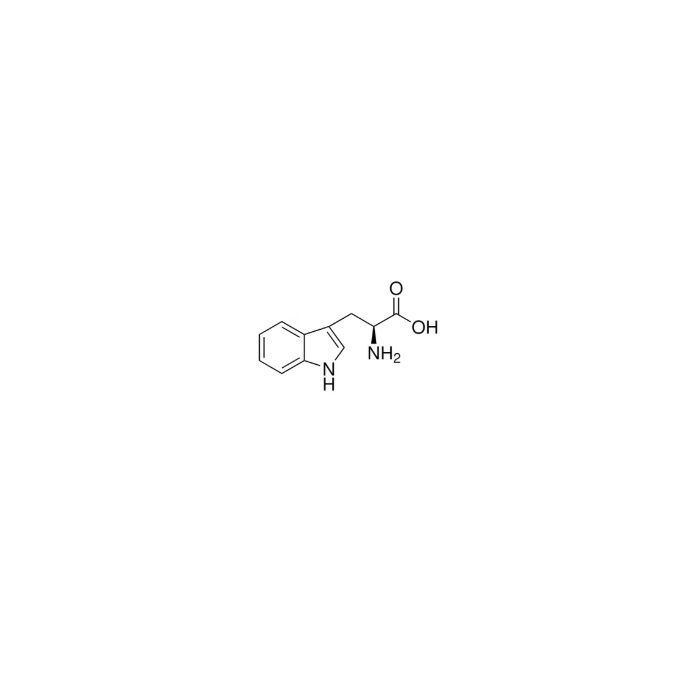
Aromatic amino acid bearing an indole side chain; proteinogenic, L-stereochemistry at the α-carbon.
Item-specific (from Product Data):
SKU: L755707
Product Name: L-Tryptophan
CAS: 73-22-3
CID: 6305
InChIKey: 298119 (as provided)
Grade: UltraBio™
Literature/computed identifiers (for reference; not item-specific):
Core: α-amino acid framework with a carboxylic acid and a primary α-amine on the same chiral carbon.
Side chain: Indole (fused benzene–pyrrole) attached via a methylene (–CH2–) at indole C-3.
Stereochemistry: L-configuration corresponding to (S) at the α-carbon under the Cahn–Ingold–Prelog system (typical for L-amino acids except cysteine).
Ionization: Zwitterionic near neutral pH (–NH3+ and –COO–), neutral indole NH (weakly acidic, non-ionized in water).
2D description in words:
A central chiral carbon bears: (i) a protonated amino group, (ii) a carboxylate group, (iii) a methylene substituent leading to a bicyclic indole ring (five-membered pyrrolic ring fused to a six-membered benzene), and (iv) a hydrogen. The indole nitrogen is part of the aromatic system and is not basic.
Synthetic Utility
L-Tryptophan is a privileged chiral building block integrating two reactive motifs: an α-amino acid and an indole heteroaromatic.
Key functional elements (general):
α-Amino acid: Amenable to standard protection strategies (Boc-/Fmoc- on the amine; methyl/tBu esters on the acid). Enables peptide bond formation via carbodiimide or uronium/ phosphonium coupling.
Indole: N–H (weakly acidic) can be protected (e.g., N-Boc, N-Alloc) to suppress side reactions. C-3 is the most nucleophilic site for electrophilic substitution; C-2 functionalization achievable via directed metalation or transition-metal catalysis.
Representative transformations (literature):
SPPS/LPPS: Fmoc-L-Trp-(Boc) or Fmoc-L-Trp(For) derivatives to improve coupling fidelity and minimize indole side reactions.
Late-stage diversification: Halogenation (NBS/NCS) at C-2/C-3 followed by cross-coupling (Suzuki, Buchwald–Hartwig) to furnish tryptophan analogues.
Oxidation: Conversion to kynurenine/kynurenic derivatives using mild oxidants (e.g., m-CPBA, enzymatic oxidations) for probe or medicinal scaffold synthesis.
Side-chain elaboration: Reductive alkylation at the α-amine; modification of the carboxyl (amide formation) to produce tryptophan amides/esters.
Practical advice:
Maintain mild conditions to preserve chirality and avoid racemization (use HOAt/HOBt surrogates or Oxyma-based activators; control base equivalents and temperature).
Indole is light/air sensitive; use inert atmosphere and amber glass when performing electrophilic or oxidative chemistry to limit byproduct formation.
Target Specificity
This product is a small-molecule amino acid, not an affinity reagent or biologic. Target/epitope specificity, clone/isotype, and species reactivity do not apply.
Item-specific data: Not applicable.
Guidance: For binding/recognition studies, L-tryptophan can act as a ligand or probe in enzyme and transporter assays; however, there is no inherent “target specificity” in the sense used for antibodies or inhibitors.
Refer instead to the Reaction & Applications and Biological Roles sections for relevant functional context.
Frequently Asked Questions
What does UltraBio? mean?
UltraBio? indicates that the product has been processed and tested for biological and biochemical applications. Specifications may include endotoxin limits, microbial controls, sterility, low DNase/RNase/protease activity, and verified biological activity where relevant.
How should this product be stored?
Store at room temperature, protected from light. The material is light-sensitive — keep it in its original opaque or amber container.
How is this product shipped?
This product ships under standard ambient conditions. No temperature-controlled packaging is required.
What are the CAS number, molecular formula and molecular weight?
The CAS Number is 73-22-3, the molecular formula is C11H12N2O2, and the molecular weight is 204.23 g/mol. InChIKey QIVBCDIJIAJPQS-VIFPVBQESA-N.
What documentation is provided?
Available product documentation, including Certificates of Analysis (COA), Safety Data Sheets (SDS), and specification sheets, is shown in the product document area. Document availability and access follow the current site policy.
We use cookies to ensure the website functions properly and, where permitted, to improve your experience. You can manage your preferences at any time in Settings. Learn more in our Cookie Policy.
Shall we send you a message when we have discounts available?
Remind me later
Thank you! Please check your email inbox to confirm.
Products are supplied to verified businesses, institutions, and qualified professionals for research and development use only. Not for use in humans, animals, diagnosis, or therapy.

 L2529359