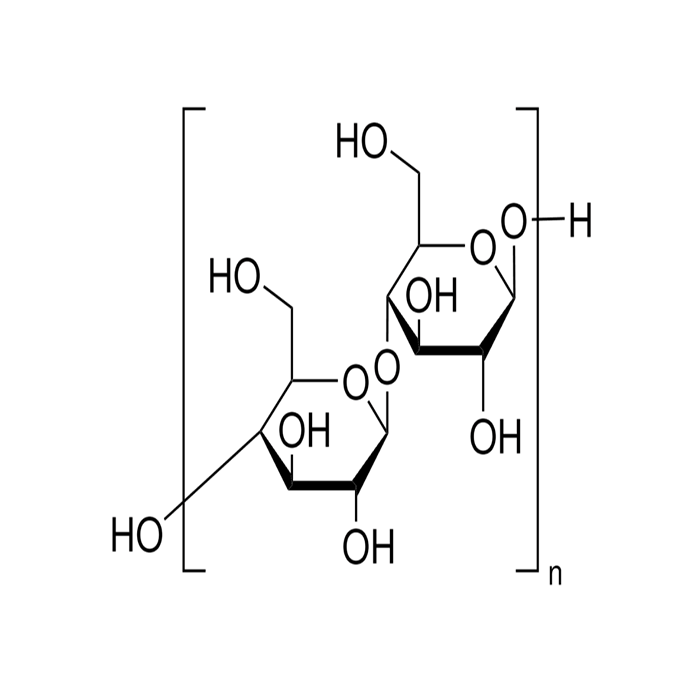
Microcrystalline Cellulose - ChP, JP, Ph.Eur., E 460(i), FCC, NF , CAS No.9004-34-6

CAS: 9004-34-6 Cat. No.: M489093 Formula: (C6H10O5)n EC Number: 232-674-9 PubChem CID: 16211032
AVAILABLE TO ORDER
Only %1 left
GRADE & PURITY ChP ? Chinese Pharmacopoeia grade — meets ChP (中国药典) monograph specifications. Use for pharmaceutical work requiring compliance with Chinese standards. JP ? Japanese Pharmacopoeia grade — conforms to JP monograph standards. Use for pharmaceutical products subject to Japanese regulatory requirements. Ph.Eur. ? European Pharmacopoeia grade — conforms to Ph.Eur. monographs across EU member states. Use for pharmaceutical work needing European compendial compliance. E 460(i) ? EU food-additive code E 460(i) — this product corresponds to microcrystalline cellulose. The E-number signals it meets the identity/spec expected for that additive in food-contact use. FCC ? Food Chemicals Codex grade — meets FCC purity/identity specs for food ingredients. Use for additives and ingredients intended for food use. NF ? National Formulary grade — meets NF monograph standards, often for excipients. Use for pharmaceutical excipients and products requiring NF compliance.
Synonyms
(5S)-6-(hydroxymethyl)-5-{[(2S)-3,4,5-trihydroxy-6-(hydroxymethyl)oxan-2-yl]oxy}oxane-2,3,4-triol | Diethylaminoethyl cellulose | Cellulosepulver | Express-Ion(TM) exchanger?? D free base, 60-130 mum | DEAE-CELLULOSE | EN300-381040 | (6S)-2-(HYDROXYMETHYL
Storage
Room temperature
Shipped In
Normal
Price
As low as €17.27 Regular Price €17.27
AVAILABLE TO ORDER

Overview

Microcrystalline cellulose is very strong and chemically inert, so it is a very ideal carrier. API layered microcrystalline cellulose can be filled into capsules or pressed into tablets. They have a very tight particle size distribution, which can better control and improve the consistency of API release between batches. The uniformity of particle size minimizes the risk of packaging or tablet pressing, resulting in higher uniformity of API content. In addition, different APIs can be used in a variety of concentrates and combined with pellet core coating in a unit dose.

Product specifications

SKUAverage Particle Size by Laser Diffraction (µm)Bulk Density (g/mL)Main Application
M489093-0115max 0.26Very fine grade, which gives a pleasant mouth feeling, masks bitter tastes and supports flavors.
M489093-02650.26–0.31Fine standard MCC grade, especially suited for wet granulation, roller compaction and spheronization. Very high compactibility.
M489093-03650.26-0.34Same quality as grade 101/50M, but very low moisture content (< 1.5 %) for processing water-sensitive actives.
M489093-04650.35-0.46Same quality as grade 101, but increased bulk density and improved flow properties.
M489093-051300.28-0.33Medium size standard MCC grade, suited for the majority of directly compressible actives. Combines good flow and high compactibility.
M489093-061300.30-0.36Same quality to grades 102/90M, but very low moisture content (< 1.5 %) for processing water-sensitive actives
M489093-071300.35-0.50Same quality to grade 102/90M, but increased bulk density and improved flow properties. Especially suited for high speed tableting and processing high density actives.
M489093-08170/1750.28-0.34Coarse, DC-grade MCC.
M489093-091800.30-0.36Coarse grade MCC, combines good compactibility and high binding capacity with outstanding flow. Provides good content uniformity at low weight variation – even when used with low concentrations of fine actives.
M489093-101700.32-0.40Same quality to grade 12, but very low moisture content (<1.5 %) for processing water-sensitive actives.
M489093-112500.31-0.37Large size MCC grade with excellent flow properties for a variety of direct compression formulations.
M489093-122500.33-0.40Same quality to grades 200/LP200, but very low moisture content (<1.5 %) for processing water-sensitive actives.
M489093-132200.20-0.37Coarse grained microcrystalline cellulose has good compressibility and adhesion, and good fluidity. Even for active ingredients with low content and fine particle size, tablets with good content uniformity and small differences in tablet weight can be obtained.

Benefits

1.High compactability,

2.Robust tablets with low friability,

3.High production yields,

4.Practically inert – compatible with most APIs,

5.Created from sustainable organic materials,

6.Contains no additives, impurities, or irradiated components,

7.Advanced carton packaging design for fast NIR identification.

Specifications

Synonyms
(5S)-6-(hydroxymethyl)-5-{[(2S)-3,4,5-trihydroxy-6-(hydroxymethyl)oxan-2-yl]oxy}oxane-2,3,4-triol | Diethylaminoethyl cellulose | Cellulosepulver | Express-Ion(TM) exchanger?? D free base, 60-130 mum | DEAE-CELLULOSE | EN300-381040 | (6S)-2-(HYDROXYMETHYL
Specifications & Purity
ChP, JP, Ph.Eur., E 460(i), FCC, NF
Storage
Room temperature
Shipped In
Normal
Grade
ChP, E 460(i), FCC, JP, NF, Ph.Eur.
Names and Identifiers
IUPAC Name
(6S)-2-(hydroxymethyl)-6-[(3S)-4,5,6-trihydroxy-2-(hydroxymethyl)oxan-3-yl]oxyoxane-3,4,5-triol
InChIKey
GUBGYTABKSRVRQ-WFVLMXAXSA-N
INCHI
1S/C12H22O11/c13-1-3-5(15)6(16)9(19)12(22-3)23-10-4(2-14)21-11(20)8(18)7(10)17/h3-20H,1-2H2/t3?,4?,5?,6?,7?,8?,9?,10-,11?,12+/m1/s1
Isomeric SMILES
C(C1[C@H](C(C(C(O1)O)O)O)O[C@H]2C(C(C(C(O2)CO)O)O)O)O
WGK Germany
3
RTECS
FJ5691460
PubChem CID
16211032

Documentation

📋 Safety Data Sheet (SDS)

Comprehensive hazard, handling, storage, and regulatory compliance document.

Download SDS →

✅ Certificate of Analysis (COA)

Lot-specific quality data. Enter your lot number to retrieve the exact COA.

Look up COA →

📊 Datasheet

Quick-reference summary of product specifications and applications.

View datasheet →

🔬 Specification Sheet

Full quality attributes and acceptance criteria for this grade.

View spec sheet →

Advanced Data

Taxonomic Classification

Taxonomy Tree

KingdomOrganic compounds
SuperclassOrganic oxygen compounds
ClassOrganooxygen compounds
SubclassCarbohydrates and carbohydrate conjugates
Intermediate Tree Nodes Glycosyl compounds
Direct ParentO-glycosyl compounds
Alternative Parents Disaccharides  Oxanes  Secondary alcohols  Hemiacetals  Polyols  Oxacyclic compounds  Acetals  Primary alcohols  Hydrocarbon derivatives  
Molecular FrameworkAliphatic heteromonocyclic compounds
Substituents O-glycosyl compound - Disaccharide - Oxane - Secondary alcohol - Hemiacetal - Oxacycle - Organoheterocyclic compound - Polyol - Acetal - Hydrocarbon derivative - Primary alcohol - Alcohol - Aliphatic heteromonocyclic compound
DescriptionThis compound belongs to the class of organic compounds known as o-glycosyl compounds. These are glycoside in which a sugar group is bonded through one carbon to another group via a O-glycosidic bond.
External Descriptors Not available
Certificates(CoA,COO,BSE/TSE and Analysis Chart)
C of A & Other Certificates(BSE/TSE, COO):
Analytical Chart:

Find and download the COA for your product by matching the lot number on the packaging.

62 results found

Lot NumberCertificate TypeDateItem
A2416611Certificate of AnalysisOct 09, 2026 M489093
A2416609Certificate of AnalysisOct 09, 2026 M489093
I2611627Certificate of AnalysisSep 04, 2026 M489093
I2611629Certificate of AnalysisSep 04, 2026 M489093
I2611631Certificate of AnalysisSep 04, 2026 M489093
J2320196Certificate of AnalysisJul 30, 2026 M489093
J2320195Certificate of AnalysisJul 30, 2026 M489093
J2320194Certificate of AnalysisJul 30, 2026 M489093
J2320193Certificate of AnalysisJul 30, 2026 M489093
G2610722Certificate of AnalysisJun 30, 2026 M489093
G2610721Certificate of AnalysisJun 30, 2026 M489093
G2610719Certificate of AnalysisJun 30, 2026 M489093
D2613353Certificate of AnalysisApr 01, 2026 M489093
D2613354Certificate of AnalysisApr 01, 2026 M489093
A2609358Certificate of AnalysisJan 05, 2026 M489093
A2609357Certificate of AnalysisJan 05, 2026 M489093
A2609356Certificate of AnalysisJan 05, 2026 M489093
F2626059Certificate of AnalysisJan 05, 2026 M489093
L2518439Certificate of AnalysisDec 10, 2025 M489093
L2518440Certificate of AnalysisDec 10, 2025 M489093
L2518441Certificate of AnalysisDec 10, 2025 M489093
F2612171Certificate of AnalysisDec 10, 2025 M489093
C2511648Certificate of AnalysisMar 05, 2025 M489093
C2511652Certificate of AnalysisMar 05, 2025 M489093
C2511653Certificate of AnalysisMar 05, 2025 M489093
C2519015Certificate of AnalysisMar 05, 2025 M489093
H2521111Certificate of AnalysisMar 05, 2025 M489093
E2612051Certificate of AnalysisMar 05, 2025 M489093
E2521515Certificate of AnalysisFeb 06, 2025 M489093
E2521471Certificate of AnalysisFeb 06, 2025 M489093
E2521472Certificate of AnalysisFeb 06, 2025 M489093
E2521514Certificate of AnalysisFeb 06, 2025 M489093
F2509658Certificate of AnalysisFeb 06, 2025 M489093
L2418867Certificate of AnalysisDec 11, 2024 M489093
L2418859Certificate of AnalysisDec 11, 2024 M489093
L2424002Certificate of AnalysisDec 11, 2024 M489093
L2424004Certificate of AnalysisDec 11, 2024 M489093
J2530106Certificate of AnalysisMay 08, 2024 M489093
G2410418Certificate of AnalysisMay 08, 2024 M489093
G2410443Certificate of AnalysisMay 08, 2024 M489093
H2402643Certificate of AnalysisApr 10, 2024 M489093
H2402644Certificate of AnalysisApr 10, 2024 M489093
H2402645Certificate of AnalysisApr 10, 2024 M489093
H2402646Certificate of AnalysisApr 10, 2024 M489093
H2402647Certificate of AnalysisApr 10, 2024 M489093
G2424085Certificate of AnalysisApr 02, 2024 M489093
G2424082Certificate of AnalysisApr 02, 2024 M489093
G2424083Certificate of AnalysisApr 02, 2024 M489093
G2424086Certificate of AnalysisApr 02, 2024 M489093
G2424084Certificate of AnalysisApr 02, 2024 M489093
G2424079Certificate of AnalysisMar 28, 2024 M489093
G2424078Certificate of AnalysisMar 28, 2024 M489093
G2424077Certificate of AnalysisMar 28, 2024 M489093
G2424080Certificate of AnalysisMar 28, 2024 M489093
G2424081Certificate of AnalysisMar 28, 2024 M489093
F2604141Certificate of AnalysisSep 26, 2023 M489093
B2627185Certificate of AnalysisSep 19, 2023 M489093
A2514002Certificate of AnalysisSep 19, 2023 M489093
L2419033Certificate of AnalysisSep 19, 2023 M489093
A2613134Certificate of AnalysisSep 19, 2023 M489093
J2530109Certificate of AnalysisSep 19, 2023 M489093
G23131114Certificate of AnalysisJul 04, 2023 M489093
Chemical and Physical Properties
Molecular Weight342.300 g/mol
XLogP3-4.700
Hydrogen Bond Donor Count8
Hydrogen Bond Acceptor Count11
Rotatable Bond Count4
Exact Mass342.116 Da
Monoisotopic Mass342.116 Da
Topological Polar Surface Area190.000 Ų
Heavy Atom Count23
Formal Charge0
Complexity382.000
Isotope Atom Count0
Defined Atom Stereocenter Count2
Undefined Atom Stereocenter Count8
Defined Bond Stereocenter Count0
Undefined Bond Stereocenter Count0
The total count of all stereochemical bonds0
Covalently-Bonded Unit Count1
Documents & Articles
ChP-Grade Reagents-The Chinese Pharmacopoeia Standard Explained
JP Grade Reagents Explained
FCC Grade Explained: Definition, Tests, Uses & How to Choose
NF Grade Explained: Standards, Tests, and Uses
E 460(i) Microcrystalline Cellulose: Regulatory Standards, Quality Control and Applications
Immobilized Enzyme Technology and Its Applications in Biocatalysis
Poly(vinyl alcohol) (PVA): From Basics to Selection Key Parameters, Freeze–Thaw vs. Chemical Crosslinking Hydrogel Routes, and an Aladdin Product List
Microcrystalline Cellulose (MCC): A Comprehensive Primer and Selection Guide—Structural Features, Key Performance Metrics, and Application Scenarios
An Introduction to Research-Grade Carbohydrates: Decoding the “Glycan Language” and a Product-Selection Guide (with Tables 1–3)
Practical Guide to Sodium Carboxymethyl Cellulose (CMC-Na): Thickening/Stabilizing Mechanisms, Key Controls for Solution Preparation, and Selection Navigation (including Table 1 and Tables A–C)
Physicochemical Properties of Diphenylamine, Analytical Applications, and a Review of Its DNA Colorimetric Reaction
Functional Framework of Starch Metabolism-Related Enzymes in Food Science Research and Mechanistic Analysis of Quality Regulation
Experimental Judgment in mRNA In Vitro Transcription: Template Design, 5′ Capping, and dsRNA Control
Key Judgments in Medical Hydrogel R&D: From Polymer Source and Crosslinking Strategy to Sterilization Planning, Scale-Up Feasibility, and Quality Control
From Natural Cellulose to Nanocrystals: Structural Characteristics, Application Directions, and Industrialization Challenges of CNC
Natural Resins in Coating Formulations: Functional Positioning, Structure–Property Relationships, and Selection Validation
From Structure to Rheology: Thickening, Stabilization, and Selection Logic of Cellulose Ethers for Personal Care Applications
Analysis of the Production Process of Hydroxypropyl Methylcellulose (HPMC) for Putty: Understanding Differences in Substitution Structure and Gelation Temperature from High-Ratio and Low-Ratio Formulations
Experimental Evaluation of the Synergistic Actions of Endoglucanase, CBH I, and β-Glucosidase in Lignocellulosic Saccharification
Experimental Applications of Carboxymethyl Cellulose (CMC) Solution in Enzyme Assays, Suspension Systems, and Functional Materials
What Is Direct Compression? Process Characteristics, Suitability Criteria, and Excipient Selection
Citations of This Product
Solution Calculators
Reviews

Customer Reviews

Frequently Asked Questions

What does ChP mean?
ChP indicates that the material complies with the published monographs of the relevant pharmacopoeia (ChP). Specifications include identity, assay, impurity limits, residual solvents and other tests defined in the monograph. ChP-compliant material is suitable for pharmacopoeia-compliant pharmaceutical use, including pharmaceutical manufacturing, QC and regulatory submission.
How should this product be stored?
Store at room temperature.
What does JP mean?
JP indicates that the material complies with the published monographs of the relevant pharmacopoeia (JP). Specifications include identity, assay, impurity limits, residual solvents and other tests defined in the monograph. JP-compliant material is suitable for pharmacopoeia-compliant pharmaceutical use, including pharmaceutical manufacturing, QC and regulatory submission.
How is this product shipped?
This product ships under standard ambient conditions. No temperature-controlled packaging is required.
What are the CAS number, molecular formula and molecular weight?
The CAS Number is 9004-34-6, the molecular formula is (C6H10O5)n. InChIKey GUBGYTABKSRVRQ-WFVLMXAXSA-N.
What documentation is provided?
Available product documentation, including Certificates of Analysis (COA), Safety Data Sheets (SDS), and specification sheets, is shown in the product document area. Document availability and access follow the current site policy.

Shall we send you a message when we have discounts available?

Remind me later

Thank you! Please check your email inbox to confirm.

Oops! Notifications are disabled.