
Determine the necessary mass, volume, or concentration for preparing a solution.
224,000+ research products · Triple ISO certified · COA & SDS available for every product · Same-day shipping on in-stock items
Why this grade
Ultra dry, ≥99.8%, water≤50 ppm Ultra dry for sensitive chromatographic and analytical workflows requiring minimal baseline interference.
Storage & shipping
Room temperature Ships FedEx DG Service Check lot-specific COA for exact specifications.
Quality documents
SDS, COA, datasheet, and spec sheet available for download. Lot-specific COA accessible via lot number lookup.
Literature proof
Cited in 9428 peer-reviewed publications across chromatography, organic synthesis, and cross-coupling reactions.
Specifications
Specifications & Purity
Ultra dry, ≥99.8%, water≤50 ppm
Storage
Room temperature
Shipped In
FedEx DG Service
Grade
Ultra dry
Purity
≥99.8%
Names and Identifiers
Canonical Smiles
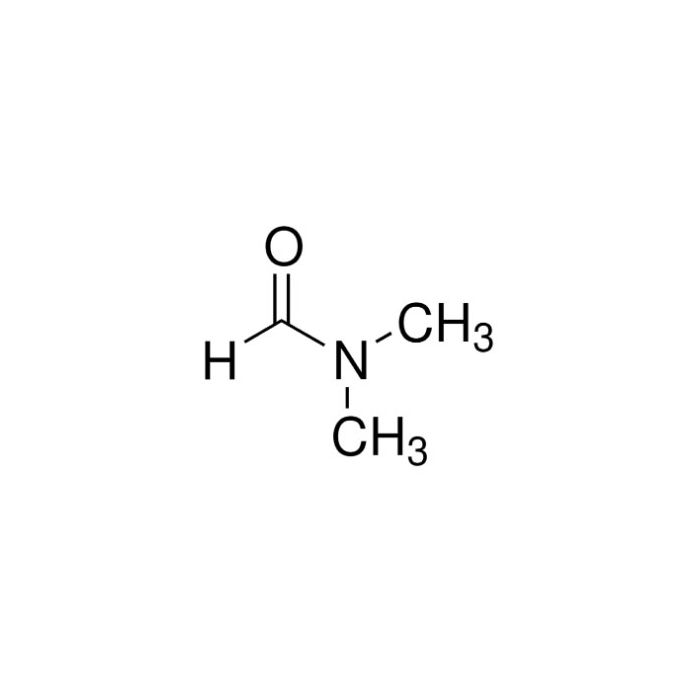
CN(C)C=O
IUPAC Name
N,N-dimethylformamide
InChIKey
ZMXDDKWLCZADIW-UHFFFAOYSA-N
INCHI
1S/C3H7NO/c1-4(2)3-5/h3H,1-2H3
Isomeric SMILES
CN(C)C=O
WGK Germany
1
RTECS
LQ2100000
UN Number
2265
Packing Group
III
Molecular Weight
73.09
Beilstein
605365
Reaxy-Rn
605365
Reaxys-RN_link_address
https://www.reaxys.com/reaxys/secured/hopinto.do?context=S&query=IDE.XRN=605365&ln=
Documentation
📋 Safety Data Sheet (SDS)
Comprehensive hazard, handling, storage, and regulatory compliance document.
Download SDS →✅ Certificate of Analysis (COA)
Lot-specific quality data. Enter your lot number to retrieve the exact COA.
Look up COA →🔬 Specification Sheet
Full quality attributes and acceptance criteria for this grade.
View spec sheet →Advanced Data
Taxonomic Classification
Taxonomy Tree
- Kingdom Organic compounds
- Superclass Organic acids and derivatives
- Class Carboxylic acids and derivatives
- Subclass Carboxylic acid derivatives
- Level5 Carboxylic acid amides
- Subclass Carboxylic acid derivatives
- Class Carboxylic acids and derivatives
- Superclass Organic acids and derivatives
| Kingdom | Organic compounds |
|---|---|
| Superclass | Organic acids and derivatives |
| Class | Carboxylic acids and derivatives |
| Subclass | Carboxylic acid derivatives |
| Intermediate Tree Nodes | Carboxylic acid amides |
| Direct Parent | Tertiary carboxylic acid amides |
| Alternative Parents | Organopnictogen compounds Organonitrogen compounds Organic oxides Hydrocarbon derivatives Carbonyl compounds |
| Molecular Framework | Aliphatic acyclic compounds |
| Substituents | Tertiary carboxylic acid amide - Organic nitrogen compound - Organic oxygen compound - Organopnictogen compound - Organic oxide - Hydrocarbon derivative - Organooxygen compound - Organonitrogen compound - Carbonyl group - Aliphatic acyclic compound |
| Description | This compound belongs to the class of organic compounds known as tertiary carboxylic acid amides. These are compounds containing an amide derivative of carboxylic acid, with the general structure RN(R1)C(R2)=O (R1-R2 any atom but H). |
| External Descriptors | a small molecule |
Certificates(CoA,COO,BSE/TSE and Analysis Chart)
C of A & Other Certificates(BSE/TSE, COO):
Analytical Chart:
Find and download the COA for your product by matching the lot number on the packaging.
| Lot Number | Certificate Type | Date | Item |
|---|---|---|---|
 I2624114 I2624114 | Certificate of Analysis | Oct 10, 2026 | D1521160 |
| H2606297 | Certificate of Analysis | Aug 15, 2026 | D1521160 |
| H2606298 | Certificate of Analysis | Aug 15, 2026 | D1521160 |
| H2606299 | Certificate of Analysis | Aug 15, 2026 | D1521160 |
| E2608329 | Certificate of Analysis | May 12, 2026 | D1521160 |
| E2608330 | Certificate of Analysis | May 12, 2026 | D1521160 |
| E2608331 | Certificate of Analysis | May 12, 2026 | D1521160 |
| F2626142 | Certificate of Analysis | May 12, 2026 | D1521160 |
Chemical and Physical Properties
| Sensitivity | Moisture sensitive |
|---|---|
| Refractive Index | 1.4269 |
| Flash Point(°F) | 136.4 °F |
| Flash Point(°C) | 58℃ |
| Boil Point(°C) | 152.8°C |
| Melt Point(°C) | -61°C |
| Molecular Weight | 73.090 g/mol |
| XLogP3 | -1.000 |
| Hydrogen Bond Donor Count | 0 |
| Hydrogen Bond Acceptor Count | 1 |
| Rotatable Bond Count | 0 |
| Exact Mass | 73.0528 Da |
| Monoisotopic Mass | 73.0528 Da |
| Topological Polar Surface Area | 20.300 Ų |
| Heavy Atom Count | 5 |
| Formal Charge | 0 |
| Complexity | 33.900 |
| Isotope Atom Count | 0 |
| Defined Atom Stereocenter Count | 0 |
| Undefined Atom Stereocenter Count | 0 |
| Defined Bond Stereocenter Count | 0 |
| Undefined Bond Stereocenter Count | 0 |
| The total count of all stereochemical bonds | 0 |
| Covalently-Bonded Unit Count | 1 |
Documents & Articles
Citations of This Product
Solution Calculators
Reviews
Customer Reviews
Need help choosing the grade?
Our grade selection guide covers purity, stabilizer status, and application suitability for all variants in our catalog.
View Ultra dry grade guide →Remind me later
Products are supplied to verified businesses, institutions, and qualified professionals for research and development use only. Not for use in humans, animals, diagnosis, or therapy.
Copyright © 2023–present Aladdin Scientific Corp. All rights reserved.