
Determine the necessary mass, volume, or concentration for preparing a solution.
224,000+ research products · Triple ISO certified · COA & SDS available for every product · Same-day shipping on in-stock items
Why this grade
Ph.Eur., ≥65% Ph.Eur. for sensitive chromatographic and analytical workflows requiring minimal baseline interference.
Storage & shipping
Protected from light,Store at -20°C,Argon charged Ships Ice chest + Ice pads Check lot-specific COA for exact specifications.
Quality documents
SDS, COA, datasheet, and spec sheet available for download. Lot-specific COA accessible via lot number lookup.
Literature proof
Cited in 2345 peer-reviewed publications across chromatography, organic synthesis, and cross-coupling reactions.
Overview
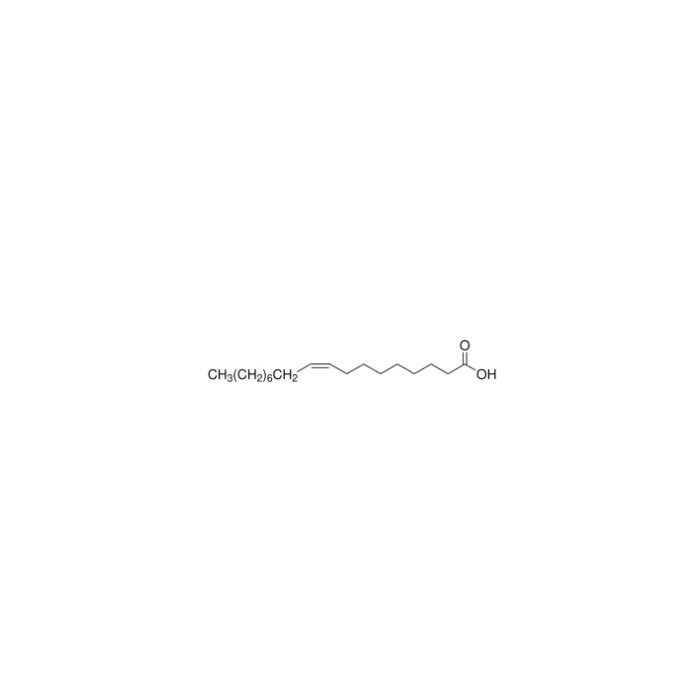
Oleic acid (OA) is a type of fatty acid. OA, as a surfactant, is widely used for the stabilization of magnetic nanoparticles synthesized by the traditional co-precipitation method. Monodisperse magnetite nanoparticles coated with oleic acid (OA) (diameters = 7 and 19 nm) were prepared.
Application
Oleic acid can be used to prepare 10-hydroxyoctadecanoic acid and methyl 10-hydroxyoctadecanoic acid.
Specifications
Specifications & Purity
Ph.Eur., ≥65%
Storage
Protected from light,Store at -20°C,Argon charged
Shipped In
Ice chest + Ice pads
This product requires cold chain shipping. Ground and other economy services are not available.
Grade
Ph.Eur.
Purity
≥65%
Names and Identifiers
Canonical Smiles
CCCCCCCCC=CCCCCCCCC(=O)O
IUPAC Name
(Z)-octadec-9-enoic acid
InChIKey
ZQPPMHVWECSIRJ-KTKRTIGZSA-N
INCHI
1S/C18H34O2/c1-2-3-4-5-6-7-8-9-10-11-12-13-14-15-16-17-18(19)20/h9-10H,2-8,11-17H2,1H3,(H,19,20)/b10-9-
Isomeric SMILES
CCCCCCCC/C=C\CCCCCCCC(=O)O
WGK Germany
1
RTECS
RG2275000
Molecular Weight
282.46
Beilstein
1726542
Reaxy-Rn
1726541
Reaxys-RN_link_address
https://www.reaxys.com/reaxys/secured/hopinto.do?context=S&query=IDE.XRN=1726541&ln=
Documentation
📋 Safety Data Sheet (SDS)
Comprehensive hazard, handling, storage, and regulatory compliance document.
Download SDS →✅ Certificate of Analysis (COA)
Lot-specific quality data. Enter your lot number to retrieve the exact COA.
Look up COA →🔬 Specification Sheet
Full quality attributes and acceptance criteria for this grade.
View spec sheet →Advanced Data
Taxonomic Classification
Taxonomy Tree
- Kingdom Organic compounds
- Superclass Lipids and lipid-like molecules
- Class Fatty Acyls
- Subclass Fatty acids and conjugates
- Class Fatty Acyls
- Superclass Lipids and lipid-like molecules
| Kingdom | Organic compounds |
|---|---|
| Superclass | Lipids and lipid-like molecules |
| Class | Fatty Acyls |
| Subclass | Fatty acids and conjugates |
| Intermediate Tree Nodes | Not available |
| Direct Parent | Long-chain fatty acids |
| Alternative Parents | Unsaturated fatty acids Straight chain fatty acids Monocarboxylic acids and derivatives Carboxylic acids Organic oxides Hydrocarbon derivatives Carbonyl compounds |
| Molecular Framework | Aliphatic acyclic compounds |
| Substituents | Long-chain fatty acid - Unsaturated fatty acid - Straight chain fatty acid - Monocarboxylic acid or derivatives - Carboxylic acid - Carboxylic acid derivative - Organic oxygen compound - Organic oxide - Hydrocarbon derivative - Organooxygen compound - Carbonyl group - Aliphatic acyclic compound |
| Description | This compound belongs to the class of organic compounds known as long-chain fatty acids. These are fatty acids with an aliphatic tail that contains between 13 and 21 carbon atoms. |
| External Descriptors | Unsaturated fatty acids |
3D Structure
Interactive Chemical Structure Model
Certificates(CoA,COO,BSE/TSE and Analysis Chart)
C of A & Other Certificates(BSE/TSE, COO):
Analytical Chart:
Find and download the COA for your product by matching the lot number on the packaging.
| Lot Number | Certificate Type | Date | Item |
|---|---|---|---|
 I2609121 I2609121 | Certificate of Analysis | Sep 16, 2026 | O1456057 |
| I2609122 | Certificate of Analysis | Sep 16, 2026 | O1456057 |
| J2509072 | Certificate of Analysis | Oct 14, 2025 | O1456057 |
| J2509089 | Certificate of Analysis | Oct 14, 2025 | O1456057 |
Chemical and Physical Properties
| Sensitivity | Light sensitive;Air sensitive;Heat sensitive |
|---|---|
| Refractive Index | 1.459 |
| Flash Point(°F) | >235.4 °F |
| Flash Point(°C) | 113 °C |
| Boil Point(°C) | 194-195°C/1.2mmHg |
| Melt Point(°C) | 13-14°C |
Documents & Articles
Review of the Structural Characteristics, Biological Functions, and Application Advances of Lycopene
Citations of This Product
Solution Calculators
Reviews
Customer Reviews
Frequently Asked Questions
What is the purity of this product?
This product is supplied at ≥65% purity (chemical assay). Lot-specific values are stated on the Certificate of Analysis.
What does Ph.Eur. mean?
Ph.Eur. indicates that the material complies with the published monographs of the relevant pharmacopoeia (Ph.Eur.). Specifications include identity, assay, impurity limits, residual solvents and other tests defined in the monograph. Ph.Eur.-compliant material is suitable for pharmacopoeia-compliant pharmaceutical use, including pharmaceutical manufacturing, QC and regulatory submission.
How should this product be stored?
Store at ?20 °C, protected from light, under argon. It is supplied under an argon blanket; reseal under inert gas after each use.
How is this product shipped?
This product ships in an insulated container with ice pads. Unpack on arrival and transfer it to the storage condition stated above.
What are the CAS number, molecular formula and molecular weight?
The CAS Number is 112-80-1, the molecular formula is C18H34O2, and the molecular weight is 282.46 g/mol. InChIKey ZQPPMHVWECSIRJ-KTKRTIGZSA-N.
What documentation is provided?
Available product documentation, including Certificates of Analysis (COA), Safety Data Sheets (SDS), and specification sheets, is shown in the product document area. Document availability and access follow the current site policy.
Need help choosing the grade?
Our grade selection guide covers purity, stabilizer status, and application suitability for all variants in our catalog.
View Ph.Eur. grade guide →Remind me later
Products are supplied to verified businesses, institutions, and qualified professionals for research and development use only. Not for use in humans, animals, diagnosis, or therapy.
Copyright © 2023–present Aladdin Scientific Corp. All rights reserved.