GRADE & PURITYRecombinant?Recombinant — produced via recombinant expression for defined sequence and consistency. Use for reproducible, animal-free proteins of known origin.ExactAb™?ExactAb™ — Aladdin's antibody line emphasizing precision and validated quality. Use for reliable, specificity-validated antibody applications.Validated?Validated grade — performance confirmed in defined applications before release. Use when you want documented assurance the reagent works as stated.0.6 mg/mL
ExactAb™, Validated, Recombinant, 0.6 mg/mL ExactAb™,Recombinant,Validated for sensitive chromatographic and analytical workflows requiring minimal baseline interference.
🌡
Storage & shipping
Store at -20°C,Avoid repeated freezing and thawing Ships Ice chest + Ice pads Check lot-specific COA for exact specifications.
📋
Quality documents
SDS, COA, datasheet, and spec sheet available for download. Lot-specific COA accessible via lot number lookup.
📚
Literature proof
Cited in 0 peer-reviewed publications across chromatography, organic synthesis, and cross-coupling reactions.
Overview
Rabbit anti Human Cdc25B Antibody, Recombinant, could be used for WB and so on. Application: WB: 1/500-1/1000 Protein Function Tyrosine protein phosphatase which functions as a dosage-dependent inducer of mitotic progression. Required for G2/M phases of the cell cycle progression and abscission during cytokinesis in a ECT2-dependent manner. Directly dephosphorylates CDK1 and stimulates its kinase activity. The three isoforms seem to have a different level of activity.
Specifications
Product Name
Recombinant Cdc25B Antibody - Primary antibody, specific to Cdc25B, Rabbit IgG
A synthetic peptide derived from human Cdc25B (AA 175-250)
Positive Control
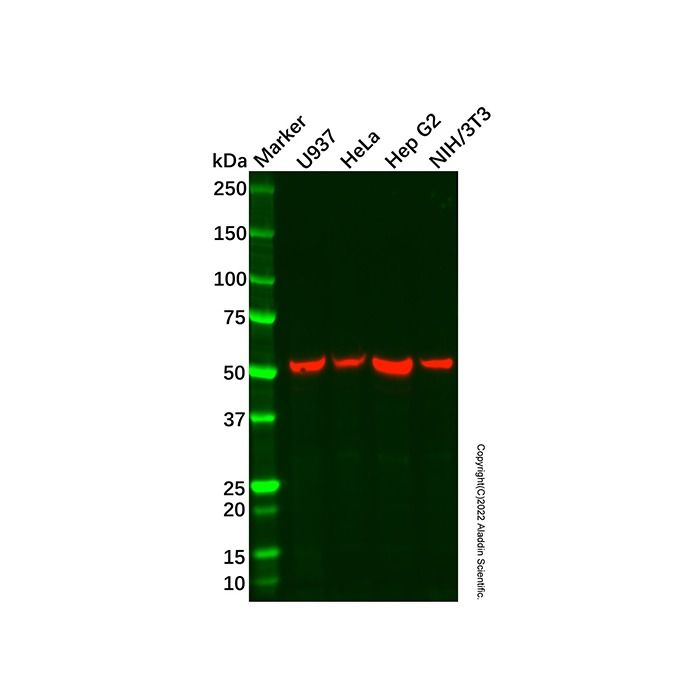
WB: U937, HeLa, Hep G2 and NIH/3T3 cell lysates.
Conjugation
Unconjugated
Grade
ExactAb™, Recombinant, Validated
Isotype
Rabbit IgG
Light Chain Type
kappa
SDS-PAGE
150 kDa
Purification Method
Protein A purified
Concentration
0.6 mg/mL
Product Line
Biological Products
Storage and Shipping
Form
Liquid
Storage
Store at -20°C,Avoid repeated freezing and thawing
Shipped In
Ice chest + Ice pads
Stability And Storage
Store at 4℃ short term (1-2 weeks). Store at -20℃ long term (24 months). Upon receipt, it is recommended to aliquot. Avoid freeze/thaw cycle.
Images
Recombinant Cdc25B Antibody (Ab095602) - Western Blot All lanes: Recombinant Cdc25B Antibody (Ab095602) at 1/1000 dilution Samples: Lysates at 20 µg per lane Secondary: Goat Anti-Rabbit IgG H&L (HRP) (Ab170144) at 1/20000 dilution Predicted band size: 65 kDa Observed band size: 53 kDa Exposure time: 10.6 s
Application
Application
Dilution info
WB
1/500-1/1000
Documentation
📋 Safety Data Sheet (SDS)
Comprehensive hazard, handling, storage, and regulatory compliance document.
Determine the necessary mass, volume, or concentration for preparing a solution.
Dilution Calculator
Determine the dilution needed to prepare a stock solution.
Reconstitution Calculator
Reviews
Customer Reviews
Application Protocols
Manufacturer-tested applications and recommended dilutions are not specified for this item; refer to the product CoA/Spec Sheet. The following generalized protocols can serve as starting points and must be optimized empirically for Ab095602.
Western Blot (general):
Sample: 20–40 µg total protein per lane. Denature in Laemmli buffer; reduce if epitope is linear.
Block: 5% BSA or milk in TBS-T for 30–60 min.
Primary: Start at 1:500–1:2,000 in TBS-T + 1–3% BSA; incubate 1 h RT or overnight 4 °C.
Secondary: HRP-conjugated anti-species IgG at 1:5,000–1:20,000; develop by ECL.
Immunofluorescence/ICC (general):
Fix: 4% PFA 10–15 min or cold methanol 5–10 min.
Permeabilize: 0.1% Triton X-100 for 5–10 min if needed.
Block: 1–3% BSA for 30 min.
Primary: 1:200–1:1,000 in blocking buffer, 1 h RT or overnight 4 °C.
Secondary: Fluor-labeled secondary 1:500–1:1,000; mount with antifade.
Immunoprecipitation (general):
Use 1–5 µg antibody per 0.5–1 mg lysate; rotate 1–4 h at 4 °C; capture with Protein A/G beads; wash and elute.
Note: Adjust conditions for epitope accessibility, fixation, and species. Validate with positive/negative controls specific to Cdc25B.
Biological Roles
Cdc25B (cell division cycle 25B) is a dual-specificity phosphatase that regulates the eukaryotic cell cycle.
Function (literature/general):
Dephosphorylates inhibitory Tyr15/Thr14 residues on CDK/cyclin complexes, promoting activation of CDK1–cyclin B and CDK2–cyclin E/A.
Participates in G2/M transition and checkpoint recovery following DNA damage, integrating signals from ATR/ATM–Chk1/Chk2 pathways.
Subcellular dynamics: shuttles between nucleus and cytoplasm; phosphorylation state and 14-3-3 interactions modulate localization and activity.
Expression and regulation (general):
Expression varies across cell-cycle phases; targeted degradation by ubiquitin–proteasome pathways helps ensure unidirectional progression.
Post-translational modifications (phosphorylation) modulate activity and interactions; feedback with CDKs creates bistable switches.
Research importance:
Monitoring Cdc25B abundance, localization, and interaction partners informs studies of checkpoint control, replication stress responses, and mitotic entry.
Note: The above summarizes Cdc25B biology for context. It does not imply or constitute medical use. Ab095602 is designated for research use only (from Product Data). Item-specific epitope, affinity, and species cross-reactivity are not specified; consult the CoA for details.
Buffer Applications
Antibody performance is highly dependent on buffer composition; the supplied formulation for Ab095602 is not specified—consult the CoA/Spec Sheet. General guidance follows.
Storage buffers (general):
PBS or HEPES at pH 7.2–7.6 with 10–50% glycerol for −20 °C storage to mitigate freeze–thaw. Small amounts of nonionic surfactant (0.01–0.02% polysorbate) may reduce aggregation.
Preservatives: 0.02–0.05% sodium azide for long-term refrigerated storage if compatible with downstream assays (avoid for live-cell applications and HRP reactions).
Working diluents (assay-dependent):
WB: TBS-T or PBS-T with 1–5% BSA or milk for blocking; primary antibody diluent typically TBS-T/PBS-T with 1–3% BSA.
IF/ICC: PBS or HEPES with 1–3% BSA and 0.05% saponin or 0.1% Triton X-100 for permeabilization if required by epitope.
IP: Isotonic buffers with mild detergents (e.g., 0.1–1% NP-40 or Triton X-100) and protease/phosphatase inhibitors to preserve complexes.
pH and ionic strength:
Maintain physiological ionic strength (~150 mM NaCl). Extreme pH or high salt may impact epitope binding.
Always verify compatibility of buffers with the specific format of Ab095602 and the detection system used.
Green Alternatives
While antibodies themselves are not interchangeable with greener “solvents,” sustainable choices can be made in their use and workflow.
Greener handling practices (general):
Minimize freeze–thaw by aliquoting to reduce waste from denaturation-related loss.
Use phosphate-buffered saline (PBS) or HEPES buffers prepared with reagent-grade components; avoid unnecessary azide in waste streams where possible (follow institutional disposal protocols when azide is present).
Choose aqueous, low-toxicity blocking agents (e.g., BSA, casein) and mild detergents at minimal effective concentrations.
Prefer fluorescent detection systems compatible with lower antibody loads and reduced exposure times to save reagents and energy.
Packaging and waste:
Consolidate cold shipments with other reagents when possible. Reuse/recycle ice packs and insulated shippers where allowed by institutional policy.
Neutralize and dispose of buffer wastes per local regulations, minimizing solvent-containing wash steps.
Comparison of common buffer additives (general):
Sodium azide: effective preservative but hazardous; consider sterile filtration and small aliquots as an alternative when compatible with application.
Glycerol vs trehalose: both enhance freeze stability; glycerol enables −20 °C storage without freezing, trehalose supports lyophilized formats—select based on workflow and disposal preferences.
These practices reduce environmental impact without compromising performance.
Pharmaceutical Uses
This product is supplied strictly for research use only (from Product Data). It is not intended for diagnostic, therapeutic, or clinical applications.
Formulation/excipient role: Not applicable. No pharmacopeial monograph or excipient function is indicated for this item.
Manufacturing/analytics context (general):
Recombinant antibodies like this may be used as analytical reagents or reference materials in process development assays (e.g., ELISA controls), but Ab095602 carries no such designation in the provided data.
Compliance and documentation:
For any use beyond basic research, users must establish suitability and obtain appropriate regulatory clearance. No claims of GMP status, endotoxin specification, or sterility are provided for this item.
For any quality attributes relevant to bioprocess analytics (e.g., host cell protein, bioburden, endotoxin), refer to the product’s CoA/Spec Sheet if available.
Physical Properties
Antibodies are macromolecular proteins; small-molecule physical constants (bp, mp, logP) do not apply.
Item-specific physical data:
Appearance: Not specified for this item; refer to CoA/Spec Sheet.
Concentration/formulation, pH, excipients: Not specified for this item; refer to CoA/Spec Sheet.
Refractive index, pKa, density: Not applicable for protein antibody solutions.
Typical antibody properties (literature/general):
Molecular size: ~150 kDa for full-length IgG; recombinant formats (scFv, Fab, Fc-fusion) vary from ~25–110 kDa.
Isoelectric point (pI): commonly in the pH 6–9 range, sequence- and glycosylation-dependent.
Solubility: readily soluble in aqueous buffers (e.g., PBS, Tris, HEPES) with stabilizers such as 0.01–0.05% nonionic surfactant or 1–5% trehalose/glycerol to mitigate aggregation.
Stability: sensitive to repeated freeze–thaw; aggregation risk at interfaces and elevated temperature; best handled with minimal agitation.
Compatibility (general):
Avoid strong denaturants (SDS, urea) unless intended for SDS-PAGE or epitope retrieval protocols.
Metal chelators (EDTA) are generally compatible unless epitope or assay requires divalent cations.
Note: For exact concentration, buffer composition, and format of Ab095602, consult the item’s CoA/Spec Sheet.
Quality & Grades
Item-specific quality notes (from Product Data):
Grade/Purity: Recombinant, ExactAb™, Validated.
Implication: The antibody is produced recombinantly, providing a defined amino-acid sequence and enabling lot-to-lot genetic identity. “Validated” indicates functional verification against its intended target under specified assay conditions by the manufacturer; see CoA/Spec Sheet for scope of validation.
What “Recombinant” means (general):
Expressed in a controlled host system from a defined sequence; lacks the hybridoma genetic drift seen with some monoclonals and batch variability of polyclonals.
Facilitates consistent affinity and specificity across lots; enables engineered formats or Fc regions if applicable (isotype/format not specified for this item).
About ExactAb™ (general description):
A designation for precisely defined recombinant antibodies. Typical benefits include sequence transparency, batch-to-batch reproducibility, and supply continuity. For Ab095602, refer to the Spec Sheet for exact sequence/isotype and QC metrics.
Validation expectations (general):
Validation may include ELISA binding to Cdc25B, Western blot banding at the expected molecular weight of target, and/or immunofluorescence localization, depending on the product. The exact validated applications and species reactivity are not specified for this item; refer to CoA/Spec Sheet.
Documentation:
For lot-specific titer, purity (e.g., % monomer by SEC), endotoxin, and host cell protein/DNA levels, consult the CoA.
Reaction & Applications
As a recombinant research antibody, this product is not used in chemical reactions. Its applications are bioanalytical.
Intended research applications (general for anti-Cdc25B antibodies):
Western blotting (WB) to detect Cdc25B isoforms in cell/tissue lysates following denaturation and reduction.
Immunofluorescence (IF) or immunocytochemistry (ICC) to visualize subcellular localization of Cdc25B during cell-cycle phases.
Immunoprecipitation (IP) or co-IP to enrich Cdc25B and interacting CDK/cyclin complexes for pathway studies.
ELISA or plate-based assays for relative quantitation of Cdc25B levels.
Assay design considerations (general):
Epitope context: Cdc25B epitope exposure can vary with fixation method; methanol vs paraformaldehyde and antigen retrieval conditions should be optimized.
Cell-cycle synchronization may improve signal for phase-specific abundance.
Controls: include knockout/siRNA knockdown, peptide-blocking (if a peptide immunogen antibody), or isotype controls to assess specificity.
Item-specific application claims from manufacturer: Not specified for this item; refer to CoA/Spec Sheet.
This section provides general use-cases. For Ab095602, consult the product documentation for validated applications and any tested species.
Reaction Conditions
Not applicable in the sense of chemical reaction conditions. For bioassays, conditions depend on the application and are not item-specific in the provided data.
General assay conditions (guidance):
WB: Denaturing SDS-PAGE, transfer to PVDF/nitrocellulose; block 30–60 min; primary incubation 1–16 h at 4–25 °C depending on affinity; HRP- or fluor-labeled secondary.
IF/ICC: Fixation with 4% paraformaldehyde or cold methanol; permeabilization as needed; primary 1–2 h at RT or overnight at 4 °C; appropriate fluorescent secondary.
IP: 1–4 h binding at 4 °C with rotation; capture on Protein A/G resin; stringent vs gentle washes tailored to complex stability.
Expected outcomes: Signal strength, background, and specificity are assay- and antibody-dependent. For Ab095602, validated conditions are not specified; refer to CoA/Spec Sheet.
These are general parameters to aid initial optimization; they are not product-specific specifications.
Safety & Handling
GHS/Regulatory status:
GHS Classification, Signal Word, H-Statements, Pictograms: Not specified for this item; refer to SDS.
General laboratory precautions (proteins/antibodies):
Use standard PPE: lab coat, gloves, and safety glasses. Handle solutions to avoid aerosol generation. Practice good hygiene and avoid ingestion or injection.
Treat as a low-hazard biotechnological product unless SDS indicates otherwise. Not known to be infectious when recombinantly produced; nevertheless, observe biosafety level 1 practices.
Incompatibilities and stability:
Avoid repeated freeze–thaw cycles (can denature/aggregate proteins). Store at the specified temperature. Do not expose to strong acids/bases, oxidizers, or organic solvents that can unfold proteins.
Adsorption to bare glass/plastics can occur at low concentrations; use low-bind tips/tubes for critical assays.
First-aid (general guidance; defer to SDS):
Skin/eye contact: Rinse with water for several minutes; remove contaminated clothing; seek medical evaluation if irritation persists.
Inhalation: Move to fresh air; seek medical attention if symptoms develop.
Ingestion: Rinse mouth; do not induce vomiting; obtain medical advice.
Always consult the product-specific SDS for authoritative safety information and institutional requirements.
Solvent Selection
This section is best interpreted as buffer selection for protein antibodies.
Item-specific formulation: Not specified for this item; refer to CoA/Spec Sheet.
General buffer guidance (antibody handling):
Working buffers: PBS (10–50 mM phosphate, 150 mM NaCl, pH 7.2–7.6) or HEPES (10–25 mM, pH 7.2–7.6). Tris buffers (pH 7.4–8.0) are also common but can interact with certain crosslinkers.
Additives to enhance stability: 0.01–0.05% nonionic surfactant (e.g., Tween 20 or Polysorbate 80) to limit surface adsorption; 10–50% glycerol or 2–5% trehalose for freeze–thaw protection when aliquoted at −20 °C.
Avoid: High concentrations of organic solvents (e.g., >5–10% methanol, acetonitrile) that can denature; strong detergents (SDS) unless required for SDS-PAGE; extreme pH (<6 or >8.5) unless the antibody is engineered for such conditions.
Compatibility with downstream applications (general):
For ELISA/IF: include carrier proteins or blocking agents (BSA 0.1–1%) to reduce nonspecific binding; confirm they do not mask epitopes or interfere with detection.
For conjugation: use amine-free buffers (e.g., PBS) when coupling via NHS esters; avoid Tris/azide if incompatible with the chemistry.
Always check the Spec Sheet for the supplied buffer composition and any required diluent for Ab095602.
Storage & Reconstitution
Item-specific storage (from Product Data):
Store at −20 °C.
Avoid repeated freezing and thawing.
Shipped in an ice chest with ice pads. Inspect immediately upon receipt.
Format-specific guidance (not specified for this item; follow CoA/Spec Sheet):
If liquid: Aliquot into low-bind tubes to single-use volumes; consider adding 10–50% glycerol for −20 °C storage to prevent freeze–thaw. Mix gently—do not vortex.
If lyophilized: Reconstitute with sterile buffer (e.g., PBS or supplier-recommended diluent) to desired concentration. Allow to sit on ice with gentle inversion until fully dissolved. Avoid foaming.
Working stocks:
Prepare working dilutions in assay-compatible buffer immediately before use. Discard unused working dilutions—do not return to stock.
Stability notes (general):
Maintain cold chain during handling. Short-term storage at 2–8 °C is typically acceptable for days to weeks depending on preservatives; verify on Spec Sheet.
Protect from microbial contamination; use sterile technique. Sodium azide, if present, is toxic—handle and dispose accordingly.
Always defer to the product CoA/SDS for exact buffer composition, reconstitution volume, and stability dating for Ab095602.
Structure & Identity
This product is a recombinant research antibody directed against the cell-cycle regulator Cdc25B. As a protein biologic, it is not described by small-molecule identifiers.
Molecular formula: Not specified for this item; refer to CoA/Spec Sheet.
Molecular weight: Not specified for this item; refer to CoA/Spec Sheet.
CAS, CID, SMILES, InChIKey: Not applicable to antibodies.
Structural features (general for IgG-class antibodies; literature):
Typical immunoglobulin architecture with two heavy chains and two light chains forming a Y‑shaped heterotetramer stabilized by disulfide bonds.
Variable domains (VH/VL) confer antigen specificity to epitopes on Cdc25B; constant domains (CH/CL) determine isotype and Fc-mediated properties.
Recombinant production implies sequence-defined polypeptides expressed in a heterologous system (e.g., mammalian or engineered lines), enabling lot-to-lot genetic identity.
Target overview (general):
Cdc25B is a dual-specificity phosphatase that activates CDK/cyclin complexes by dephosphorylating inhibitory threonine/tyrosine residues, with roles in G2/M transition and checkpoint recovery.
Synthetic Utility
Not applicable. As a recombinant antibody, Ab095602 is not a synthetic building block or reagent for organic transformations.
If your objective is chemical synthesis related to Cdc25B pathways (e.g., small-molecule modulators or phosphatase probes), consider consulting small-molecule reagent sections instead. This antibody is best suited for analytical and immunodetection workflows.
Refer to Reaction & Applications and Application Protocols for bioanalytical use guidance.
Epitope, immunogen, and binding region: Not specified for this item; refer to CoA/Spec Sheet.
Isotype/format (e.g., IgG1, recombinant monoclonal/polyclonal, host species): Not specified for this item; refer to CoA/Spec Sheet.
Species reactivity/cross-reactivity: Not specified for this item; refer to CoA/Spec Sheet.
Clone ID or catalog alias: Not specified for this item; refer to CoA/Spec Sheet.
General note: Cdc25B has conserved regions across vertebrates; however, epitope selection determines cross-species recognition. Always confirm species reactivity and epitope mapping for your experimental system.
Frequently Asked Questions
What does ExactAb? mean?
ExactAb? indicates the product has been validated for use in rigorous antibody validation workflows. Validation may include positive/negative control samples, signal-to-noise testing, and protocol-specific QC. Lot-specific test data is published on the Certificate of Analysis where available.
What does Recombinant mean?
Recombinant is a defined analytical purity tier suitable for workflows requiring a specific validated property. It specifies a minimum assay percentage, controlled limits on common impurities (water, heavy metals, residue on ignition), and lot-to-lot consistency. Recombinant is one of several purity tiers — choose based on the sensitivity and regulatory requirements of your method.
How should this product be stored?
Store at ?20 °C. Avoid repeated freeze–thaw cycles. Aliquot into single-use volumes before freezing.
How is this product shipped?
This product ships in an insulated container with ice pads. Unpack on arrival and transfer it to the storage condition stated above.
What documentation is provided?
Available product documentation, including Certificates of Analysis (COA), Safety Data Sheets (SDS), and specification sheets, is shown in the product document area. Document availability and access follow the current site policy.
Which species reactivity has this antibody been validated against?
Validated reactivity is listed on the PDP and on each lot's datasheet. We validate against the most commonly tested species for the target (Recombinant Cdc25B Antibody); cross-reactivity in untested species may exist but is not guaranteed. Contact technical support for specific species inquiries.
Need help choosing the grade?
Our grade selection guide covers purity, stabilizer status, and application suitability for all variants in our catalog.
We use cookies to ensure the website functions properly and, where permitted, to improve your experience. You can manage your preferences at any time in Settings. Learn more in our Cookie Policy.
Shall we send you a message when we have discounts available?
Remind me later
Thank you! Please check your email inbox to confirm.
Products are supplied to verified businesses, institutions, and qualified professionals for research and development use only. Not for use in humans, animals, diagnosis, or therapy.

 ZJ24F0809737