Recombinant DEK Antibody - Primary antibody, specific to DEK, Rabbit IgG

Cat. No.: Ab099554
AVAILABLE TO ORDER
GRADE & PURITY Recombinant ? Recombinant — produced via recombinant expression for defined sequence and consistency. Use for reproducible, animal-free proteins of known origin. ExactAb™ ? ExactAb™ — Aladdin's antibody line emphasizing precision and validated quality. Use for reliable, specificity-validated antibody applications. Validated ? Validated grade — performance confirmed in defined applications before release. Use when you want documented assurance the reagent works as stated. 0.5 mg/mL
Application
IHC, WB
Host species
Rabbit
Reactive species
Human
Isotype
Rabbit IgG
Conjugation
Unconjugated
★
Size
Germany (EU)
USA*
Price
Qty
10μl
Ab099554-10μl
—
2 In stock
€86.69
50μl
Ab099554-50μl
—
1 In stock
€225.53
100μl
Ab099554-100μl
Made to order · 8–12 wks
€364.36
1ml
Ab099554-1ml
Made to order · 8–12 wks
€2,950.23
Enter a quantity for the sizes you want to add.
🧪
Why this grade

ExactAb™, Validated, Recombinant, 0.5 mg/mL ExactAb™,Recombinant,Validated for sensitive chromatographic and analytical workflows requiring minimal baseline interference.

🌡

Storage & shipping

Store at -20°C,Avoid repeated freezing and thawing Ships Ice chest + Ice pads Check lot-specific COA for exact specifications.

📋

Quality documents

SDS, COA, datasheet, and spec sheet available for download. Lot-specific COA accessible via lot number lookup.

📚

Literature proof

Cited in 0 peer-reviewed publications across chromatography, organic synthesis, and cross-coupling reactions.

Overview

Rabbit anti Human DEK Antibody, Recombinant, could be used for WB, IHC and so on.
Application:
WB: 1/500-1/2000
IHC: 1/50-1/100
Protein Function
Involved in chromatin organization.

Specifications

Product Name
Recombinant DEK Antibody - Primary antibody, specific to DEK, Rabbit IgG
Synonyms
D6S231EDEK oncogene (DNA binding) | DEK oncogene | DEK | protein DEK | D6S231E antibody | Dek antibody | DEK gene antibody | DEK oncogene antibody | DEK oncogene DNA binding antibody | DEK_HUMAN antibody | Protein DEK antibody | D6S231EDEK oncogene (DNA b
Specifications & Purity
ExactAb™, Validated, Recombinant, 0.5 mg/mL
Host species
Rabbit
Specificity
DEK
Immunogen
Recombinant protein of human DEK (AA 78-208)
Positive Control
WB: K562 and HeLa cell lysates. IHC: Human lung cancer tissue.
Conjugation
Unconjugated
Grade
ExactAb™, Recombinant, Validated
Isotype
Rabbit IgG
SDS-PAGE
150 kDa
Purification Method
Antigen affinity purified
Concentration
0.5 mg/mL
Product Line
Biological Products
Storage and Shipping
Form
Liquid
Storage
Store at -20°C,Avoid repeated freezing and thawing
Shipped In
Ice chest + Ice pads
Stability And Storage
Store at 4°C short term (1-2 weeks). Store at -20°C long term (24 months). Upon receipt, it is recommended to aliquot. Avoid freeze/thaw cycle.
Images

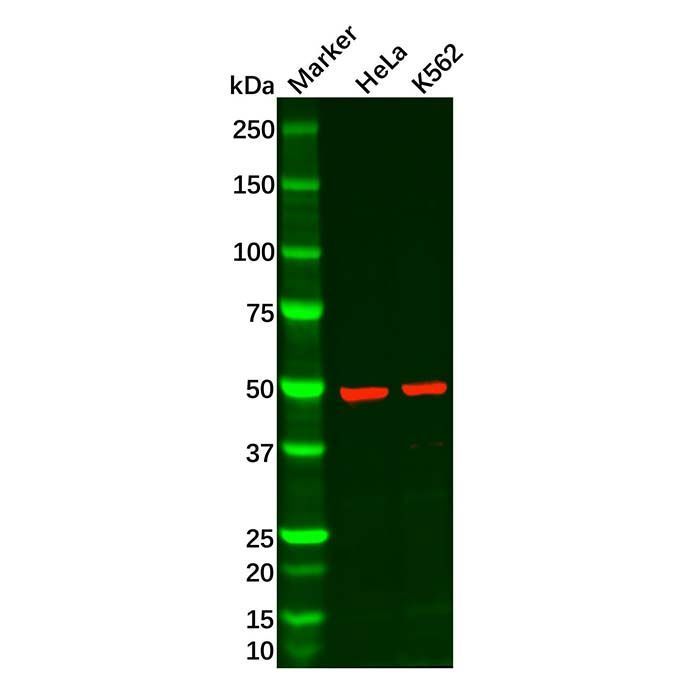
Recombinant DEK Antibody (Ab099554)- Western Blot
All lanes: Recombinant DEK Antibody (Ab099554) at 1/2000 dilution
Samples: Lysates at 20 µg per lane
Secondary: Goat Anti-Rabbit IgG H&L (HRP) (Ab170144) at 1/20000 dilution

Predicted band size: 43 kDa
Observed band size: 49 kDa
Exposure time: 22.3 s

Recombinant DEK Antibody (Ab099554) - IHC
Immunohistochemistry analysis of paraffin-embedded Human lung cancer using Recombinant DEK Antibody (Ab099554). High-pressure and temperature Sodium Citrate pH 6.0 was used for antigen retrieval.

Application
Application
Dilution info
WB

1/500-1/2000

IHC

1/50 - 1/100

Documentation

📋 Safety Data Sheet (SDS)

Comprehensive hazard, handling, storage, and regulatory compliance document.

<<<<<<< HEAD Download SDS → ======= Download SDS → >>>>>>> release248-p3

✅ Certificate of Analysis (COA)

Lot-specific quality data. Enter your lot number to retrieve the exact COA.

Look up COA →

📊 Datasheet

Quick-reference summary of product specifications and applications.

View datasheet →

🔬 Specification Sheet

Full quality attributes and acceptance criteria for this grade.

View spec sheet →

Advanced Data

Associated Targets(Human)
DEK Tbio Protein DEK (0 Activities)
Activity TypeActivity Value -log(M)Mechanism of ActionActivity ReferencePublications (PubMed IDs)
Certificates (CoA,COO,BSE/TSE and Analysis Chart)
C of A & Other Certificates(BSE/TSE, COO):
Analytical Chart:

Find and download the COA for your product by matching the lot number on the packaging.

2 results found

Lot NumberCertificate TypeDateItem
ZJ24F0303234ZJ24F0303234Certificate of AnalysisMar 14, 2024 Ab099554
ZJ24F0303235ZJ24F0303235Certificate of AnalysisMar 14, 2024 Ab099554
Documents & Articles
Solution Calculators
Reviews

Customer Reviews

Application Protocols

Manufacturer-validated applications and recommended dilutions for SKU Ab099554 are not specified in the provided data. Please consult the CoA/Spec Sheet for authoritative, item-specific protocols.

General protocol outlines (literature/general; adapt to this product once details are known):

  • Western blot (WB):
    • Block membrane in 5% BSA or milk in TBS-T, 1 h RT.
    • Primary antibody incubation in blocker (optimize concentration by titration), 1 h RT or overnight 4°C.
    • Wash 3× with TBS-T; incubate with HRP- or fluorophore-conjugated secondary; develop appropriately.
  • Immunofluorescence (IF/ICC):
    • Fix cells with 4% PFA, 10–15 min; permeabilize with 0.1–0.3% Triton X-100.
    • Block with 1–5% BSA; incubate with primary (titrated), then fluorescent secondary; image with appropriate filters.
  • IHC (FFPE):
    • Deparaffinize and rehydrate; perform antigen retrieval (citrate pH 6 or Tris-EDTA pH 9).
    • Block endogenous peroxidase if HRP-based detection is used; proceed with primary, secondary, and chromogen.
  • ELISA:
    • Coat capture antibody (if using as capture) overnight; block; add samples; detect with matched detection antibody and HRP/TMB.

Replace the generalized concentrations/incubation times with those on the product CoA once available.

Biological Roles

Target: DEK protein (general background, literature).

  • Functional overview: DEK is a conserved chromatin-associated phosphoprotein implicated in DNA topology regulation, chromatin remodeling, and transcriptional control. It interacts with histones and DNA, influencing nucleosome architecture and gene expression programs.
  • Cellular localization: Predominantly nuclear; has been observed in the nucleoplasm and associated with chromatin. Extracellular release has been reported under certain conditions (literature), but intracellular nuclear localization is the canonical context.
  • Molecular activities: DNA-binding and regulation of supercoiling; involvement in RNA processing and splicing has been described. DEK participates in DNA damage responses and replication stress pathways (literature).
  • Biological pathways: Linked to regulation of proliferation and differentiation through chromatin state modulation; interacts with key transcription factors and chromatin modifiers (general literature).

Relevance to experimental design:

  • Antibodies against DEK enable detection and quantitation of DEK expression, assessment of subcellular localization, and immunoprecipitation of DEK-containing complexes for downstream proteomics or ChIP-style assays (if antibody is suitable; verify on CoA).

Note: The specific epitope, species reactivity spectrum, and validated applications for SKU Ab099554 are not provided here; please consult the CoA/Spec Sheet for item-specific details.

Buffer Applications

As an antibody reagent, buffer systems are central to performance, though the exact supplied buffer for this item is not specified.

General buffer guidance (literature/general):

  • Storage/dilution: PBS (10–50 mM phosphate, 100–150 mM NaCl, pH 7.2–7.6) or TBS for most immunoassays. Maintain isotonicity to preserve antibody structure.
  • Blocking: 1–5% BSA, 3–5% nonfat dry milk, or commercial blockers reduce nonspecific binding in WB/IHC/ELISA. Avoid milk when detecting phospho-epitopes.
  • Wash buffers: PBS-T or TBS-T with 0.05–0.1% Tween-20 enhance stringency without denaturation.
  • Antigen retrieval (IHC): Citrate buffer (pH ~6.0) or Tris-EDTA (pH ~9.0) heat-induced retrieval can expose epitopes; optimize per tissue and fixation.
  • Conjugation-ready: For chemical labeling (e.g., NHS ester dyes), use amine-free buffers (PBS) and avoid Tris/glycine during coupling.

For this item, verify the actual buffer composition, presence of carrier proteins or preservatives, and recommended diluents on the CoA/Spec Sheet before protocol development.

Green Alternatives

While green chemistry frameworks primarily target small-molecule solvents and reagents, protein antibody workflows can also incorporate sustainability principles.

  • Buffer selection (general): Prefer phosphate- or Tris-based buffers prepared from high-purity salts in reusable glassware. Minimize hazardous preservatives; if sodium azide is included (not specified here), ensure proper waste segregation to avoid formation of metal azides.
  • Resource efficiency: Aliquot to reduce waste from degraded material. Use minimal effective antibody concentrations determined by titration to reduce consumption.
  • Packaging and cold chain: This product ships cold (ice chest + ice pads). Consolidating orders and coordinating delivery can reduce shipping-related emissions and packaging waste.
  • Alternative formats: For high-throughput screens, consider recombinant antibody fragments (Fab/scFv) or renewable binders where appropriate; they may allow expression at scale, reducing animal-derived inputs (general consideration).

Tradeoffs (general): Preservatives improve shelf life but add disposal considerations; glycerol improves freeze–thaw stability but increases carbon footprint and viscosity. Balance stability versus environmental impact through careful aliquoting and storage discipline.

No item-specific environmental metrics are provided; consult your institution’s green lab guidelines for disposal and solvent/buffer selection.

Pharmaceutical Uses

This product is designated for research use only. It is not intended for diagnostic, therapeutic, or clinical applications.

Non-clinical and manufacturing-relevant contexts (general):

  • Process analytics: Antibodies to intracellular targets like DEK can be used as in-process controls for cell line characterization or research-scale QC assays (e.g., blot-based identity tests) within non-GMP environments.
  • Assay development: May serve as a research reagent for developing analytical methods (e.g., ELISA prototypes) prior to any separate clinical-grade development using distinct materials.

Regulatory note: No pharmacopeial status, clinical-grade certification, or lot release specs are provided for this item. Any use in regulated environments would require separate qualification and documentation. For all regulated applications, consult QA/RA and obtain materials explicitly qualified for such use.

All uses must adhere to the provided Research Use Only notice.

Physical Properties

As a recombinant antibody, small-molecule physicochemical constants are not applicable. Only high-level, literature-type properties are provided for user context.

  • Appearance: Not specified for this item; refer to CoA/Spec Sheet.
  • Concentration/formulation: Not specified for this item; refer to CoA/Spec Sheet.
  • Molecular weight: Not specified for this item; refer to CoA/Spec Sheet. (General note: full-length IgG is typically ~150 kDa, literature.)
  • pI / pKa: Not specified for this item; refer to CoA/Spec Sheet. (Antibody pI typically ranges ~6–9, literature, sequence-dependent.)
  • Solubility: Antibodies are water-soluble in isotonic buffers (e.g., PBS, Tris) and generally insoluble in organic solvents (literature/general). Exact solubility for this item is not specified.
  • Stability modifiers: Presence/absence of carrier proteins (e.g., BSA), preservatives (e.g., sodium azide), or glycerol content: Not specified for this item; refer to CoA/Spec Sheet.
  • Other physical constants (BP, MP, density, refractive index, logP): Not applicable to macromolecular protein reagents.

For definitive values and composition of the supplied lot (buffer, pH, concentration, stabilizers), consult the item’s CoA/Spec Sheet and SDS.

Quality & Grades
  • Grade/Purity (as provided): Recombinant, ExactAb™, Validated.

What this means for professional users:

  • Recombinant: Produced from a defined sequence in a controlled expression system, avoiding batch-to-batch variability inherent to hybridoma ascites or polyclonal sources. Expected advantages include consistent epitope recognition and lot-to-lot reproducibility (general rationale).
  • ExactAb™: Brand/program designation indicating precision recombinant engineering and process control. Specific performance metrics for this item are not specified; refer to CoA/Spec Sheet for titer/affinity or sequence data if available.
  • Validated: Indicates this antibody has undergone application-specific or epitope validation by the manufacturer. Exact tested applications and validation methods are not specified in the provided data; consult the product CoA/Spec Sheet for details (e.g., WB, IHC, IF, ELISA).

Additional quality considerations (general):

  • Purity profile (SDS-PAGE, SEC-HPLC), endotoxin levels, and bioburden limits for this specific item are not specified; check CoA.
  • Stabilizers/preservatives (e.g., BSA, trehalose, glycerol, azide) impact assay compatibility; confirm formulation before sensitive applications (e.g., live-cell staining, conjugation).
  • For quantitative work, confirm concentration by A280 or manufacturer’s stated concentration on the label/CoA.
Reaction & Applications

Chemical reaction applications (e.g., synthesis, catalysis) are not applicable to an antibody reagent. Instead, antibodies are used as affinity reagents in bioanalytical assays.

General application landscape for anti-DEK antibodies (literature/general):

  • Western blotting (WB): Detection of DEK in cell/tissue lysates following SDS-PAGE and transfer to membranes; requires antigen retrieval conditions compatible with epitope recognition.
  • Immunofluorescence (IF) / Immunocytochemistry (ICC): Subcellular localization studies for nuclear DEK with appropriate fixation (e.g., PFA) and permeabilization (e.g., Triton X-100), protocol dependent on epitope.
  • Immunohistochemistry (IHC): Formalin-fixed paraffin-embedded (FFPE) sections may require optimized antigen retrieval (citrate or EDTA buffers), followed by detection with HRP/DAB or fluorescence.
  • ELISA / Sandwich immunoassays: Quantification in lysates or biological fluids, provided the antibody is compatible with capture/detection formats.

Manufacturer-validated applications for this exact product are not specified in the provided data. Please consult the CoA/Spec Sheet for tested applications, recommended dilutions, and performance notes.

Reaction Conditions

Chemical reaction conditions are not pertinent to antibody function. However, experimental conditions strongly affect immunoassay performance (general guidance):

  • Temperature: Perform antibody incubations typically at room temperature (20–25°C) for 1 h or at 4°C overnight to enhance affinity-driven binding while reducing nonspecific interactions (literature/general). Optimize based on assay.
  • Buffer stringency: Addition of mild detergents (0.05–0.1% Tween-20) and salt (150–300 mM NaCl) in wash buffers increases specificity in WB/IHC/ELISA.
  • Fixation/permeabilization: For cellular DEK detection, PFA (3–4%) fixation followed by permeabilization (0.1–0.5% Triton X-100 or saponin) is common. Conditions must be optimized to preserve the DEK epitope recognized by the specific antibody clone (not specified here).
  • Antigen retrieval: Heat-induced retrieval in citrate (pH ~6) or Tris-EDTA (pH ~9) buffers can unmask DEK epitopes in FFPE sections; titrate retrieval time and temperature to balance signal and morphology.
  • Secondary detection: Choose species- and isotype-matched secondary antibodies; confirm this item’s isotype on the CoA/Spec Sheet.

Note: The above are literature-based general conditions. For this product (SKU Ab099554), manufacturer-validated conditions and dilutions are not specified in the provided data; consult the CoA/Spec Sheet.

Safety & Handling

This product is a research-grade recombinant antibody. No specific GHS hazards are provided in the product data.

  • GHS classification, signal word, pictograms, H-statements: Not specified for this item; refer to SDS.
  • General laboratory safety (best practice):
    • Wear appropriate PPE: lab coat, gloves (nitrile), and safety glasses.
    • Avoid ingestion, inhalation of aerosols, and skin/eye contact. Handle using aseptic technique to prevent contamination.
    • Do not pipette by mouth; use calibrated pipettes and filtered tips for sterility-sensitive applications.
  • Storage incompatibilities (general): Avoid strong oxidizers and proteases. Do not mix with microbial cultures unless intended. If sodium azide is present (not specified), avoid contact with metals that form explosive azides; flush drains with copious water.
  • Special risks for protein reagents: Repeated freeze–thaw cycles can denature antibodies and reduce binding activity; strictly follow aliquoting guidance.
  • First-aid overview (general): In case of skin contact, wash with water and soap. For eye contact, rinse with water for several minutes; remove contacts if easy. If inhaled, move to fresh air. If swallowed, rinse mouth. Seek medical attention if any adverse effect persists.

Always consult the SDS and CoA/Spec Sheet for lot-specific hazard, buffer composition, and preservative information.

Solvent Selection

This is a protein reagent supplied in an aqueous buffer; organic solvent selection is not typically applicable.

Practical notes (general, for antibodies):

  • Preferred diluents: Isotonic aqueous buffers such as PBS (pH ~7.2–7.6) or TBS, optionally with 0.05–0.1% Tween-20 for blotting workflows and 1–5% BSA or nonfat dry milk for blocking (literature/general). Verify compatibility with your assay and with the supplied formulation.
  • Avoid organic solvents (e.g., acetone, acetonitrile, DMSO) as primary diluents; these can denature antibodies. Small percentages of glycerol (10–50%) are sometimes used to enhance freeze–thaw stability; composition for this item is not specified.
  • For conjugation workflows, use low-amine buffers (e.g., PBS) and avoid primary amine-containing Tris during NHS–ester coupling (general recommendation).

For this specific item’s buffer composition and recommended diluents, refer to the CoA/Spec Sheet.

Storage & Reconstitution
  • Storage conditions (as provided): Store at -20°C. Avoid repeated freezing and thawing.
  • Shipping: Shipped in an ice chest with ice pads to maintain the cold chain.

General handling guidance for antibodies (supplemental, literature/general):

  • Upon receipt: Inspect for any signs of warming or leakage. Centrifuge briefly to collect contents in the vial.
  • Aliquoting: To minimize activity loss, aliquot into single-use volumes appropriate for your workflow immediately after first thaw. Avoid multiple freeze–thaw cycles.
  • Working buffer: Use an appropriate isotonic buffer (e.g., PBS) for dilutions as recommended in the CoA/Spec Sheet. Confirm the presence/absence of preservatives (e.g., azide) before live-cell use or conjugation.
  • Reconstitution: If supplied lyophilized (not specified), reconstitute with sterile, antibody-grade water or buffer to the desired concentration, gently invert to dissolve; avoid vigorous vortexing and foam formation. Allow to equilibrate on ice.
  • Short-term storage: 2–8°C for hours to a few days is typical once diluted; add carrier protein (e.g., 0.1–1% BSA) if compatible to reduce adsorption (general guidance). Verify compatibility with your assay and with the supplied formulation.
  • Long-term storage: -20°C or below as stated. For some formulations, -80°C provides extended stability; consult CoA for this item.

Always defer to the item label and CoA/Spec Sheet for lot-specific buffer composition, concentration, and any stabilizers.

Structure & Identity

Recombinant DEK Antibody (ExactAb™, Validated) is a recombinant immunoglobulin reagent directed against the human DEK protein target. This entry is an antibody product rather than a small molecule.

  • Item-specific identifiers:
    • Molecular formula: Not specified for this item; refer to CoA/Spec Sheet.
    • Molecular weight: Not specified for this item; refer to CoA/Spec Sheet.
    • SMILES / InChI / InChIKey / CAS / CID: Not applicable to antibodies; not specified for this item.
  • Structural features (general, literature):
    • Typical recombinant antibodies are full-length IgG molecules composed of two heavy chains (~50 kDa each) and two light chains (~25 kDa each) with intra- and inter-chain disulfide bonds. Total MW typically ~150 kDa (literature, for IgG). Actual isotype/subclass for this item: Not specified; refer to CoA/Spec Sheet.
    • Antigen-binding fragments (Fab) contain variable regions (VH/VL) that define specificity to DEK epitopes; Fc region mediates effector functions and protein A/G binding (general antibody architecture).
  • 2D description in words (general): Y-shaped heterotetrameric glycoprotein with two identical heavy chains and two identical light chains linked by disulfides; variable domains at the tips of the Y mediate DEK recognition. Exact sequence/epitope for this item is not specified.
Synthetic Utility

Not applicable. As a recombinant antibody reagent, this product is not used as a synthetic building block or catalyst in organic or organometallic chemistry.

For laboratory planning, refer instead to the sections on Reaction & Applications (bioanalytical) and Application Protocols for immunoassay-related use.

Target Specificity

Item-specific target details are limited in the provided data.

  • Antigen: DEK protein (general target name inferred from product title). Specific epitope/peptide sequence: Not specified for this item; refer to CoA/Spec Sheet.
  • Species reactivity: Not specified for this item; refer to CoA/Spec Sheet.
  • Clone/isotype/host: Not specified for this item; refer to CoA/Spec Sheet. Product is described as recombinant.
  • Cross-reactivity: Not specified for this item; refer to CoA/Spec Sheet.

Practical guidance: Before experimental use, verify epitope, species reactivity, and isotype on the item label/CoA to ensure compatibility with your samples and secondary antibodies.

Frequently Asked Questions

What does ExactAb? mean?
ExactAb? indicates the product has been validated for use in rigorous antibody validation workflows. Validation may include positive/negative control samples, signal-to-noise testing, and protocol-specific QC. Lot-specific test data is published on the Certificate of Analysis where available.
What does Recombinant mean?
Recombinant is a defined analytical purity tier suitable for workflows requiring a specific validated property. It specifies a minimum assay percentage, controlled limits on common impurities (water, heavy metals, residue on ignition), and lot-to-lot consistency. Recombinant is one of several purity tiers — choose based on the sensitivity and regulatory requirements of your method.
How should this product be stored?
Store at ?20 °C. Avoid repeated freeze–thaw cycles. Aliquot into single-use volumes before freezing.
How is this product shipped?
This product ships in an insulated container with ice pads. Unpack on arrival and transfer it to the storage condition stated above.
What documentation is provided?
Available product documentation, including Certificates of Analysis (COA), Safety Data Sheets (SDS), and specification sheets, is shown in the product document area. Document availability and access follow the current site policy.
Which species reactivity has this antibody been validated against?
Validated reactivity is listed on the PDP and on each lot's datasheet. We validate against the most commonly tested species for the target (Recombinant DEK Antibody); cross-reactivity in untested species may exist but is not guaranteed. Contact technical support for specific species inquiries.

Need help choosing the grade?

Our grade selection guide covers purity, stabilizer status, and application suitability for all variants in our catalog.

View Recombinant grade guide → View Validated grade guide → View ExactAb™ grade guide →

Related Products

Goat Anti-Rabbit IgG H&L Antibody - Secondary antibody, for ELISA,LF,GICA various applications, from Rabbit, generated in Goat
Goat Anti-Rabbit IgG H&L (AF594) - Secondary antibody, IgG
Goat Anti-Rabbit IgG H&L (Biotin) - Secondary antibody, IgG
Goat Anti-Rabbit IgG H&L (AF488) - Secondary antibody, IgG
Goat Anti-Rabbit IgG H&L (AF405) - Secondary antibody, IgG
Donkey Anti-Rabbit IgG H&L (AF647) - Secondary antibody, specific to , IgG
Donkey Anti-Rabbit IgG H&L (Biotin) - Secondary antibody, IgG
Goat Anti-Rabbit IgG H&L (HRP) - Secondary antibody
Goat Anti-Rabbit IgG H&L Antibody - Secondary antibody, Goat IgG
Goat Anti-Rabbit IgG H&L (Biotin) - Secondary antibody
Goat Anti-Rabbit IgG H&L (Cy5) - Secondary antibody
Goat Anti-Rabbit IgG H&L (FITC) - Secondary antibody
Goat Anti-Rabbit IgG H&L (TRITC) - Secondary antibody
Goat Anti-Rabbit IgG H&L (Biotin) - Secondary antibody, Goat IgG
Goat Anti-Rabbit IgG H&L (HRP) - Secondary antibody, Goat IgG
Goat Anti-Rabbit IgG H&L (Cy5) - Secondary antibody, Goat IgG
Goat Anti-Rabbit IgG H&L (TRITC) - Secondary antibody, Goat IgG
Goat Anti-Rabbit IgG H&L (FITC) - Secondary antibody, Goat IgG
Goat Anti-Rabbit IgG H&L (PE) - Secondary antibody, Goat IgG
Goat Anti-Rabbit IgG H&L (APC) - Secondary antibody, Goat IgG
Goat Anti-Rabbit IgG H&L (AF647) - Secondary antibody, Goat IgG
Goat Anti-Rabbit IgG H&L (AF405) - Secondary antibody, Goat IgG
Goat Anti-Rabbit IgG H&L (AF555) - Secondary antibody, Goat IgG
Goat Anti-Rabbit IgG H&L (AF546) - Secondary antibody, specific to Rabbit IgG
Goat Anti-Rabbit IgG H&L (AF700) - Secondary antibody, specific to Rabbit IgG
Goat Anti-Rabbit IgG H&L (AF488) - Secondary antibody
Goat Anti-Rabbit IgG H&L (AF647) (Ready to use) - Secondary antibody, specific to Rabbit IgG

Shall we send you a message when we have discounts available?

Remind me later

Thank you! Please check your email inbox to confirm.

Oops! Notifications are disabled.