GRADE & PURITYRecombinant?Recombinant — produced via recombinant expression for defined sequence and consistency. Use for reproducible, animal-free proteins of known origin.ExactAb™?ExactAb™ — Aladdin's antibody line emphasizing precision and validated quality. Use for reliable, specificity-validated antibody applications.Validated?Validated grade — performance confirmed in defined applications before release. Use when you want documented assurance the reagent works as stated.0.25 mg/mL
ExactAb™, Validated, Recombinant, 0.25 mg/mL ExactAb™,Recombinant,Validated for sensitive chromatographic and analytical workflows requiring minimal baseline interference.
🌡
Storage & shipping
Store at -20°C,Avoid repeated freezing and thawing Ships Ice chest + Ice pads Check lot-specific COA for exact specifications.
📋
Quality documents
SDS, COA, datasheet, and spec sheet available for download. Lot-specific COA accessible via lot number lookup.
📚
Literature proof
Cited in 0 peer-reviewed publications across chromatography, organic synthesis, and cross-coupling reactions.
Overview
Rabbit anti Human PDCD4 Antibody, Recombinant (R09-8I4), could be used for WB and so on. Application: WB: 1/500 - 1/2000
Specifications
Product Name
Recombinant PDCD4 Antibody - Primary antibody, specific to PDCD4, Rabbit IgG
Synonyms
Death up-regulated gene protein antibody | Dug antibody | H731 antibody | Ma3 antibody | MGC33046 antibody | MGC33047 antibody | Neoplastic transformation inhibitor antibody | Neoplastic transformation inhibitor protein antibody | Nuclear antigen H731 ant
Specifications & Purity
ExactAb™, Validated, Recombinant, 0.25 mg/mL
Host species
Rabbit
Specificity
PDCD4
Immunogen
A synthetic peptide derived from human PDCD4 (AA 400-469)
Positive Control
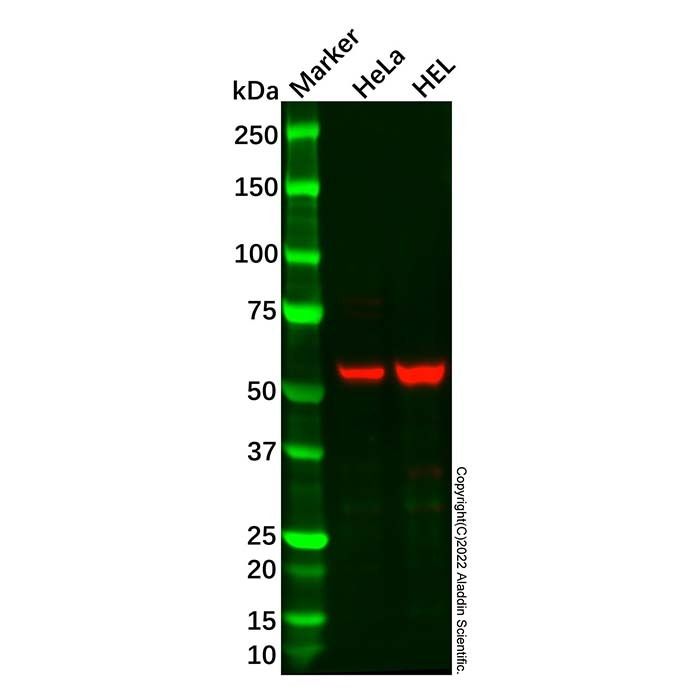
WB: HeLa and HEL cell lysates.
Conjugation
Unconjugated
Grade
ExactAb™, Recombinant, Validated
Isotype
Rabbit IgG
Light Chain Type
kappa
SDS-PAGE
150 kDa
Purification Method
Protein A purified
Concentration
0.25 mg/mL
Product Line
Biological Products
Storage and Shipping
Form
Liquid
Storage
Store at -20°C,Avoid repeated freezing and thawing
Shipped In
Ice chest + Ice pads
Stability And Storage
Store at 4°C short term (1-2 weeks). Store at -20°C long term (24 months). Upon receipt, it is recommended to aliquot. Avoid freeze/thaw cycle.
Images
Recombinant Pokemon/ZBTB7A Antibody (Ab135136) - Western Blot All lanes: Recombinant Pokemon/ZBTB7A Antibody (Ab135136) at 1/1000 dilution Samples: Lysates at 20 µg per lane Secondary: Goat Anti-Rabbit IgG H&L (HRP) (Ab170144) at 1/20000 dilution
Predicted band size: 70 kDa Observed band size: 72 kDa Exposure time: 20.7 s
Application
Application
Dilution info
WB
1/500-1/2000
Documentation
📋 Safety Data Sheet (SDS)
Comprehensive hazard, handling, storage, and regulatory compliance document.
Determine the necessary mass, volume, or concentration for preparing a solution.
Dilution Calculator
Determine the dilution needed to prepare a stock solution.
Reconstitution Calculator
Reviews
Customer Reviews
Application Protocols
Item-specific tested applications, recommended dilutions, and positive control suggestions: Not specified for this item; refer to CoA/Spec Sheet.
General starting points (to be optimized empirically and validated locally):
WB: Start at 1:1,000 in TBST with 5% BSA; incubate overnight at 4°C. Adjust according to signal and background.
IHC: Begin with 1:200 in blocking buffer after HIER (citrate pH 6 or Tris-EDTA pH 9); include no-primary and isotype controls.
IF: Trial 1:200–1:500 with appropriate permeabilization; include secondary-only control.
IP: 1–5 µg antibody per mg total protein lysate with Protein A/G beads depending on isotype (isotype for this item is not specified).
Controls and validation (general):
Genetic knockout/knockdown controls for PDCD4.
Peptide competition if immunogen is available (not specified for this item).
Parallel detection using orthogonal methods (e.g., mass spectrometry or a second, independent antibody).
Biological Roles
Target overview (literature/general):
PDCD4 (Programmed Cell Death 4) is an RNA-binding regulatory protein known to inhibit cap-dependent translation via interactions with eIF4A helicase through MA-3 domains. It participates in pathways controlling cell growth, differentiation, and stress responses.
Subcellular localization: Predominantly cytoplasmic with context-dependent nuclear presence, regulated by phosphorylation and degradation pathways (e.g., proteasome-mediated turnover following specific kinase signaling).
Functional implications: PDCD4 modulates translation of specific mRNAs and can influence AP-1–dependent transcription (literature). It is frequently used as a readout in studies of translational control and signal transduction.
Relevance for research use (general):
Model systems: Human cell lines, primary cells, and tissues for mechanistic studies of translational regulation and stress signaling.
Controls: Use genetic perturbations (CRISPR/Cas9 knockout or siRNA knockdown) and overexpression of PDCD4 to confirm antibody specificity and pathway assignments.
Note: This section summarizes general biology of PDCD4 to contextualize antibody use; it does not imply any clinical or diagnostic application.
Buffer Applications
Antibody performance depends strongly on buffer composition. While this item’s exact formulation is not specified, the following are general, widely used systems:
Immobilization/detection buffers (general):
PBS (10 mM phosphate, 137 mM NaCl, 2.7 mM KCl, pH 7.4) for storage, dilution, and washing.
TBS (25–50 mM Tris, 150 mM NaCl, pH 7.4–7.6) often preferred for alkaline phosphatase detection systems.
Additives: 0.05% Tween-20 for washing (reduces nonspecific binding), 1–5% BSA or 5% non-fat milk for blocking in WB/IHC.
Antigen retrieval (IHC, general):
Heat-induced epitope retrieval (HIER) using citrate buffer pH 6.0 or Tris-EDTA pH 9.0, optimized empirically for PDCD4 epitope accessibility.
Storage buffer guidance (general):
Neutral pH, isotonic salts; optional 50% glycerol or 0.02–0.05% sodium azide if compatible with downstream applications. For this item, only temperature and freeze–thaw guidance are specified; composition is not.
Item-specific buffer composition, pH, and stabilizers: Not specified for this item; refer to CoA/Spec Sheet.
Green Alternatives
Green chemistry concepts are less about solvent replacement here and more about sustainable antibody use and waste minimization.
Practical sustainability measures (general):
Optimize dilutions and titrations to minimize reagent consumption and repeats.
Use reusable, validated containers and low-adsorption plastics to reduce loss and plastic waste.
Prepare aliquots to avoid freeze–thaw-induced degradation and product wastage.
Choose phosphate-buffered or Tris-buffered aqueous systems over solvent-intensive workflows where compatible.
Dispose of buffers and gels via local regulations; avoid adding hazardous preservatives unless required by protocol.
Comparison of workflow choices (general):
Chemiluminescent WB vs. fluorescent WB: Fluorescence can reduce repeated exposures and reprobing, saving reagents and time; choose based on sensitivity and instrument availability.
Automated staining platforms can improve reproducibility and reduce trial-and-error, lowering total reagent and energy use.
No greener chemical substitute is applicable for the antibody itself; focus on greener protocols and efficient experimental design.
Pharmaceutical Uses
This product is for research use only and is not intended for human or veterinary use.
General notes on antibodies in manufacturing (context only):
Research-grade antibodies may be used in process development assays (e.g., analytics, in-process controls) but are not suitable as GMP materials.
Formulation excipients for stability (e.g., sugars, polyols, amino acids) are commonly used in therapeutic antibody development; these examples are not specific to this product.
No pharmacopeial status or excipient role is claimed or implied for this item.
Item-specific regulatory/compendial status and any formulation role: Not specified for this item; refer to CoA/Spec Sheet.
Physical Properties
Item-specific physico-chemical data: Not specified for this item; refer to CoA/Spec Sheet.
General/literature properties for IgG-type antibodies (for context only):
Molecular weight: ~150 kDa (varies with isotype and glycosylation).
Isoelectric point (pI): Typically pH 6–9 range, isotype- and sequence-dependent.
Solubility: Readily soluble in aqueous buffers (e.g., PBS, TBS) with stabilizers (e.g., 0.02–0.1% sodium azide, 1–5% trehalose, 0.1–1% BSA) as formulation-appropriate.
Stability: Enhanced by low temperature storage, neutral pH, and avoidance of repeated freeze-thaw cycles.
Optical properties: Protein A280 for concentration estimation using ε ~1.35–1.5 (mg/mL)−1 cm−1 for IgG (literature; actual ε is sequence/formulation-dependent).
Notes:
This product’s exact concentration, buffer composition, excipients, and formulation are not provided in the Product Data and should be verified on the product label and CoA.
Recombinant: Produced via recombinant expression for high lot-to-lot consistency versus hybridoma or polyclonal materials.
ExactAb™: Aladdin’s line emphasizing sequence-defined, reproducible antibodies and stringent QC.
Validated: This product has been validated by the manufacturer; specific tested applications and species are not listed here and should be confirmed on the CoA/Spec Sheet.
Practical implications:
Recombinant production minimizes batch drift and reduces background associated with undefined serum proteins.
Sequence-defined antibodies often show improved specificity and epitope fidelity; however, clone ID, isotype, and epitope mapping details are not specified for this item.
Validation typically includes specificity assessment (e.g., knockdown/knockout controls, peptide blocking, or orthogonal methods) and assay performance metrics; exact datasets are not provided here.
What is NOT specified for this item (consult CoA/Spec Sheet):
Use the CoA/Spec Sheet for method setup, while leveraging the benefits of recombinant, ExactAb™-grade reproducibility.
Reaction & Applications
As an antibody reagent, this product is intended for immunoanalytical and detection workflows rather than chemical synthesis.
Item-specific applications: Not specified for this item; refer to CoA/Spec Sheet.
General/literature applications for PDCD4 antibodies:
Western blotting (WB): Detection of PDCD4 in cell/tissue lysates; include positive controls expressing PDCD4 and negative controls (e.g., PDCD4 knockout/knockdown where available).
Immunohistochemistry (IHC) and Immunofluorescence (IF): Assessment of PDCD4 protein localization (cytoplasmic/nuclear) after appropriate antigen retrieval and fixation optimization.
Immunoprecipitation (IP)/Co-IP: Pull-down of PDCD4 to evaluate interacting partners in translation initiation complexes.
ELISA/Quantification: Sandwich or indirect ELISA formats for relative PDCD4 level measurement with matched pairs.
Practical tips (general):
Validate working dilution via small titration series under your assay conditions.
Maintain cold chain and avoid freeze–thaw (explicitly advised for this item) to preserve binding activity.
Reaction Conditions
Classical chemical reaction conditions do not apply. For immunoassays, consider the following general operational conditions instead:
Western blotting (general guidance):
Sample: Denatured lysates prepared in SDS sample buffer; reducing vs. non-reducing conditions may affect PDCD4 detection depending on epitope.
Transfer: PVDF or nitrocellulose membranes; block in 5% milk or BSA.
Incubation: Primary antibody typically 4°C overnight or 1–2 h at room temperature; optimize dilution empirically.
IHC/IF (general guidance):
Fixation: Paraformaldehyde or formalin fixation; permeabilization with 0.1–0.5% Triton X-100 if intracellular epitopes are targeted.
Antigen retrieval: Heat-induced in citrate pH 6.0 or Tris-EDTA pH 9.0 as needed.
IP (general guidance):
Lysis: Non-denaturing buffers (e.g., 20–50 mM Tris, 150 mM NaCl, 0.5–1% NP-40/Triton X-100) with protease/phosphatase inhibitors.
Beads: Protein A/G selection based on antibody isotype (isotype for this item is not specified).
Item-specific conditions, recommended dilutions, and expected performance: Not specified for this item; refer to CoA/Spec Sheet.
Safety & Handling
Item-specific GHS/SDS data: Not specified for this item; refer to SDS.
General lab safety guidance for recombinant antibodies:
PPE: Wear lab coat, nitrile gloves, and safety glasses. Avoid inhalation of aerosols and contact with skin/eyes.
Handling: Work on ice or at 2–8°C during bench use to preserve activity. Avoid repeated freeze–thaw cycles (explicitly noted for this item) by preparing aliquots.
Incompatibilities: Strong oxidizers and proteases can degrade proteins; avoid microbial contamination. Follow biocontainment practices appropriate for non-hazardous recombinant proteins.
First aid (general): Rinse skin/eyes with water for at least 15 minutes if contacted. If ingested/inhaled and adverse symptoms occur, seek medical advice. Provide SDS to responders.
Waste: Dispose according to institutional policies for non-hazardous biological reagents; decontaminate surfaces with suitable disinfectants.
Shipping/storage risks: This item ships cold (ice chest + ice pads) and should be promptly refrigerated or frozen per storage guidance upon receipt.
Always defer to the SDS and institutional EHS guidance for authoritative safety information.
Solvent Selection
This product is an aqueous protein reagent (antibody), not a small-molecule solute. Traditional solvent selection parameters (polarity, dielectric, miscibility) are not typically applicable.
Practical guidance (general):
Preferred media: Physiological aqueous buffers (e.g., PBS, TBS) at neutral pH, optionally with carrier protein (e.g., BSA) and cryoprotectant (e.g., glycerol or trehalose) depending on the formulation and application.
Organic solvents: Avoid significant proportions of organic solvents that denature proteins (e.g., high % acetonitrile, methanol). Small amounts may be tolerated in certain protocols (e.g., antigen retrieval, IHC), but compatibility must be empirically confirmed.
Detergents/surfactants: Low levels of nonionic detergents (e.g., 0.01% Tween-20) can reduce nonspecific binding in immunoassays; ensure compatibility with your detection system.
Refer to the product’s formulation on the CoA/Spec Sheet before adjusting buffer composition.
Storage & Reconstitution
Item-specific storage (from Product Data):
Store at -20°C.
Avoid repeated freezing and thawing.
Shipped in ice chest with ice pads; promptly transfer to recommended storage upon receipt.
Aliquoting recommendations (general best practice):
Upon first thaw, dispense into single-use aliquots sized for one experiment to preserve activity and avoid freeze–thaw damage.
For frequent use, consider storage at -20°C in 50% glycerol (if compatible with formulation and downstream assays) to permit subzero liquid handling.
Reconstitution guidance:
Physical state and buffer composition for this item are not specified; refer to the label/CoA. If supplied lyophilized, reconstitute with sterile, neutral pH buffer (e.g., PBS) to the desired concentration, gently invert (avoid vigorous vortexing), and allow complete dissolution on ice.
Short-term handling (general):
Keep on ice during use; minimize time at room temperature.
Protect from microbial contamination; use sterile technique when opening and aliquoting.
Documentation: Record lot number, aliquot map, and first-thaw date for traceability.
Any additional stabilizers/preservatives and exact concentration: Not specified for this item; refer to CoA/Spec Sheet.
Structure & Identity
A recombinant monoclonal antibody directed against human PDCD4 (Programmed Cell Death 4), supplied under Aladdin ExactAb™ line.
Molecular formula/InChIKey/SMILES/CAS/CID: Not specified for this item; refer to CoA/Spec Sheet. (Antibodies are biologics and typically lack small-molecule identifiers.)
General structural features (literature/general):
Typical antibody architecture: IgG-class immunoglobulin with two heavy and two light chains stabilized by disulfide bonds; Fc and Fab regions enable effector function and antigen binding, respectively.
Approximate molecular weight: ~150 kDa for a full-length IgG (literature, varies by isotype and glycosylation).
Antigen: PDCD4, a cytoplasmic and nuclear protein with MA-3 domains that bind and inhibit eIF4A (literature). The antibody’s epitope/clone/isotype are not specified for this item.
2D/sequence description (general):
Antibody primary structure comprises variable regions (VH/VL) conferring specificity to PDCD4 epitopes and constant regions (CH/CL) that determine isotype and Fc interactions. Exact sequence is not provided for this product.
Synthetic Utility
Not typically applicable. This product is a recombinant antibody intended for biomolecular detection and enrichment, not a chemical building block.
Relevant laboratory utility (general):
Target capture: Immunoprecipitation/Co-IP of PDCD4 from lysates to study associated translation complexes.
Detection: WB, IF, IHC to visualize or quantify PDCD4 expression and localization.
Orthogonal validation: Use in tandem with mass spectrometry or genetic controls to corroborate target identity.
For chemical synthesis applications, refer to small-molecule reagents rather than antibodies.
Target Specificity
Antigen: PDCD4 (Programmed Cell Death 4)
Clone, isotype, host species, and epitope: Not specified for this item; refer to CoA/Spec Sheet.
Species reactivity and cross-reactivity: Not specified for this item; refer to CoA/Spec Sheet.
Validation status: Listed as “Validated” in Product Data; detailed evidence and datasets are not provided here.
General notes (for context only):
PDCD4 is conserved across mammals; however, epitope accessibility and homology-driven cross-reactivity must be empirically verified for each species and assay.
Frequently Asked Questions
What does ExactAb? mean?
ExactAb? indicates the product has been validated for use in rigorous antibody validation workflows. Validation may include positive/negative control samples, signal-to-noise testing, and protocol-specific QC. Lot-specific test data is published on the Certificate of Analysis where available.
What does Recombinant mean?
Recombinant is a defined analytical purity tier suitable for workflows requiring a specific validated property. It specifies a minimum assay percentage, controlled limits on common impurities (water, heavy metals, residue on ignition), and lot-to-lot consistency. Recombinant is one of several purity tiers — choose based on the sensitivity and regulatory requirements of your method.
How should this product be stored?
Store at ?20 °C. Avoid repeated freeze–thaw cycles. Aliquot into single-use volumes before freezing.
How is this product shipped?
This product ships in an insulated container with ice pads. Unpack on arrival and transfer it to the storage condition stated above.
What documentation is provided?
Available product documentation, including Certificates of Analysis (COA), Safety Data Sheets (SDS), and specification sheets, is shown in the product document area. Document availability and access follow the current site policy.
Which species reactivity has this antibody been validated against?
Validated reactivity is listed on the PDP and on each lot's datasheet. We validate against the most commonly tested species for the target (Recombinant PDCD4 Antibody); cross-reactivity in untested species may exist but is not guaranteed. Contact technical support for specific species inquiries.
Need help choosing the grade?
Our grade selection guide covers purity, stabilizer status, and application suitability for all variants in our catalog.
We use cookies to ensure the website functions properly and, where permitted, to improve your experience. You can manage your preferences at any time in Settings. Learn more in our Cookie Policy.
Shall we send you a message when we have discounts available?
Remind me later
Thank you! Please check your email inbox to confirm.
Products are supplied to verified businesses, institutions, and qualified professionals for research and development use only. Not for use in humans, animals, diagnosis, or therapy.

 ZJ24F0708784