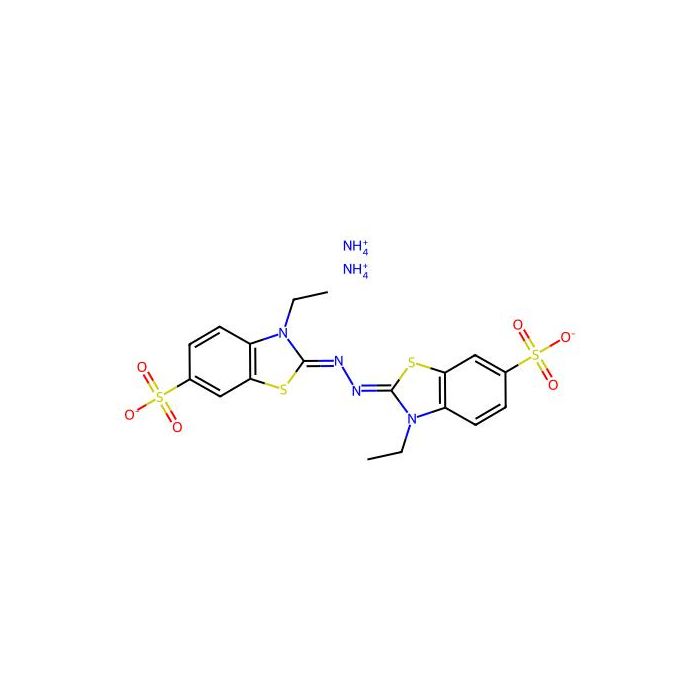
ABTS diammonium salt - Moligand™, 10 mM in DMSO , CAS No.30931-67-0

CAS: 30931-67-0 Cat. No.: A1498336 Fórmula: C18H24N6O6S4 Peso molecular: 548.68 Beilstein Registry Number: 7329461 Número EC: 250-396-6
Disponible para pedir
GRADE & PURITY Moligand™ ? Moligand™ — Aladdin's line of ligands and bioactive small molecules. Use for receptor, pathway, and binding studies needing defined small-molecule tools. 10 mM in DMSO
Storage
Protected from light,Desiccated,Store at -80°C
Shipped In
Dry ice packs + Cold packs
★
Size
Alemania (EU)
USA*
Price
Qty
1ml
A1498336-1ml
Fabricado bajo pedido · 8–12 semanas
37,23€
Enter a quantity for the sizes you want to add.
🧪
Why this grade

Moligand™, 10 mM in DMSO Moligand™ for sensitive chromatographic and analytical workflows requiring minimal baseline interference.

🌡

Storage & shipping

Protected from light,Desiccated,Store at -80°C Ships Dry ice packs + Cold packs Check lot-specific COA for exact specifications.

📋

Quality documents

SDS, COA, datasheet, and spec sheet available for download. Lot-specific COA accessible via lot number lookup.

📚

Literature proof

Cited in 245 peer-reviewed publications across chromatography, organic synthesis, and cross-coupling reactions.

Descripción general

ABTS diammonium salt is a substrate for horseradish peroxidase (HRP) conjugate.

Specifications

Especificaciones y pureza
Moligand™, 10 mM in DMSO
Condiciones de almacenamiento de almacenamiento
Protected from light,Desiccated,Store at -80°C
Enviado en
Dry ice packs + Cold packs
Este producto requiere envío en cadena de frío. Los servicios terrestres y otros servicios económicos no están disponibles.
Grado
Moligand™
Nombres e identificadores
Isómeros SMILES
CCN1/C(=N/N=C/2\SC3=C(N2CC)C=CC(=C3)S(=O)(=O)O)/SC4=C1C=CC(=C4)S(=O)(=O)O.N.N
WGK Alemania
3
RTECS
DL7002000
CAS alternativo
28752-68-3
Peso molecular
548.68
Beilstein
7329461
Reaxy-Rn
4779196

Documentation

📋 Safety Data Sheet (SDS)

Comprehensive hazard, handling, storage, and regulatory compliance document.

Download SDS →

✅ Certificate of Analysis (COA)

Lot-specific quality data. Enter your lot number to retrieve the exact COA.

Look up COA →

📊 Datasheet

Quick-reference summary of product specifications and applications.

View datasheet →

🔬 Specification Sheet

Full quality attributes and acceptance criteria for this grade.

View spec sheet →

Advanced Data

Certificados (CoA, COO, BSE/TSE y tabla de análisis)
C of A & Other Certificates(BSE/TSE, COO):
Analytical Chart:

Find and download the COA for your product by matching the lot number on the packaging.

1 results found

Lot NumberCertificate TypeFechaArticulo
G2621451Certificate of AnalysisJul 23, 2026 A1498336
Preguntas frecuentes y artículos
Alkaline Phosphatase (AP) and Horseradish Peroxidase (HRP) Colorimetric Detection Systems—A Complete Guide: Mechanisms of Soluble Colorimetric vs. Precipitating Substrates, Selection, and Troubleshooting (with Product Navigator Tables 1–3)
Laccase: Technical Characteristics, Optimization Strategies, and Industrial Application Progress
Functions and Significance of Common Physiological and Biochemical Indices in Animals and Plants
Phycocyanin: A Review of Sources, Structural Features, Production Processes, Applications, and Claimed Benefits
Amino Acid Oxidases: Oxygen-Dependent Oxidative Deamination Systems and Their Analytical and Applied Uses
Cholesterol Esterase: Mechanistic Insights and Application Frameworks Driven by Interfacial Hydrolysis
Procyanidins: Structural Features and Key Points for Research and Application
Paeonol: Physicochemical Features, Uses, and Key Points for Research Applications
Flavones: Structural Features, Physicochemical Properties, and Key Points for Research and Applications
Review of Glucose-6-phosphate Dehydrogenase (G6PD): Structural Features, Metabolic Functions, and Research Applications
Glycoprotein Hormone Family: Molecular Features, Signaling Bias, and In Vivo Pharmacokinetics
Review of the Structural Characteristics, Biological Functions, and Application Advances of Lycopene
Antioxidant Enzyme Networks in Skin Cells and Their Applications in Skincare and Cosmetics
The Role of Tannins in Astringency, Precipitation, and Antioxidant Activity of Plant Extracts
Common Methods and Experimental Design for Evaluating Antioxidant Activity of Plant Extracts
The Chemical Basis of Natural Lacquer Durability: Urushiol Structure, Oxidative Polymerization Film Formation, and Coating Film Properties
Mechanisms and Applications of Feruloyl Esterase in Feed and Food Fermentation
Functional Roles of Auxiliary Enzymes in Enzyme-Coupled Colorimetric Reactions: Mutarotase, Oxidases, Peroxidases, and Dehydrogenases
Antioxidant Mechanisms, Stability, and Delivery Strategies of Resveratrol in Skincare Research
Antioxidant Mechanisms of Ferulic Acid in Skincare, Vitamin C/E Synergy, and Stable Delivery Applications
Skin Anti-Aging Mechanisms of Carnosine and Decarboxy Carnosine: Active Carbonyl Scavenging, Oxidative-Stress Buffering, and Inhibition of Collagen Glycation Cross-Linking
Scientific Rationale and Application Assessment of Olive Leaf Extract in Skin Redness Care
Anti-Photoaging Potential of Artemia Extract: UV-Induced Damage Cascades, HSP70-Related Stress Protection, and GP4G Metabolic Insights
Structural Characteristics of Ergothioneine, OCTN1-Mediated Uptake by Skin Cells, and Antioxidant Mechanisms
Citations of This Product
Calculadoras de soluciones
Reseñas

Reseñas de cliente

Shall we send you a message when we have discounts available?

Remind me later

Thank you! Please check your email inbox to confirm.

Oops! Notifications are disabled.