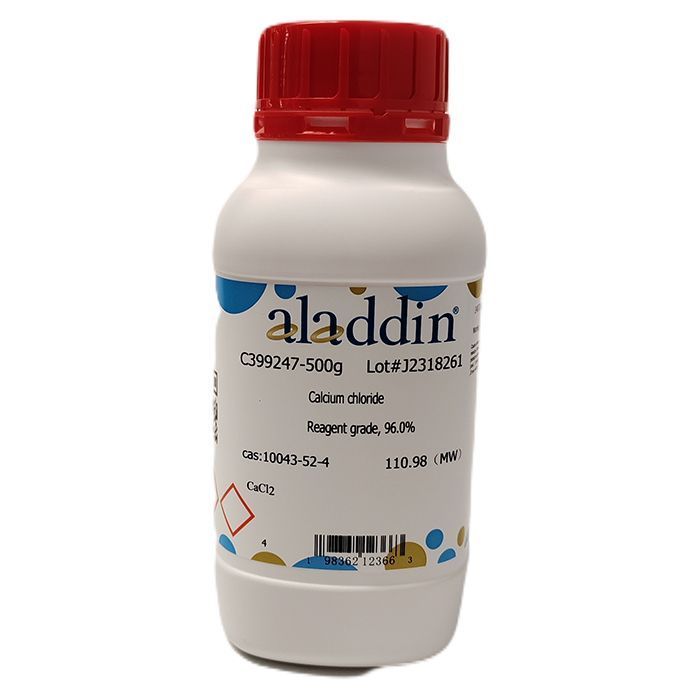
Calcium chloride - Reagent grade, ≥96% , CAS No.10043-52-4

CAS: 10043-52-4 Cat. No.: C399247 Fórmula: CaCl2 Peso molecular: 110.98 Número EC: 233-140-8 PubChem CID: 5284359
Disponible para pedir
GRADE & PURITY Reagent Grade ? General reagent-grade purity suitable for most laboratory work. Use as a dependable default when no specific higher grade is required. ≥96%
Synonyms
INS NO.509 | Calcium(2+) chloride | DTXCID30235 | DTXSID5020235 | Calcium chloride, Prilled | Calcium dichloride | Bovikalc | Cacl2 (anhydrous) | DB01164 | Q208451 | [CaCl2] | Dowflake | CALCIUM CHLORIDE ANHYDROUS [HSDB] | 856 - Pickles | NCGC00260134-01
Storage
Room temperature,Argon charged
Shipped In
Normal
★
Size
Alemania (EU)
USA*
Price
Qty
500g
C399247-500g
3 Disponible
—
10,33€
12×500g
C399247-12×500g
Fabricado bajo pedido · 8–12 semanas
86,69€
20×500g
C399247-20×500g
Fabricado bajo pedido · 8–12 semanas
138,75€
Enter a quantity for the sizes you want to add.
🧪
Why this grade

Reagent grade, ≥96% Reagent Grade for sensitive chromatographic and analytical workflows requiring minimal baseline interference.

🌡

Storage & shipping

Room temperature,Argon charged Ships Normal Check lot-specific COA for exact specifications.

📋

Quality documents

SDS, COA, datasheet, and spec sheet available for download. Lot-specific COA accessible via lot number lookup.

📚

Literature proof

Cited in 2916 peer-reviewed publications across chromatography, organic synthesis, and cross-coupling reactions.

Descripción general

Calcium chloride was used during the assay of transglutaminase (TG) activity.It was also used for of modification of calcium alginate hydrogels.
It may be used in the following processes:
Modification of natural zeolite to increase its ability of fluoride removal.
Synthesis of calcium sulfate whiskers utilized in making polymer reinforcing composite materials.
Synthesis of calcium chloride-anodized aluminum composites, a solid sorbent.
As an extractant in the soil analysis process.
As a catalyst in the synthesis of aldols by reacting dimethylsilyl (DMS) enolates with aldehydes

Specifications

Sinónimos
INS NO.509 | Calcium(2+) chloride | DTXCID30235 | DTXSID5020235 | Calcium chloride, Prilled | Calcium dichloride | Bovikalc | Cacl2 (anhydrous) | DB01164 | Q208451 | [CaCl2] | Dowflake | CALCIUM CHLORIDE ANHYDROUS [HSDB] | 856 - Pickles | NCGC00260134-01
Especificaciones y pureza
Reagent grade, ≥96%
Condiciones de almacenamiento de almacenamiento
Room temperature,Argon charged
Enviado en
Normal
Grado
Reagent Grade
Pureza
≥96%
Nombres e identificadores
Pubchem Sid
Pubchem Sid Url
https://pubchem.ncbi.nlm.nih.gov/substance/504763484
Sonrisas canónicas
[Cl-].[Cl-].[Ca+2]
IUPAC Name
calcium;dichloride
InChIKey
UXVMQQNJUSDDNG-UHFFFAOYSA-L
INCHI
1S/Ca.2ClH/h;2*1H/q+2;;/p-2
Isómeros SMILES
[Cl-].[Cl-].[Ca+2]
WGK Alemania
1
PubChem CID
5284359
Peso molecular
110.98

Documentation

📋 Safety Data Sheet (SDS)

Comprehensive hazard, handling, storage, and regulatory compliance document.

Download SDS →

✅ Certificate of Analysis (COA)

Lot-specific quality data. Enter your lot number to retrieve the exact COA.

Look up COA →

📊 Datasheet

Quick-reference summary of product specifications and applications.

View datasheet →

🔬 Specification Sheet

Full quality attributes and acceptance criteria for this grade.

View spec sheet →

Advanced Data

Taxonomic Classification

Taxonomy Tree

KingdomInorganic compounds
SuperclassMixed metal/non-metal compounds
ClaseAlkaline earth metal salts
SubclassAlkaline earth metal chlorides
Intermediate Tree Nodes Not available
Direct ParentAlkaline earth metal chlorides
Alternative Parents Inorganic chloride salts  Inorganic calcium salts  
Molecular FrameworkNot available
Substituents Alkaline earth metal chloride - Inorganic calcium salt - Inorganic chloride salt - Inorganic salt
DescripciónThis compound belongs to the class of inorganic compounds known as alkaline earth metal chlorides. These are inorganic compounds in which the largest halogen atom is Chlorine, and the heaviest metal atom is a lanthanide.
External Descriptors inorganic chloride - calcium salt
Estructura 3D
Modelo de Estructura Química Interactiva


Objetivos asociados (no humanos)
Colletotrichum musae (107 Activities)
Activity TypeRelationActivity valueUnitsAction TypeJournalPubMed IddoiAssay Aladdin ID
Fusarium verticillioides (912 Activities)
Activity TypeRelationActivity valueUnitsAction TypeJournalPubMed IddoiAssay Aladdin ID
Lasiodiplodia theobromae (193 Activities)
Activity TypeRelationActivity valueUnitsAction TypeJournalPubMed IddoiAssay Aladdin ID
Mecanismos de acción
Certificados (CoA, COO, BSE/TSE y tabla de análisis)
C of A & Other Certificates(BSE/TSE, COO):
Analytical Chart:

Find and download the COA for your product by matching the lot number on the packaging.

29 results found

Lot NumberCertificate TypeFechaArticulo
G2610360Certificate of AnalysisMay 28, 2026 C399247
G2610289Certificate of AnalysisMay 28, 2026 C399247
B2606095Certificate of AnalysisJan 27, 2026 C399247
B2606102Certificate of AnalysisJan 27, 2026 C399247
H2508299Certificate of AnalysisJun 25, 2025 C399247
H2508298Certificate of AnalysisJun 25, 2025 C399247
D2511456Certificate of AnalysisMar 04, 2025 C399247
D2511513Certificate of AnalysisMar 04, 2025 C399247
H2401367Certificate of AnalysisJun 29, 2024 C399247
H2401366Certificate of AnalysisJun 29, 2024 C399247
I2306321Certificate of AnalysisSep 08, 2023 C399247
I2306322Certificate of AnalysisSep 08, 2023 C399247
F2302672Certificate of AnalysisMay 19, 2023 C399247
G2326434Certificate of AnalysisMay 19, 2023 C399247
G2326159Certificate of AnalysisMay 19, 2023 C399247
F2316535Certificate of AnalysisMay 19, 2023 C399247
F2316533Certificate of AnalysisMay 19, 2023 C399247
F2302665Certificate of AnalysisMay 19, 2023 C399247
E2420070Certificate of AnalysisMay 19, 2023 C399247
J2318261Certificate of AnalysisMay 19, 2023 C399247
J2318262Certificate of AnalysisMay 19, 2023 C399247
C2307710Certificate of AnalysisFeb 07, 2023 C399247
L2214016Certificate of AnalysisDec 21, 2022 C399247
J2213352Certificate of AnalysisSep 01, 2022 C399247
J2213356Certificate of AnalysisSep 01, 2022 C399247
A2330474Certificate of AnalysisSep 01, 2022 C399247
A2309502Certificate of AnalysisSep 01, 2022 C399247
B2223652Certificate of AnalysisJan 24, 2022 C399247
B2223650Certificate of AnalysisJan 24, 2022 C399247
Propiedades químicas y físicas
SolubilidadSoluble in water, alcohol, ,acetic acid, and acetone.
SensibilidadSensitive to humidity
Punto de ebullición (°C)1600°C
Punto de fusión (°C)782°C
Peso molecular110.980 g/mol
XLogP3
Hydrogen Bond Donor Count0
Hydrogen Bond Acceptor Count2
Rotatable Bond Count0
Exact Mass109.9 Da
Monoisotopic Mass109.9 Da
Topological Polar Surface Area0.000 Ų
Heavy Atom Count3
Formal Charge0
Complexity0.000
Isotope Atom Count0
Defined Atom Stereocenter Count0
Undefined Atom Stereocenter Count0
Defined Bond Stereocenter Count0
Undefined Bond Stereocenter Count0
The total count of all stereochemical bonds0
Covalently-Bonded Unit Count3
Preguntas frecuentes y artículos
The Key to Gene Delivery to Cells —In Vitro Cell Transfection Techniques
Competent E. coli Cell Preparation Using the Calcium Chloride Method
E. coli Competence Protocol for Plasmid Transformation
Common Protein Gel Staining Methods
Differences Between Transformation and Transfection
Five Key Structural Features of Plasmids
Mag-Fluo-4 AM Magnesium/Calcium Ion Fluorescent Probe: Properties, Experimental Use, and Aladdin Metal Ion Fluorescent Probe Selection Guide
How to Choose Reagent Grades in Scientific Research? A Practical Guide to Reagent Grade
A Practical Guide to Fragrance Compositions: Turning a Black-Box Formula into an Engineerable System—Compatibility, Stability, Controlled Release, Traceability, and Selection
Practical Guide to Sodium Carboxymethyl Cellulose (CMC-Na): Thickening/Stabilizing Mechanisms, Key Controls for Solution Preparation, and Selection Navigation (including Table 1 and Tables A–C)
Selection of Common Research Salts: A Task Map for Alkali Metal Salts & Alkaline Earth Metal Salts (with Product Tables 1–6)
Proteinase K: Frequently Asked Questions
Deoxyribonuclease (DNase): DNA Hydrolytic Cleavage Properties, Methodological Value, and Multi-Context Applications
Chymosin: A Review of Molecular Features, Coagulation Kinetics, and Activity Evaluation
Micrococcal Nuclease (MNase): A Technical Review of Enzymatic Properties, Reaction Control, and Research and Biomanufacturing Applications
Hemicellulases: A Review of Substrate Specificity, Catalytic Systems, and Research and Industrial Applications
Phytase: Enzymological Properties, Mechanism of Action, and Applications in Feed and Food
Chitinases: Substrate-Specific Degradation Mechanisms, Enzymatic Properties, and Application Directions
Whey Protein: Composition Profile, Manufacturing Routes, and Key Product-Type Essentials
Coelenterazine (CTZ) Differences and an Application Overview
Alginate : An Overview of Extraction and Purification Processes, Quality Identification, and Multidomain Applications
Clostridial Proteases: Classification, Molecular Mechanisms, and Research Applications
Furin: A Review of Its Structural Features, Substrate Recognition, and Research Applications
The Key Starting Point for Phosphatidylserine Research: Changes in Membrane Localization, Functional Shifts, and Interpretation of Findings
Functional Framework of Starch Metabolism-Related Enzymes in Food Science Research and Mechanistic Analysis of Quality Regulation
Research Framework for Multi-Enzyme Digestion Strategies and Optimization of Proteomic Coverage
Selection Logic, Operating Parameters, and Application Boundaries of Common Cell Culture Coating Solutions
Key Judgments in Medical Hydrogel R&D: From Polymer Source and Crosslinking Strategy to Sterilization Planning, Scale-Up Feasibility, and Quality Control
From Natural Cellulose to Nanocrystals: Structural Characteristics, Application Directions, and Industrialization Challenges of CNC
Capable of Swelling, Adsorption, and Cation Exchange: What Makes Montmorillonite Clay Different?
Oxalate Metabolism and Degradation Detection Methods: Enzymatic Assays, Chromatography, and Enzymatic Degradation System Analysis
From Structure to Rheology: How Carbomer Forms Gel Structures and Enables Thickening, Suspension, and Auxiliary Emulsion Stabilization
Structure, Properties, and Mechanisms of Powdered Fragrances and Fragrance Delivery Materials: Stability, Release Mechanisms, and Selection Logic
Mechanisms and Troubleshooting of Foam Reduction in Personal and Household Care Formulations: Film Rupture, Weak Interfacial Films, Insufficient Surfactant Supply, and Phase-State Disturbance
Experimental Applications of Carboxymethyl Cellulose (CMC) Solution in Enzyme Assays, Suspension Systems, and Functional Materials
Moisturizing Mechanisms of Tremella fuciformis Polysaccharides: From Polysaccharide Structure and Hydration Rheology to Dynamic Film Formation on the Skin Surface
Mechanistic Basis of Acetyl Hexapeptide-8 in the Management of Expression Lines: SNARE Complex Interference, Constraints on Percutaneous Delivery, and Combination Strategies
Citations of This Product
Calculadoras de soluciones
Reseñas

Reseñas de cliente

Preguntas frecuentes

What is the purity of this product?
This product is supplied at ≥96% purity (chemical assay). Lot-specific values are stated on the Certificate of Analysis.
What does Reagent Grade mean?
Reagent Grade is a defined analytical purity tier suitable for general analytical and reagent applications. It specifies a minimum assay percentage, controlled limits on common impurities (water, heavy metals, residue on ignition), and lot-to-lot consistency. Reagent Grade is one of several purity tiers — choose based on the sensitivity and regulatory requirements of your method.
How should this product be stored?
Store at room temperature under argon. It is supplied under an argon blanket; reseal under inert gas after each use.
How is this product shipped?
This product ships under standard ambient conditions. No temperature-controlled packaging is required.
What are the CAS number, molecular formula and molecular weight?
The CAS Number is 10043-52-4, the molecular formula is CaCl2, and the molecular weight is 110.98 g/mol. InChIKey UXVMQQNJUSDDNG-UHFFFAOYSA-L.
What documentation is provided?
Available product documentation, including Certificates of Analysis (COA), Safety Data Sheets (SDS), and specification sheets, is shown in the product document area. Document availability and access follow the current site policy.

Need help choosing the grade?

Our grade selection guide covers purity, stabilizer status, and application suitability for all variants in our catalog.

View Reagent Grade grade guide →

¿Quieres que te enviemos un mensaje cuando tengamos descuentos disponibles?

Recordármelo más tarde

¡Gracias! Por favor, revisa tu bandeja de entrada de correo electrónico para confirmar.

¡Vaya! Las notificaciones están desactivadas.