Determine the necessary mass, volume, or concentration for preparing a solution.
| Activity Type | Relation | Activity value | Units | Action Type | Journal | PubMed Id | doi | Assay Aladdin ID |
|---|

Taxonomy Tree
| Kingdom | Organic compounds |
|---|---|
| Superclass | Organic oxygen compounds |
| Clase | Organic hydroperoxides |
| Subclass | Not available |
| Intermediate Tree Nodes | Not available |
| Direct Parent | Organic hydroperoxides |
| Alternative Parents | Peroxols Alkyl hydroperoxides Hydrocarbon derivatives |
| Molecular Framework | Aliphatic acyclic compounds |
| Substituents | Hydroperoxide - Alkyl hydroperoxide - Peroxol - Hydrocarbon derivative - Organooxygen compound - Aliphatic acyclic compound |
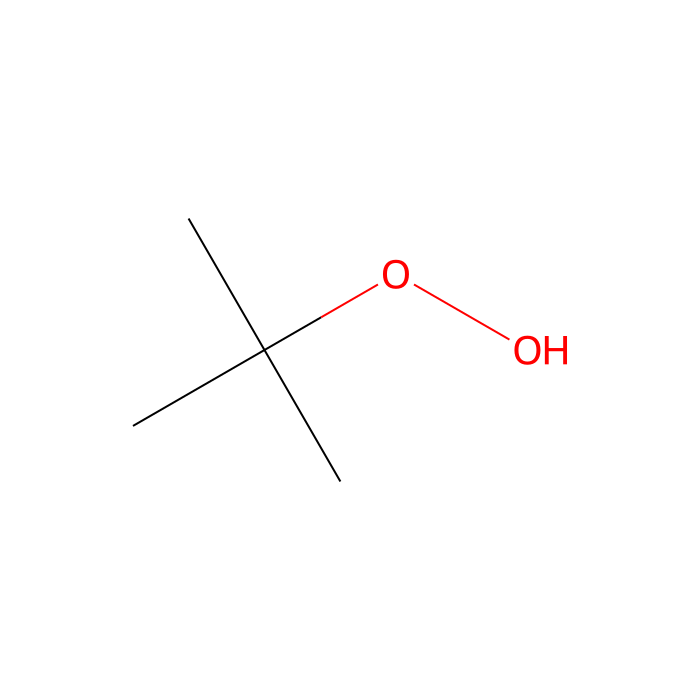
| Descripción | This compound belongs to the class of organic compounds known as organic hydroperoxides. These are organic compounds comprising the hydroperoxide functional group, with the general formula [O-O]2-. |
| External Descriptors | an organic hydroperoxide |
| Activity Type | Relation | Activity value | Units | Action Type | Journal | PubMed Id | doi | Assay Aladdin ID |
|---|
| Activity Type | Relation | Activity value | Units | Action Type | Journal | PubMed Id | doi | Assay Aladdin ID |
|---|
| Activity Type | Relation | Activity value | Units | Action Type | Journal | PubMed Id | doi | Assay Aladdin ID |
|---|
| Activity Type | Relation | Activity value | Units | Action Type | Journal | PubMed Id | doi | Assay Aladdin ID |
|---|
| Activity Type | Relation | Activity value | Units | Action Type | Journal | PubMed Id | doi | Assay Aladdin ID |
|---|
| Activity Type | Relation | Activity value | Units | Action Type | Journal | PubMed Id | doi | Assay Aladdin ID |
|---|
| Activity Type | Relation | Activity value | Units | Action Type | Journal | PubMed Id | doi | Assay Aladdin ID |
|---|
| Activity Type | Relation | Activity value | Units | Action Type | Journal | PubMed Id | doi | Assay Aladdin ID |
|---|
| Activity Type | Relation | Activity value | Units | Action Type | Journal | PubMed Id | doi | Assay Aladdin ID |
|---|
| Activity Type | Relation | Activity value | Units | Action Type | Journal | PubMed Id | doi | Assay Aladdin ID |
|---|
| Activity Type | Relation | Activity value | Units | Action Type | Journal | PubMed Id | doi | Assay Aladdin ID |
|---|
| Activity Type | Relation | Activity value | Units | Action Type | Journal | PubMed Id | doi | Assay Aladdin ID |
|---|
Find and download the COA for your product by matching the lot number on the packaging.
| Lot Number | Certificate Type | Fecha | Articulo |
|---|---|---|---|
 G2621360 | Certificate of Analysis | Jul 14, 2026 | T466691 |
| G2621361 | Certificate of Analysis | Jul 14, 2026 | T466691 |
| E2615260 | Certificate of Analysis | May 09, 2026 | T466691 |
| E2615261 | Certificate of Analysis | May 09, 2026 | T466691 |
| A2627103 | Certificate of Analysis | Sep 05, 2025 | T466691 |
| I2510586 | Certificate of Analysis | Sep 05, 2025 | T466691 |
| I2510588 | Certificate of Analysis | Sep 05, 2025 | T466691 |
| Sensibilidad | Light and heat sensitive |
|---|---|
| Índice de refracción | 1.4007 |
| Punto de inflamación (°F) | 107.6 °F |
| Punto de inflamación (°C) | 43 °C |
| Punto de ebullición (°C) | 89°C |
| Punto de fusión (°C) | -3°C |
| Peso molecular | 90.12 |
| XLogP3 | 0.600 |
| Hydrogen Bond Donor Count | 1 |
| Hydrogen Bond Acceptor Count | 2 |
| Rotatable Bond Count | 1 |
| Exact Mass | 90.0681 Da |
| Monoisotopic Mass | 90.0681 Da |
| Topological Polar Surface Area | 29.500 Ų |
| Heavy Atom Count | 6 |
| Formal Charge | 0 |
| Complexity | 35.300 |
| Isotope Atom Count | 0 |
| Defined Atom Stereocenter Count | 0 |
| Undefined Atom Stereocenter Count | 0 |
| Defined Bond Stereocenter Count | 0 |
| Undefined Bond Stereocenter Count | 0 |
| The total count of all stereochemical bonds | 0 |
| Covalently-Bonded Unit Count | 1 |
H226:Flammable liquid and vapor
H242:Heating may cause a fire
H302:Harmful if swallowed
H304:May be fatal if swallowed and enters airways
H314:Causes severe skin burns and eye damage
H317:May cause an allergic skin reaction
H335:May cause respiratory irritation
H336:May cause drowsiness or dizziness
H341:Suspected of causing genetic defects
H371:May cause damage to organs
H372:Causes damage to organs through prolonged or repeated exposure
H410:Very toxic to aquatic life with long lasting effects
H311+H331:Toxic in contact with skin or if inhaled.
P201:Obtain special instructions before use.
P210:Keep away from heat, hot surface, sparks, open flames and other ignition sources. - No smoking.
P202:Do not handle until all safety precautions have been read and understood.
P220:Keep away from clothing and other combustible materials.
P233:Keep container tightly closed.
P234:Keep only in original container.
P240:Ground/bond container and receiving equipment.
P241:Use explosion-proof [electrical/ventilating/lighting/.../] equipment.
P242:Use only non-sparking tools.
P243:Take precautionary measures against static discharge.
P260:Do not breathe dust/fume/gas/mist/vapors/spray.
P264:Wash hands [and …] thoroughly after handling.
P270:Do not eat, drink or smoke when using this product.
P271:Use only outdoors or in a well-ventilated area.
P272:Contaminated work clothing should not be allowed out of the workplace.
P273:Avoid release to the environment.
P280:Wear protective gloves/protective clothing/eye protection/face protection.
P391:Collect spillage.
P301+P310:IF SWALLOWED: Immediately call a POISON CENTER/doctor/...
P301+P330+P331:IF SWALLOWED: Rinse mouth. Do NOT induce vomiting.
P303+P361+P353:IF ON SKIN (or hair): Take off Immediately all contaminated clothing. Rinse SKIN with water [or shower].
P308+P311:IF exposed or concerned: Call a POISON CENTER/doctor/...
P333+P313:IF SKIN irritation or rash occurs: Get medical advice/attention.
P361+P364:Take off immediately all contaminated clothing and wash it before reuse.
P370+P378:In case of fire: Use ... to extinguish.
P405:Store locked up.
P410:Protect from sunlight.
P420:Store separately.
P403+P233:Store in a well-ventilated place. Keep container tightly closed.
P403+P235:Store in a well-ventilated place. Keep cool.
P501:Dispose of contents/container to an approved waste disposal plant.
P304+P340+P310:IF INHALED: Remove person to fresh air and keep comfortable for breathing. Immediately call a POISON CENTER/ doctor.
P305+P351+P338+P310:IF IN EYES: Rinse cautiously with water for several minutes. If contact lenses are worn and can be easily removed, remove Contact lenses. Continue rinsing. Immediately call an emergency center/doctor.