pour les flux de travail chromatographiques et analytiques sensibles nécessitant une interférence de ligne de base minimale.
🌡
Stockage & expédition
Room temperature Expédition . Consultez le COA spécifique au lot pour les spécifications exactes.
📋
Documents qualité
SDS, COA, fiche technique et fiche de spécifications disponibles au téléchargement. COA spécifique au lot accessible via la recherche par numéro de lot.
📚
Preuve documentaire
Cité dans 0 publications à comité de lecture couvrant la chromatographie, la synthèse organique et les réactions de couplage croisé.
This compound belongs to the class of organic compounds known as phenylpropanes. These are organic compounds containing a phenylpropane moiety.
External Descriptors
Not available
1. Djoumbou Feunang Y, Eisner R, Knox C, Chepelev L, Hastings J, Owen G, Fahy E, Steinbeck C, Subramanian S, Bolton E, Greiner R, and Wishart DS. ClassyFire: Automated Chemical Classification With A Comprehensive, Computable Taxonomy. Journal of Cheminformatics, 2016, 8:61.
Certificats (CoA, COO, BSE/TSE et tableau d'analyse)
C of A & Other Certificates(BSE/TSE, COO):
Analytical Chart:
Propriétés chimiques et physiques
Poids moléculaire
215.090 g/mol
XLogP3
2.600
Hydrogen Bond Donor Count
1
Hydrogen Bond Acceptor Count
1
Rotatable Bond Count
2
Exact Mass
213.999 Da
Monoisotopic Mass
213.999 Da
Topological Polar Surface Area
20.200 Ų
Heavy Atom Count
11
Formal Charge
0
Complexity
116.000
Isotope Atom Count
0
Defined Atom Stereocenter Count
0
Undefined Atom Stereocenter Count
1
Defined Bond Stereocenter Count
0
Undefined Bond Stereocenter Count
0
The total count of all stereochemical bonds
0
Covalently-Bonded Unit Count
1
Calculateurs de solution
Molarity Calculator
Determine the necessary mass, volume, or concentration for preparing a solution.
Dilution Calculator
Determine the dilution needed to prepare a stock solution.
Reconstitution Calculator
Avis
Avis des clients
Application Protocols
Not applicable. No immunoassay or cell-based application protocols (e.g., WB, IHC, IF, FC) are associated with this chemical building block. For synthetic use, follow standard organic chemistry procedures as appropriate to your transformation and consult the SDS for handling guidance.
Biological Roles
This product is a synthetic organic building block (aryl bromide benzylic alcohol) and does not have established endogenous biological roles.
Not a natural metabolite or cofactor; no known participation in canonical metabolic pathways is reported for this specific structure (literature/general).
The benzylic secondary alcohol functionality can interact nonspecifically with biomolecules via hydrogen bonding, but such behavior is context-dependent and not a defined “biological role.”
In research settings, compounds of this type are used to construct more complex molecules for biological evaluation; any biological activity would arise from the final synthesized targets rather than this intermediate itself.
No claims are made regarding bioactivity, safety in vivo, or clinical relevance. For research use only (per product data).
Buffer Applications
Not typically applicable. 1-(3-Bromophenyl)propan-2-ol is a neutral organic building block and is not used as a buffering agent. For laboratory use, select standard biological buffers (e.g., phosphate, Tris, HEPES) as appropriate to your system.
Green Alternatives
As a substrate/building block, the compound itself is not readily substituted. However, greener choices can be made for the transformations it typically undergoes and the solvents used.
Greener solvent swaps (general guidance):
Replace DCM/chloroform with EtOAc, 2-MeTHF, CPME, or toluene where feasible.
Use 2-MeTHF or CPME in place of THF/Et2O for extractions and coupling reactions; both have better safety/greenness profiles and allow higher reflux temperatures.
Favor aqueous-organic biphasic media (dioxane/H2O, MeTHF/H2O) for Suzuki couplings to reduce dipolar aprotics usage.
Greener reagents/oxidants:
Use catalytic TEMPO/bleach, O2, or H2O2 systems for alcohol oxidation to the ketone instead of stoichiometric chromium reagents.
For alcohol activation, consider sulfonyl carbonates or catalytic Mitsunobu variants; enzymatic esterifications can serve as mild alternatives for derivatization/resolution.
Energy efficiency:
Employ flow chemistry for cross-coupling to enhance heat/mass transfer and reduce solvent volumes.
Comparison highlights (general):
DCM vs EtOAc: EtOAc is biodegradable with lower toxicity; often interchangeable for workups and some oxidations.
THF vs 2-MeTHF: 2-MeTHF forms fewer peroxides, is biomass-derived, and improves phase separation; drying may be slightly more demanding.
Always validate solvent/reagent substitutions on small scale to confirm selectivity and yield.
Pharmaceutical Uses
There are no pharmacopeial excipient listings or formulation roles specified for this item. As a bifunctional intermediate (aryl bromide plus secondary alcohol), it may serve as a synthetic precursor during discovery or process routes to APIs or agrochemicals, but it is not itself an excipient or drug substance in this context.
Regulatory status: Not specified for this item; refer to CoA/Spec Sheet.
Typical role (general): intermediate for structure–activity exploration, enabling late-stage diversification via cross-coupling and orthogonal transformations at the alcohol.
All uses are limited to research and laboratory synthesis; no clinical or therapeutic claims are made.
Physical Properties
Item-specific physical specifications (appearance, exact density, refractive index, UV cutoffs, water/peroxide/metal content) are not provided in the product data. Where useful, general literature/computed expectations are noted and clearly labeled.
Appearance: Not specified for this item; refer to CoA/Spec Sheet.
Molecular formula (literature): C9H11BrO
Molecular weight (literature): ~215.09 g/mol
pKa (alcohol OH, literature/general): typical secondary benzylic alcohols have very weak acidity (pKa of ROH generally ~16–18 in water; benzylic substitution has minimal effect on aqueous pKa).
LogP (qualitative, literature/general): aryl-bromide secondary alcohols are moderately lipophilic and poorly soluble in water; specific value not determined for this compound.
Boiling point / melting point / density / refractive index: Not specified for this item; refer to CoA/Spec Sheet.
Solubility (general expectation):
Organic: expected to be soluble in common aprotic organics (e.g., THF, EtOAc, DCM, toluene) and in lower alcohols (MeOH, EtOH).
Aqueous: expected to have low solubility in water due to the aryl bromide and benzylic chain.
Spectral identifiers: Compound identity is typically confirmed by 1H/13C NMR (benzylic CH2 ~2.8–3.2 ppm; CH–OH ~3.8–4.2 ppm), MS (M/M+2 bromine pattern), and IR (broad O–H ~3200–3600 cm–1). Item-specific spectra are not provided here.
Quality and Grades
Grade/Purity: Not specified for this item; refer to CoA/Spec Sheet.
Appearance: Not specified for this item; refer to CoA/Spec Sheet.
Guidance on typical grades for this compound class (general information):
Research grade/98%+: Suitable for synthetic applications where minor impurities do not affect downstream steps. Verify by NMR/HPLC as needed.
Chromatography/HPLC grade (when applicable to solvents): Not relevant here; this product is a building block, not a solvent.
Stabilizers: None stated for this item. Secondary benzylic alcohols usually do not require added stabilizers. If extremely high purity is critical (e.g., kinetic studies, chiral resolutions), consider repurification (short-path distillation or flash chromatography) based on your analytical data.
Lot-specific QC typically includes NMR, MS, and purity by GC/HPLC. For stereochemical applications, confirm enantiopurity if relevant; this listing does not specify optical activity and should be assumed racemic unless the CoA states otherwise.
If your application is moisture- or oxidation-sensitive (e.g., selective oxidations), you may wish to run Karl Fischer or peroxide tests in-house; no item-specific values are provided here.
Reaction and Applications
1-(3-Bromophenyl)propan-2-ol is a versatile bifunctional building block: an aryl bromide amenable to cross-coupling and a secondary benzylic alcohol suited to oxidation, activation, or substitution.
Cross-coupling on the aryl bromide (literature/general):
Suzuki–Miyaura with aryl/alkenyl boronic acids to diversify the ring. Alcohol typically survives; protect if subsequent strong base or acid is expected.
Buchwald–Hartwig amination to install anilines. Use precatalysts tolerant of alcohols or protect as silyl/benzyl ether.
Sonogashira to introduce alkynes; consider alcohol protection to prevent side reactions.
Transformations at the alcohol (literature/general):
Oxidation to ketone (m-bromopropiophenone) via DMP, PCC, Swern, TEMPO/bleach; enables further aryl/ketone chemistry.
Activation and substitution: convert to mesylate/tosylate or halide (Appel, PPh3/CBr4 or PPh3/CCl4) for SN1/SN2 chemistry at the secondary center.
Mitsunobu inversion to access inverted stereochemistry with nucleophiles (carboxylates, azide, thiols).
Protection as silyl ether (TBS, TBDPS) for robust cross-coupling sequences.
Elimination/dehydration (literature/general):
Acidic or Burgess-type dehydration can deliver the corresponding alkenes (mixtures of regio-/stereoisomers), which can be further functionalized.
Asymmetric synthesis context:
Starting from racemate, kinetic resolution (enzymatic acylation or chiral catalysts) can deliver enantioenriched alcohol/ester pairs.
Use cases include library synthesis, fragment growth around a 3-substituted aryl core, and convergent routes where the aryl bromide couples late in the sequence.
Reaction Conditions
General literature conditions for representative transformations of 1-(3-bromophenyl)propan-2-ol (optimize to your substrate/scale):
Suzuki–Miyaura coupling (on aryl Br): Pd(PPh3)4 (1–3 mol%), K2CO3 (2–3 equiv), aryl/alkenyl boronic acid (1.2–1.5 equiv), 1,4-dioxane/H2O (4:1), 80–100 °C, 2–12 h. Alcohol often tolerated; protect if basic workup or further steps demand.
Buchwald–Hartwig amination: Pd2(dba)3 (1–2 mol% Pd), BINAP/XPhos (2–4 mol%), NaOtBu (2 equiv), toluene or dioxane, 90–110 °C, 6–16 h. Silyl-protect the alcohol to minimize side processes.
Sonogashira: Pd(PPh3)2Cl2 (1–2 mol%), CuI (5–10 mol%), Et3N or iPr2NEt as base, THF or DMF, rt–60 °C, 2–8 h. Copper-free variants with bulky ligands to suppress Glaser coupling.
Oxidation to ketone: DMP (1.5 equiv), CH2Cl2, 0 °C→rt, 0.5–3 h; or Swern (oxalyl chloride/DMSO, −78 °C then Et3N), 70–95% typical literature yields for benzylic secondary alcohols.
Alcohol activation: MsCl (1.2 equiv), Et3N (2 equiv), CH2Cl2, 0 °C→rt, 1–3 h; or TsCl/pyridine, 0 °C→rt, 4–16 h. Subsequent SN reactions in DMF/MeCN at 50–90 °C.
Mitsunobu inversion: PPh3 (1.2–1.5 equiv), DIAD/DEAD (1.2–1.5 equiv), THF, 0 °C→rt, 2–6 h, with a pronucleophile (e.g., RCO2H, HN3, PhSH).
Protection: TBSCl (1.2–1.5 equiv), imidazole (2 equiv), DMF, rt, 2–6 h; deprotect with TBAF in THF at rt.
These are general literature conditions; adjust catalyst/ligand, base, and solvent to balance reactivity and functional group tolerance. Monitor by TLC/GC/HPLC and confirm identity by NMR/MS.
Safety and Handling
Authoritative safety classification (GHS, pictograms, H/P statements) is not provided in the product data. Always consult the product SDS.
GHS/Signal word/Pictograms: Not specified for this item; refer to SDS.
General hazards (literature/general):
May cause skin/eye irritation; avoid inhalation of vapors and contact with skin/eyes.
Organic bromides can be harmful if swallowed or inhaled; handle in a fume hood.
PPE: lab coat, nitrile gloves, safety goggles. Use in a chemical fume hood.
Incompatibilities (general): strong oxidizers (risk of exotherm/oxidation), strong bases (may promote elimination to alkene), acid halogenating systems (may convert –OH to halide).
Benzylic alcohol reactivity: benzylic positions are more readily oxidized; avoid unnecessary exposure to oxidants and elevated temperatures during storage.
First aid (overview; defer to SDS):
Inhalation: move to fresh air; seek medical attention if symptoms persist.
Skin: wash with soap and water; remove contaminated clothing.
Eyes: rinse cautiously with water for several minutes; remove contact lenses if present and easy to do; seek medical advice.
Ingestion: rinse mouth; do not induce vomiting; seek medical attention.
Spill/cleanup: absorb with inert material (vermiculite), collect in suitable container; ventilate area and avoid ignition sources.
Waste: dispose of as halogenated organic waste in accordance with institutional and local regulations.
Solvent Selection
This compound is a neutral, moderately lipophilic secondary benzylic alcohol with an aryl bromide. It generally dissolves well in common organic solvents; water solubility is expected to be low.
Container: Store tightly closed in an amber glass bottle to minimize light exposure; use PTFE-lined cap if long-term.
Atmosphere: Store under air or inert gas as preferred; minimizing moisture ingress is prudent for sensitive transformations, though the alcohol itself is not highly air-sensitive.
Stability notes (general): Benzylic alcohols are typically stable at ambient conditions. Avoid prolonged exposure to strong light/heat and oxidants.
Reconstitution: Not applicable. Use as received. If solidification/crystallization occurs on cold storage, warm gently to room temperature to liquefy (if applicable) and homogenize before use.
Shipping: Not specified for this item; refer to CoA/Spec Sheet.
Research use: For research use only (per product data).
Upon first opening, record the open date and, if critical to your workflow, verify purity by NMR/GC/HPLC. If employing moisture-sensitive steps, consider transferring an aliquot to a dry box or dispensing under inert atmosphere.
Structure and Identity
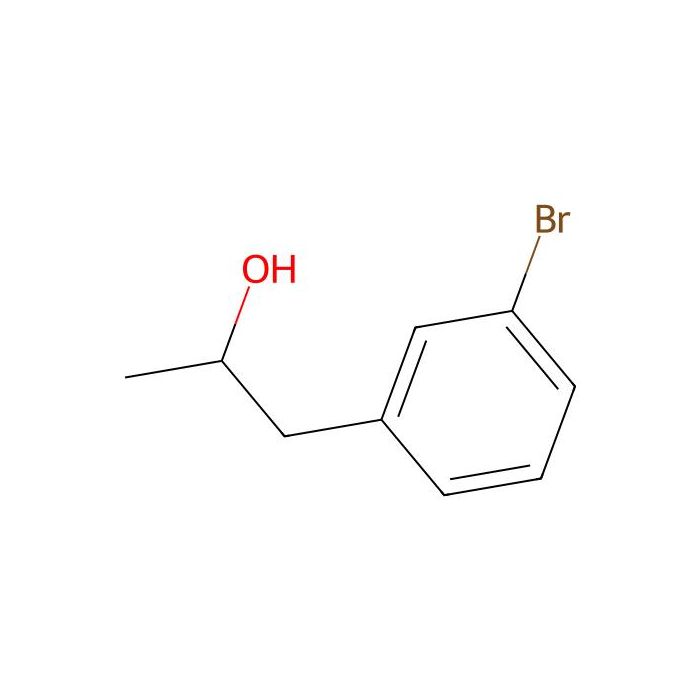
1-(3-Bromophenyl)propan-2-ol is a benzylic, secondary alcohol bearing a meta-bromine substituent on the aryl ring and a propan-2-ol side chain.
Preferred name: 1-(3-Bromophenyl)propan-2-ol
CAS: 1184574-05-7 (product data)
CID: 57162659 (product data)
InChIKey: Not specified for this item; refer to CoA/Spec Sheet.
SMILES: Not specified for this item; refer to CoA/Spec Sheet.
Structural features (general description):
Aromatic ring substituted with bromine at the meta (3-) position
Benzylic –CH2– group linking the ring to a secondary alcohol center [–CH(OH)–CH3]
One stereogenic center at the alcohol-bearing carbon (typically supplied as racemate unless otherwise stated; grade not specified for this item)
2D structure in words: a 3-bromophenyl ring bonded via the ring carbon at position 1 to a methylene (–CH2–) which is attached to a secondary alcohol carbon bearing a hydroxyl (–OH) and a methyl (–CH3).
Synthetic Utility
Functional group set: (i) aryl bromide (cross-coupling handle), (ii) secondary benzylic alcohol (oxidation/activation site). This orthogonality enables modular assembly strategies.
Key disconnections and uses (literature/general):
Aryl diversification first: perform Suzuki/Buchwald–Hartwig/Sonogashira on the 3-bromophenyl unit, then manipulate the alcohol (oxidation to ketone, nucleophilic substitutions after activation, or stereochemical inversion).
Alcohol-first strategy: set stereochemistry via enzymatic resolution or asymmetric reduction on the corresponding ketone; protect (TBS/TBDPS) and then cross-couple the aryl bromide.
Relay to electrophiles: convert the alcohol to mesylate/tosylate or halide (Appel) to generate a secondary electrophile for SN1/SN2 (substrate control and solvent polarity govern selectivity; benzylic assistance can promote ionization).
Oxidation chemistry: the benzylic secondary alcohol oxidizes cleanly to the ketone, facilitating aldolizations, oxime/hydrazone formation, or further reductions to tailored stereochemical outcomes.
Alkenylation by dehydration: access allylic/benzylic alkenes for subsequent hydroboration, epoxidation, or Heck coupling.
Strategic notes:
Alcohol protection enhances compatibility with strong bases and organometallic reagents used in couplings.
The bromide’s meta disposition is retained through typical two-electron processes, aiding regio-defined library synthesis.
Target Specificity
Not applicable. This product is a small-molecule building block, not a biological macromolecule or affinity reagent. No antigen/epitope, clone, isotype, or species reactivity information applies.
Nous utilisons des cookies pour garantir le bon fonctionnement du site et, lorsque cela est autorisé, pour améliorer votre expérience. Vous pouvez gérer vos préférences à tout moment dans les Paramètres. Pour en savoir plus, consultez notre Politique relative aux cookies.
Souhaitez-vous que nous vous envoyions un message lorsque des réductions seront disponibles?
Me rappeler plus tard
Merci ! Veuillez vérifier votre boîte de réception e-mail pour confirmer.
Products are supplied to verified businesses, institutions, and qualified professionals for research and development use only. Not for use in humans, animals, diagnosis, or therapy.