Certificats (CoA, COO, BSE/TSE et tableau d'analyse)
C of A & Other Certificates(BSE/TSE, COO):
Analytical Chart:
Propriétés chimiques et physiques
Poids moléculaire
253.020 g/mol
XLogP3
3.200
Hydrogen Bond Donor Count
0
Hydrogen Bond Acceptor Count
4
Rotatable Bond Count
2
Exact Mass
251.94 Da
Monoisotopic Mass
251.94 Da
Topological Polar Surface Area
17.100 Ų
Heavy Atom Count
13
Formal Charge
0
Complexity
198.000
Isotope Atom Count
0
Defined Atom Stereocenter Count
0
Undefined Atom Stereocenter Count
0
Defined Bond Stereocenter Count
0
Undefined Bond Stereocenter Count
0
The total count of all stereochemical bonds
0
Covalently-Bonded Unit Count
1
Calculateurs de solution
Molarity Calculator
Determine the necessary mass, volume, or concentration for preparing a solution.
Dilution Calculator
Determine the dilution needed to prepare a stock solution.
Reconstitution Calculator
Avis
Avis des clients
Application Protocols
Not applicable. No bioassay or immunoassay application protocols (e.g., WB, IHC, IF, FC) are associated with this small-molecule building block. For practical use, see Reaction Conditions and Synthetic Utility.
Biological Roles
Item-specific biological function data are not applicable; this is a synthetic small-molecule building block for research use only.
General medicinal chemistry context (literature):
CF2H as a motif: The difluoromethyl group is a recognized bioisostere for OH/SH or isosteric with methyl while imparting distinct polarity and metabolic stability. It can serve as a weak H-bond donor, modulate pKa of adjacent heteroatoms, and increase lipophilicity and membrane permeability.
Aryl halides as handles: The 5-bromo substituent facilitates late-stage diversification via cross-coupling to explore SAR. The ortho-fluoro adjacent to the carbonyl activates the ring toward SNAr, enabling rapid library generation.
ADME implications: Incorporating CF2H often reduces oxidative metabolism and can influence binding interactions through polarized C–F bonds (literature observations). These are general considerations, not properties tested for this specific item.
No claims are made regarding biological activity, safety, or efficacy. For all biological experiments, the compound is supplied strictly for research use only.
Buffer Applications
Not typically applicable. 1-(5-Bromo-2-fluorophenyl)-2,2-difluoroethanone is a hydrophobic organic building block, not a buffering reagent. For practical use, focus on the Synthetic Utility, Reaction & Applications, and Solvent Selection sections.
Green Alternatives
While the molecule itself is a specialized halogenated building block (not readily substituted by a “green” equivalent without changing project aims), greener choices can often be made around its use, particularly in solvent and reagent selection.
Greener choices (general guidance):
Solvents: consider replacing DCM/DMF where feasible with 2-MeTHF, CPME, EtOAc, propylene carbonate, Cyrene, or MeCN. Evaluate solubility and reaction performance.
Bases/reagents: employ milder, less hazardous bases (e.g., K2CO3, Cs2CO3) before resorting to strong alkoxides or NaH for SNAr/enolate chemistry; use catalytic quantities of metal reagents with efficient ligands to reduce Pd loading in couplings.
Workup: use brine-free minimal aqueous washes; switch to solid-supported scavengers to reduce solvent volumes.
Illustrative comparison (general; not item-specific):
DCM vs EtOAc: EtOAc offers lower toxicity and a better environmental profile; boiling point higher but still manageable.
DMF/NMP vs Cyrene/PC/MeCN: Cyrene and propylene carbonate are safer alternatives with high polarity; MeCN offers lower viscosity and easier removal than DMF.
THF vs 2-MeTHF/CPME: 2-MeTHF/CPME provide improved safety (peroxide risk still exists but generally lower than diethyl ether) and process robustness.
Note: Because halogenated aromatic building blocks may be persistent in the environment, implement strict waste segregation and consider solvent recovery to minimize environmental impact.
Pharmaceutical Uses
This product is offered for research use only. No therapeutic or diagnostic use is intended.
Formulation/manufacturing context (general):
Role: halogenated, CF2H-containing intermediate for medicinal chemistry and process development. It can be elaborated via cross-coupling or nucleophilic aromatic substitution to access diversified benzoyl-difluoromethyl analogs.
Excipient status: none; it is not used as an excipient.
Pharmacopeial status: no monograph anticipated; any use would be as an API intermediate or impurity reference in development settings.
Process considerations:
Control of residual palladium and halides may be required downstream if the compound is used in GMP-relevant synthetic routes; however, this listing does not specify GMP status. Verify specifications on a project-specific CoA.
Appearance: Not specified for this item; refer to CoA/Spec Sheet.
Grade/Purity: Not specified for this item; refer to CoA/Spec Sheet.
Molecular Formula: Not specified for this item; refer to CoA/Spec Sheet.
Molecular Weight: Not specified for this item; refer to CoA/Spec Sheet.
General/literature expectations for this compound class (α,α-difluoroketone, halogenated aryl):
Phase at RT: typically a low-melting solid or high-boiling oil; exact MP/BP Not specified for this item.
Volatility: reduced versus non-halogenated analogs due to Br and multiple F.
Solubility: expected to be sparingly soluble in water and readily soluble in common organic solvents such as dichloromethane, chloroform, THF, acetonitrile, ethyl acetate, and toluene (literature/general behavior for aryl difluoroketones).
Polarity: moderate polarity from the aryl benzoyl and CF2 moieties; behaves as a polar, aprotic organic substrate.
Acidic proton: the –CHF2 group adjacent to a carbonyl exhibits enhanced acidity relative to benzylic/allylic C–H (literature), enabling base-mediated transformations.
Do not treat any value above as an item specification. Where numerical values are required for method development (e.g., density, refractive index, UV cutoff), they are Not specified for this item; refer to CoA/Spec Sheet and SDS for authoritative data.
Quality and Grades
Grade/Purity: Not specified for this item; refer to CoA/Spec Sheet. Without a declared grade (e.g., AR, HPLC, anhydrous), users should verify suitability for their application (synthesis, screening, or analytical) based on the provided CoA.
Context on common grades (general guidance):
Research grade: typically suitable for synthetic chemistry and discovery workflows; may not include low UV-absorbing or metal-trace specifications.
HPLC grade/LC-MS grade (if applicable in other listings): indicates tight control of non-volatile residues and UV background, valuable when the compound is used as a reference or analyte. Not specified for this item.
Stabilizers/Inhibitors: none stated for this item. If needed, confirm absence/presence of stabilizers on the CoA.
Quality verification tips:
Confirm identity by NMR and HRMS upon receipt if the compound will be used as a key intermediate. The benzoyl–CHF2 motif shows characteristic 19F resonances (often a doublet from 1JHF coupling) and 13C–19F couplings in 13C NMR.
Check for hydrolysis or decomposition by TLC/HPLC if stored for extended periods.
Documentation: CoA and SDS are the authoritative sources for item-specific specifications and test methods.
Reaction and Applications
As an aryl α,α-difluoroketone with two strategic aryl halogens, this compound is a versatile building block for discovery and synthesis.
Key synthetic directions (literature/general):
Cross-coupling at Ar–Br: Pd-catalyzed Suzuki–Miyaura (with boronic acids/esters), Buchwald–Hartwig amination, Negishi/Kumada/Stille can diversify the 5-position. The ortho-fluoro often survives many coupling conditions, enabling sequential functionalization.
SNAr at Ar–F (ortho to carbonyl): Under strong nucleophiles (alkoxides, amines, thiolates) and polar aprotic solvents, the 2-fluoro can be displaced due to activation by the adjacent carbonyl, providing 2-substituted benzoyl-CHF2 products.
Transformations of the –C(=O)–CHF2 unit:
Reduction to secondary alcohols (Ar–CH(OH)–CHF2) using NaBH4 or hydrosilanes (literature), often chemoselective vs. aryl bromide.
Enolate chemistry: the enhanced acidity of –CHF2 allows base-mediated functionalization (e.g., alkylation, aldol-type additions) with carefully chosen bases and temperatures.
Oxidation or halogenation at the α-position (to generate CF2X derivatives) under electrophilic conditions.
Carbonyl derivatives: formation of oximes, hydrazones, or imines followed by further transformations can introduce handles while retaining CF2.
Applications in discovery (general):
CF2H is a lipophilicity-tuning and H-bond donor motif valued in medicinal and agrochemical chemistry; this scaffold enables late-stage diversification at the 5-position and ortho position to access SAR arrays.
Practical notes:
Maintain anhydrous conditions for strong-base steps; the –CHF2 proton can be competitively quenched by water/alcohols.
In couplings, pre-test ligand/base systems to avoid competitive SNAr at Ar–F if retention of F is desired.
Reaction Conditions
The following are general, literature-style conditions for transformations relevant to this scaffold. They are provided as guidance, not as item-specific specifications.
Suzuki–Miyaura coupling at Ar–Br:
Catalyst: Pd(PPh3)4 (1–3 mol%) or Pd2(dba)3 (1 mol%) with SPhos/XPhos (2–4 mol%).
Base: K2CO3, Cs2CO3, or K3PO4 (2–3 equiv).
Solvent: toluene/H2O, 1,4-dioxane/H2O, or 2-MeTHF/H2O.
Temperature: 60–100 °C; inert atmosphere.
Buchwald–Hartwig amination (Ar–Br → Ar–NR2):
Catalyst: Pd2(dba)3 (1–2 mol%) + BrettPhos/RuPhos or Pd-PEPPSI precatalysts.
Temperature: 50–120 °C depending on nucleophile strength.
Reduction of the ketone to alcohol (Ar–CH(OH)–CHF2):
Reagent: NaBH4 (1–2 equiv) in MeOH/EtOH or THF/MeOH mixtures; 0–25 °C.
Alternative: DIBAL-H in toluene/THF at −78 to 0 °C for enhanced selectivity.
Enolate functionalization at –CHF2 position:
Base: LDA or LiHMDS (1.1–1.5 equiv) in THF at −78 to −40 °C, then electrophile (alkyl halide, aldehyde).
These conditions are representative starting points drawn from common literature practice on related substrates; optimization is recommended for each application.
Safety and Handling
Authoritative safety information is provided in the SDS. The following summarizes general best practices for aryl α,α-difluoroketones and halogenated aromatics.
Item-specific hazard data (from Product Data):
GHS Signal Word: Not specified for this item; refer to SDS.
H-Statements: Not specified for this item; refer to SDS.
GHS Classification/Pictograms: Not specified for this item; refer to SDS.
General handling guidance (literature/typical for compound class):
Likely hazards: organic vapors/particulates may cause irritation to eyes, skin, and respiratory tract; avoid inhalation and contact. Halogenated aromatics and activated difluoromethyl ketones can be harmful if swallowed or absorbed.
PPE: lab coat, safety glasses or goggles, appropriate chemically resistant gloves (e.g., nitrile). Use in a functioning chemical fume hood.
Incompatibilities: strong bases can induce deprotonation at –CHF2; strong nucleophiles may trigger SNAr on the ortho-fluoro ring position; strong oxidizers or reducing agents may react at the carbonyl. Avoid prolonged contact with strong bases unless intended.
First aid (overview; follow SDS): rinse affected skin/eyes with water for ≥15 minutes; remove contaminated clothing; if inhaled, move to fresh air; if ingested, rinse mouth—seek medical attention in all cases of significant exposure.
Spills: absorb with inert material (vermiculite) and contain; prevent entry into drains; ventilate area.
Waste: collect as halogenated organic waste per institutional and regulatory requirements.
Storage conditions per Product Data: Room temperature. Store tightly closed, desiccated, and protected from light. Always defer to SDS/label for any additional requirements.
Solvent Selection
This molecule is a moderately polar, halogenated aryl α,α-difluoroketone. It is generally well soluble in polar aprotic and many chlorinated solvents and poorly soluble in water.
Likely good solvents (general guidance): dichloromethane (DCM), chloroform, acetonitrile, THF, DMF/DMAc, ethyl acetate, toluene; often soluble in acetone and MEK. Not miscible with water.
When to choose polar aprotics: for SNAr, cross-couplings, and base-mediated transformations of the –CHF2 moiety, choose DMF, DMSO, NMP, acetonitrile, or 2-MeTHF depending on the base and temperature.
When to choose chlorinated solvents: DCM/CHCl3 for extractions, workups, and reactions needing moderate polarity with good solubility and easy removal.
Avoid highly protic aqueous media: the substrate is hydrophobic and susceptible to base-mediated side reactions; aqueous solubility is low.
Quick comparison (general):
DCM vs. EtOAc: DCM offers higher solubility and faster evaporation; EtOAc provides a greener profile and compatibility with normal-phase chromatography.
Acetonitrile vs. DMF: MeCN is lower boiling and easier to remove; DMF provides higher polarity and stability at elevated temperature.
2-MeTHF/CPME: useful greener alternatives to THF/DCM for many couplings and reductions; evaluate solubility first.
Always verify actual solubility and stability experimentally on small scale before committing to process-scale operations.
Shipped In: Not specified for this item; refer to CoA/Spec Sheet.
Form: Neat small-molecule building block; no reconstitution typically required.
General storage guidance (for halogenated aryl α,α-difluoroketones):
Keep container tightly closed in a dry, well-ventilated place. Protect from moisture and prolonged light.
If long-term storage is planned, consider storing under inert gas and with desiccant to minimize hydrolysis or base-catalyzed side reactions at the –CHF2 position.
Avoid contact with strong bases or nucleophiles in storage areas; segregate from oxidizers and acids per standard chemical hygiene.
If supplied as a solution (rare; not specified here), verify solvent, concentration, and stabilizers on the label and store accordingly.
Reconstitution: Not applicable. If dilution or stock solutions are needed for workflows, prepare fresh solutions in suitable anhydrous solvents (e.g., DCM, MeCN, THF) and store aliquots at low temperature if stability studies support it. Always refer to the SDS and CoA for definitive handling and stability instructions.
Structure and Identity
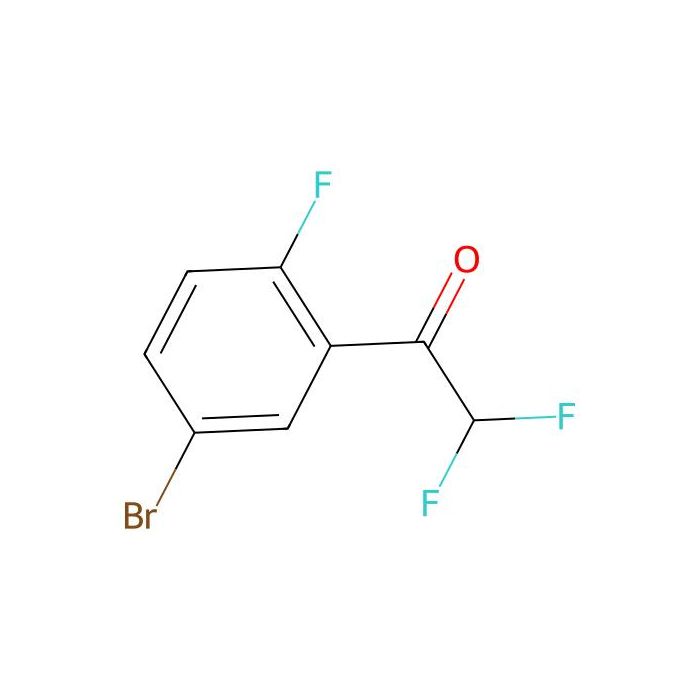
Brief overview: 1-(5-Bromo-2-fluorophenyl)-2,2-difluoroethanone is an aryl α,α-difluoroketone bearing an ortho-fluoro and meta-bromo substituent on the phenyl ring. It serves as a halogenated, difluoromethyl-containing building block.
InChIKey (from Product Data): 453856 (note: truncated/short format as provided)
SMILES: Not specified for this item; refer to CoA/Spec Sheet.
Molecular Formula (literature/computed, not item-specific): C8H4BrF3O
Molecular Weight (literature/computed, not item-specific): ~253.01 g/mol
Structural features (general description):
Core scaffold: a phenyl ring attached through a benzoyl linkage to a CHF2 group (i.e., Ar–C(=O)–CHF2).
Ring substitution: bromine at the 5-position and fluorine at the 2-position relative to the acyl group (ortho-F, meta-Br to the carbonyl).
Functional groups: aryl bromide (for cross-coupling), aryl fluoride (potential for SNAr under activating conditions), and an α,α-difluoroketone (electron-withdrawing CF2 adjacent to a carbonyl).
Stereochemistry: none (achiral as drawn). 2D depiction would show an acyl linkage from the ring to a carbonyl carbon, followed by a terminal difluoromethyl (CHF2) substituent.
Notes:
Any definitive identifiers not listed above are Not specified for this item; refer to CoA/Spec Sheet.
Synthetic Utility
Functional group handles and their strategic use:
Aryl bromide (5-position): enables Pd-catalyzed cross-couplings (Suzuki–Miyaura, Buchwald–Hartwig, Sonogashira after iodination or direct if conditions allow, Negishi, Stille). This allows rapid diversification without disturbing the ortho-fluoro or the CF2H-bearing carbonyl under many conditions.
Ortho-aryl fluoride (2-position): activated toward SNAr by the adjacent benzoyl group; nucleophilic substitution with amines, alkoxides, and thiolates is feasible under polar aprotic conditions and elevated temperatures.
α,α-Difluoroketone (–C(=O)–CHF2):
Enolate generation under strong, non-nucleophilic bases (e.g., LDA, LiHMDS) enables C–C bond formation (alkylation, aldol additions) while retaining fluorines with careful temperature control.
Chemoselective reductions to secondary alcohols (Ar–CH(OH)–CHF2) using NaBH4, DIBAL-H, or catalytic hydrogenation variants (condition-dependent).
Derivatization to oximes/hydrazones opens pathways to further transformations.
Retrosynthetic value:
Serves as a convergent junction: aryl diversification via Ar–Br, nucleophile incorporation via Ar–F SNAr, and manipulation of the CHF2-ketone motif—three orthogonal vectors for library synthesis.
Practical guidance:
Sequence planning: commonly, first perform cross-coupling at Br, then SNAr at F, and finally manipulate the carbonyl/CHF2 motif, minimizing protecting-group needs.
Monitor potential competitive SNAr during strong-base couplings; ligand choice (e.g., bulky dialkylbiaryl phosphines) can suppress undesired pathways.
Target Specificity
Not applicable. This product is a small-molecule chemical building block and does not possess biological target specificity data (no antigen/epitope/isotype information).
We use cookies to ensure the website functions properly and, where permitted, to improve your experience. You can manage your preferences at any time in Settings. Learn more in our Cookie Policy.
Shall we send you a message when we have discounts available?
Remind me later
Thank you! Please check your email inbox to confirm.
Products are supplied to verified businesses, institutions, and qualified professionals for research and development use only. Not for use in humans, animals, diagnosis, or therapy.