Certificats (CoA, COO, BSE/TSE et tableau d'analyse)
C of A & Other Certificates(BSE/TSE, COO):
Analytical Chart:
Propriétés chimiques et physiques
Poids moléculaire
213.270 g/mol
XLogP3
3.200
Hydrogen Bond Donor Count
1
Hydrogen Bond Acceptor Count
2
Rotatable Bond Count
4
Exact Mass
213.115 Da
Monoisotopic Mass
213.115 Da
Topological Polar Surface Area
35.300 Ų
Heavy Atom Count
16
Formal Charge
0
Complexity
189.000
Isotope Atom Count
0
Defined Atom Stereocenter Count
0
Undefined Atom Stereocenter Count
0
Defined Bond Stereocenter Count
0
Undefined Bond Stereocenter Count
0
The total count of all stereochemical bonds
0
Covalently-Bonded Unit Count
1
Calculateurs de solution
Molarity Calculator
Determine the necessary mass, volume, or concentration for preparing a solution.
Dilution Calculator
Determine the dilution needed to prepare a stock solution.
Reconstitution Calculator
Avis
Avis des clients
Application Protocols
No application protocols are provided for this item. As a small-molecule reagent/building block, it does not have standardized assay protocols like antibodies or enzymes.
For synthetic use, consult the Reaction Conditions, Synthetic Utility, and Solvent Selection sections for practical guidance.
If incorporating into screening libraries or SAR studies, follow your lab’s compound management SOPs (dissolution in DMSO, plating, and storage), and validate concentration by UV/LC when appropriate.
Item-specific recommended dilutions, positive controls, or assay conditions: Not applicable.
Biological Roles
Item-specific biological data: Not specified for this item; refer to literature if needed.
General context (for small aromatic anilines and aryl–alkyl ethers):
2-(2-Phenylethoxy)aniline is a synthetic organic building block and is not known as a natural metabolite or a component of primary biochemical pathways.
The primary aniline functionality can form salts with mineral/organic acids, which may influence solubility and partitioning in biological assay media, but this compound is typically used in chemical synthesis rather than in biological systems.
Anilines, in general, can undergo oxidative metabolism (e.g., N-oxidation, N-acetylation) in biological contexts; aryl–alkyl ethers are susceptible to O-dealkylation in vivo (literature). These are generic observations and not item-specific performance claims.
Use limitation
Research use only. Not intended for diagnostic, therapeutic, or clinical applications.
Buffer Applications
This product is a hydrophobic aromatic amine and is not commonly employed as a buffering agent.
Not typically applicable: 2-(2-Phenylethoxy)aniline does not constitute a conjugate acid–base pair with a pKa/pH window suitable for standard laboratory buffer systems.
Practical note: If used in aqueous-phase transformations (e.g., diazotization), buffering is typically provided by mineral acids or standard buffers (acetate, phosphate). Choose the buffer appropriate to the transformation, not the substrate.
For buffering needs, consult dedicated buffering reagents (e.g., phosphate, HEPES, acetate) and established recipes.
Green Alternatives
While 2-(2-Phenylethoxy)aniline itself is a substrate rather than a solvent, greener choices can be made for media and auxiliaries used in its synthesis, derivatization, and processing.
Prefer greener solvents where feasible (general guidance)
Replace chlorinated solvents: Use EtOAc, 2-MeTHF, CPME, MeCN, or dimethyl carbonate instead of DCM/chloroform when solubility and selectivity allow.
Swap THF for 2-MeTHF or CPME in base- or organometal-catalyzed reactions to reduce peroxide risk and improve life-cycle metrics.
Use toluene over xylene, and isopropanol/ethanol over methanol when performance permits (lower toxicity, better sustainability).
Workup and purification
Favor aqueous base/acid extractions with greener organics (EtOAc, MTBE) rather than halogenated solvents.
Consider crystallization or trituration to minimize silica usage; if chromatography is required, heptane/EtOAc or cyclohexane/EtOAc systems are typically greener than hexanes/DCM.
Reagent choices
For acylations, use propylphosphonic anhydride (T3P) in EtOAc/2-MeTHF as a lower-impact coupling system vs oxalyl chloride or SOCl2 routes.
Explore catalytic C–N bond formation (Buchwald–Hartwig with ligand-optimized Pd at low loadings) over stoichiometric nucleophiles to reduce waste.
Comparative snapshot (general)
DCM vs EtOAc: EtOAc offers lower toxicity and better environmental profile; bp tradeoff may impact drying time.
THF vs 2-MeTHF: 2-MeTHF is bio-based, forms fewer peroxides, and offers advantageous biphasic separations; minor differences in polarity can affect rates/selectivity.
Adopt solvent/reagent selection guides (e.g., CHEM21, ACS GCI) and confirm performance under your specific conditions.
Pharmaceutical Uses
No pharmacopeial status or excipient role is provided for this item.
Item-specific note: Not specified for this item; refer to CoA/Spec Sheet.
General context (non-clinical)
2-(2-Phenylethoxy)aniline can serve as a synthetic intermediate or scaffold in medicinal chemistry programs due to the presence of a modifiable primary aniline and an ether-linked aryl group.
Typical uses in an R&D setting include:
Preparation of amide, sulfonamide, urea, and carbamate libraries via N-derivatization.
Introduction of ortho-heterocyclic frameworks (e.g., benzoxazole/benzoxazine motifs) through intramolecular cyclization strategies after suitable functionalization (literature).
Exploration of SAR by modifying the phenethyl ether chain or by halogenating/functionalizing either aromatic ring.
Important: All mentions above refer to its role as a research intermediate or building block only. No therapeutic, diagnostic, or clinical claims are made or implied.
Physical Properties
Item-specific specifications have not been provided for this catalog entry; defer to the CoA/Spec Sheet for definitive values.
Appearance: Not specified for this item; refer to CoA/Spec Sheet.
Molecular formula / weight: Not specified for this item; refer to CoA/Spec Sheet.
Melting/boiling point: Not specified for this item; refer to CoA/Spec Sheet.
Density/refractive index: Not specified for this item; refer to CoA/Spec Sheet.
UV cutoff/λmax: Not specified for this item; refer to CoA/Spec Sheet.
Water/peroxide/metal content: Not specified for this item; refer to CoA/Spec Sheet.
General expectations (literature/typical for anilide phenethyl ethers; qualitative only):
State and volatility: Aromatic aniline ethers of this size commonly occur as low-melting solids or viscous oils with low to moderate volatility.
Solubility profile: Expected to be sparingly soluble in water and freely soluble in common organic solvents (e.g., EtOAc, DCM, THF, toluene, MeOH/EtOH to varying extent) due to the balance of anilide polarity and two aryl rings.
Acid–base behavior: The primary aniline nitrogen is a weak base (typical aniline pKaH ≈ 4.6–5.5, literature), enabling salt formation with strong acids and enhanced aqueous solubility under acidic conditions.
Partitioning: The presence of two phenyl rings and an ether generally confers moderate lipophilicity (qualitative; logP expected to be positive, literature trend for diaryl/aryl-alkyl ethers).
Note: Use measured values from the CoA/Spec Sheet for method development or process design. Literature/typical remarks above are provided solely for qualitative guidance.
Quality and Grades
Item-specific grade/purity: Not specified for this item; refer to CoA/Spec Sheet.
Interpretation and guidance for professional users:
Without a declared grade (e.g., “≥98%,” “AR,” “HPLC,” or “anhydrous”), assume standard research-grade material and verify fitness-for-use via the lot-specific CoA.
For analytical or catalysis-sensitive applications, confirm:
Assay/purity method (GC, HPLC, qNMR) and mass balance.
Residual solvents and volatile impurities (GC headspace).
Water content (Karl Fischer) if moisture-sensitive downstream chemistry is planned (e.g., acid chloride formation after amine protection). Not specified for this item; refer to CoA/Spec Sheet.
Stabilizers or inhibitors: None stated for this item; refer to CoA/Spec Sheet.
UV-Vis background if planning photochemical steps or detection at low wavelength.
What the common grades imply (general knowledge):
AR/ACS grade: Tight impurity limits suitable for most synthetic work.
HPLC/UV grade: Low background absorbance and particulates for chromatographic work.
Anhydrous grade: Controlled moisture level for air-/water-sensitive reactions; typically packaged under inert gas in a dried container.
Recommendation: For route-critical steps (e.g., palladium-catalyzed couplings, diazotizations), request a recent CoA, and, if necessary, pre-treat (e.g., pass through basic alumina, convert to a salt/free base, or dry over molecular sieves) to meet your internal specifications.
Reaction and Applications
2-(2-Phenylethoxy)aniline is a versatile building block that combines a nucleophilic aniline with an aryl–alkyl ether and two aromatic rings. This functionality supports diverse transformations in discovery and process chemistry.
N-derivatization: Efficient acylation (acyl chlorides, anhydrides) and sulfonylation (sulfonyl chlorides) to form amides and sulfonamides; carbamate formation via chloroformates or CDI.
Electrophilic aromatic substitution (EAS): The –NH2 and –O– substituents are ortho/para-directing and strongly activating, enabling rapid EAS (e.g., nitration under mild conditions, formylation via Vilsmeier if protected, Friedel–Crafts conditions on the pendant phenyl ring).
Diazotization/azo coupling: Formation of diazonium salts under nitrosating conditions (0–5 C) followed by Sandmeyer-type substitutions, or azo coupling with activated aromatics.
Cross-couplings and N-arylation: After appropriate protection (e.g., Boc, Ac), the aniline nitrogen can be engaged in Buchwald–Hartwig amination to construct C–N bonds; the pendant phenyl ring may participate in Suzuki/Sonogashira after prior halogenation.
Ether manipulations: Aryl–alkyl ethers can be cleaved under strong Lewis acidic conditions (e.g., BBr3/BCl3, literature) to reveal phenolic intermediates; the benzylic segment allows potential oxidative or radical functionalizations.
Intramolecular cyclizations: Ortho-substitution pattern can be leveraged to access benzoxazole/benzoxazine motifs after directed functionalization (literature precedents).
Practical tips
Protect the aniline (Boc, Cbz, Ac) to control chemoselectivity during electrophilic or metal-catalyzed steps.
For diazotization, rigorously control temperature and quench nitrosating species; isolate as tetrafluoroborate if needed for stability (literature practice).
Monitor for over-activation in EAS; use stoichiometry and temperature to moderate polysubstitution.
When attempting ether cleavage, verify compatibility of the aniline function or protect it to avoid side reactions.
Reaction Conditions
No item-specific reaction condition data are provided. The following are general literature-guided starting points for transformations of primary anilines and aryl–alkyl ethers; optimize for your substrate and scale.
N-Acylation / N-Sulfonylation
Typical: RCOCl (1.05–1.2 equiv) or (RCO)2O in DCM or THF, 0–25 C, with Et3N/DIPEA (2–3 equiv); 0.5–2 h. Sulfonyl chlorides behave similarly; pyridine or DMAP can accelerate. Expected high conversions under mild conditions.
Carbamate/Urea formation
With CDI or triphosgene equivalents in THF/2-MeTHF at 0–25 C; then add alcohol/amine nucleophile. Monitor to avoid over-carbamoylation.
Diazotization and substitution
1–2 M HCl or HBF4, 0–5 C, NaNO2 (1.1 equiv) to form diazonium; subsequent Sandmeyer with CuX in MeCN/water or alcohols. Keep temperature low; quench excess nitrite.
Electrophilic aromatic substitution (EAS)
Mild nitration: HNO3/Ac2O or HNO3/AcOH at 0–25 C (protect –NH2 if needed). Formylation: Vilsmeier (POCl3/DMF) with protected aniline at 0–60 C.
Ether cleavage (literature)
BBr3 (1–3 equiv) in DCM at –78 to 0 C, then warm to RT; aqueous quench. Assess compatibility with –NH2 (often protect first) and with benzylic ether stability.
Metal-catalyzed N-arylation (if further elaboration desired)
Pd2(dba)3 (0.5–1 mol%), BINAP/XPhos-type ligands (1–2 mol%), NaOtBu or Cs2CO3 base, toluene/dioxane, 80–110 C, 2–16 h. Protect aniline if selectivity is an issue.
All conditions above are general guidance from literature precedent and should be validated and optimized experimentally for this specific substrate and desired transformation.
Safety and Handling
No GHS classification or hazard statements are provided in the Product Data. Always consult the product SDS for authoritative safety information and local regulatory requirements.
GHS and labeling
Signal word / H-statements / pictograms: Not specified for this item; refer to SDS.
Anticipated hazards (general for aniline derivatives and aromatic ethers; literature-based)
Primary anilines can be harmful if swallowed, inhaled, or absorbed through skin; they may cause irritation to skin, eyes, and respiratory tract. Some anilines exhibit methemoglobinemia potential; handle with care and avoid exposure.
Aromatic ethers and hydrocarbons can be combustible; keep away from ignition sources.
PPE and engineering controls
Wear lab coat, appropriate gloves (e.g., nitrile), splash goggles, and use in a fume hood to minimize vapor/aerosol exposure.
Avoid skin contact; wash thoroughly after handling.
Incompatibilities and precautions (general)
Strong oxidizers (risk of exotherm/oxidation), strong acids/bases (may induce decomposition, ether cleavage, or salt formation), and nitrosating agents (risk of N-nitrosation in amines) should be avoided unless intended.
Peroxide formation: Not typically a concern for aryl–alkyl ethers compared with dialkyl ethers, but standard good practice is to store away from light/air and check aged materials.
First aid (overview; defer to SDS)
Inhalation: Move to fresh air; seek medical attention if symptoms persist.
Skin/eye contact: Rinse with plenty of water for at least 15 minutes; remove contaminated clothing; obtain medical advice.
Ingestion: Rinse mouth; do not induce vomiting; seek medical attention.
Fire response
Use CO2, dry chemical, or foam. Cool containers with water spray. Combustion may produce COx and NOx.
Always follow your institution’s EHS protocols and the SDS for this specific product.
Solvent Selection
This product is an aromatic aniline bearing an aryl–alkyl ether; it functions as a substrate/reagent rather than as a solvent. However, choosing an appropriate reaction/processing solvent is important for its use.
Polarity and miscibility (general expectations)
Likely sparingly soluble in water; readily soluble in many organic solvents (e.g., DCM, chloroform, THF, EtOAc, toluene, acetone, alcohols to varying degrees). Acidic aqueous media can increase apparent solubility via anilinium salt formation.
Selection guidance by task
N-acylation/N-sulfonylation: Use aprotic solvents (DCM, THF, DMF, MeCN) with a base (e.g., Et3N, DIPEA, pyridine). Maintain low temperature to control exotherms.
Diazotization/coupling: Aqueous mineral acid with an organic co-solvent (EtOH, MeOH, THF) at 0–5 C for diazotization; couple in alcohols, acetates, or mixed phases as required.
Metal-catalyzed couplings (if N-arylation or further functionalization): Polar aprotics like dioxane, toluene, CPME, or tert-amyl alcohol under Pd/Cu catalysis depending on the system.
Workup and crystallization: Aromatic hydrocarbons (toluene, xylene) and esters (EtOAc/hexanes mixtures) often aid in trituration or crystallization of aromatic amines; verify experimentally.
Small comparative view (general)
DCM vs EtOAc: DCM offers higher solubility and low bp for easy removal; EtOAc is a greener alternative with broader safety profile.
THF vs 2-MeTHF: 2-MeTHF provides improved sustainability and phase behavior, often with comparable solubilizing power for aryl amines.
Always confirm actual solubility and stability experimentally for your specific lot/conditions.
Storage and Reconstitution
Storage (from Product Data)
Store at room temperature.
Additional handling guidance (general best practice for aniline-containing aromatics)
Keep container tightly closed in a dry, well-ventilated place. Protect from light and air to minimize slow oxidative discoloration/polymerization typical of anilines.
If long-term storage is anticipated, consider inert-atmosphere blanketing (nitrogen/argon) and inclusion of a desiccant. Avoid strong acids/oxidizers in proximity.
Form and reconstitution
Physical form is not specified; if supplied as a solid or viscous oil, dissolve in suitable anhydrous organic solvents (e.g., DMSO, THF, DCM, EtOAc, MeOH/EtOH as compatible) to prepare stock solutions. Filter if needed to remove particulates.
For biological screening, DMSO stocks (10–100 mM) are commonly prepared; verify solubility and stability. Avoid repeated freeze–thaw by aliquoting.
Stability notes
Anilines can slowly oxidize on air exposure; minimize headspace oxygen and light. Check for color changes or new impurities by TLC/LC before critical use.
Shipping
Shipped In: Not specified for this item; refer to CoA/Spec Sheet.
Always refer to the lot-specific CoA and SDS for definitive storage, stability, and handling instructions.
Research Use Only.
Structure and Identity
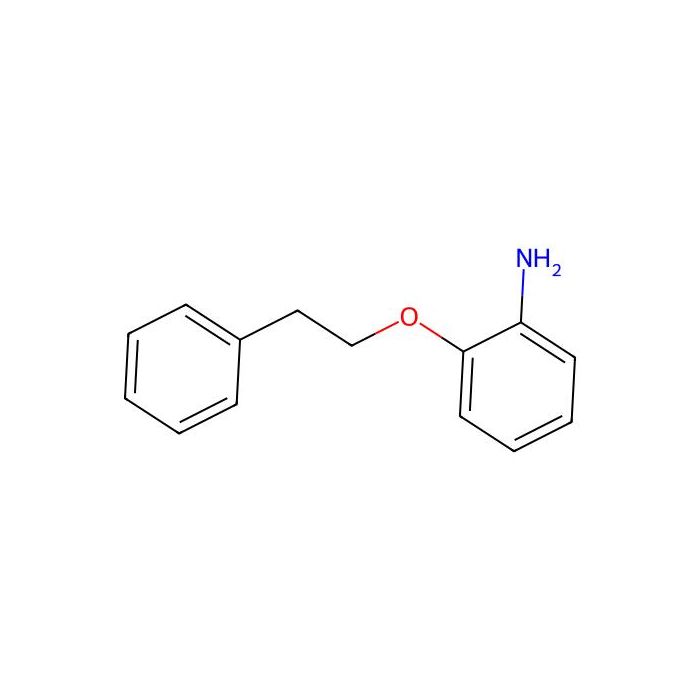
Brief description: 2-(2-Phenylethoxy)aniline is an ortho-anilide bearing an O–CH2–CH2–Ph substituent on the aromatic ring, combining a primary aniline with an aryl–alkyl ether linkage.
Item-specific identifiers (from Product Data)
SKU: P987837
Product Name: 2-(2-Phenylethoxy)aniline
CAS: 97476-32-9
PubChem CID: 16771131
InChIKey: 418289 (as provided)
Storage Conditions: Room temperature
Grade/Purity: Not specified for this item; refer to CoA/Spec Sheet.
Structure and functional groups (general description)
Core scaffold: Aniline (C6H4–NH2) bearing an ortho ether substituent.
Ether segment: Aryl–O–CH2–CH2–Ph (an aryl–alkyl ether terminating in a phenyl ring), i.e., a phenethyl ether.
Functional groups: Primary aniline (–NH2), aryl–alkyl ether (Ar–O–CH2–), two phenyl rings (one anilide ring and one terminal phenyl).
Regiochemistry: “2-” indicates the ether substituent is ortho to the aniline –NH2 on the same ring, enabling potential intramolecular interactions and directing effects in electrophilic substitution.
Stereochemistry: None (achiral, no stereocenters).
Additional identifiers
Molecular formula: Not specified for this item; refer to CoA/Spec Sheet.
Molecular weight: Not specified for this item; refer to CoA/Spec Sheet.
SMILES / InChI: Not specified for this item; refer to CoA/Spec Sheet.
2D structure (described in words)
An aniline ring bearing –NH2 at position 1 and –O–CH2–CH2–Ph at position 2 (ortho). The ether chain links the aniline ring oxygen to a two-carbon spacer ending in a second phenyl ring.
Synthetic Utility
Key reactive elements and strategic value:
Functional groups and reactivity
Primary aniline (–NH2): Nucleophilic at nitrogen; readily transformed into amides, sulfonamides, carbamates, ureas, isocyanates (via phosgene equivalents), imines, and diazonium salts (under nitrosating conditions).
Aryl–alkyl ether (Ar–O–CH2–CH2–Ph): Typically robust under basic conditions; can be cleaved under strong Lewis acids (e.g., BBr3/BCl3, literature) to unveil phenolic functionality on the aniline ring; benzylic CH2 group can be oxidized or functionalized.
Two aromatic rings: Enable divergent late-stage functionalizations (electrophilic substitution, directed metalation after appropriate blocking/protection, and cross-couplings after halogenation).
Retrosynthetic leverage
Disconnection via the ether: Access by O-alkylation of 2-aminophenol derivatives with 2-phenethyl halides/sulfonates.
Disconnection via the aniline: Construct the aniline by reduction of nitro precursors following ether installation.
Named reactions and tactics (literature)
Buchwald–Hartwig amination (for further N-arylation), Sandmeyer/Meerwein (via diazonium), Vilsmeier–Haack formylation (with temporary protection), Bischler–Napieralski-like cyclizations for related systems after prefunctionalization, and directed ortho metalation (DoM) on the pendant phenyl after N-protection.
Practical considerations
Protect –NH2 (Boc/Ac) to modulate reactivity/solubility and to prevent catalyst poisoning in cross-couplings.
In EAS, strong activation can lead to polysubstitution—use temperature control and stoichiometry to favor monosubstitution.
If pursuing ether cleavage, evaluate compatibility of the aniline (often protect) and consider milder alternatives (e.g., oxidative benzylic cleavage) when appropriate.
Target Specificity
Not applicable. This product is a small-molecule building block, not a biological macromolecule or affinity reagent.
Antigen/epitope, clone, isotype, species reactivity: Not applicable.
No target-binding specificity is claimed or implied for this item.
Use in biochemical assays, if any, should be as a chemical substrate/intermediate rather than a selective binder.
Foire aux questions
What is the purity of this product?
This product is supplied at ≥95% purity (chemical assay). Lot-specific values are stated on the Certificate of Analysis.
How should this product be stored?
Store at room temperature.
What are the CAS number, molecular formula and molecular weight?
The CAS Number is 97476-32-9, the molecular formula is C14H15NO, and the molecular weight is 213.270 g/mol. InChIKey XHTYNSVPAGBEAU-UHFFFAOYSA-N.
What documentation is provided?
Available product documentation, including Certificates of Analysis (COA), Safety Data Sheets (SDS), and specification sheets, is shown in the product document area. Document availability and access follow the current site policy.
We use cookies to ensure the website functions properly and, where permitted, to improve your experience. You can manage your preferences at any time in Settings. Learn more in our Cookie Policy.
Shall we send you a message when we have discounts available?
Remind me later
Thank you! Please check your email inbox to confirm.
Products are supplied to verified businesses, institutions, and qualified professionals for research and development use only. Not for use in humans, animals, diagnosis, or therapy.