This compound belongs to the class of organic compounds known as bromobenzenes. These are organic compounds containing a bromine atom attached to a benzene ring.
External Descriptors
Not available
1. Djoumbou Feunang Y, Eisner R, Knox C, Chepelev L, Hastings J, Owen G, Fahy E, Steinbeck C, Subramanian S, Bolton E, Greiner R, and Wishart DS. ClassyFire: Automated Chemical Classification With A Comprehensive, Computable Taxonomy. Journal of Cheminformatics, 2016, 8:61.
Determine the necessary mass, volume, or concentration for preparing a solution.
Dilution Calculator
Determine the dilution needed to prepare a stock solution.
Reconstitution Calculator
Avis
Avis des clients
Application Protocols
Not applicable. No immunoassay or bioanalytical application protocols (e.g., WB, IHC, IF, FC) are associated with this small-molecule building block. For practical use, refer instead to:
Reaction Conditions for synthetic protocols (couplings, metalations, deprotection).
Solvent Selection for dissolution, workup, and purification guidance.
Biological Roles
Item-specific
Research use only (per Product Data). No biological role or function is claimed for this catalog item.
General chemistry/biochemistry context
2-(3-Bromophenyl)-1,3-dioxolane is a synthetic small molecule with an aryl bromide and an acetal moiety. It is not known as a natural metabolite or cofactor.
In biological settings, acetals are generally stable at neutral pH but hydrolyze under acidic conditions; however, this compound is intended for laboratory synthesis rather than biological experimentation.
The bromophenyl group provides a handle for the synthesis of probe molecules, but any biological activity would be incidental and context-dependent; no specific targets are inherent to this scaffold.
Conclusion: This reagent is best viewed as a synthetic intermediate. For biochemical or cellular studies, the deprotected aldehyde or further elaborated derivatives would generally be of interest, but no intrinsic biological role is established.
Buffer Applications
Not typically applicable. 2-(3-Bromophenyl)-1,3-dioxolane is a neutral, hydrophobic organic building block and does not serve as a buffering agent. For experimental planning, focus instead on:
Choosing compatible organic/aqueous media for reactions (see Solvent Selection).
Managing pH only in the context of acetal stability: avoid acidic aqueous buffers if the goal is to retain the acetal; use acidic aqueous media intentionally for deprotection (see Reaction Conditions).
Green Alternatives
While 2-(3-bromophenyl)-1,3-dioxolane itself is a specific building block rather than a solvent, greener choices can be made in the processes that utilize it.
Greener solvent choices for common operations (literature guidance)
Cross-coupling: Replace dioxane/DMF with bio-derived 2-MeTHF, CPME, or water/ethanol mixtures when catalyst system allows. Aqueous micellar catalysis (e.g., TPGS-750-M) has enabled Suzuki couplings of aryl bromides at scale.
Extractions: Prefer EtOAc or MTBE over chlorinated solvents where practicable.
Deprotection: Conduct acetal hydrolysis in aqueous ethanol or acetone/water with catalytic mineral acid, minimizing strong acid load and avoiding chlorinated media.
Choose heterogeneous catalysts or recyclable ligands; consider ppm-level Pd catalysis.
Comparison snapshot (general)
Traditional vs greener options:
1,4-Dioxane (effective, toxic/suspected carcinogen) → 2-MeTHF/CPME (bio-based/low peroxide risk for CPME), water–ethanol (benign) where compatible.
DCM for workups → EtOAc/Heptane (lower toxicity, easier recovery).
Tradeoffs
Some greener solvents demand different bases or catalyst systems; solubility of inorganic bases may limit rates. Validate on small scale, and monitor for acetal stability (some bio-based solvents contain residual acidity — ensure neutralization/quality control).
Pharmaceutical Uses
Item-specific
No pharmacopeial grade or excipient status is specified for this item; it is sold for research use only.
General context (no therapeutic claims)
Role as an intermediate: Aryl acetals such as 2-(3-bromophenyl)-1,3-dioxolane are commonly used in medicinal chemistry routes to enable transformations on the aryl bromide (cross-coupling, metalation) while masking the aldehyde. After diversification, controlled deprotection unveils the aldehyde for further elaboration (e.g., reductive amination, oxime formation, Wittig/Julia olefination).
Process considerations: The acetal’s acid lability necessitates neutral to basic workups and avoidance of acidic excipients/solvents during intermediate isolations. Residual mineral acids from prior steps should be neutralized to prevent hydrolysis during storage.
Impurity control: Typical related substances include the corresponding benzaldehyde (hydrolysis), diol/ethylene glycol, and coupling byproducts. Analytical control with HPLC-UV (254 nm) and GC-MS is standard.
Note: This product is not intended for human or veterinary use, drug substance manufacture without further qualification, or clinical applications.
Physical Properties
Item-specific (from Product Data)
Appearance: Not specified for this item; refer to CoA/Spec Sheet.
Grade/Purity: Not specified for this item; refer to CoA/Spec Sheet.
Literature/computed (non-spec; for general reference only)
Molecular formula: C9H9BrO2 (derived from name/structure)
Molecular weight: 229.07 g/mol (calculated)
Expected phase at ambient conditions: Organic liquid or low-melting solid; many aryl dioxolanes are liquids near room temperature (literature trend).
Solubility: Low in water; miscible with common organic solvents (e.g., dichloromethane, THF, toluene, ethyl acetate) — typical for neutral aryl acetals (literature).
Volatility: Moderate; handle in a fume hood to limit inhalation (general guidance for aryl acetals).
UV behavior: Aryl chromophore absorbs in the UV (200–280 nm region); useful for TLC/UV detection (literature observation for bromophenyl derivatives).
Not specified for this item (do not treat as specifications)
Boiling point, melting point, density, refractive index, pKa, logP/logS: Not specified for this item; refer to CoA/Spec Sheet.
Notes for practitioners (general): As a benzylic acetal, the compound is typically hydrolytically stable under neutral to basic conditions but can hydrolyze to 3-bromobenzaldehyde under acidic, aqueous conditions with heating. Avoid unnecessary exposure to strong acids if the acetal must be preserved.
Quality and Grades
Item-specific (from Product Data)
Grade/Purity: Not specified for this item; refer to CoA/Spec Sheet.
Guidance on grades (general chemistry/laboratory context)
Research grade: Suitable for most synthetic applications, method development, and screening. If trace impurities (e.g., residual aldehyde or hydrolysis products) are critical, verify by NMR/GC before use.
Chromatography/HPLC suitability: If using in analytical method development, low-UV-absorbing solvents and impurity profiling are recommended; no HPLC grade is implied for this item.
Stabilizers: None indicated for this listing. In general, cyclic acetals do not require stabilizers; absence of acid is sufficient to maintain integrity. If extreme stability is required, store with an acid scavenger present in the headspace (e.g., carbonate-lined cap) — assess suitability for your process.
Recommended user QC (best practices)
Identity: 1H/13C NMR to confirm acetal methylene signals (two O–CH2 groups) and aromatic pattern consistent with meta-bromophenyl; IR for acetal C–O stretches; MS for M and M+2 (Br isotopes).
Purity: GC-FID or HPLC-UV with dual-wavelength monitoring (e.g., 210/254 nm). Monitor for 3-bromobenzaldehyde (potential hydrolysis impurity) and diol/ethylene glycol.
Water/acid sensitivity check: Briefly expose a small aliquot to mildly acidic aqueous conditions to confirm expected stability/deprotection behavior if relevant to your process.
Reaction and Applications
Key application: This molecule is the ethylene acetal (1,3-dioxolane) of 3-bromobenzaldehyde, combining an orthogonally removable aldehyde protecting group with a versatile aryl bromide handle.
Protecting-group strategy (literature)
The 1,3-dioxolane is acid-labile and generally stable to bases, many nucleophiles, and transition-metal catalysts. It permits multistep sequences where the bromide undergoes transformation first, followed by acetal deprotection to unveil the aldehyde.
Cross-coupling at Ar–Br: Suzuki–Miyaura (to install aryl/alkenyl/heteroaryl boron partners), Negishi, Stille, or Heck reactions. Acetal typically survives Pd-catalyzed couplings under neutral/basic conditions.
Nucleophilic substitution/metalation: Lithium–halogen exchange (e.g., n-BuLi, −78 to −40 °C) enabling formylation, borylation, or electrophile trapping. Monitor for potential acetal sensitivity under prolonged or warmer conditions.
Grignard formation: ArMgBr formation followed by electrophile addition; avoid acidic quench conditions that would prematurely hydrolyze the acetal.
Directed functionalization: Electrophilic aromatic substitutions (e.g., nitration, bromination at other positions) can proceed with suitable control; protect the acetal from strong acids where feasible.
Deprotection: Aqueous acid (HCl, H2SO4, p-TsOH in aqueous EtOH/acetone) to regenerate 3-bromobenzaldehyde (or, after prior transformations on the ring, the adjusted benzaldehyde).
Use cases
Synthesis of meta-substituted benzaldehyde libraries via first modifying the aryl bromide (cross-coupling, lithiation–electrophile capture) and then unveiling the aldehyde.
Late-stage introduction of aldehyde functionality in complex small molecules, leveraging the acetal’s robustness during earlier steps.
Reaction Conditions
General, literature-based guidance for common operations on 2-(3-bromophenyl)-1,3-dioxolane (not item-specific specifications):
Pd-catalyzed Suzuki–Miyaura coupling (at Ar–Br)
Catalyst: Pd(PPh3)4 (1–3 mol%) or Pd-precatalyst with phosphine/biarylphosphine ligand (e.g., XPhos, SPhos 0.5–2 mol%).
Base: K2CO3, K3PO4, Cs2CO3 (2–3 equiv). Aqueous or anhydrous depending on solvent.
Solvent: 1,4-dioxane/H2O (3:1), toluene/H2O, or 2-MeTHF; 60–100 °C, 2–16 h.
Notes: Acetal typically survives; monitor for hydrolysis in prolonged aqueous runs.
Metal–halogen exchange and electrophile trapping
Conditions: n-BuLi (1.1–1.5 equiv) in dry THF at −78 to −40 °C; quench with electrophiles (DMF for formylation, B(OMe)3 then pinacol for borylation, CO2 for carboxylation).
Alternative: i-PrMgCl·LiCl (turbo-Grignard) at −20 to 0 °C for halogen–magnesium exchange, then electrophile.
Caution: Keep temperatures low and times short to minimize acetal transacetalization or cleavage.
Heck coupling
Catalyst: Pd(OAc)2 (1–3 mol%) + PPh3 or Pd(PPh3)4; base Et3N or K2CO3; solvent DMF, NMP, or toluene; 80–120 °C, 6–18 h.
Acetal deprotection (hydrolysis)
Reagents: 0.5–2 M HCl or p-TsOH (5–10 mol%) in aqueous ethanol or acetone/H2O.
Conditions: 40–80 °C, 1–6 h; gives 3-bromobenzaldehyde (or modified aldehyde after prior transformations).
Workup: Neutralize, extract into EtOAc, dry, and purify swiftly to avoid overexposure to acid.
Analytical monitoring
TLC (hexanes/EtOAc 9:1 → 7:3) under 254 nm UV; GC or HPLC-UV at 254 nm.
Reported yields for these operations vary broadly (50–95%) depending on partners and conditions.
Safety and Handling
Item-specific (from Product Data)
GHS classification, signal word, pictograms, H-statements: Not specified for this item; refer to SDS.
Storage: Room temperature; shipped in normal conditions.
General safety guidance (literature/good laboratory practice; not a substitute for the SDS)
Likely hazards: Organic liquids of this class are often combustible and may cause skin/eye irritation. Aromatic bromides may cause respiratory irritation on inhalation of vapors/mists.
PPE: Wear lab coat, safety glasses or splash goggles, and appropriate chemical-resistant gloves (e.g., nitrile). Use in a chemical fume hood to control vapors and prevent inhalation exposure.
Handling: Avoid contact with strong acids (risk of acetal hydrolysis); avoid strong bases/nucleophiles at elevated temperatures (possible ring opening). Keep away from ignition sources.
Incompatibilities: Strong mineral acids and Lewis acids (promote deprotection/hydrolysis); strong oxidizers (risk of exotherm); very strong nucleophiles under forcing conditions may open the acetal.
First aid (overview):
Inhalation: Move to fresh air; seek medical attention if symptoms persist.
Skin contact: Wash with soap and water; remove contaminated clothing.
Eye contact: Rinse cautiously with water for several minutes; remove contact lenses if present and easy to do; seek medical attention if irritation persists.
Ingestion: Rinse mouth; do not induce vomiting; seek medical advice.
Spills: Absorb with inert material (vermiculite, sand), collect for disposal. Prevent entry to drains.
Always consult the product SDS for authoritative hazard classification, exposure limits, and disposal requirements.
Solvent Selection
This product is a neutral aryl acetal building block, not a solvent. Solvent selection here refers to choosing appropriate media to dissolve and manipulate 2-(3-bromophenyl)-1,3-dioxolane in reactions or purifications.
Polarity/miscibility (literature trends)
Expected to be soluble in common organic solvents: dichloromethane, chloroform, THF, dioxane, toluene, ethyl acetate, acetone, acetonitrile.
Poorly soluble in water; partitioning favored to organic phase in extractions.
Choosing solvents by task
Cross-coupling: 1,4-dioxane, THF, toluene, or mixtures with water (e.g., dioxane/H2O) are commonly used for aryl bromides. Polar aprotic media (DMAc, NMP) enable higher temperatures but consider EHS aspects.
Metal–halogen exchange/formylation: Anhydrous ethereal solvents (THF, Et2O) at cryogenic to low temperatures are typical; acetals are generally base-stable but minimize prolonged exposure to very strong bases.
Deprotection (acetal hydrolysis): Aqueous alcohols (MeOH/H2O) or acetone/H2O with catalytic mineral acid (HCl, H2SO4) under reflux are effective.
Purification: Normal-phase silica gel elution with hexanes/EtOAc or hexanes/DCM gradients; the acetal is less polar than the corresponding aldehyde, aiding separation.
Small comparison (general)
THF vs 1,4-dioxane: THF offers better solubility for polar bases but is peroxide-forming; dioxane tolerates water in coupling but has higher toxicity concerns. Select based on catalyst/base system and EHS policy.
Storage and Reconstitution
Item-specific (from Product Data)
Storage Conditions: Room temperature.
Shipped In: Normal conditions.
Practical storage guidance (general)
Container: Store tightly closed in a clean, dry, chemically compatible container (amber glass recommended) to minimize light-catalyzed side reactions and moisture ingress.
Atmosphere: Ambient atmosphere is typically acceptable; for long-term storage, a dry inert headspace (N2/Ar) is prudent to limit moisture exposure.
Avoid: Strong acids, acid vapors, and strongly acidic desiccants, which can promote acetal hydrolysis over time.
Stability: Acetals are generally stable at neutral to basic pH; routine benchtop handling is acceptable. If frequent opening is expected in humid environments, consider storing in a desiccator.
Reconstitution
Not applicable; supplied as a neat compound. For solution preparation, use anhydrous organic solvents (e.g., DCM, THF, toluene, EtOAc, MeCN) appropriate to your application.
Solution stability: In dry, neutral organic solvents at room temperature, solutions are typically stable for days. Avoid adding acids; prepare fresh solutions for acid-catalyzed transformations or deprotection steps.
Always refer to the product’s CoA/Spec Sheet and SDS for definitive storage limitations and handling instructions.
Structure and Identity
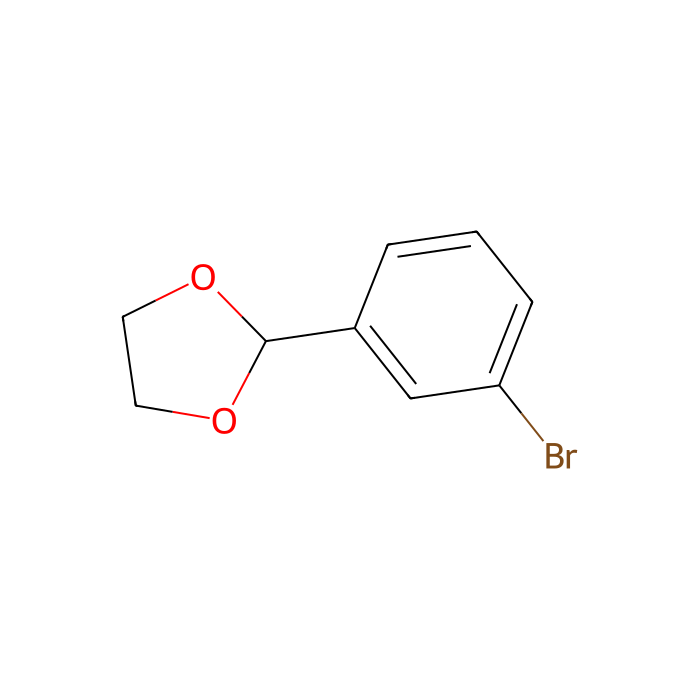
Brief description: 2-(3-Bromophenyl)-1,3-dioxolane is an aryl acetal — the ethylene acetal of 3-bromobenzaldehyde. It features a 1,3-dioxolane ring bonded at C-2 to a meta-bromophenyl group.
Item-specific (from Product Data)
Product Name: 2-(3-Bromophenyl)-1,3-dioxolane
CAS: 17789-14-9
CID: 87306
InChIKey: 391837 (as provided)
Storage: Room temperature; shipped under normal conditions
Literature/computed identifiers (for reference; not item-specific)
Molecular formula (derived from structure): C9H9BrO2
Ring system: Five-membered 1,3-dioxolane (cyclic acetal) containing two heteroatoms (O,O).
Substitution pattern: The dioxolane C-2 is benzylic and attached to the 3-bromophenyl ring (meta-bromo substituent relative to the acetal-bearing carbon on the ring).
Functional groups: Aryl bromide (good handle for cross-coupling and metal–halogen exchange), cyclic acetal (protecting group for the corresponding aldehyde; acid-labile, base-stable).
Stereochemistry: The benzylic acetal center is sp3 and may be stereogenic in substituted systems; in this symmetrical ethylene acetal, no fixed stereocenter is specified or expected in the isolated product.
2D structure in words: A meta-bromobenzene ring bearing, at the carbon between the 2- and 4-positions, a benzylic carbon that is part of a five-membered O–CH2–CH–O–CH2 ring (1,3-dioxolane).
Synthetic Utility
2-(3-Bromophenyl)-1,3-dioxolane is a valuable bifunctional synthon combining a masked aldehyde (as a 1,3-dioxolane) with an aryl bromide.
Functional group strategy (literature)
Orthogonality: The acetal is stable to many bases and transition-metal conditions, enabling transformations on the aryl bromide (e.g., Suzuki, Buchwald–Hartwig after further halogenation) without unveiling the aldehyde.
Timed deprotection: Acidic aqueous workup at a late stage yields the corresponding benzaldehyde cleanly, improving step economy versus protect–deprotect cycles on sensitive intermediates.
Named reactions and tactics
Suzuki–Miyaura and related Pd-catalyzed cross-couplings on Ar–Br to assemble biaryls/heterobiaryls.
Metal–halogen exchange (n-BuLi, i-PrMgCl·LiCl turbo-Grignard) to access aryllithium/arylmagnesium species for borylation (to give pinacol boronates), formylation, or electrophile trapping.
Heck alkenylations to append alkenes at the aryl position, retaining the acetal.
Subsequent acetal hydrolysis to reveal the aldehyde for carbonyl chemistry: Wittig, HWE, Knoevenagel, reductive amination, or conversion to acyl derivatives.
Retrosynthetic value
Viewed retrosynthetically as 3-bromobenzaldehyde protected as an ethylene acetal, it enables convergent routes where aryl coupling/functionalization precedes carbonyl chemistry.
Practical notes
Monitor for trace hydrolysis to 3-bromobenzaldehyde; add mild base (e.g., NaHCO3) to aqueous phases during extractions. Avoid acidic silica; pre-neutralize with triethylamine if needed.
Target Specificity
Not applicable. This product is a small-molecule synthetic intermediate and is not a biological macromolecule or affinity reagent. No antigen, epitope, clone, isotype, or species reactivity information is relevant or provided for this item.
Foire aux questions
What is the purity of this product, and how is it determined?
This product is supplied at ≥97% purity, determined by gas chromatography (GC). Lot-specific values are stated on the Certificate of Analysis.
How should this product be stored?
Store at room temperature.
How is this product shipped?
This product ships under standard ambient conditions. No temperature-controlled packaging is required.
What are the CAS number, molecular formula and molecular weight?
The CAS Number is 17789-14-9, the molecular formula is C9H9BrO2, and the molecular weight is 229.07 g/mol. InChIKey VYPYKCPWNPPBBX-UHFFFAOYSA-N.
What documentation is provided?
Available product documentation, including Certificates of Analysis (COA), Safety Data Sheets (SDS), and specification sheets, is shown in the product document area. Document availability and access follow the current site policy.
Nous utilisons des cookies pour garantir le bon fonctionnement du site et, lorsque cela est autorisé, pour améliorer votre expérience. Vous pouvez gérer vos préférences à tout moment dans les Paramètres. Pour en savoir plus, consultez notre Politique relative aux cookies.
Souhaitez-vous que nous vous envoyions un message lorsque des réductions seront disponibles?
Me rappeler plus tard
Merci ! Veuillez vérifier votre boîte de réception e-mail pour confirmer.
Products are supplied to verified businesses, institutions, and qualified professionals for research and development use only. Not for use in humans, animals, diagnosis, or therapy.

 C1926156